In heavy industrial applications, the success of your machinery depends less on the motor's raw power and more on the integrity of the interface that feeds it. Selecting the wrong slip ring for rotating equipment often leads to a cycle of frequent maintenance and intermittent signal loss that can cripple a project's efficiency. You've likely dealt with the frustration of carbon dust buildup or data interference that forces an unscheduled stop in production. It's a common challenge for engineers managing high-speed data or high-voltage power in the harsh, dusty conditions of an Australian site.
This guide provides the technical framework you need to specify hardware that eliminates these vulnerabilities. You'll learn how to achieve maintenance-free operation and 360-degree continuous rotation without the risk of cable fatigue. We will compare the performance of technologies from leading manufacturers like Mercotac, Meridian Laboratory, BGB Innovation, and Prosper Rotation. By the end of this article, you'll have the expert insights required to select a configuration that maintains signal integrity and withstands local environmental demands. This ensures your equipment remains operational and reliable, regardless of the mechanical or electrical complexity of your system.
Key Takeaways
- Define the core function of a slip ring for rotating equipment in maintaining 360-degree continuous rotation without cable tangling or signal degradation.
- Identify the essential electrical specifications, such as circuit count and voltage ratings, necessary to prevent arcing and ensure long-term reliability.
- Evaluate the performance differences between conventional carbon brushes for high-power loads and liquid metal technology for high-precision, low-noise data transfer.
- Select appropriate IP ratings and mechanical mounting styles to protect your hardware against dust ingress and extreme Australian temperature fluctuations.
- Learn how technical application consulting can help you avoid common procurement errors regarding RPM limits and current capacity.
The Role of a Slip Ring for Rotating Equipment
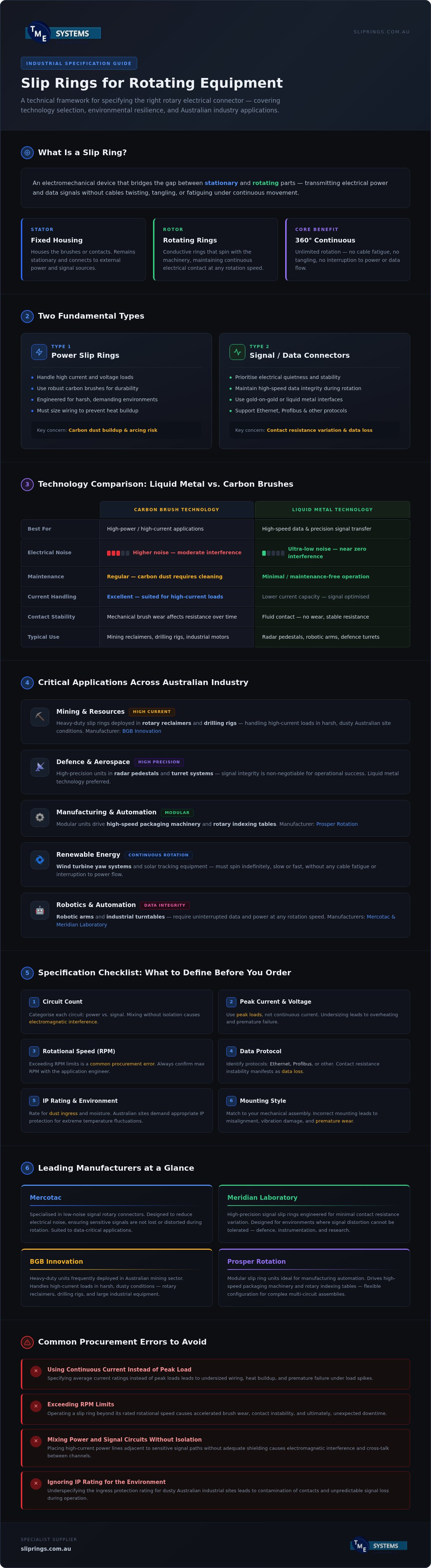
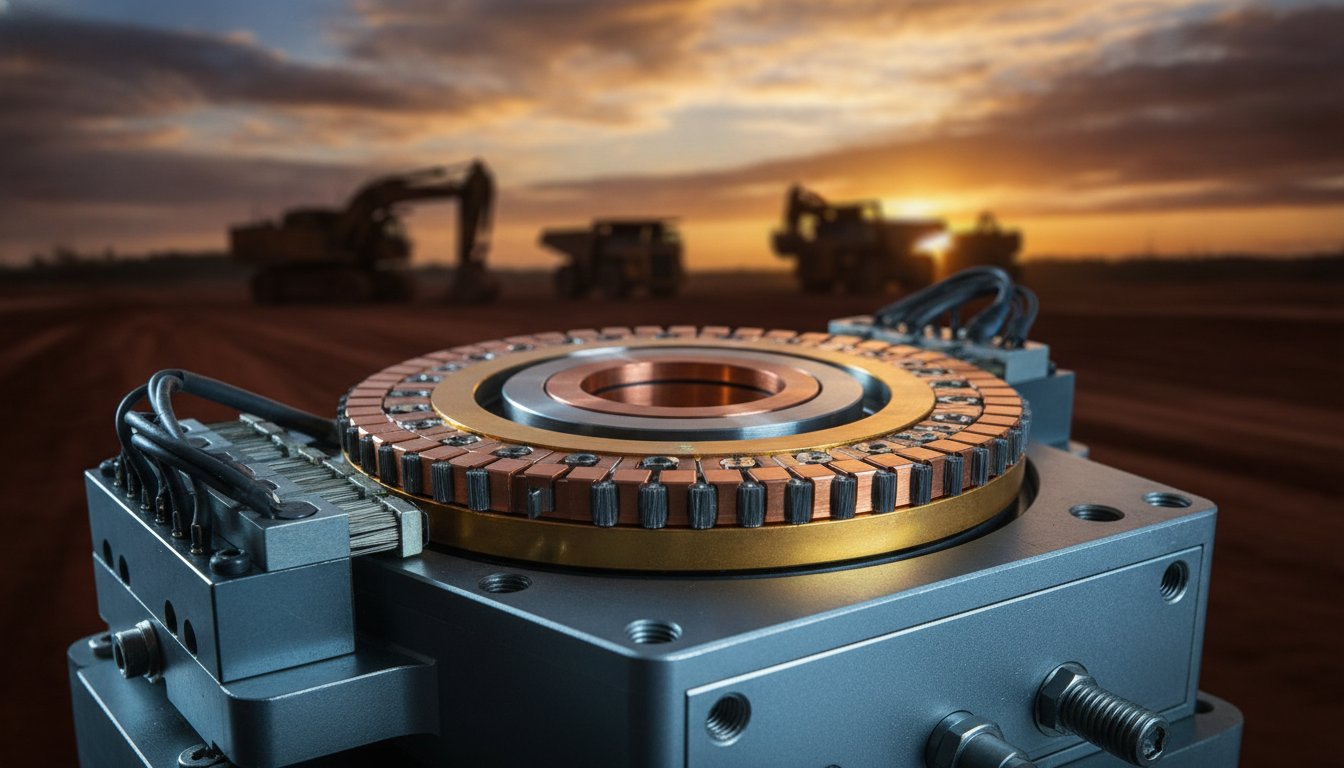
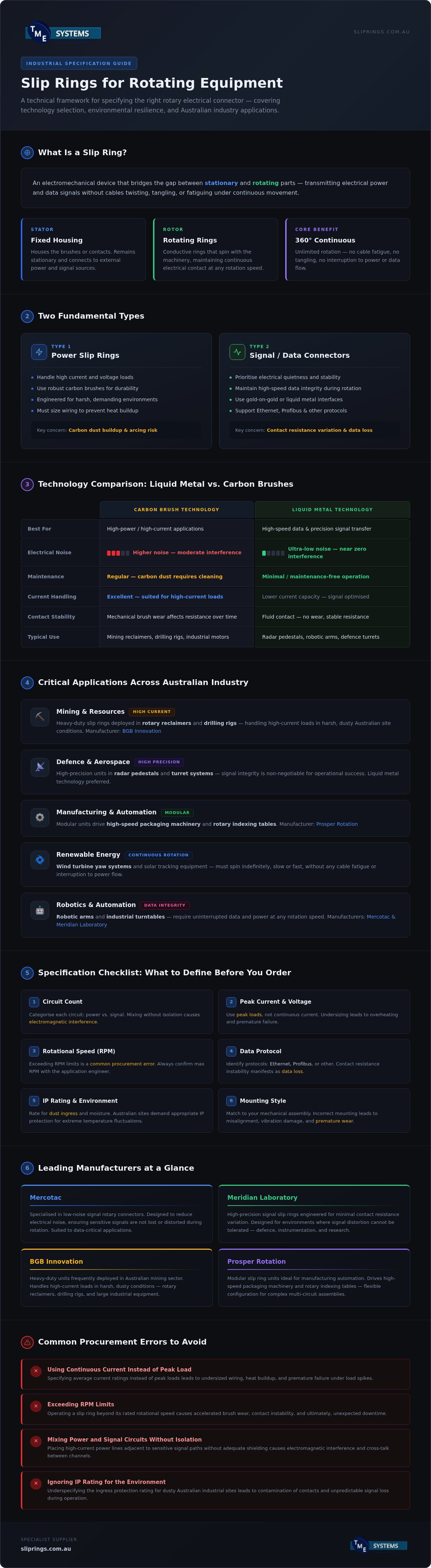
A slip ring for rotating equipment is an electromechanical device designed to bridge the gap between stationary and moving parts. It serves as a critical interface, allowing the transmission of electrical power and data signals from a fixed structure to a rotating assembly. Without this technology, hard-wired cables would twist, tangle, and eventually fail under the mechanical stress of continuous movement. The device consists of two primary components: the stationary 'stator', which houses the brushes or contacts, and the 'rotor', which contains the conductive rings that spin with the machinery.
It's vital to distinguish between power slip rings and signal rotary connectors. Power units are engineered to handle high current and voltage, often employing robust carbon brushes for durability. Signal and data connectors, however, prioritise electrical quietness and high-speed data integrity. Technologies such as those found in Mercotac slip rings or Meridian Laboratory slip rings are specifically designed to reduce electrical noise, ensuring that sensitive signals aren't lost or distorted during rotation.
How Slip Rings Enable Continuous 360-Degree Rotation
The primary function of these components is to provide a reliable mechanical interface that maintains electrical continuity regardless of the rotation speed. By using a series of concentric rings and sliding contacts, the system removes the physical limitations of traditional wiring. This capability is essential for equipment that must spin indefinitely, such as wind turbine yaw systems, robotic arms, or industrial turntables. Whether the rotation is a slow, methodical crawl or a high-speed revolution, the slip ring ensures power and data flow without interruption or cable fatigue.
Critical Applications Across Australian Industry
In the Australian mining sector, heavy-duty slip rings from BGB Innovation are frequently deployed in rotary reclaimers and drilling rigs to handle high-current loads in harsh, dusty environments. The defence sector relies on high-precision units for radar pedestals and turret systems, where signal integrity is a non-negotiable requirement for operational success. Manufacturing facilities also utilise modular units, such as those from Prosper Rotation, to drive high-speed packaging machinery and rotary indexing tables. These diverse applications highlight how a correctly specified slip ring for rotating equipment supports the long-term reliability of local industrial infrastructure.
Technical Specifications: Defining Your Rotary Connection Requirements
Specifying a slip ring for rotating equipment requires a precise audit of your system's electrical and mechanical parameters. Overlooking a single variable, such as peak current or rotational speed, can lead to premature component failure or data corruption. Engineers must move beyond generic descriptions and define the exact environment the hardware will inhabit. This process begins with a clear understanding of the electrical load and the mechanical constraints of the assembly.
Circuit Count and Electrical Load Capacity
The first step is to categorise your circuits by function. You must distinguish between high-current power lines and low-voltage signal paths. Mixing these without adequate isolation can cause electromagnetic interference. When calculating the total amperage, consider the peak loads rather than just the continuous operating current. For multi-circuit units, ensure the internal wiring is sized to prevent heat buildup. If you're managing complex arrays, you can consult with an application engineer to verify your circuit configuration and prevent cross-talk between adjacent signal channels.
Signal Integrity and Noise Reduction
Maintaining signal quality is paramount when transmitting data protocols like Ethernet or Profibus. Contact resistance plays a major role here; any instability in the connection will manifest as data loss. Electrical noise in rotary joints is the fluctuation in resistance during rotation. To combat this, high-performance units often utilise gold-on-gold contacts or liquid metal interfaces to keep resistance stable. Shielding is also vital to protect sensitive signals from the electrical noise generated by nearby power circuits within the same housing.
Rotational speed, measured in RPM, directly impacts both mechanical wear and signal clarity. High-speed applications generate more friction, which increases the operating temperature and can degrade the contact surfaces over time. You must also evaluate the dielectric strength and insulation resistance of the unit. These specifications ensure the slip ring can withstand voltage spikes without arcing between circuits. In Australian industrial settings, where equipment often runs at high duty cycles, choosing a unit with high insulation resistance is a necessary safeguard against short circuits and operational downtime. By matching the RPM limits and dielectric properties to your specific machinery, you ensure the long-term stability of the entire rotating system.
Selecting the Right Technology: Liquid Metal vs. Conventional Brushes
Choosing the contact technology for a slip ring for rotating equipment determines the system's long-term maintenance profile and signal reliability. Conventional carbon brush systems remain the standard for high-power, heavy-duty applications. They are robust and can handle significant current loads, making them suitable for the large-scale machinery found in Australian mineral processing plants. However, the sliding contact between a carbon brush and a conductive ring naturally generates wear and conductive dust. This requires regular inspection and cleaning to prevent short circuits and maintain performance.
In contrast, liquid metal and brushless technologies offer a path toward maintenance-free operation and superior signal integrity. These systems replace the physical friction of a solid brush with a conductive liquid or high-precision contact interface. This shift eliminates the primary cause of electrical noise and mechanical wear. For engineers managing sensitive data or high-speed communication, the choice of technology isn't just about power; it's about the precision of the electrical connection.
The Mercotac Advantage: Liquid Metal Connections
Liquid metal technology provides a constant, extremely low-resistance electrical path that solid brushes cannot match. Because the connection is made through a pool of conductive liquid, the contact remains stable even during high-speed rotation. This makes Mercotac slip rings an ideal choice for sensitive instrumentation, such as strain gauges or thermocouples, where even minor resistance fluctuations can lead to inaccurate data. For applications with strict environmental requirements, mercury-free alternatives are available to meet specific safety and regulatory standards without sacrificing electrical performance.
Meridian Laboratory and High-Precision Rotary Connectors
When your application demands high RPM without signal degradation, brushless designs provide a distinct advantage. Meridian Laboratory slip rings utilise proprietary technology to ensure near-zero electrical noise at speeds that would cause conventional brushes to bounce or arc. These units are frequently specified for laboratory testing and high-speed imaging equipment where data loss is not an option. They also offer significant customisation, allowing the hardware to fit into unique mechanical envelopes or specialised housing configurations required by Australian defence or aerospace projects.
Maintenance cycles vary significantly between these technologies. While carbon brushes might require servicing every few thousand hours depending on the environment, liquid metal and brushless units often operate for hundreds of millions of revolutions without intervention. Consider these factors when evaluating longevity:
- Carbon Brushes: Require regular cleaning of conductive dust and periodic brush replacement to prevent arcing.
- Liquid Metal: Generally maintenance-free for the life of the unit, provided operating temperatures remain within specification.
- Brushless Precision: Designed for high-speed reliability with minimal mechanical wear, reducing the total cost of ownership for a slip ring for rotating equipment.
Environmental Resilience and Mechanical Mounting Styles
The operational environment in Australia presents unique challenges that can quickly degrade a standard slip ring for rotating equipment. High ambient temperatures in the outback, abrasive dust in mining regions, and corrosive salt air in coastal facilities all demand specific engineering considerations. If the housing and sealing aren't matched to these conditions, internal contacts will fail long before their rated lifecycle. Selecting the right hardware involves balancing environmental protection with the mechanical constraints of your machinery.
Housing materials play a vital role in this durability. While lightweight aluminium is suitable for many indoor industrial applications, 316 stainless steel is often required for marine environments or food processing plants to prevent corrosion. Temperature resilience is another critical factor. Standard units may operate reliably up to 80 degrees Celsius, but specialised configurations are necessary for equipment located near furnaces or in refrigerated storage where seals can become brittle and lose their integrity.
IP Ratings and Sealing for Harsh Conditions
Selecting the correct IP rating is the first line of defence against premature failure. For sites dealing with fine, abrasive mining dust, an IP65 or IP67 rating is essential to ensure the internal contacts remain uncontaminated. In food processing or marine applications, the hardware must withstand high-pressure wash-downs or temporary immersion without moisture ingress. BGB Innovation slip rings are specifically engineered with heavy-duty sealing to maintain electrical performance in these punishing environments, providing a reliable barrier against the ingress of contaminants that cause arcing and signal noise.
Through-Bore vs. Capsule Mounting Configurations
Mechanical integration depends on the physical layout of your machinery. Through-bore designs feature a hollow centre, allowing the unit to be mounted directly over a central drive shaft or to accommodate hydraulic and pneumatic lines. This is the preferred style for large-scale industrial turntables and wind turbines. In contrast, capsule slip rings offer a compact, fully enclosed solution for space-constrained equipment like CCTV gimbals or small robotic joints. For projects requiring a balance of both, Prosper Rotation slip rings provide modular mounting flexibility, allowing for custom circuit counts within a standardised mechanical envelope.
Choosing the wrong mounting style can lead to excessive mechanical stress on the rotor, causing vibration and premature bearing wear. It's essential to align the slip ring's centre of rotation perfectly with the equipment's shaft to avoid these issues. If you're unsure which configuration fits your mechanical envelope, you can request a technical review of your equipment specifications to ensure a precise fit and long-term reliability.
Optimising Equipment Performance with Technical Consultation
Selecting a slip ring for rotating equipment isn't just about matching a part number; it's about engineering a solution for a specific mechanical lifecycle. Professional application engineering during the procurement phase ensures that the electrical and mechanical parameters align with the realities of the field. When you involve technical experts early, you move from simply buying a component to integrating a reliable subsystem that supports your machinery's long-term performance. This consultative approach is the most effective way to mitigate the risk of premature failure and costly unscheduled downtime.
Integration is another area where consultation adds value. Many modern systems require the slip ring to work in tandem with other rotary components, such as fluid unions or optical encoders. Ensuring these parts fit within the same mechanical envelope without interfering with each other's operation is a complex task that benefits from expert oversight. By considering the entire rotary stack, engineers can avoid mechanical interference and ensure that power and data paths remain clear and isolated.
Avoiding Common Specification Pitfalls
Off-the-shelf solutions often fail because they don't account for the subtle variables of specialised machinery. A common mistake is oversizing current capacity as a safety buffer, which can lead to unnecessary heat generation or increased mechanical drag. Conversely, ignoring RPM limits often results in contact bounce, which destroys signal integrity and accelerates wear. Vibration and shock are also critical; a unit rated for a stable factory floor won't survive the constant oscillations of a mobile drilling rig or a high-speed centrifuge. You can find detailed checklists for these variables in the Industrial Slip Rings Australia: The Technical Procurement Reference.
TME Systems Pty Ltd: Authoritative Support for Australian Procurement
TME Systems Pty Ltd acts as a technical intermediary, bridging the gap between global manufacturing capabilities and local engineering needs. We provide national distribution and technical assistance across all Australian states, ensuring that project managers have access to expert advice regardless of their location. Whether you're specifying a high-precision rotary connector for a defence project or a heavy-duty unit for a mine site, our team streamlines the selection process to reduce the risk of component failure. Our goal is to ensure that every slip ring for rotating equipment we supply is perfectly matched to its application, environment, and duty cycle.
If you're currently designing a new system or upgrading an existing assembly, our engineers can help you navigate the complexities of circuit counts, signal protocols, and environmental sealing. We invite you to contact our team for a comprehensive technical review of your rotating equipment requirements at sliprings.com.au. By partnering with a specialist, you ensure that your investment in rotary technology delivers the reliability and longevity your operations demand.
Securing Reliable Performance for Rotating Systems
Ensuring the longevity of your industrial machinery requires more than just a functional connection; it demands a precise match between electrical requirements and mechanical realities. We've explored how the right technology, whether it's the near-zero noise of liquid metal or the rugged durability of conventional brushes, dictates your long-term maintenance costs. Choosing the correct slip ring for rotating equipment means accounting for Australia's specific environmental challenges, from outback dust to coastal humidity, while strictly adhering to RPM and circuit specifications.
TME Systems Pty Ltd provides an extensive range of heavy-duty and high-precision solutions as an authorised Australian distributor for Mercotac and Meridian Laboratory. Our specialised technical support is grounded in Australian engineering standards, helping you move beyond off-the-shelf compromises toward a configuration that works. Don't leave your signal integrity to chance when expert advice is readily available. You can Request a Technical Consultation for Your Rotary Equipment to verify your specifications and ensure your project’s success. We look forward to helping you achieve a maintenance-free, high-performance rotary solution.
Frequently Asked Questions
What is the difference between a slip ring and a rotary union?
A slip ring transmits electrical power and data signals between stationary and rotating components. In contrast, a rotary union is designed to transfer fluids or gases, such as water, hydraulic oil, or compressed air. While they serve different purposes, they're often integrated into a single multi-passage assembly to provide both electrical and fluid connectivity in complex industrial machinery.
Can a slip ring for rotating equipment transmit high-speed data like Ethernet?
Specialised designs can transmit high-speed data protocols including 1000Base-T Ethernet without packet loss. These units utilise specific shielding techniques and high-performance contact materials to maintain signal integrity. Using a slip ring for rotating equipment that is specifically rated for data ensures that electrical noise doesn't corrupt sensitive communication between your PLC and rotating sensors.
How do I determine the right IP rating for a slip ring in a dusty environment?
For dusty Australian industrial sites, you should specify an IP65 or IP67 rating. IP65 provides complete protection against dust ingress and low-pressure water jets, while IP67 offers total dust protection and resistance to temporary immersion. These ratings ensure that abrasive particles don't reach the internal contacts, which prevents premature wear and maintains a stable electrical connection.
What is the typical lifespan of a liquid metal slip ring compared to a brush type?
Liquid metal connectors typically last for hundreds of millions of revolutions because they lack the physical friction found in solid contacts. Conventional brush types usually have a shorter operational life and require servicing or replacement every few thousand hours. This difference exists because carbon brushes gradually wear down and produce conductive dust that must be managed to avoid failure.
Can slip rings be customised for unique mounting dimensions?
Customisation is a standard part of the procurement process for industrial applications. Manufacturers can modify the mechanical envelope, mounting flanges, or through-bore diameters to suit your specific shaft size or housing constraints. This flexibility ensures that the hardware integrates perfectly with your existing rotating assembly without requiring extensive mechanical modifications to your machinery.
What maintenance is required for a standard industrial slip ring?
Brush-type units require periodic cleaning to remove carbon dust and inspection of the brush length to ensure consistent contact pressure. Liquid metal and brushless technologies are generally maintenance-free for the life of the unit. However, it's still good practice to monitor the operating temperature and seal integrity to ensure the environment hasn't compromised the internal components.
How do I reduce electrical noise in my rotary connection?
Reducing noise starts with selecting high-precision contact materials like gold-on-gold or liquid metal interfaces. You should also ensure that sensitive signal cables are properly shielded and that high-power circuits are physically separated from data lines. These steps minimise the resistance fluctuations and electromagnetic interference that often plague a slip ring for rotating equipment in high-speed applications.
Are there mercury-free options for liquid metal rotary connectors?
Mercury-free liquid metal connectors are available for applications with strict environmental or safety regulations. These units use alternative conductive alloys that provide the same low-resistance, maintenance-free performance as traditional mercury-wetted designs. They're an excellent choice for food processing facilities or medical environments where the use of mercury is restricted but high signal integrity is still required.