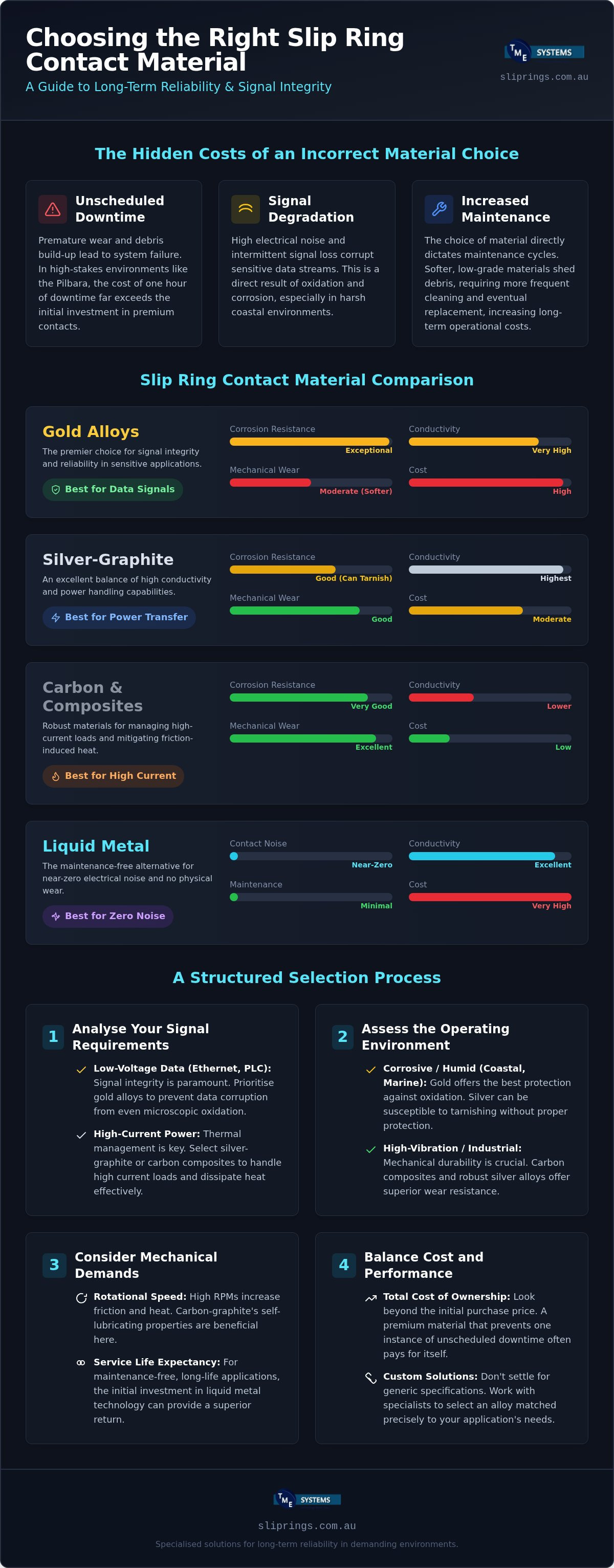
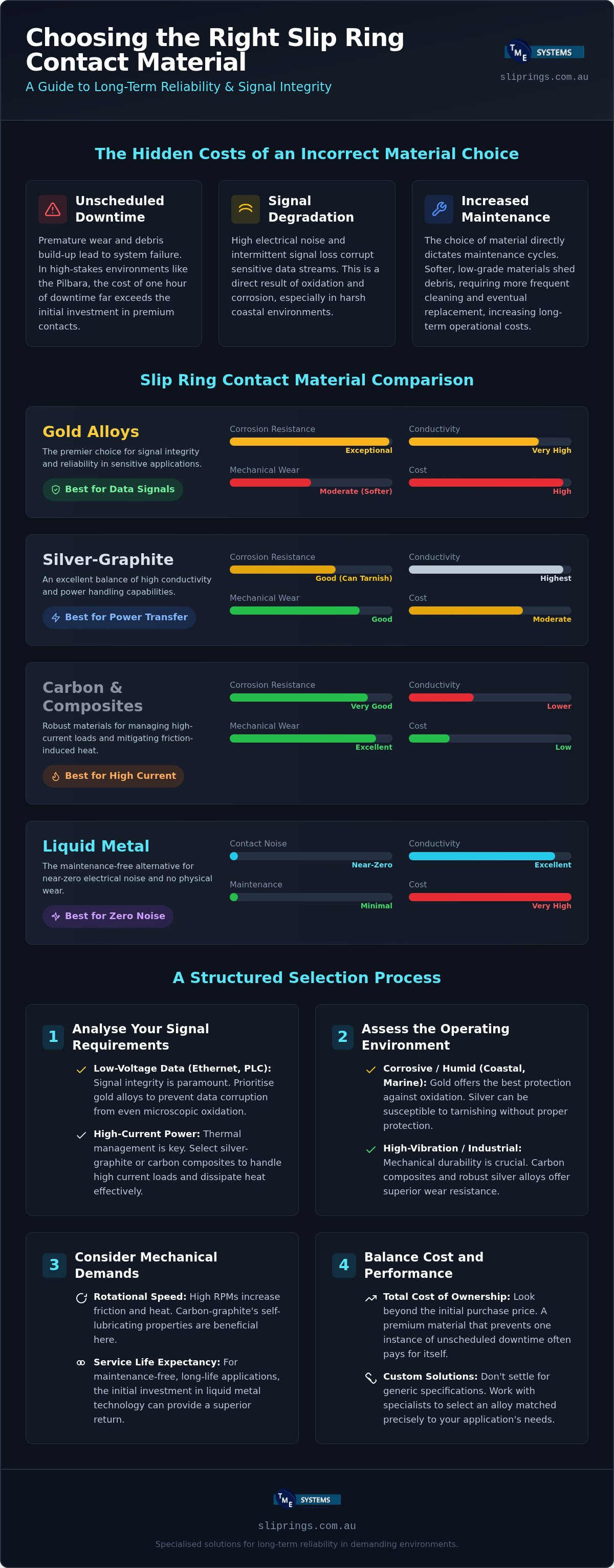
The true cost of a rotary interface isn't found on the initial purchase order. Instead, it's hidden in the cumulative hours of unscheduled downtime and signal degradation experienced in the field. If you've managed equipment in the Pilbara or along the salt-heavy coastline, you're already familiar with how quickly oxidation and brush wear can compromise a system. High electrical noise doesn't just disrupt data; it signals a fundamental mismatch between your hardware and its environment.
Choosing the right slip ring contact material is the primary lever for controlling these variables. Whether you're dealing with high-speed data or heavy-duty power transmission, the interface between the brush and the ring dictates your maintenance schedule. Recent shifts towards higher-conductivity precious metal alloys reflect a growing industry need to eliminate noise while meeting updated RoHS compliance standards. We'll explore how specific grades, such as silver-graphite or gold-on-gold alloys, impact electrical resistance and mechanical longevity. You'll discover how to match contact properties to your specific operating conditions to achieve stable signal transmission and a better return on investment. This guide provides the technical framework needed to move beyond generic specifications and select a solution built for long-term reliability.
Key Takeaways
- Understand how your choice of slip ring contact material directly influences signal clarity and prevents data corruption in sensitive rotary systems.
- Compare the functional differences between gold and silver alloys to match the right level of corrosion resistance to your specific operating environment.
- Identify when to utilise carbon-graphite or metal-graphite composites to manage high-current loads and mitigate the effects of friction-induced heat.
- Explore the technical advantages of liquid metal technology for applications requiring near-zero electrical noise and significantly reduced maintenance intervals.
- Master a structured selection process that balances rotational speed and signal requirements to maximise the overall service life of your rotary hardware.
Understanding the Role of Contact Materials in Slip Ring Performance
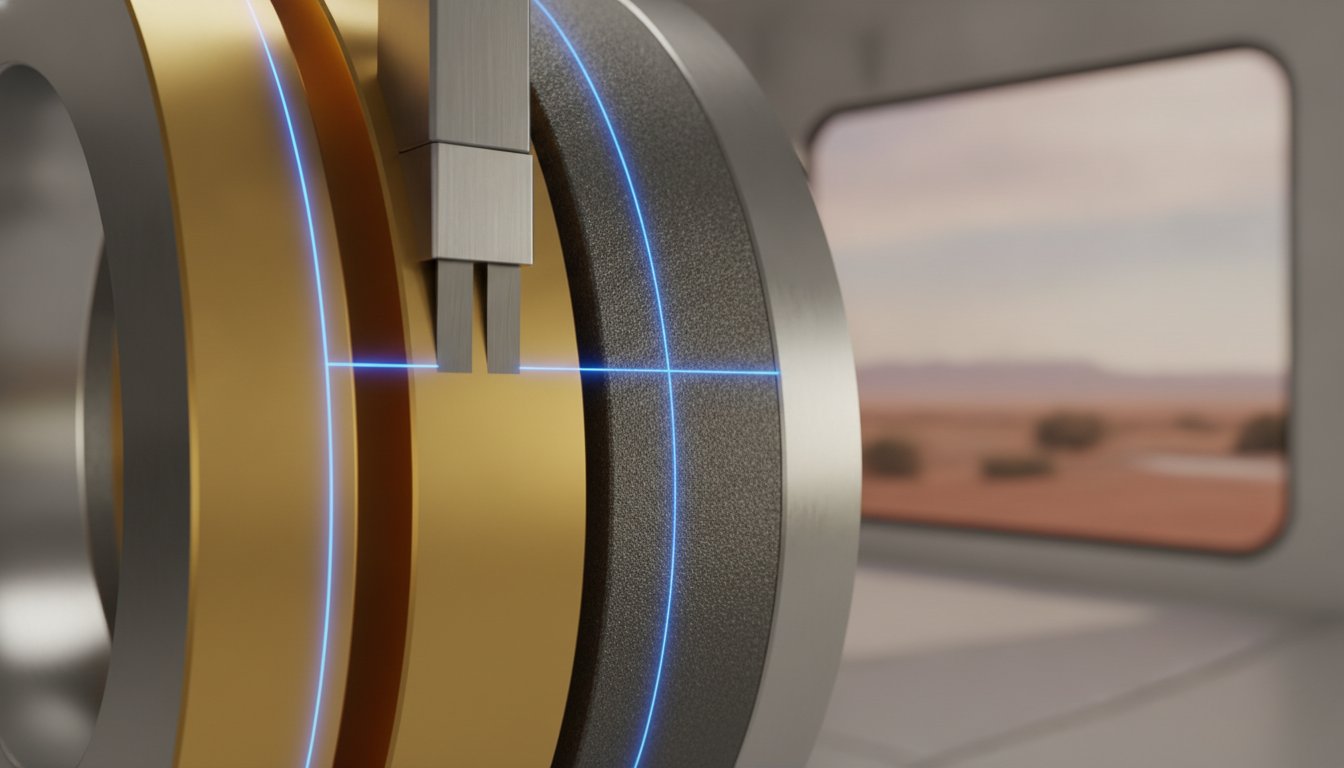
A slip ring is a precision-engineered device that facilitates the transfer of power and data across a rotating joint. The efficiency of this transfer depends entirely on the contact interface, the microscopic area where the stationary brush meets the rotating ring. At this junction, the physical and chemical properties of the slip ring contact material dictate the performance limits of the entire system. If the material choice is poorly matched to the application, the system will suffer from excessive electrical noise and premature failure.
Hardness plays a contradictory role in mechanical wear rates. While harder materials like stainless steel or specific copper alloys resist physical abrasion, they often exhibit higher contact resistance. Conversely, softer precious metals like gold provide superior conductivity but may wear more quickly if the spring tension is not perfectly calibrated. The goal is to select a material that balances these mechanical demands with the need for a high signal-to-noise ratio (SNR). High electrical resistance at the contact point leads to voltage drops and localised heat generation, which can further degrade the material over time.
Conductivity and Tribology Fundamentals
Electrical conductivity is not the only factor to consider when evaluating metal alloys. Tribology, the science of friction and wear in sliding contacts, reveals that the interaction between surfaces is dynamic. As the ring rotates, a "film" or patina forms on the contact surface. This layer is a combination of oxides, atmospheric moisture, and wear particles. A stable film can actually protect the slip ring contact material and reduce friction, but an inconsistent or overly thick film acts as an insulator, causing intermittent signal loss and data corruption.
Why Material Choice Dictates Maintenance Cycles
Maintenance requirements are often a direct consequence of debris management. Soft or low-grade materials tend to shed fine metallic dust as they wear. This debris can accumulate between the rings, leading to short circuits or increased electrical interference. In high-stakes industrial environments, the cost of an hour of downtime far outweighs the initial investment in premium contacts. High-performance systems, such as those from Meridian Laboratory slip rings, utilise specialised alloys to minimise this shedding and extend the time between service intervals.
Contact resistance is the measure of electrical opposition occurring at the physical junction where the stationary brush meets the rotating ring surface. By choosing materials with high noble metal content, engineers can ensure this resistance remains low and stable throughout the equipment's operational life. This stability is essential for maintaining the integrity of sensitive digital signals in modern automated machinery.
Comparing Precious Metal Contacts: Gold vs Silver for Signal Integrity
Gold and silver represent the high end of the slip ring contact material spectrum. Selecting between them requires a precise understanding of your electrical load and environmental exposure. While gold is often viewed as the ultimate solution for every application, silver offers specific advantages in thermal management and current density that gold cannot match. The decision hinges on the balance between initial material cost and the required signal-to-noise ratio over the life of the equipment.
Gold Contacts for Precision and Data
Gold-on-gold interfaces are essential when dealing with low-voltage data streams, such as Ethernet or PLC signals. Gold's primary advantage is its immunity to oxidation. In many industrial settings, even a microscopic layer of tarnish can increase contact resistance enough to drop a digital packet. This makes gold the preferred choice for high-frequency applications where signal integrity is paramount. Early NASA research on slip ring materials highlighted that gold alloys provide exceptionally stable contact resistance over millions of rotations, provided the contact force is correctly managed.
For systems requiring high-speed data transmission without interference, Meridian Laboratory slip rings utilise specialised precious metal configurations. These designs typically require lower contact forces than industrial carbon brushes. This reduction in force minimises mechanical wear while still ensuring a consistent electrical path. It's a delicate balance that prevents the contact bounce often seen in lower-quality hardware, ensuring that sensitive data remains uncorrupted even at high rotational speeds.
Silver and Silver-Alloy Applications
Silver-on-silver contacts provide a pragmatic middle ground for medium power loads. Silver has the highest thermal conductivity of any metal, allowing it to dissipate heat more effectively than gold. This characteristic is vital in packaging machinery or medical imaging equipment where the slip ring must handle both data and moderate power levels simultaneously. The ability to manage thermal loads prevents the contact surface from degrading during long duty cycles.
Silver-graphite brushes are frequently used to reduce friction. The graphite acts as a solid lubricant, while the silver provides the necessary conductivity. This combination is particularly effective in reducing the "stick-slip" effect during low-speed rotation. However, silver is susceptible to tarnishing, particularly in environments with high sulphur content. If your equipment operates in a coastal or heavy industrial zone, the resulting silver sulphide layer can increase electrical noise. In these scenarios, gold plating or more robust environmental sealing is necessary. If you're unsure which alloy suits your local environment, seeking specialised technical advice can prevent costly mid-project redesigns and premature failure.
Heavy-Duty Power Transfer: Carbon and Composite Brush Materials
While gold and silver excel in signal integrity, heavy industrial applications require a slip ring contact material capable of sustaining hundreds of amps without melting or excessive wear. Carbon-graphite remains the primary candidate for these high-current environments. It possesses a unique molecular structure that allows it to act as a solid lubricant. This characteristic is vital for large-scale machinery like wind turbines and overhead cranes, where mechanical friction would otherwise lead to rapid component failure and frequent maintenance shutdowns.
Carbon-Graphite Brush Characteristics
The effectiveness of carbon-based brushes is documented in various technical literature, including a comprehensive study on slip ring contact alloys and composite structures. Carbon brushes handle high current densities because they maintain a stable contact surface even as temperatures rise. Unlike metals, carbon does not weld to the ring under high electrical loads, which prevents catastrophic seizing. For operators managing robust power transfer in industrialised settings, BGB Innovation slip rings are the industry standard, specifically designed to accommodate the physical demands of large-bore rotary joints.
Composite Materials for Harsh Environments
In environments like Australian mining sites, standard carbon may not provide sufficient conductivity for the required torque. This is where metal-graphite composites become essential. By impregnating the carbon matrix with copper or silver, manufacturers create a brush that combines the lubricity of graphite with the electrical performance of a metal. These composites are particularly effective at preventing "galling," a form of surface damage caused by adhesion between sliding parts. Copper-graphite is typically favoured for its balance of cost and conductivity in high-load power circuits. Managing these complex material interactions is a core focus of BGB Innovation slip rings Australia: heavy duty solutions, which are engineered to resist surface scoring even in abrasive outback conditions.
A pragmatic consideration when using carbon or composite materials is the generation of brush dust. As the brush wears, fine particles accumulate within the housing. If left unmanaged, this conductive dust can create tracking paths between rings, leading to short circuits. Regular cleaning cycles, often involving compressed air or specialised vacuum systems, are mandatory to maintain system longevity. Selecting the correct slip ring contact material grade for your specific amperage and RPM can significantly reduce the volume of debris produced. This ensures the maintenance burden doesn't negate the performance gains of a high-conductivity composite, ultimately protecting the equipment's operational ROI.
Liquid Metal Contacts: The Maintenance-Free Alternative
While previous sections detailed the benefits of solid alloys, liquid metal technology represents a fundamental departure from traditional brush-based systems. In these units, the slip ring contact material is a pool of conductive liquid metal, such as mercury or gallium-based alloys. This pool creates a molecular bond between the rotating and stationary components, effectively eliminating the physical friction associated with solid contacts. For engineers, this means the total removal of "contact bounce" and the achievement of near-zero electrical noise. It's a level of signal clarity that solid brushes simply cannot replicate, particularly in sensitive instrumentation where even micro-volts of interference can skew results.
The performance gap between liquid metal and traditional brushes becomes most apparent at high rotational speeds. Solid brushes are prone to oscillation and thermal expansion at high RPMs, which increases contact resistance and wear. Liquid metal, however, maintains a constant, low-resistance path regardless of speed. This stability ensures that data integrity remains perfect even in demanding centrifuges or high-speed packaging lines. Because the conduction happens through a liquid medium, there's no mechanical interface to degrade, which fundamentally changes the maintenance profile of the rotary joint.
Mercotac Liquid Metal Technology
In the Australian industrial landscape, Mercotac slip rings have become the preferred solution for applications where downtime is unacceptable. These rotary connectors are considered maintenance-free for the entire service life of their internal bearings. There are no brushes to wear down, no dust to accumulate, and no periodic tensioning required. They provide a stable electrical path that doesn't fluctuate over time, ensuring that your equipment's performance at year five is identical to day one. If you're managing high-frequency equipment, you can request a technical consultation to determine if liquid metal is the right fit for your specific RPM requirements.
Mercury-Free Alternatives
Environmental and safety regulations have driven a significant shift toward gallium-based liquid metal alloys. These mercury-free options allow businesses to benefit from liquid metal performance while meeting strict compliance standards, particularly within the Australian food and beverage sectors. Gallium alloys remain liquid at room temperature and offer similar conductivity to mercury without the associated toxicity risks. This transition is a key focus for local operators who need to balance high-speed data integrity with workplace safety protocols. For a deeper dive into these options, see our Mercotac Distributors Australia: professional guide to liquid metal rotary connectors. Unlike traditional slip ring contact material choices that require periodic inspection, these sealed units are designed to operate reliably until the mechanical bearing reaches its end-of-life. This provides a predictable and cost-effective lifecycle for critical machinery where traditional maintenance would be too intrusive or expensive.
Selection Criteria: Matching Contact Materials to Your Application
Selecting the appropriate slip ring contact material requires a systematic evaluation of your application's technical parameters. A generic choice often leads to avoidable failures or excessive maintenance costs. By following a structured selection process, you ensure that the rotary interface is matched to the physical and electrical realities of your system. This is a technical audit rather than a simple procurement task.
Step one is to define your signal type. Power transmission requires high-current capacity, typically found in carbon or metal-graphite composites. Sensitive data signals, such as those used in robotics or high-definition video, demand the low-noise properties of gold-on-gold or liquid metal contacts. Step two involves assessing rotational speed (RPM). Friction heat is a direct byproduct of speed. High RPM applications can cause standard brushes to bounce or overheat, leading to rapid degradation of the contact surface. You must select a material that maintains its mechanical integrity at your specific operating speed.
Step three focuses on the operating environment. In Australia, equipment often faces harsh conditions, from the fine dust of mining regions to the salt-laden air of coastal facilities. These variables dictate whether you need noble metals that resist oxidation or sealed units that prevent ingress. Finally, step four is to determine the required service life and maintenance budget. If your equipment is in a hard-to-reach location, the ROI of a premium, maintenance-free material far outweighs the cost of frequent brush replacements.
Environmental Factors in Material Selection
Australian coastal and marine applications present a unique challenge due to accelerated corrosion and humidity. For these environments, selecting sealed units with high IP ratings is essential to protect the internal contact surfaces. IP ratings must complement material choice to ensure that environmental protection matches the internal contact durability. Ambient temperature also plays a critical role, as extreme heat can thin out lubricants or interfere with the protective film formation needed for stable conductivity. In desert or tropical regions, these thermal variables can cause soft alloys to wear at twice their predicted rate if the housing is not properly ventilated or sealed.
The TME Systems Consultative Approach
Procurement should never be a blind transaction. Technical assistance is vital to ensure that the chosen slip ring contact material meets the specific duty cycle of your machinery. We provide detailed consulting to bridge the gap between manufacturer specifications and real-world performance. For applications requiring custom configurations, Prosper Rotation slip rings offer a modular approach. This allows for the selection of specific material grades for each channel, ensuring that power and data are handled with equal efficiency within a single compact unit. This level of customisation ensures that you aren't over-engineering simple power lines while still providing maximum protection for critical data paths.
Maximising Operational Reliability Through Strategic Material Selection
The long-term performance of your rotary equipment depends on the integrity of the contact interface. The specific slip ring contact material you choose directly influences electrical noise levels, maintenance intervals, and resistance to harsh Australian environments. Whether you require the precision of gold-on-gold alloys for high-frequency data or the robust power capacity of BGB Innovation's carbon-graphite brushes, the goal is to align material properties with your application's duty cycle. Liquid metal alternatives from Mercotac provide a maintenance-free pathway for high-speed systems where traditional brushes might fail.
TME Systems is a specialised Australian distributor for Mercotac and BGB, providing national supply and technical application consulting for complex rotary requirements. We help you navigate the trade-offs between initial procurement costs and long-term operational ROI. By matching the right alloys or liquid metal connectors to your specific RPM and environmental variables, you'll eliminate unscheduled downtime and ensure stable signal transmission. Contact TME Systems for expert technical assistance with your slip ring selection to secure a solution engineered for longevity. We look forward to helping you optimise your next engineering project.
Frequently Asked Questions
What is the best slip ring contact material for high-speed data transmission?
Gold-on-gold alloys and liquid metal are the superior choices for high-speed data transmission. Gold's immunity to oxidation ensures that sensitive digital packets, such as Ethernet or PLC signals, are not lost due to signal degradation. For applications requiring near-zero electrical noise, liquid metal rotary connectors from Mercotac or Meridian Laboratory are ideal. These options eliminate the mechanical contact bounce found in traditional brush systems, which is essential for maintaining signal integrity at high rotational speeds.
Do gold-on-gold slip rings really last longer than silver ones?
Gold-on-gold contacts typically offer a longer service life in low-voltage signal applications because they do not form a tarnish layer. Silver is highly conductive but susceptible to sulphidation, which increases resistance over time. However, silver is more durable for medium power loads where its superior thermal conductivity prevents overheating. The choice between the two depends on whether your priority is long-term signal stability or the ability to handle higher electrical currents without mechanical failure.
How often do carbon brushes need to be replaced in industrial slip rings?
The replacement frequency for carbon brushes varies significantly based on rotational speed, current density, and the operating environment. In heavy-duty industrial applications, such as wind turbines or cranes, brushes typically require inspection every six months and replacement every 12 to 24 months. Monitoring the wear line and managing brush dust is essential to prevent tracking. BGB Innovation systems are designed for robust power transfer, but regular maintenance cycles are still necessary to ensure optimal contact performance.
Are liquid metal slip rings safe for use in Australian manufacturing?
Liquid metal slip rings are safe and highly effective for Australian manufacturing when correctly specified for the application. While mercury-filled units are common in industrial settings, there is a strong shift toward gallium-based, mercury-free alternatives to meet strict health and safety compliance standards. These connectors are sealed units, which prevents exposure to the conductive liquid. They are particularly valued in food processing and pharmaceutical sectors where traditional brush dust would pose a contamination risk.
Can I mix different contact materials within a single multi-circuit slip ring?
You can certainly mix different contact materials within a single multi-circuit assembly to handle hybrid requirements. This is common in systems that need to transfer both high-current power and sensitive data signals simultaneously. For example, a Prosper Rotation slip ring might utilise silver-graphite for power circuits and gold-on-gold for data channels. This modular approach allows engineers to optimise the slip ring contact material for each specific circuit, ensuring maximum efficiency without over-engineering the entire unit.
What causes electrical noise in slip ring contacts and how can I reduce it?
Electrical noise is primarily caused by fluctuating contact resistance, debris accumulation, and mechanical "bounce" at high speeds. To reduce this interference, you should select a slip ring contact material with high noble metal content, such as gold, which maintains a clean interface. Ensuring proper brush tension and regular cleaning of carbon dust also helps. For the most demanding instrumentation, switching to liquid metal rotary connectors will virtually eliminate noise by providing a continuous molecular bond for conduction.
Why is contact resistance higher in some materials than others?
Contact resistance is influenced by the base conductivity of the metal and the formation of surface films. Harder materials often have higher resistance because they don't conform as easily to the mating surface at a microscopic level. Additionally, non-noble metals like copper or silver develop oxide or sulphide layers that act as insulators. Choosing a noble metal like gold or a self-lubricating composite like silver-graphite ensures a more stable and lower resistance path throughout the component's operational life.
How does the Australian climate affect slip ring contact oxidation?
The Australian climate, particularly in coastal or tropical regions, accelerates the oxidation and sulphidation of non-noble contact materials. High humidity and salt spray create a corrosive environment that can rapidly degrade silver or copper surfaces, leading to intermittent signal loss. In these conditions, using gold-plated contacts or hermetically sealed liquid metal units is essential. These choices prevent the atmospheric moisture from reaching the critical contact interface, ensuring reliable performance in the most challenging local environments.