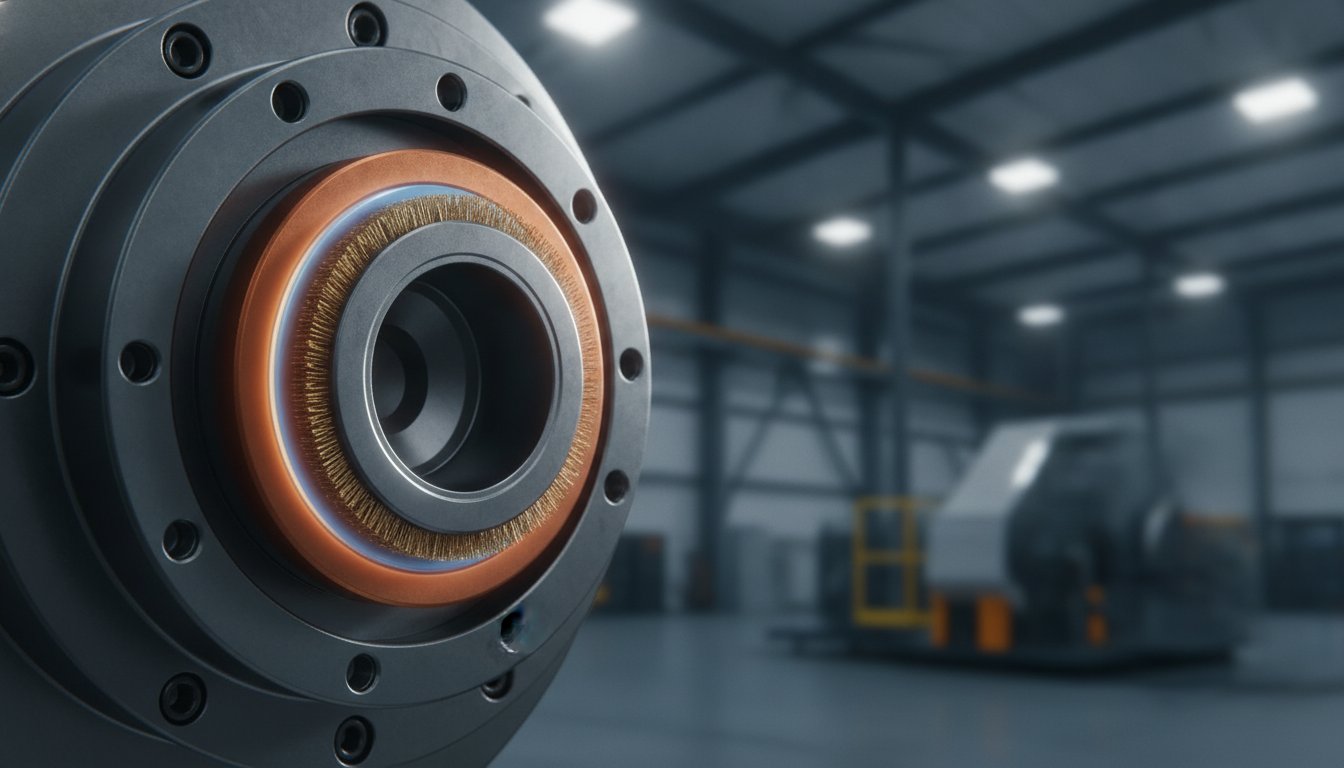
Your slip ring's RPM speed rating isn't telling you how fast it can spin before it breaks. It's telling you how fast it can spin before it starts generating noise. That distinction matters enormously in high-speed rotary applications, and it's one that catches Australian engineers off guard more often than it should.
If you've experienced premature contact wear, unexplained signal degradation at higher speeds, or struggled to find local technical support that actually understands your operating parameters, you're dealing with a problem that begins at the specification stage. A slip ring RPM speed rating is, at its core, a thermal threshold. Exceed it, and contact resistance climbs, signal integrity deteriorates, and component lifespan shortens, often well before any mechanical failure gives you a visible warning.
This guide cuts through the ambiguity. You'll learn how to correctly interpret RPM ratings in context, understand the thermal and electrical factors that govern high-speed performance, and identify the right rotary connector for your specific application requirements. Whether you're specifying a new system or troubleshooting an existing one, the technical framework ahead will give you the clarity to make a well-grounded decision.
Key Takeaways
- A slip ring RPM speed rating defines the threshold at which electrical performance degrades, not the point of mechanical failure — a distinction that directly affects signal integrity and component longevity.
- Frictional heat is the primary limiting factor in high-speed rotary applications, and Australia's elevated ambient temperatures reduce your available thermal headroom more than most standard specifications account for.
- Contact technology matters at speed: liquid metal connectors maintain significantly lower noise levels than traditional brush contacts, which are prone to bounce and increased resistance as rotational velocity rises.
- Dust, particulate ingress, and harsh site conditions common across Australian industrial environments accelerate contact wear at high RPM, making ingress protection ratings a critical part of your specification process.
- TME Systems provides access to Mercotac and Meridian Laboratory slip rings alongside technical consulting to help engineers correctly match high-speed rotary connector specifications to their actual operating conditions.
Defining the Slip Ring RPM Speed Rating: More Than Just Rotations
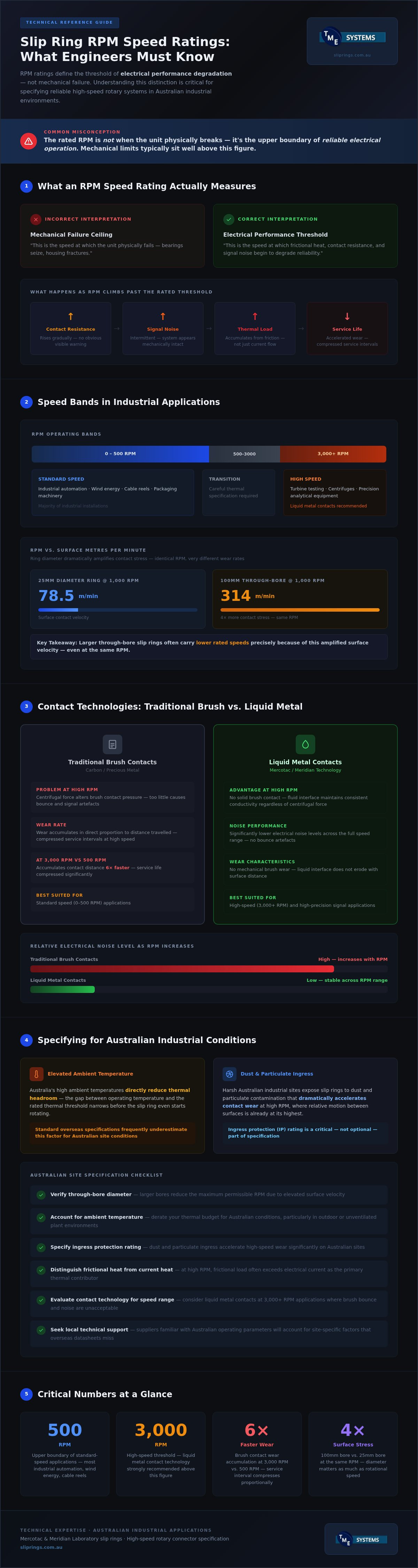
When a datasheet lists a maximum RPM figure for a rotary connector, it's tempting to treat that number as a hard mechanical ceiling, the point at which the unit physically fails. That interpretation is incorrect, and acting on it leads to underspecified systems. A slip ring RPM speed rating defines the rotational threshold at which electrical performance begins to degrade, not the speed at which bearings seize or housings fracture. The mechanical limits typically sit well above the rated figure; it's the electrical limits that govern the specification.
The distinction matters because degradation is gradual and often invisible. As rotational velocity increases, contact resistance rises, signal noise climbs, and thermal load accumulates. None of these changes produce an immediate, obvious failure. What they produce instead is a system that functions poorly, intermittently, and with accelerating wear, all while appearing mechanically intact. The "maximum" figure on a datasheet is therefore better understood as the upper boundary of reliable electrical operation, not the upper boundary of physical survival.
Centrifugal force compounds this. At higher RPMs, the outward force acting on contact brushes alters the pressure they exert against the rotating ring surface. Too little contact pressure and the brush begins to bounce, introducing signal artefacts. Too much compensatory spring tension to counteract that bounce accelerates wear. This balance becomes increasingly difficult to maintain as speed rises, which is precisely why slip ring technology has evolved toward liquid metal contact interfaces for demanding high-speed applications.
RPM vs. Surface Metres Per Minute
RPM alone doesn't tell you the full story. What actually governs contact stress is the linear velocity at the contact interface, measured in surface metres per minute. A 25mm diameter ring spinning at 1,000 RPM generates a contact surface velocity of roughly 78.5 metres per minute. Scale that to a 100mm through-bore design at the same RPM, and that figure exceeds 314 metres per minute. Larger through-bore slip rings face significantly greater contact stress at identical RPM values, which is why high-bore-diameter designs often carry lower rated speeds.
The Threshold of "High Speed" in Industrial Applications
Industry practice generally categorises slip ring applications into two operational bands. Standard-speed applications run up to approximately 500 RPM and cover the majority of industrial automation, wind energy, and cable reel installations. High-speed applications begin around 3,000 RPM and extend into turbine testing, centrifuge instrumentation, and precision analytical equipment. At the boundary between these bands, the slip ring RPM speed rating functions as a thermal threshold: the point at which frictional heat generation at the contact interface exceeds the assembly's capacity to dissipate it, driving resistance upward and signal quality downward.
Mechanical and Thermal Dynamics of High-Speed Rotation
Heat is the dominant failure mechanism in high-speed rotary electrical connections, and it doesn't originate solely from current flow. Frictional heat generated at the contact interface is a separate and often larger contributor that standard amperage-based thermal calculations miss entirely. As rotational velocity increases, the energy dissipated through sliding contact rises proportionally, and in many high-speed applications, this frictional load exceeds the thermal contribution of the electrical current passing through the circuit. Understanding this distinction is fundamental to correctly interpreting a slip ring RPM speed rating and applying it accurately.
Traditional carbon and precious metal brush contacts wear in direct proportion to the distance they travel across the ring surface. That distance is a function of both speed and time. A brush running at 3,000 RPM accumulates surface contact distance roughly six times faster than one running at 500 RPM, which compresses the effective service interval significantly. Wear debris compounds the problem: fine metallic particles generated by brush abrasion settle in the contact zone, increasing resistance and accelerating further wear in a self-reinforcing cycle.
Thermal expansion introduces a separate complication. As contact assemblies heat up during high-speed operation, dimensional tolerances shift. Ring diameters expand, brush holders move fractionally out of alignment, and the spring-loaded pressure intended to maintain consistent contact force becomes miscalibrated against a geometry that's no longer the same as it was at ambient temperature. The result is unpredictable contact pressure variation, which manifests as signal noise and intermittent resistance spikes rather than clean, diagnosable failure.
Friction and Lubrication at Scale
Contact pressure must be high enough to maintain electrical continuity but low enough to limit frictional heat. This balance is difficult to hold at elevated RPM. Conventional lubricants thin under heat and centrifugal force, migrating away from the contact zone precisely when they're most needed. Solid-film lubricants perform better at speed but introduce their own wear products into the contact interface. At extreme rotational velocities, this trade-off becomes unresolvable with brush-based designs, which is one reason liquid metal contact technology represents a meaningful engineering advance for demanding applications.
Vibration compounds bearing fatigue independently of thermal load. At high RPM, even minor mechanical imbalance generates cyclical radial forces that accelerate bearing wear and introduce micro-movement at the contact interface. That micro-movement is sufficient to break the oxide film on precious metal contacts, initiating fretting corrosion that progressively degrades electrical performance without any visible mechanical damage.
Heat Dissipation Strategies
Housing material selection directly affects how quickly frictional heat moves away from the contact zone. Aluminium alloy housings offer thermal conductivity roughly four times higher than stainless steel, making them the preferred choice where heat dissipation is the primary concern. Stainless steel offers superior corrosion resistance and structural integrity in harsh environments, but it retains heat rather than shedding it, which narrows the usable RPM window under sustained load.
In ultra-high-speed test rigs, active cooling through forced air or liquid-cooled mounting plates extends operational headroom considerably. These approaches are well-established in centrifuge instrumentation and turbine test applications where continuous high-speed operation is unavoidable. For most industrial installations, however, the more practical lever is ambient temperature management: a slip ring assembly rated to a given maximum RPM at 25°C may need to be derated when operating in a Queensland processing facility where ambient temperatures regularly exceed 40°C. That thermal headroom reduction is rarely accounted for at the specification stage, and it's a common source of premature wear in Australian deployments.
When thermal conditions in your application fall outside what standard datasheets address, the Meridian Laboratory slip ring range offers configurations designed for high-speed and thermally demanding environments, and selecting the right variant for your specific ambient and duty-cycle conditions is exactly the kind of specification decision that benefits from informed technical guidance.
Contact Technologies: Liquid Metal vs. Traditional Brushes at High RPM
Contact technology is where the theoretical limits of a slip ring RPM speed rating become physical reality. Two fundamentally different engineering approaches exist for maintaining electrical continuity across a rotating interface: mechanical brush contacts and liquid metal interfaces. Their performance characteristics diverge sharply as rotational velocity climbs, and understanding that divergence is essential to specifying the right component for your application.
Signal-to-noise ratio is the clearest differentiator at high speed. Brush contacts introduce noise through a mechanism called brush bounce: as rotational velocity increases, the brush tip begins to lose consistent contact with the ring surface, creating micro-interruptions in the electrical path. These interruptions manifest as voltage spikes, signal artefacts, and resistance fluctuations that are particularly damaging in low-voltage instrumentation circuits, sensor signal lines, and data transmission applications. The faster the rotation, the more pronounced the bounce, and the worse the SNR becomes.
Liquid metal interfaces don't bounce. There's no solid contact element to lift away from the ring surface, which means the electrical path remains continuous regardless of rotational velocity. That's not a marginal improvement; it's a qualitative shift in how the connection behaves at speed.
Liquid Metal Rotary Connectors (Mercotac)
Mercotac slip rings use a liquid metal interface that eliminates mechanical wear at the contact zone entirely. Because the conductive medium is fluid, there's no brush to abrade, no wear debris to accumulate, and no contact pressure to miscalibrate as speed increases. The result is a noise floor that remains stable across the operating RPM range rather than climbing with it. For applications transmitting low-level analogue signals or high-frequency data at elevated speeds, this stability is difficult to achieve through any other means. Mercotac units are available in both mercury-wetted and mercury-free configurations, with mercury-free options suited to environments where hazardous material restrictions apply. RPM capability varies by model, so confirming the specific rating against your operating speed is a necessary step in the selection process.
High-Performance Brush Systems (Meridian Laboratory)
Where liquid metal isn't appropriate, whether due to circuit count, current capacity, or application geometry, advanced brush technology offers a credible alternative for demanding high-speed work. Meridian Laboratory slip rings utilise Rotocon technology, a precision contact system engineered specifically to maintain signal integrity at speeds that standard capsule rings can't reliably sustain. Rotocon-based designs can operate at 10,000 RPM and above without the signal degradation that characterises conventional brush assemblies at those velocities. Maintenance intervals are substantially longer than standard capsule rings, reflecting the tighter manufacturing tolerances and superior contact materials used throughout the assembly.
The practical comparison is straightforward. Standard capsule rings are adequate below 500 RPM for general-purpose circuits. Above that threshold, and particularly in signal-critical applications, the choice narrows to liquid metal for the lowest possible noise floor or Rotocon-based precision brush systems where circuit complexity or current requirements make liquid metal impractical. Matching that choice to your actual slip ring RPM speed rating requirement, rather than defaulting to the most familiar technology, is where correct specification begins.

Specifying Speed Ratings for Australian Industrial Environments
Standard datasheets are written for standard conditions. That typically means a 25°C ambient temperature, clean operating air, and intermittent load cycles. Australian industrial sites routinely violate all three of those assumptions simultaneously, which is why a slip ring RPM speed rating that looks adequate on paper can underperform in the field before the installation has completed its first month of operation.
Ambient temperature is the most direct variable. At 40°C and above, common across Queensland, the Northern Territory, and inland Western Australia during summer, the thermal headroom between operating temperature and the contact assembly's rated limit narrows considerably. A unit running at 80% of its rated RPM in a 40°C plant room may be generating the same internal contact temperatures as one running at full rated speed in a 25°C test environment. That equivalence doesn't appear anywhere on the datasheet, and it's a gap that catches engineers out repeatedly.
Dust and particulate ingress compounds the problem. Fine silica dust, coal particulate, and mineral residue common to Australian mining, quarrying, and processing sites don't just accumulate inside housings; they migrate into the contact zone and act as an abrasive medium. At high rotational velocities, that abrasive action accelerates contact wear at a rate that far exceeds what clean-environment wear calculations predict. The result is shortened service intervals and rising contact resistance that degrades signal quality progressively rather than catastrophically.
Duty cycle is the third variable to nail down before committing to a specification. A slip ring running at 3,000 RPM for ten-second bursts every few minutes faces a fundamentally different thermal load than one running continuously at the same speed. Continuous 100% duty cycle applications require derating the rated maximum RPM to account for sustained heat accumulation with no recovery period between cycles. Intermittent high-speed bursts allow the assembly to shed heat between peaks, which preserves a larger usable operating window.
As a practical rule, specify for at least 20% above your maximum operational RPM. That margin absorbs process variability, accounts for ambient temperature penalties, and provides buffer against the gradual performance reduction that accompanies normal contact wear over time.
Environmental Sealing and Speed
IP-rated seals introduce a trade-off that's easy to overlook. The lip seals and labyrinth arrangements used to achieve IP65 or IP66 ratings add rotational drag, and that drag generates heat. At high RPM, the additional thermal load from sealing friction can meaningfully reduce the effective speed ceiling of an otherwise capable assembly. Where harsh site conditions demand both ingress protection and high rotational performance, BGB Innovation slip rings offer heavy-duty sealing configurations designed to manage this trade-off without sacrificing operational reliability.
Integration with Australian Machinery
Mounting quality directly determines whether a slip ring operates within its rated parameters or outside them. Shaft run-out, even at fractions of a millimetre, generates cyclical radial loading at high speed that introduces vibration, accelerates bearing fatigue, and creates micro-movement at the contact interface. Precise concentricity between the rotor and stator is not a finishing detail; it's a prerequisite for stable high-speed operation. Australian site conditions, including temperature-driven structural movement in steel fabrications and vibration from adjacent heavy plant, often require derating standard RPM specifications to maintain acceptable performance across the full operating year. Confirming those site-specific parameters before finalising your specification is the step that separates a reliable installation from an expensive one.
If your application involves elevated ambient temperatures, contaminated air, or continuous-duty high-speed cycles, contact TME Systems to work through the derating calculations and identify the right configuration for your operating conditions.
High-Performance Rotary Solutions from TME Systems Pty Ltd
Accessing the right slip ring technology is one challenge. Accessing it with the technical backing to specify it correctly for Australian operating conditions is another. TME Systems bridges both. As an authorised Australian distributor for Mercotac and Meridian Laboratory, TME Systems provides engineers and procurement teams with direct access to world-leading high-speed rotary connector technology, supported by application engineering that's grounded in the realities of local industrial environments.
That distinction matters more than it might first appear. A generic "contact us" form connected to an offshore supplier doesn't help you work through derating calculations for a 42°C plant room, or determine whether a liquid metal interface is appropriate for your circuit configuration. Local technical consulting does. TME Systems organises the selection process around your actual operating parameters: rotational speed, ambient temperature, duty cycle, circuit count, signal type, and site conditions. That structured approach is what separates a correctly specified installation from one that underperforms within its first service interval.
Our High-Speed Product Portfolio
Three product lines address the full spectrum of high-speed rotary connector requirements:
- Mercotac slip rings are the preferred solution where a low noise floor is non-negotiable. The liquid metal contact interface eliminates brush bounce entirely, delivering stable electrical continuity across the operating RPM range. For low-level analogue signals, sensor outputs, and data lines running at elevated speeds, Mercotac sets the benchmark for signal integrity.
- Meridian Laboratory slip rings utilise Rotocon precision contact technology to sustain reliable performance at extreme rotational velocities, including applications operating above 10,000 RPM. Where circuit complexity or current capacity makes liquid metal impractical, Meridian Laboratory provides a credible high-performance alternative with substantially extended maintenance intervals.
- Prosper Rotation slip rings address applications where installation envelope is constrained. Compact form factors don't compromise the slip ring RPM speed rating requirements in many space-restricted high-speed installations, and Prosper Rotation's range covers those configurations without forcing a design compromise.
Expert Technical Assistance
Bringing a complex rotary challenge to TME Systems works best when you arrive with specifics. Maximum and continuous operating RPM, ambient temperature range, duty cycle profile, circuit count, signal types, current ratings, and any IP or environmental requirements are the parameters that drive a meaningful recommendation. The more precisely those inputs are defined, the more accurately the specification can be matched to your actual operating conditions rather than a generic datasheet assumption.
For applications that sit outside standard configurations, whether that's defence instrumentation, centrifuge test rigs, or continuous-duty mining equipment operating in high-particulate environments, collaborative application engineering is available to work through the variables systematically. That process draws on the same technical framework covered throughout this guide. For a broader reference on how that process applies across different industries and installation types, the Slip Ring Application Engineering technical reference provides additional depth.
If your application involves a demanding slip ring RPM speed rating requirement and you're not confident the standard specification covers your operating conditions, contact TME Systems to work through the detail before committing to a configuration.
Specify with Confidence, Specify for Australian Conditions
A slip ring RPM speed rating is a thermal and electrical threshold, not a mechanical ceiling. That single reframe changes how you specify, how you derate for ambient conditions, and how you evaluate contact technology. Get it right at the specification stage and you avoid the premature wear, signal degradation, and shortened service intervals that follow from treating a datasheet figure at face value.
Three points are worth carrying forward. Contact surface velocity matters as much as RPM alone. Australia's ambient temperatures reduce your thermal headroom in ways standard datasheets don't account for. And liquid metal interfaces deliver qualitatively different noise performance at speed compared to brush-based designs.
TME Systems is an authorised Australian distributor for Mercotac and Meridian Laboratory, with an NSW-based engineering team that has supported demanding applications across mining, defence, and precision instrumentation. If your operating conditions fall outside what a standard datasheet covers, the right conversation to have is a technical one.
Contact TME Systems to discuss your high-speed slip ring requirements and get a specification you can rely on.
Frequently Asked Questions
What happens if I exceed the slip ring RPM speed rating?
Exceeding the rated speed primarily triggers electrical signal noise and increased contact resistance before any mechanical breakage occurs. This happens because the contact interface cannot dissipate frictional heat quickly enough, leading to intermittent connectivity. Over time, this thermal load softens contact materials and accelerates wear, which eventually compromises the mechanical integrity of the internal bearings and housing.
Do high-speed slip rings require more maintenance?
Maintenance requirements depend heavily on the contact technology used. Traditional brush-based slip rings require more frequent inspections at high speeds because the physical abrasion between the brush and ring accumulates wear debris faster. Conversely, liquid metal rotary connectors like those from Mercotac are essentially maintenance-free for the duration of their service life, as they lack the solid-to-solid friction that necessitates cleaning or brush replacement.
Can I use a liquid metal slip ring for high-RPM signal transfer?
Liquid metal slip rings are specifically engineered for high-speed signal transfer where low electrical noise is critical. Because the conductive path is a fluid, it maintains constant contact without the brush bounce common in mechanical systems. This makes them the preferred choice for transmitting sensitive data, video signals, or low-voltage sensor outputs in applications reaching several thousand RPM.
How does temperature affect the RPM rating of a slip ring?
Elevated ambient temperatures directly reduce the effective slip ring RPM speed rating by narrowing the thermal headroom of the assembly. Since the RPM rating is largely a limit on heat generation, operating in a 40°C Australian summer means the unit will reach its maximum safe internal temperature at a lower rotational speed than it would in a temperate 25°C environment.
What is the difference between continuous and intermittent RPM ratings?
A continuous rating applies to 100% duty cycles where the unit never stops to shed heat, while an intermittent rating allows for higher speeds during short bursts. Intermittent operation takes advantage of the time between rotations to dissipate accumulated frictional energy. If your application runs 24/7, you must specify based on the continuous rating to avoid thermal runaway and premature failure.
How do I reduce signal noise at high rotation speeds?
Reducing signal noise at high speeds requires minimising contact resistance fluctuations, often achieved by switching to liquid metal or precision Rotocon technology. Beyond the component choice, ensure your mounting is perfectly concentric. Even minor shaft run-out generates high-frequency vibrations that translate directly into electrical noise, regardless of the quality of the rotary connector itself.
Does the mounting orientation affect the maximum RPM of a slip ring?
Mounting orientation is a critical factor for liquid metal slip rings, which typically must be mounted horizontally or vertically as specified by the manufacturer to keep the conductive fluid in place. While mechanical brush-based rings are less sensitive to orientation, any mounting that introduces unbalanced radial loads will decrease the effective maximum RPM by accelerating bearing fatigue and causing uneven contact wear.
Are there mercury-free slip rings capable of high RPM?
Mercury-free liquid metal options are available for high-RPM applications where environmental or safety regulations prohibit mercury use. These specialised connectors provide similar low-noise benefits to standard liquid metal units. Additionally, high-performance brush systems from Meridian Laboratory can sustain speeds exceeding 10,000 RPM without using any liquid conductors, providing a robust alternative for stringent regulatory environments.