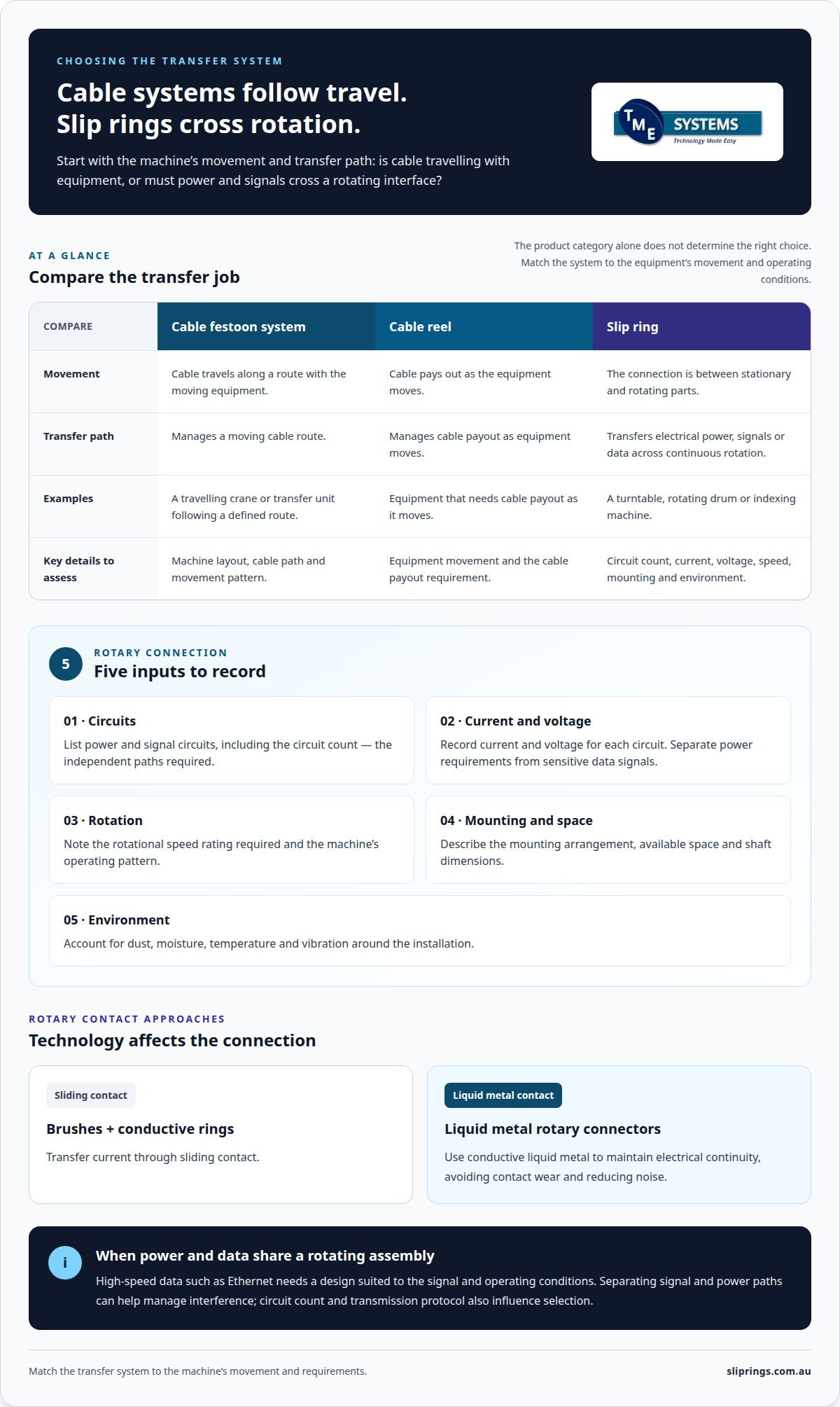
The obvious choice may be the wrong one: cable systems and slip rings solve different transfer problems. In a Conductix-Wampfler vs TME Systems comparison, first ask whether power and data must travel along moving equipment or across a rotating interface. Cable festoon systems and reels manage moving cable routes; slip rings and rotary electrical connectors transfer power or signals across continuous rotation.
That distinction matters when a machine must carry power and data while meeting movement, circuit, speed, mounting and environmental requirements. The product category alone does not determine the right choice. Start with the machine’s operating conditions and what needs to pass between its fixed and moving parts.
This article compares cable festoon systems, cable reels and slip rings, and explains what to consider for rotary data transmission. It also outlines how TME Systems’ technical application consulting can help match a slip ring to an application, considering circuit count, current, voltage, speed, mounting style and environment.
Key Takeaways
- Map the equipment’s movement and transfer path first; this helps distinguish a cable-handling system from a rotary electrical connection.
- Compare product ranges by function and application rather than assuming similarly named systems perform the same job.
- Use the equipment’s operating environment and required power and data transfer to narrow suitable system types.
- Separate product selection from installation and maintenance support when assessing what each supplier can contribute.
- For a rotary connection, prepare the circuit, electrical and mechanical requirements to guide a more focused application discussion.
Slip rings and rotary data transmission
A slip ring transfers electrical power, signals or data between stationary and rotating parts. Its fixed side connects to the stationary structure, and its rotating side connects to the moving assembly. In a Conductix-Wampfler vs TME Systems comparison, distinguish this rotary function from cable systems designed to follow travelling equipment.
For example, a rotating handling platform may need power for drives and signals for sensors. A vehicle turntable may need control signals to cross its rotating interface without twisting cables. Circuit count depends on the independent power and signal paths the assembly must carry.
Begin selection by recording the rotating assembly’s electrical and mechanical requirements. Gather the key details before comparing slip ring options:
- Power and signal circuits, including circuit count.
- Current and voltage for each circuit, separating power from sensitive data signals.
- Rotational speed rating and the machine’s operating pattern.
- Mounting arrangement, available space and shaft dimensions.
- Environmental conditions, including dust, moisture, temperature and vibration.
These details guide the choice of contact technology and assembly format. A through-bore slip ring has a hollow centre for shaft mounting or auxiliary components. A capsule format may suit end-of-shaft mounting where a solid centre is acceptable. Choose based on the machine’s geometry and how the connector attaches to the rotating structure.
Combining power and data in one assembly calls for attention to signal integrity. High-speed data, such as Ethernet, requires a design suited to the signal and operating conditions. Separating signal and power paths can help manage interference, while the required circuit count and transmission protocol also influence selection. This is an important technical distinction in Conductix-Wampfler vs TME Systems.
Contact technology matters too. Brushes and conductive rings transfer current through sliding contact. Liquid-metal rotary connectors use conductive liquid metal to maintain electrical continuity, avoiding contact wear and reducing noise. A liquid-metal slip ring may suit applications where these characteristics matter, provided its electrical and mechanical requirements match the machine.
Material-handling equipment, rotating machinery and energy-storage systems can each have different transfer needs. A handling turntable may prioritise control signals and drive power, while an energy-storage interface may have distinct circuit requirements. Assess the actual load, movement, mounting and environment rather than choosing by application label alone.
Also consider heat, enclosure protection and maintenance access. Current, ambient temperature and duty affect heat within the assembly; dust and moisture influence enclosure requirements. These conditions inform thermal derating and the required IP rating, helping engineers assess whether the rotary connection suits its installation.
TME Systems Pty Ltd
TME Systems helps Australian customers assess slip ring requirements through technical application consulting. Turn to the company when your application needs a rotary electrical connection and you want to match the selection to its operating conditions.
The product range includes Mercotac® slip rings, Meridian Laboratory ROTOCON connectors, BGB Innovation slip-ring assemblies and Prosper Rotation conductive slip rings. Selection can account for circuit count, current, voltage, speed, mounting style and environmental requirements. These factors help identify a suitable rotary connection for the assembly.
For a focused technical discussion, outline the machine’s movement, electrical requirements, mounting arrangement and operating environment. Contact TME Systems Pty Ltd to discuss your slip ring application and selection requirements.
What industries and applications does each company serve in Australia?
Supplier names alone do not distinguish these product categories. Start with the equipment’s movement: cable travelling along a route, or power and signals crossing a rotating joint. Conductix-Wampfler’s cable festoon systems and reels relate to moving cable applications. Rotary electrical connections serve machines with rotating assemblies.
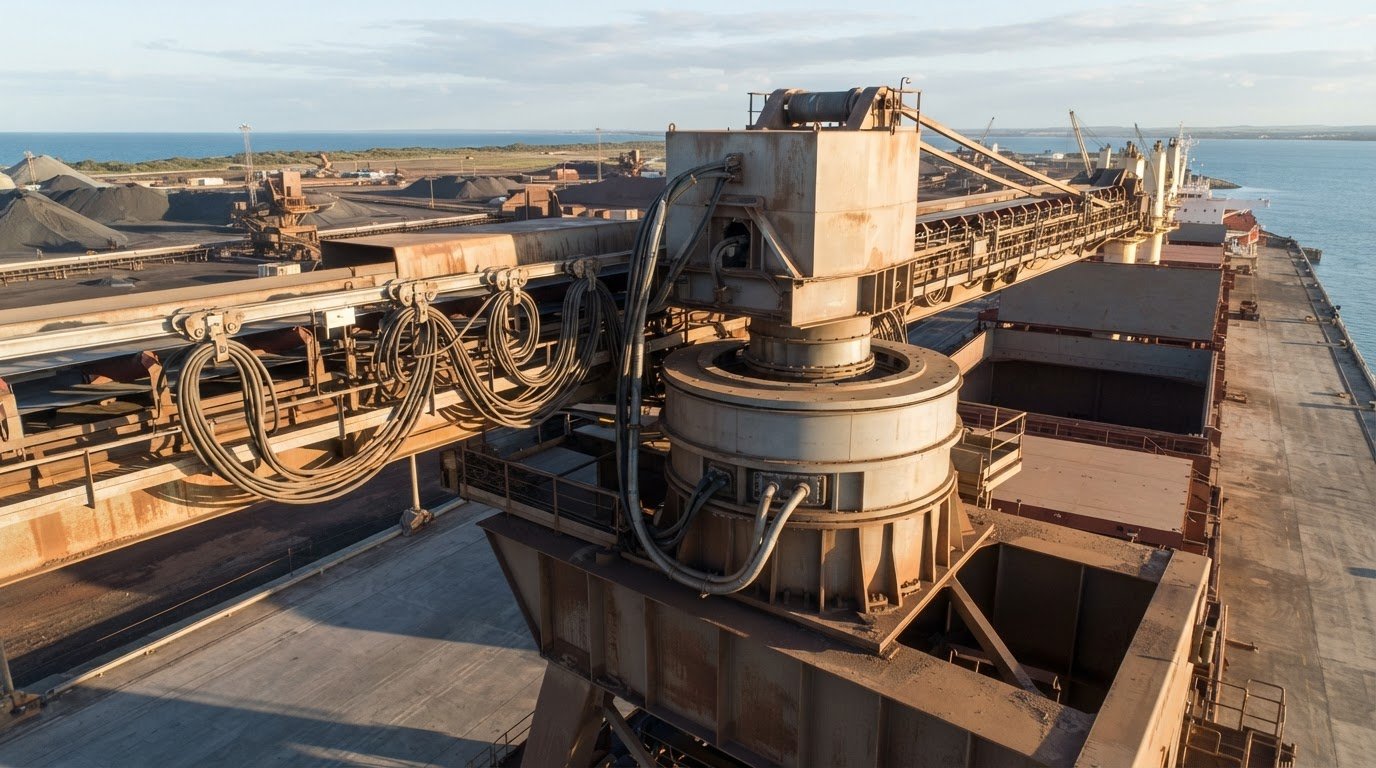
For a travelling crane, the cable route and travel pattern define the cable-handling task. A festoon system can guide cable along the machine’s path, while a reel manages cable payout as equipment moves. These examples describe application fit, not a claim that one product suits every crane or installation.
Similar considerations apply to industrial material handling. A travelling transfer unit, for example, may need a cable supply that follows its movement along a defined route. The relevant details include the machine layout, cable path and movement pattern. These details are more useful than a broad label such as manufacturing or logistics.
Rotary applications have a different requirement. A turntable, rotating drum or indexing machine may need electrical circuits to pass between stationary and moving parts. A rotary joint is relevant at that interface, whether the machine supports automation, handles material or forms part of a vehicle production line. The interface itself, rather than the sector name, guides selection.
To compare application fit, classify the equipment by its movement and transfer point:
- Linear travel: identify where the cable moves with a crane, transfer unit or travelling machine.
- Cable payout: assess whether a reel fits equipment that draws cable during movement.
- Rotation: locate the fixed-to-rotating interface on a turntable, drum or indexing assembly.
- Combined motion: separate the travelling cable route from the rotating electrical connection.
The distinction matters when equipment has more than one type of movement. A crane may travel across a runway while a mounted device rotates. Its travel cable arrangement and rotary interface perform separate tasks, so do not assume one product category covers both.
In Australian industrial projects, examples such as mining material handling, manufacturing automation and vehicle assembly help describe operating contexts. They do not, by themselves, establish a supplier’s sector coverage. Use each example to identify the machine, movement, transfer point and environmental conditions. This keeps the comparison grounded in engineering requirements.
For rotary connections, assess circuit count, current, voltage, speed, mounting and environment. These parameters help determine whether a connector suits the machine’s duty. For cable systems, route geometry and cable movement are central. Match the product category to the transfer task before comparing suppliers’ industry lists.
What are the Australian locations, offices, and service areas of Conductix-Wampfler and TME Systems?
For Australian projects, distinguish product supply from an office location or an on-site service area. TME Systems supplies industrial slip rings to customers across Australia. The project location does not change the technical selection criteria, which depend on the machine and its operating requirements.
Conductix-Wampfler’s cable festoon systems and reels relate to cable movement on equipment, including applications at industrial sites such as ports, mines and factories. The site’s requirements affect delivery planning, installation coordination and practical support arrangements. An application location should not be mistaken for a supplier’s office location.
A useful comparison separates the geography into distinct questions:
- Office: identify whether the relevant organisation has a named Australian office for the product category.
- Supply: establish whether the equipment is supplied to the project’s Australian location.
- Technical support: distinguish remote application guidance from work performed at the site.
- Installation and maintenance: record who is responsible for each activity and where it is delivered.
For example, a mine in Western Australia may need a rotary connector for a machine, while a port in Queensland needs cable management for travelling equipment. Both are Australian applications, but they involve different products, site logistics and engineering requirements. National product supply does not, by itself, mean every support activity takes place on site.
For a rotary electrical joint, project location is only one consideration. Engineers also need the equipment’s circuit requirements, current, voltage, speed, mounting arrangement and operating environment. These details support a technical discussion of product fit; installation responsibilities are a separate part of project planning.
For cable systems, the project team must account for the route between the supply point and moving equipment. A long travel path at a regional processing site presents different logistics from a compact factory installation. These examples illustrate why location and application should be considered together, without assuming that the same service arrangement applies across every Australian state.
In a procurement comparison, record the project’s state or territory, site access requirements, equipment type and required support activity. Then distinguish product supply from engineering assistance, installation and ongoing maintenance. This creates a clearer view of geographic fit for Conductix-Wampfler and TME Systems Pty Ltd than an office address alone. For slip ring applications, technical selection centres on the machine requirements and conditions at its Australian installation site.
TME Systems supplies industrial slip rings to customers across Australia. Conductix-Wampfler cable festoon systems and reels are used for applications at industrial sites such as mines, ports and factories, including projects in Western Australia and Queensland.
How do Conductix-Wampfler and TME Systems Pty Ltd compare on technical support, installation, and maintenance
Separate product-selection advice from installation and maintenance when comparing Conductix-Wampfler and TME Systems. Cable festoon systems and reels need planning around cable routes and equipment travel. Slip rings need assessment of rotary electrical requirements. These distinct tasks call for different technical information and support scopes.
For a cable festoon or reel, the engineering discussion centres on the moving equipment, cable path, travel and connection points. A travelling crane, for example, needs its route and cable movement considered together. Installation planning then addresses how the cable system fits the machine and site; maintenance planning concerns the installed system and its operating conditions.
Slip ring selection follows a different path. Relevant inputs include circuit count, current, voltage, rotational speed, mounting style and environmental requirements. For a turntable, engineers also need to understand how the rotating assembly connects to the fixed structure. These details support product selection but do not define who installs or maintains the equipment.
Compare support responsibilities by separating the work into stages:
- Application review: match the equipment motion and transfer task to the product category.
- Technical selection: assess operating requirements, layout and product compatibility.
- Installation: define who handles physical fit, connections and integration with the machine.
- Maintenance: establish inspection and servicing responsibilities for the installed system.
This distinction matters in a project that combines cable travel and rotation. For example, a crane with a rotating attachment may need a cable-management arrangement for crane travel and a separate rotary connection. Product-selection guidance should not be confused with installation, commissioning or ongoing maintenance.
For TME Systems Pty Ltd, technical application consulting helps with slip ring selection against circuit count, current, voltage, speed, mounting style and environmental requirements. That is a defined technical contribution. It should be distinguished from installation at the site, which is a separate activity and must not be treated as part of the same scope.
Conductix-Wampfler’s cable system categories make route and movement central to the support discussion. A reel on travelling equipment, for instance, raises different integration questions from a slip ring on a rotating shaft. Compare each company’s products against the task they address, rather than assuming both provide identical engineering or site support.
Before finalising a project scope, map the equipment, transfer point and required support activities. A selection review may need drawings, electrical requirements and mounting details. Installation planning needs site and machine integration information, while maintenance planning needs clear responsibility boundaries. This helps project teams distinguish product guidance from physical work at an Australian site.
Conductix-Wampfler & TME Systems Pty Ltd range in Australia
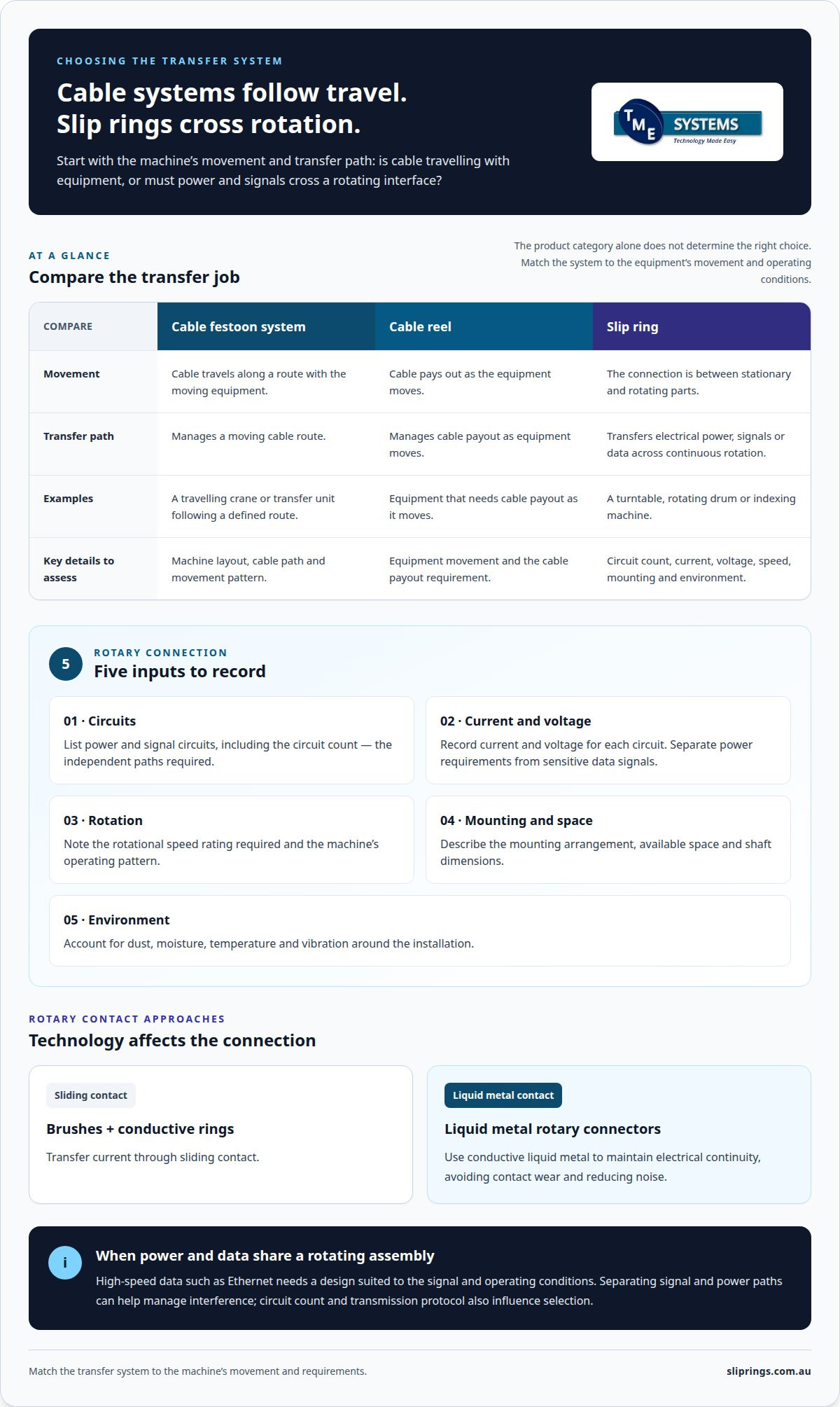
These product ranges address different transfer paths. Conductix-Wampfler cable festoon systems and reels manage cable movement along equipment. Slip rings perform another function: transferring electrical power, signals or data between stationary and rotating parts. A festoon or reel is not a direct substitute for a rotary electrical connection.
A cable festoon system supports moving equipment by guiding cable along a route. For example, a travelling machine may need a cable supply that follows its movement across a structure. A cable reel stores and pays out cable as equipment travels or operates. The machine’s travel path and cable-handling needs help determine the appropriate arrangement.
Slip rings address rotation rather than linear travel. A rotating table, drum or turntable may need electrical connections across its fixed and rotating sides. Circuit count, current, voltage, speed, mounting style and operating environment shape a slip ring’s suitability. These requirements differ from the cable length and travel path central to selecting a festoon or reel.
For a practical comparison, match each product group to the equipment’s movement before assessing individual specifications:
- Travelling movement: consider a festoon or reel where cable must follow equipment along a defined route.
- Continuous rotation: consider a slip ring where circuits must cross a rotating interface.
- Combined movement: identify each movement separately; a machine may need cable management for travel and a rotary connection at a rotating assembly.
A travelling crane with a rotating component, for instance, presents two transfer tasks. Cable handling along the crane’s travel path differs from transferring circuits through the rotating component. Treating both as one selection can obscure the connection points and operating conditions each system needs to address.
Compare functional categories first, then consider the engineering inputs for each. Festoon and reel decisions centre on route geometry, cable movement and equipment travel. Rotary connection decisions centre on circuit requirements, rotation, mounting space and environmental conditions. This distinction makes the comparison useful without treating unlike products as equivalents.
In Australia, the right category depends on the machine layout and where transfer occurs. A linear path calls for a cable-management assessment; a rotating interface calls for a rotary-connection assessment. If equipment combines travel and rotation, map both paths and specify each connection separately. This gives procurement and engineering teams a clear basis for comparing relevant product ranges.
Set the next step for your rotary application
The Conductix-Wampfler vs TME Systems decision is most useful when it reflects the transfer task your machine actually has. If the requirement is a rotary electrical connection, align the application details with the right slip ring category rather than choosing by supplier name alone.
TME Systems supplies Mercotac® slip rings, Meridian Laboratory ROTOCON connectors, BGB Innovation slip-ring assemblies and Prosper Rotation conductive slip rings. Its technical application consulting helps relate a machine’s operating requirements to slip ring selection. To start a focused discussion, describe the rotating assembly, its electrical needs, mounting arrangement and working environment.
That gives the selection process a practical starting point and helps clarify whether the requirement is for rotary power transfer, signal transmission or both. If your project involves a rotating interface, discuss your requirements with TME Systems. A clear engineering brief is a constructive first step towards selecting a suitable solution.