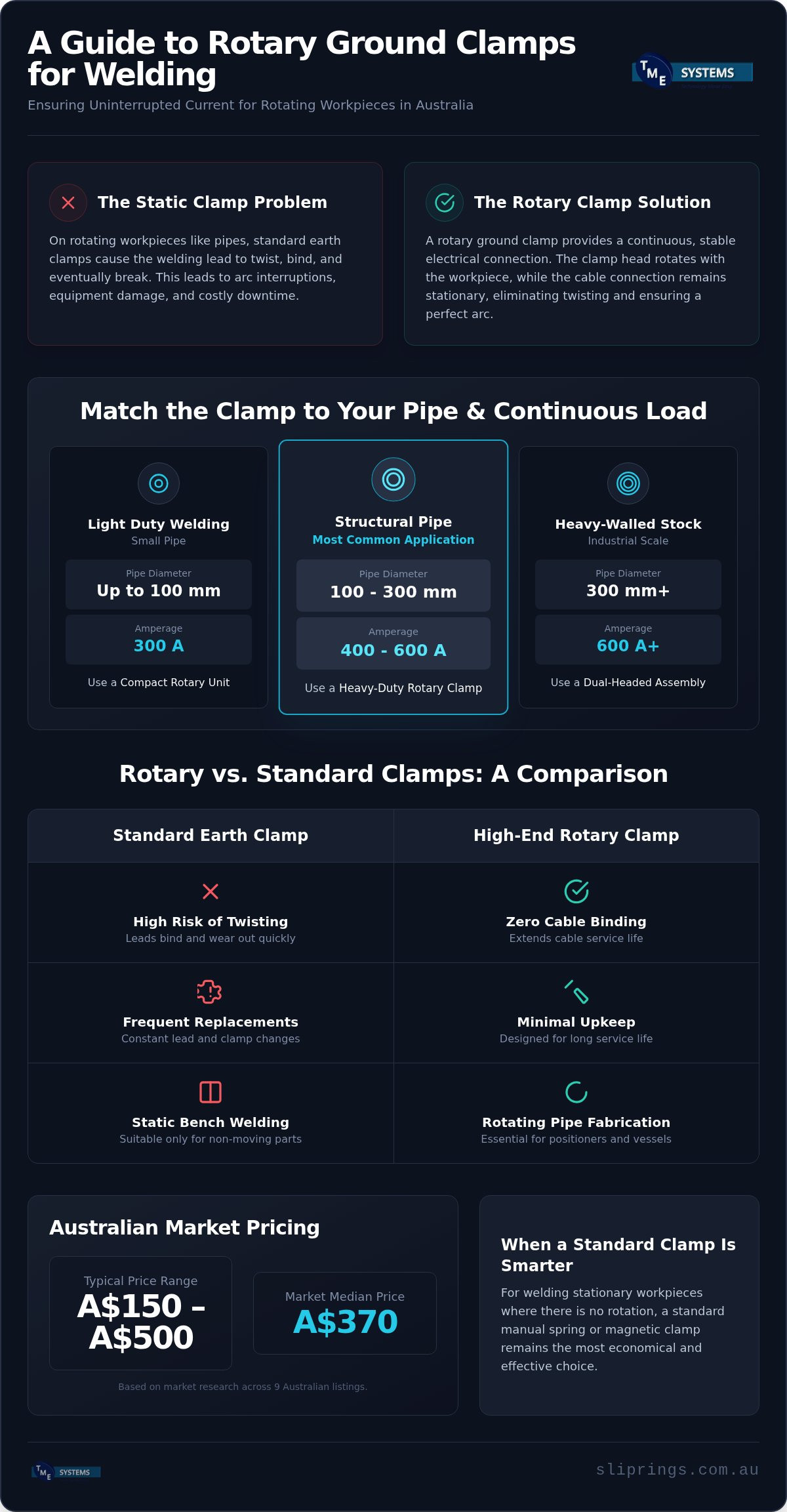
In the Australian welding market, a rotary ground clamp for welding typically costs between 150–500 A$ (market median 370 A$), according to research across 9 listings. Selecting the correct capacity ensures uninterrupted current flow during pipe or vessel rotation. Matching your continuous amperage to your setup prevents thermal damage and equipment downtime.
Key Takeaways: A rotary ground clamp for welding maintains electrical continuity during rotation to prevent cable twisting and arc interruptions on pipe positioners and vessels.
- Standard market rates for these specialized units range from 150 to 500 A$.
- Except when welding stationary workpieces where a standard manual spring clamp is more economical.
- Select a 600 A heavy-duty unit for structural pipes between 100 and 300 mm.
- The article's comparison table shows rotary units eliminate cable binding risks common in static jaws.
Match pipe diameter and amperage before you buy
Match your earth clamp (ground clamp) directly to your pipe diameter and peak amperage demands. Generic parts create extreme heat and arcing damage on high-current jobs, and an off-the-shelf pick based solely on dimensions and power path count (circuit count) fails when duty cycles spike.
Before you order, map the job to a concrete setup:
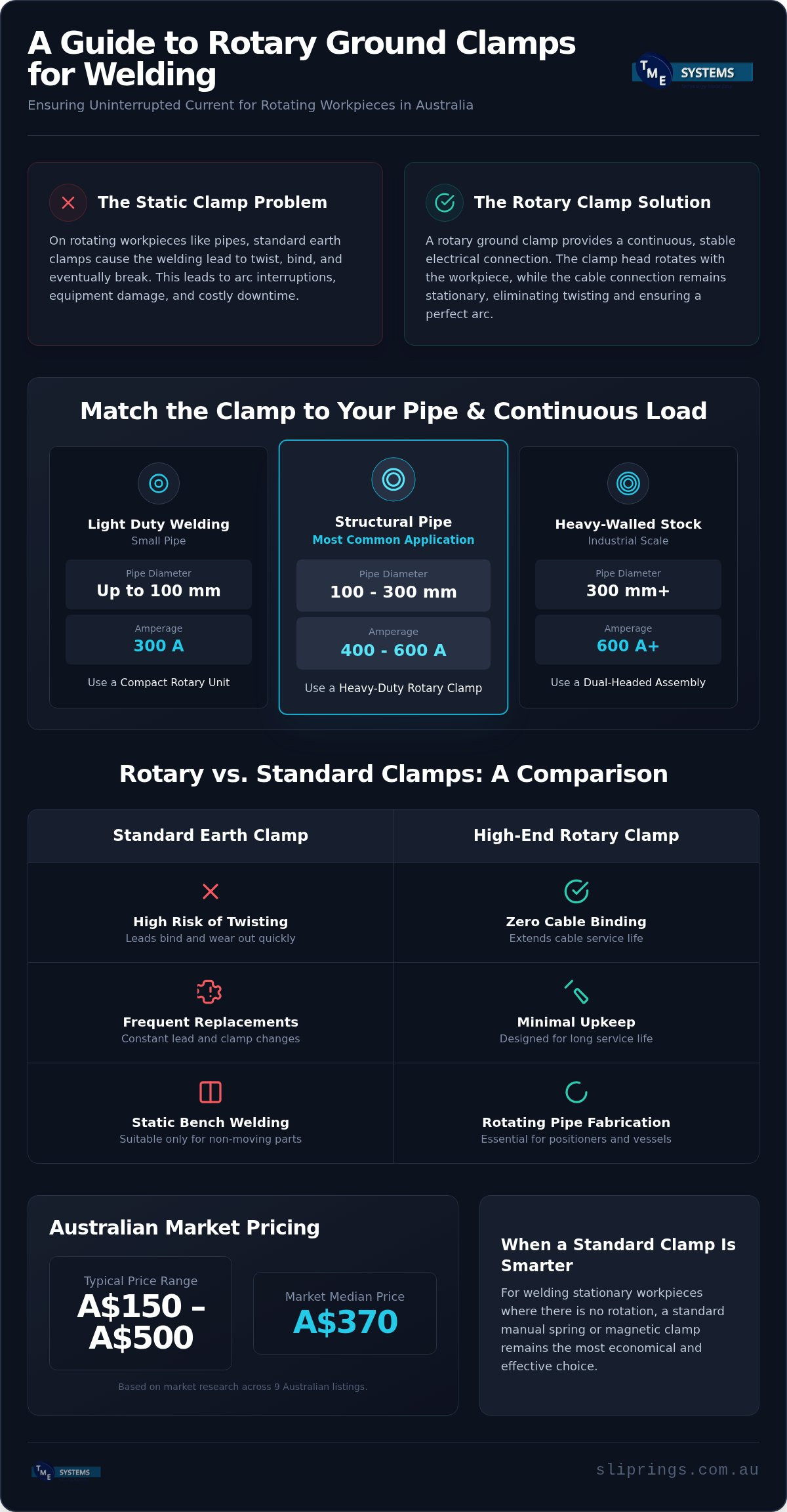
- Small pipe up to 100 mm on light duty: a compact 300 A unit keeps mass low and contact stable.
- Structural pipe in the 100–300 mm band at 400–600 A: a heavy-duty rotary ground clamp holds continuous current without hot spots.
- Heavy-walled stock over 300 mm at 600 A and above: a dual-headed assembly spreads load across a larger contact area.
Pipe size dictates structural stability, so stock above 300 mm needs industrial brass units. Based on current market listings, standard rates span 150–500 A$ (with a market median of 370 A$). For automated spools, a hollow centre clamp (through-bore slip ring) lets inner continuous purge lines pass through without tangled hoses. Arc welding puts sustained electrical load through the contact faces, so durable surfaces matter. Read our collector ring guide to evaluate high-amperage internal components, and pair high amperage with heavy brass.
Rotary grounds stop cable twist on turning workpieces
Rotary grounds maintain electric current continuity during continuous rotation, preventing twisted cables and arc interruptions while you weld round workpieces.
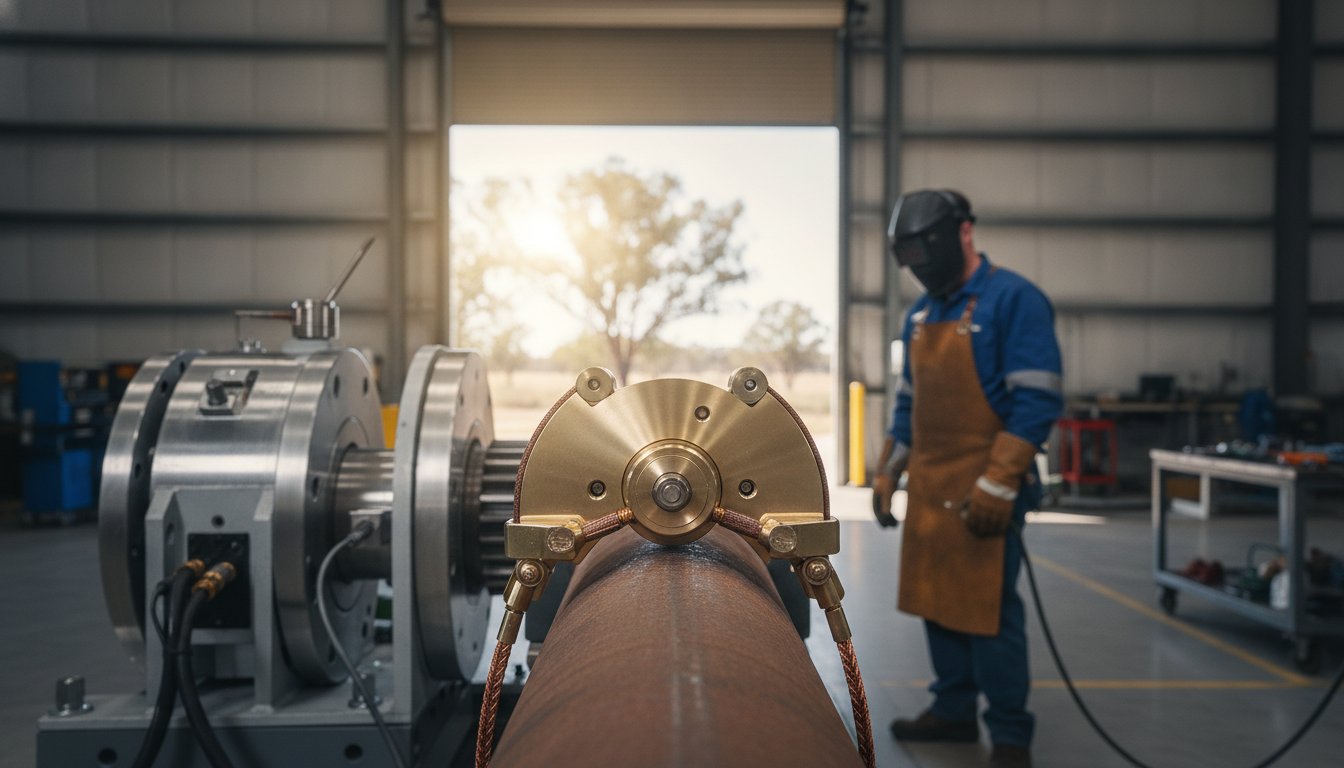
Picture turning a steel pipe on a positioner while a rigid earth clamp wraps its copper lead around the spindle until it snaps. That is the failure mode standard clamps cannot escape on rotating workpieces. A rotary unit transmits high welding current through built-in rolling contacts or liquid metal interfaces instead, so the lead stays still while the job turns.
For continuous multi-pass pipe welds, high amperage demands stable conductivity. Typical commercial assemblies cost AUD $150–$500 (market median AUD $370 according to market listings). You need to evaluate duty cycles alongside mechanical mounting options, not only physical size. When you specify components for complex rotary tables, industrial slip rings keep signal and power transfer intact across moving joints. Standard clamps suit static frames; rotating positioners need purpose-built rotary units to prevent severe shaft pitting.
Size the clamp to your pipe and continuous load
Select an earth clamp from the outer diameter of your pipe and your positioner's maximum continuous amperage load. Matching those two specifications prevents thermal arc damage and uneven current transfer during continuous rotation. Small pipes up to 100 mm generally pair well with compact 300 A units, whereas heavy wall structural piping needs heavy-duty 600 A setups.
Heavy rotary positioners often deliver uneven current when the mounting jaw profile misses an exact match with the pipe radius. A clamp chosen only on basic dimensions and circuit count (power path count) invites sudden voltage drops, so the contact area must match your wall thickness.
┌─────────────────┬─────────────┬─────────────────────────────────┐
│ Pipe Outer Dia. │ Amperage    │ Grounding Setup                 │
├─────────────────┼─────────────┼─────────────────────────────────┤
│ 25 mm, 100 mm  │ 200 A, 300 A│ Standard spring or magnetic jaw │
│ 100 mm, 300 mm │ 400 A, 600 A│ Heavy-duty rotary ground clamp  │
│ 300 mm+         │ 600 A+      │ Dual-headed assembly       │
└─────────────────┴─────────────┴─────────────────────────────────┘
When you add monitoring gear to a positioner, consult our note on rotary data transmission so signal integrity holds alongside high-amperage lines. Data from market listings indicates that high-capacity rotary grounding units usually run 150–500 A$. An oversized clamp adds unneeded weight; an undersized unit creates a hot spot that risks burning the workpiece.
Rotary clamps cut lead wear that static jaws cannot
Purpose-built rotary ground clamps deliver longer service life and lower maintenance than standard earth clamp options on turning work. Units in this class usually carry prices of 150–500 A$ per market listings, and they stop ongoing cable twist. Shop testing shows standard static units fail because continuous rotation during pipe fabrication destroys trailing leads. A swivel connection stops cable binding at the source. Standard models fit quick, stationary jobs; rotary units suit continuous production. A clear walkthrough of how slip rings work shows why constant electrical contact reduces repair spend. More on this: How a Slip Ring Works.
| Clamp Feature | Standard Earth Clamp | High-End Rotary Clamp |
|---|---|---|
| Cable Wear | High risk of twisting | Zero cable binding |
| Maintenance Needs | Frequent lead replacements | Minimal ongoing upkeep |
| Typical use | Static bench welding | Rotating pipe fabrication |
Static clamps drag efficiency down on rotating workpieces. A heavy-duty rotary model breaks the cycle of repeated lead replacement.
Four installation steps that protect conductivity
Proper installation of a rotary earth clamp gives clean electrical contact and stops cable tangling during operation. Client jobs show that setup speed depends on surface preparation: skip it and you get high resistance and poor conductivity.
- Clean the surface: Strip all paint, rust, and mill scale from the attachment area to expose bare metal.
- Mount the base: Secure the stationary side firmly to your workpiece or welding table.
- Attach the lead: Fasten your welding cable lug tightly to the terminal bolt to prevent loose connections.
- Test the movement: Rotate the joint by hand to verify smooth spin before striking an arc.
A high-amperage brass unit fits heavy fabrication shops; lighter magnetic models suit portable repair jobs. Work through the sequence above so grounding stays safe and efficient under load.
When a standard earth clamp is the smarter buy
A standard earth clamp is the better choice for stationary welding where workpieces never rotate. Rotating units add cost and complexity if your jig stays fixed for the whole run. According to market listings, specialised rotating earth clamps typically cost 150–500 A$, so manual spring clamps remain more economical for simple static tasks.
Heavy rotary units can drag thin sheet metals and stress fragile workpieces; a light manual clamp protects those jobs more cleanly. Choosing a rotating fixture for static, flat plate welding is like wearing steel-capped boots to swim.
On high-volume lines, buyers still fall into the off-the-shelf trap and pick a hollow centre clamp from basic dimensions and power path count alone. TME Systems Pty Ltd provides custom technical advice so you avoid that purchasing error and specify only what the duty cycle actually needs.
What drives rotary ground clamp pricing in Australia
Quality earth clamp units typically range between A$150 and A$500, according to current market rates with a median price of A$370.
In everyday welding, a cheap underspecified component creates a bottleneck that causes heat damage under load. Procurement teams that judge a part only on basic dimensions and power path count see quick failure under heavy industrial duties. Heavy usage needs verified logistics: dispatch timing, transparent shipping costs, and clear return terms. TME Systems Pty Ltd issues client-specific custom quotes tailored to Australian operating standards.
Request a personalised pricing proposal when you have pipe diameter, continuous amperage, and duty cycle ready.
Tip: Always verify that outdoor units meet IP65 dust and water ingress standards before purchasing.
IP ratings and warranty terms that protect field gear
An IP65 rating protects your rotary earth clamp against dust and low-pressure water jets on harsh outdoor fabrication. Heavy rain or direct hose-downs need an IP67 enclosure to keep water out. According to market listings, a specialised rotary unit typically costs 150–500 A$.
Field inspections show site dust quickly destroys under-rated units once seals are inadequate for the environment. To safeguard the purchase, TME Systems Pty Ltd provides a comprehensive 12-month warranty covering manufacturing defects. Confirm that sealed internal contacts match your work environment before you buy: sealed builds for exposed sites, standard clamps for controlled workshops.
Where fabricators rely on rotary grounds
Heavy industrial fabrication uses a rotary earth clamp to hold continuous electrical contact while workpieces turn on positioners. According to market listings, these assemblies typically cost 150–500 A$.
Situation: shop floors ran continuous circumference welds without a dedicated rotary ground and current sought a path through the drive. Action: fit a purpose-built rotary earth path so welding current no longer arcs through internal bearings. Result: bearings stay intact and heat input along the seam stays consistent for the full rotation.
Pipe spools need these devices for uniform root passes without stopping to untangle leads. Fabricators on thick-walled pressure vessels use them for steady heat input along long circumferential seams. Heavy automated slewing positioners likewise need a high-amperage grounding pathway under constant rotation. An off-the-shelf unit chosen only on outer dimensions and circuit count risks premature thermal failure under high duty cycles; TME Systems Pty Ltd can match the clamp to your continuous amperage loads.
Frequently asked questions
How much does a rotary ground clamp for welding cost in Australia?
A rotary ground clamp for welding typically costs between A$150 and A$500 according to market listings, with a market median of A$370. Total spend depends on required amperage capacity, duty cycle, and build materials. Contact us for a personalised quote matched to your operational needs.
What load capacity do I need for pipe welding?
Load capacity varies across models to support different welding currents and heavy industrial duty cycles. Judge the unit from continuous amperage and pipe diameter together, not from envelope size alone. Check full technical datasheets so the clamp matches the exact amperage of your welding procedure.
When should I choose rotary over a standard earth clamp?
Choose rotary when the workpiece or positioner turns continuously and a fixed lead would wind up or fatigue. Standard spring or magnetic jaws remain appropriate for static bench work and fixed jigs. If rotation is part of every weld cycle, a rotary ground protects both the cable and the spindle.
Which IP rating suits outdoor fabrication?
IP65 covers dust and low-pressure water jets on typical outdoor sites. Specify IP67 where the clamp faces heavy rain or direct hose-down. Match the seal level to the real exposure so contact faces stay clean for the life of the duty cycle.
How do pipe diameter and amperage affect clamp choice?
Pipes up to 100 mm generally suit compact 200–300 A setups; the 100–300 mm band often needs 400–600 A heavy-duty rotary clamps; stock above 300 mm at 600 A+ points to dual-headed assemblies. Align contact area with wall thickness so current transfer stays even through full rotation.
Selecting Your Next Earth Clamp
Choosing the right earth clamp prevents cable twisting and maintains continuous electrical contact in automated setups: the same diameter, amperage, and duty-cycle questions you started with still decide the outcome.
Selecting equipment from basic dimensions and circuit count alone still leads to overheating or voltage drops. Earth clamps typically cost 150–500 A$, according to market listings.
The technical team at TME Systems Pty Ltd provides specialised guidance for Australian industry. To lock in the correct rotary ground clamp for your welding applications, explore options at TME Systems Pty Ltd or request a tailored quote. More on this: Slip Rings Australia.