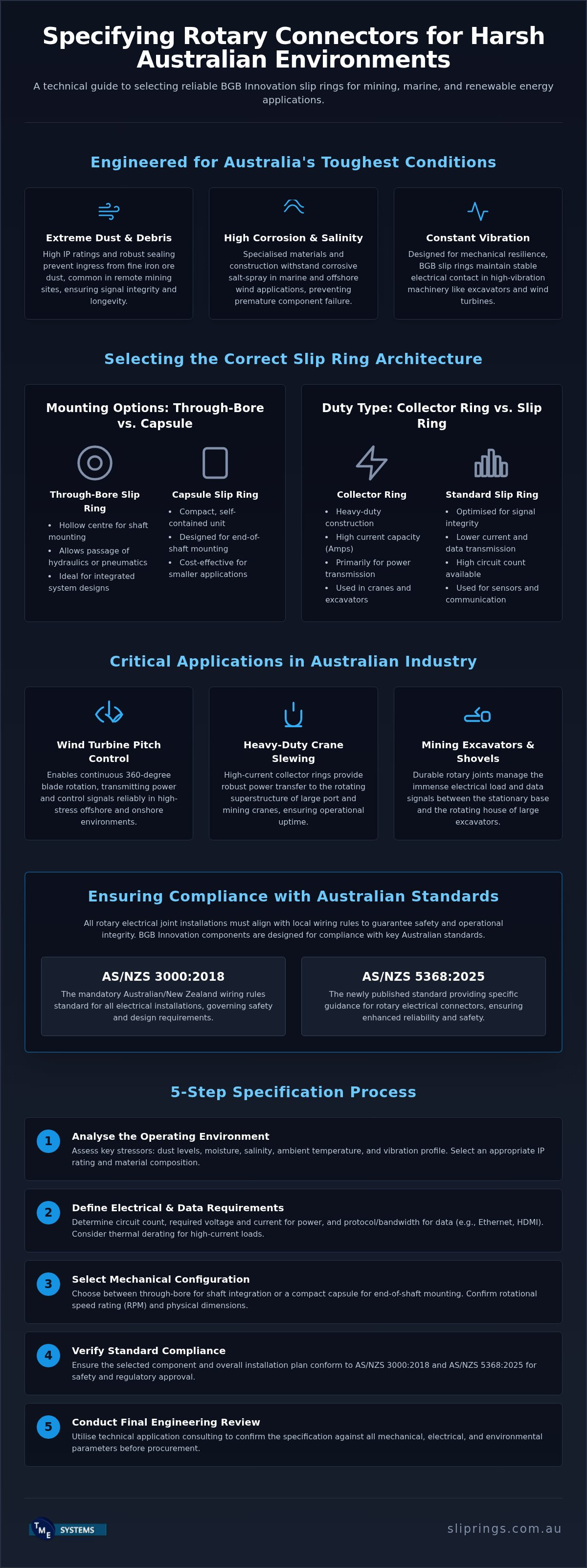
With the Australian mining equipment market projected to exceed A$18 billion by 2033, the cost of a single component failure in remote, demanding Australian sites has never been more punitive. For engineers managing assets in these environments, the search for reliable hardware often leads to bgbinnovation.com, where technical resilience meets specific industrial needs. You likely recognise that traditional brush systems often fail prematurely when subjected to the relentless dust of the interior or the corrosive air of coastal marine operations.
This article serves as a professional guide to specifying BGB Innovation rotary connectors tailored for Australia's harshest conditions. By following this technical reference, you can reduce unplanned downtime and ensure your installations meet the rigorous requirements of AS/NZS 3000:2018 and the newly published AS/NZS 5368:2025. We will analyse essential selection criteria, including through-bore mounting options, liquid metal technology, and thermal derating protocols, to help you identify the most reliable solution for your specific application.
Key Takeaways
- Learn how BGB design philosophy addresses common component failures in high-vibration Australian mining and marine environments.
- Identify the specific performance requirements for wind turbine pitch control and heavy-duty crane slewing applications to reduce unplanned downtime.
- Ensure all rotary electrical joint installations align with Australian wiring rules, including AS/NZS 3000:2018 and the current AS/NZS 5368:2025 standards.
- Discover how to use technical application consulting at bgbinnovation.com to conduct a final engineering review and ensure correct component specification.
- Master the selection between through-bore and capsule configurations to match your specific mechanical mounting requirements and IP rating needs.
BGB Innovation Slip Rings in the Australian Industrial Landscape
Australia’s heavy industrial sectors, particularly mining and renewable energy, operate in some of the most unforgiving environments on Earth. In these settings, the failure of a single rotating component can halt production, leading to significant financial losses. BGB Innovation has established itself as a specialist in the design and manufacture of rotary electrical joints, providing the mechanical resilience required for these high-stakes applications. While many engineers start their research at bgbinnovation.com, the practical implementation in Australia requires a deep understanding of local environmental stressors like fine iron ore dust and high salt-spray levels in offshore wind zones.
The Role of Rotary Electrical Joints
A slip ring is an electromechanical device that allows the transmission of power and electrical signals from a stationary to a rotating structure. Without this interface, 360-degree rotation would result in tangled cables and mechanical failure. A rotary electrical joint serves as the critical link for power and data in rotating systems. It's the component that ensures electrical continuity while the machinery remains in motion, preventing the mechanical strain that occurs with traditional fixed-wired connections.
The distinction between a collector ring vs slip ring is vital for correct specification. Collector rings are heavy-duty rotary connectors designed for high current capacity, often used in large mining excavators or slewing cranes. Standard slip rings are typically optimised for signal integrity and lower currents, such as those found in sensors or communication arrays. Choosing the wrong architecture leads to premature failure and increased maintenance costs, especially when thermal management isn't properly addressed for the Australian climate.
BGB’s Engineering Heritage in Heavy Industry
BGB’s engineering heritage is rooted in the demanding wind energy and maritime sectors. These industries require components that can withstand constant vibration and provide superior environmental sealing. The BGB product range available via TME Systems is built around this philosophy of durability. By focusing on mechanical properties and physical configurations, BGB ensures that their hardware remains functional in the presence of thermal expansion and high-speed rotation.
When you evaluate options on bgbinnovation.com, it is clear that their modular system architecture allows for significant customisation. This flexibility is essential for Australian engineers who must often retrofit existing machinery to comply with updated safety standards. It's a pragmatic approach that values long-term reliability over quick, off-the-shelf fixes that don't account for the unique demands of local infrastructure. This heritage of quiet competence ensures that every component is selected based on its ability to perform in the physical and functional realities of the field.
Engineering for Reliability: The BGB Design Philosophy
BGB Innovation prioritises mechanical resilience through a pragmatic design philosophy. While the technical data hosted at bgbinnovation.com highlights the importance of matching contact materials to specific environmental stressors, understanding the engineering behind these values is essential for long-term asset management. Reliability in Australian conditions depends on the precise interaction between contact materials and the surrounding environment. This approach ensures that components don't just meet a specification but survive the operational realities of the field.
Contact Technology and Wear Reduction
Selecting the correct contact material is a balance between electrical conductivity and mechanical wear. Traditional carbon brushes are often prone to high friction and dust accumulation; this increases electrical noise and compromises signal integrity. BGB employs silver-graphite brush technology to mitigate these issues. This combination provides a low-resistance path that is particularly effective for sensitive data signals in high-vibration environments. It's a solution that prioritises signal clarity over cheaper, less durable alternatives.
Maintenance intervals are a critical concern for remote operations. By using materials with superior wear characteristics, BGB reduces the frequency of brush replacements. This is especially relevant when considering the complex materials used to make wind turbines, where every component must withstand constant rotational stress for years. Silver-graphite contacts maintain signal integrity even when subjected to the fine particulates common in Australian mining regions. This reduces the total cost of ownership by extending the service life of the rotary joint.
Thermal Management in High-Current Applications
Heat is the primary enemy of electrical continuity. In a high-current slip ring for cranes, managing the temperature rise is a core engineering challenge. High ambient temperatures in regions like the Pilbara require strict adherence to thermal derating protocols. As temperatures increase, the allowable current must be reduced to prevent the degradation of internal insulation and contact surfaces. Ignoring these thermal limits often leads to premature component failure and costly downtime.
Thermal expansion also plays a significant role in component longevity. As internal parts heat up, they expand at different rates. This can lead to changes in contact pressure, potentially increasing wear or causing intermittent signal loss. BGB designs account for these variables by using housing materials and configurations that facilitate efficient heat dissipation. If you're unsure how these variables affect your specific site conditions, you might consider a technical application consultation to verify your specifications before procurement.
Rotational speed ratings are another variable that changes with frame size. Larger units often have lower maximum RPM limits due to the centrifugal forces acting on the brushes. Ensuring the selected unit operates well within its mechanical limits is vital for preventing catastrophic failure. This methodical approach to engineering ensures that each slip ring remains a dependable part of the industrial system.
Critical Applications: From Wind Turbines to Mining Excavators
BGB Innovation components are specified across diverse Australian sectors where rotation is a fundamental requirement. From the gusty coastal wind farms of Victoria to the iron-rich red dirt of Western Australia, these slip rings manage the critical transfer of power and data. While technical data on bgbinnovation.com provides a global baseline, the local application requires a focus on environmental sealing and mechanical durability. Choosing a component that matches the specific stressors of the site is the first step toward operational stability.
Renewable Energy and Wind Power
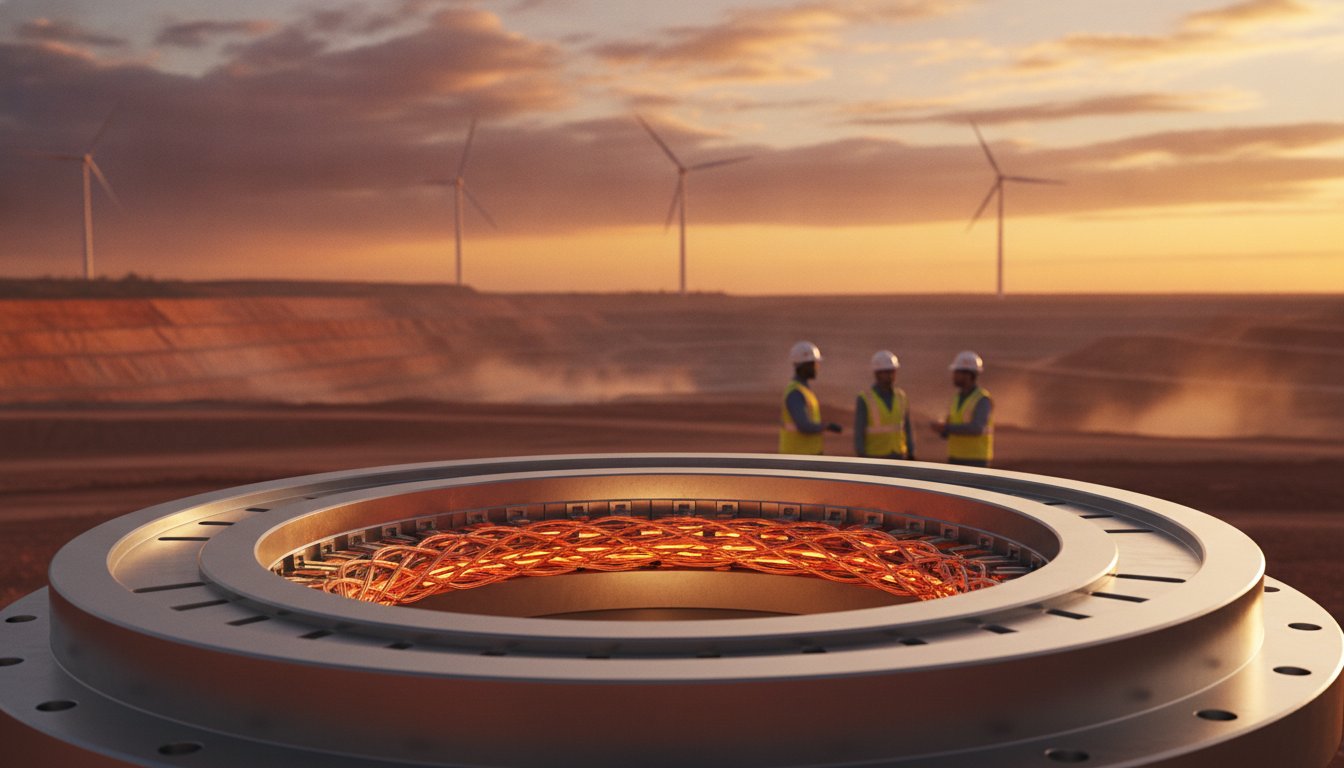
In wind turbines, slip rings are essential for blade pitch control and yaw systems. They transfer sensor data and power from the stationary nacelle to the rotating hub. Reliability is paramount because Australian wind farms are often in remote locations where maintenance access is difficult and expensive. With installed wind capacity forecasted to reach 52 GW by 2031, the demand for high-integrity rotary joints is increasing. BGB supports this transition by providing units designed for high-cycle life and minimal maintenance. This ensures consistent power generation even in turbulent coastal conditions.
Heavy Lifting and Mining Machinery
Mining excavators and slewing cranes require high-current slip rings to operate effectively. These machines often benefit from the advantages of slip-ring motors in mining, such as high starting torque and controlled acceleration. The environmental challenge in the Pilbara or Hunter Valley is significant. Fine iron ore dust is highly abrasive and conductive. Standard seals often fail under these conditions. BGB designs for these environments include IP-rated enclosures and specialised brush materials to prevent ingress. For those needing specific durability data, reviewing BGB Innovation slip rings Australia provides insights into how these units perform under extreme load.
Marine-grade solutions are also critical for offshore platforms and winches. These units use stainless steel housings to combat salt-air corrosion. In Australian manufacturing, custom configurations are often required for high-speed packaging equipment. These setups might involve high-speed data transmission through Ethernet-compatible rotary joints. This ensures signal integrity isn't lost during rapid rotation. By matching the slip ring to the specific mechanical and environmental constraints of the site, engineers can significantly reduce the risk of unplanned downtime.
Specifying the Right Slip Ring for Australian Standards
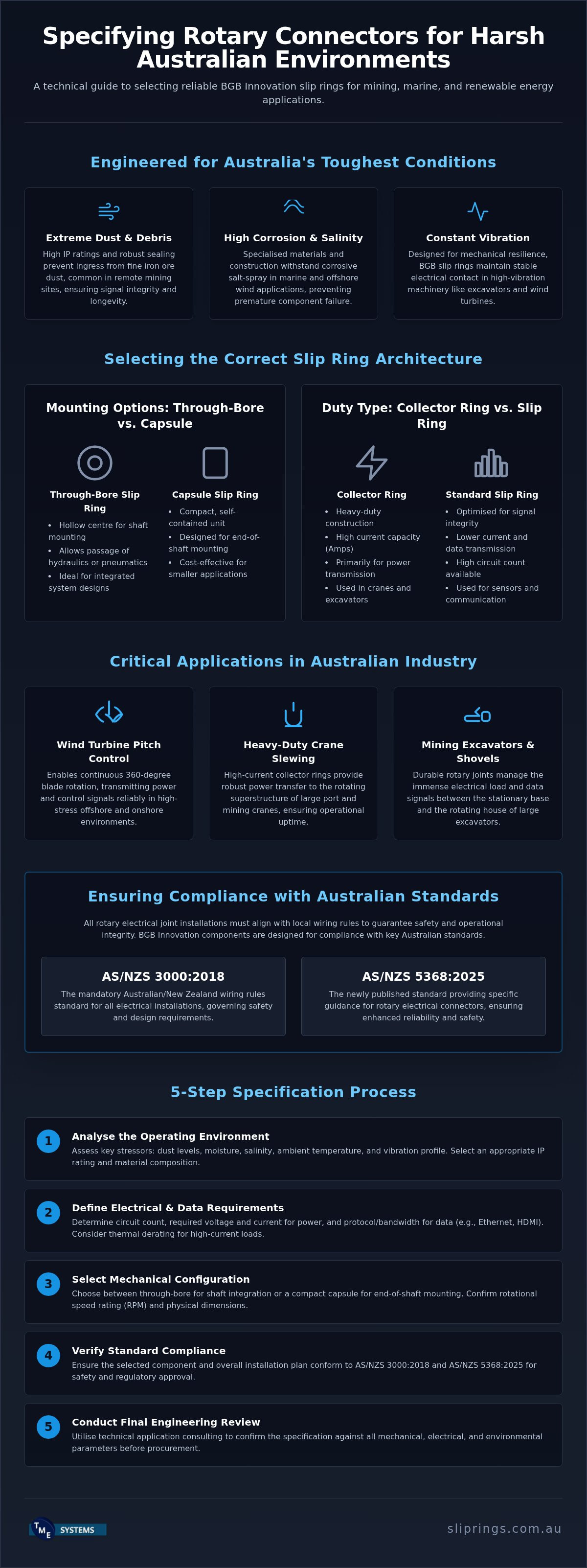
Selecting a rotary connector for an Australian industrial site requires more than just matching electrical specifications found on bgbinnovation.com. Engineers must ensure that every component aligns with local regulatory frameworks and environmental conditions. Compliance with AS/NZS 3000:2018 is non-negotiable for Australian industrial electrical installations. This standard dictates the fundamental safety and installation requirements that protect both the equipment and the personnel operating it. When you specify a BGB Innovation unit, the selection process must account for these rules to ensure the final assembly is fit for purpose.
Electrical Compliance and AS/NZS 5368:2025
For those operating in the mining and quarrying sectors, the publication of AS/NZS 5368:2025 on 27 June 2025 introduced updated requirements for electrical equipment. This standard supersedes several previous guidelines, including AS/NZS 3007:2013. It places a heavy emphasis on the insulation resistance and dielectric strength of components used in harsh environments. Ensuring your slip ring meets these updated benchmarks is essential for maintaining site compliance. A professional selection process verifies that the chosen rotary joint can withstand the specific fault levels and voltage surges common in heavy-duty power distribution networks.
Physical Configuration: Through-Bore vs Capsule
The mechanical integration of a slip ring often dictates the success of a retrofit or new build. A through-bore slip ring is the preferred choice when the unit must be mounted directly over a rotating shaft. This hollow centre allows for the passage of auxiliary components like hydraulic lines or pneumatic hoses. Conversely, capsule slip rings offer space-saving advantages for compact systems where end-of-shaft mounting is possible. These solid units are often easier to seal, making them suitable for high-vibration applications where space is at a premium. Choosing between these form factors depends on your existing mechanical footprint and the required circuit count for power and signal paths.
Environmental protection is defined by the IP rating of the enclosure. In Australian mining, an IP65 or higher rating is often necessary to prevent the ingress of conductive iron ore dust. Similarly, determining the correct circuit count is vital; you must provide enough independent paths for high-current power while maintaining isolated channels for sensitive data signals. Over-specifying can lead to unnecessary bulk, while under-specifying compromises the system's future-proofing. To ensure your selection meets all local technical and regulatory requirements, you can consult with our application engineers for a final design review.
Pragmatic specification involves balancing these technical needs with the physical realities of the site. By focusing on compliant hardware and the correct mechanical configuration, you reduce the risk of installation delays and long-term maintenance issues. This methodical approach to procurement ensures that your BGB Innovation components perform reliably within the Australian industrial landscape.
Technical Consulting and Local Supply for BGB Components
Procurement for heavy industry requires a move away from simple part replacement toward a model of technical application consulting. Technical accuracy matters. While bgbinnovation.com provides the foundational data for their rotary joints, the final engineering review is what ensures the component survives the intended duty cycle. TME Systems serves as a specialised intermediary in Australia, bridging the gap between global manufacturing capabilities and local site requirements. This consultative approach ensures that every specification is verified against the physical realities of the installation environment.
Application Engineering Support
Engineers rarely face a one-size-fits-all scenario in the field. Collaborating on custom configurations allows for the adjustment of housing materials or contact types to suit unique projects. We analyse environmental variables such as rotational speed, ambient temperature, and ingress protection requirements before any order is finalised. This methodical process ensures that the hardware matches the operational demands of the specific industrial application. It prevents the common mistake of selecting a component based on electrical capacity alone while ignoring mechanical stressors.
In some complex systems, a single machine may require multiple rotary technologies to function correctly. You might find a high-current BGB unit integrated with Mercotac liquid metal rotary connectors for superior signal clarity; or perhaps Prosper Rotation slip rings for specific auxiliary functions. Choosing between these technologies requires an expert who understands how different contact methods interact within a single mechanical assembly. This ensures that power transmission doesn't interfere with sensitive data signals.
Streamlining Industrial Procurement
Local distribution simplifies the supply chain by providing a direct point of contact for technical support and documentation. Accessing CAD files and technical drawings locally reduces the lead time on design phases for new equipment or retrofits. It also ensures that any queries regarding compliance with Australian standards are handled by someone familiar with the local regulatory landscape. This reduces administrative friction and speeds up the procurement cycle for critical components.
For a detailed look at managing these complex orders, our industrial slip ring supplier Australia guide provides a step-by-step framework for professional procurement. By using local expertise, you ensure that every BGB Innovation component is backed by a thorough engineering review. This commitment to technical excellence is what differentiates a simple vendor from a dependable industrial partner. Reliability is the result of careful selection.
Optimising Rotary Performance in Australian Environments
Selecting the right rotary joint is about more than matching a part number. It's about understanding the specific mechanical and environmental stressors of your site. While the technical data at bgbinnovation.com provides a baseline, successful implementation in Australia requires strict adherence to local standards like AS/NZS 5368:2025 and AS/NZS 3000:2018. Ensuring your hardware survives the relentless dust of a mining site or the salt spray of a coastal wind farm is a matter of professional selection over simple replacement.
TME Systems acts as the authorised distributor and technical intermediary for these components nationwide. By accessing specialist technical application consulting, you can verify your designs and ensure long-term reliability for your rotating assets. Contact TME Systems for BGB Innovation technical support to conduct a final engineering review of your requirements. A methodical approach to procurement today will protect your operations from unplanned downtime tomorrow.
Frequently Asked Questions
What is the difference between a collector ring and a slip ring in heavy industry?
Collector rings are heavy-duty rotary connectors designed for high current capacity, whereas standard slip rings are typically optimised for signal integrity and lower currents. In applications like large mining excavators, collector rings handle the primary power feed. Standard slip rings within the same machine manage sensor feedback and control signals. Choosing the right architecture prevents premature wear and ensures the mechanical properties match the electrical load requirements of the system.
How do I determine the correct IP rating for a slip ring in a marine environment?
A marine environment typically requires an IP rating of IP65 or IP66 to protect against salt spray and water ingress. These ratings ensure the internal electrical paths remain dry and free from corrosive salt-air buildup. For offshore platforms or winches, stainless steel enclosures are often paired with these ratings. You should consult the technical data at bgbinnovation.com to verify that the enclosure design provides adequate environmental sealing for your specific coastal location.
Can BGB Innovation slip rings handle high-speed data transmission like Ethernet?
BGB Innovation slip rings can handle high-speed data transmission, including Ethernet and HDMI, when configured with specialised high-frequency circuits. These designs minimise electrical noise and crosstalk, which are critical for maintaining signal integrity during continuous rotation. Using silver-graphite contacts helps ensure low resistance. It's essential to specify the data protocol early in the design phase to ensure the rotary joint meets the required bandwidth and shielding requirements for your specific project.
What maintenance is required for BGB silver-graphite brush systems?
Silver-graphite brush systems require periodic inspection to remove conductive wear debris and check brush length. Unlike traditional carbon brushes, these systems produce less dust but still require a clean environment to maintain signal clarity. Regular cleaning intervals depend on the rotational speed rating and the operational duty cycle of the machinery. Proper maintenance ensures that electrical noise remains low and prevents the buildup of contaminants that could lead to short circuits or signal degradation.
Are BGB slip rings compliant with Australian AS/NZS 3000:2018 standards?
BGB slip rings are compliant with AS/NZS 3000:2018 standards when they are selected and installed according to the Australian wiring rules. Compliance depends on ensuring that insulation resistance, dielectric strength, and current-carrying capacities meet the specific requirements of the installation site. TME Systems provides technical application consulting to help engineers verify that their chosen hardware aligns with these non-negotiable safety regulations and the current AS/NZS 5368:2025 standard for mining equipment.
How does thermal derating affect the current capacity of a slip ring?
Thermal derating reduces the allowable current of a slip ring as the ambient temperature increases. This prevents internal components from exceeding their maximum operating temperature, which could damage insulation or cause thermal expansion issues. In the high-temperature regions of Australia, this is a critical consideration for a high-current slip ring for cranes. You must calculate the derated capacity based on the peak site temperature to ensure the rotary joint operates safely without overheating.
What are the mounting options for through-bore slip rings on large shafts?
Through-bore slip rings are designed for direct mounting over a rotating shaft, typically using clamping collars or set screws to secure the rotor. This hollow centre allows the passage of auxiliary components like hydraulic lines or pneumatic hoses. Mounting options depend on the shaft diameter and the available axial space. It's important to ensure the housing is properly torque-stayed to prevent it from rotating with the shaft, which would strain the stationary cable connections.
Can BGB Innovation products be customised for specific circuit counts?
BGB Innovation products use a modular system that allows for custom configurations of power and signal circuits. You can specify the exact circuit count required for your application, whether you need a few high-current paths or dozens of low-power signal channels. This flexibility is visible on bgbinnovation.com, where various frame sizes accommodate different stacking heights. Customisation ensures you don't pay for unused capacity while meeting the specific electrical requirements of your rotating machinery.