What if the most expensive part of your rotary system isn't the hardware itself, but the three hours of unscheduled downtime it caused during a critical production shift? For many Australian engineers, the reality of intermittent signal noise or premature component degradation in harsh, saline environments is a constant operational burden. Identifying the root causes of slip ring failure is essential for any facility looking to move beyond reactive maintenance and toward long-term reliability. You've likely experienced the frustration of data inaccuracies or brush wear that accelerates despite following standard service protocols.
In this technical guide, you'll discover the specific mechanical and electrical factors that lead to premature wear and learn how to specify components designed for Australia's unique industrial conditions. We'll explore how selecting robust solutions from brands like Mercotac or BGB Innovation can eliminate common failure modes. This article provides a comprehensive framework for optimising your maintenance intervals and implementing a replacement strategy that prioritises technical accuracy over quick fixes. We'll also examine how emerging trends, such as the shift toward contactless technology and the 2026 RoHS compliance updates, influence your component selection today.
Key Takeaways
- Identify the critical distinctions between total electrical continuity loss and subtle signal degradation to recognise early warning signs before a total system shutdown.
- Analyse how environmental stressors like dust ingress and high humidity act as primary causes of slip ring failure in Australian industrial settings.
- Discover how to prevent electrical arcing and surface pitting by selecting robust components from specialised manufacturers like Mercotac and BGB Innovation.
- Learn to specify the correct contact materials, such as gold-on-gold or silver-graphite, based on your application's specific RPM and duty cycle.
- Optimise your maintenance strategy by shifting from time-based intervals to predictive schedules grounded in actual cycle counts and technical audits.
Identifying the Primary Mechanics of Slip Ring Failure
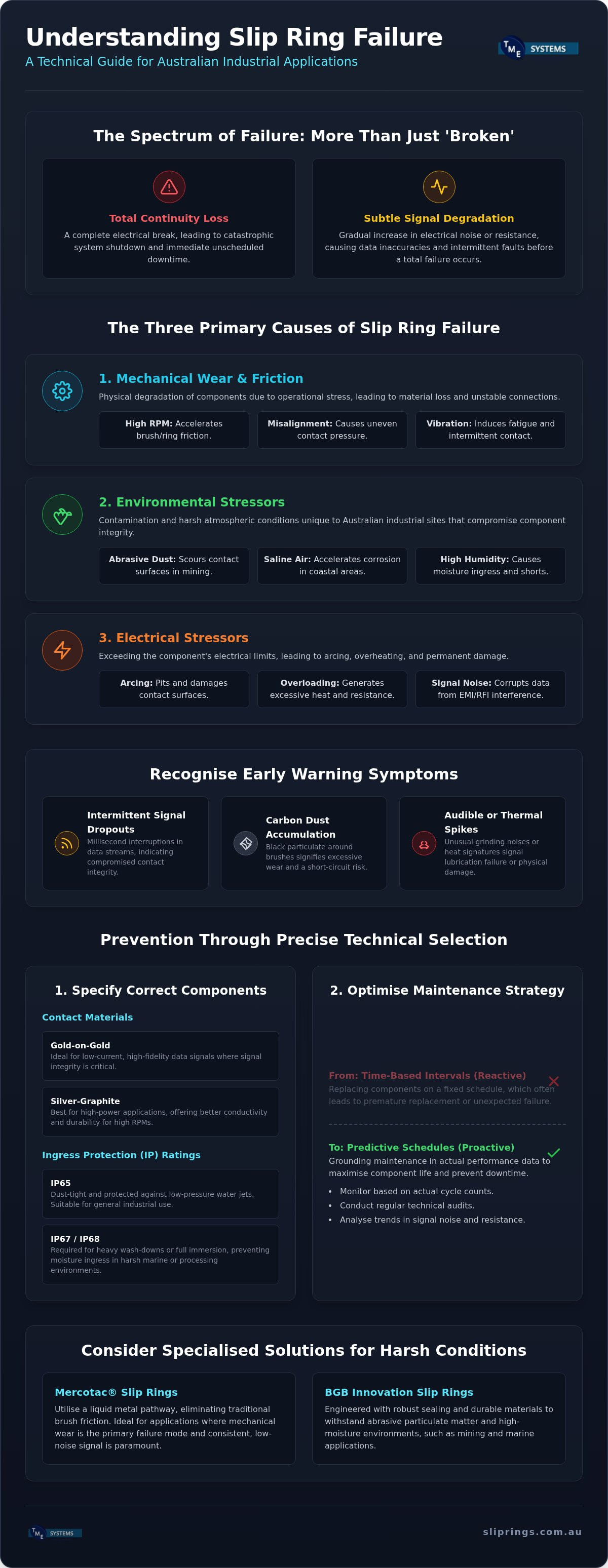
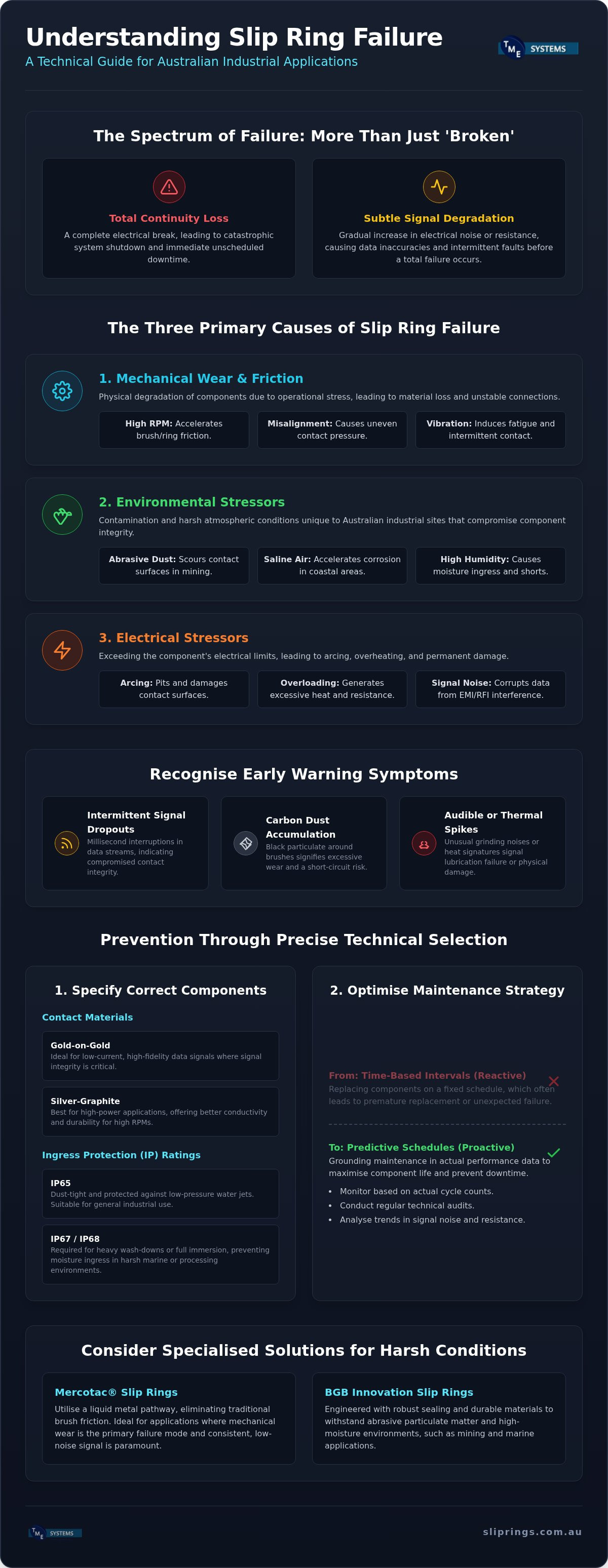
Understanding the root causes of slip ring failure requires a shift in perspective. Failure isn't always a binary state of "working" or "broken". Instead, it encompasses both the total loss of electrical continuity and the gradual, unacceptable degradation of signal quality. In many high-precision industrial applications, slip ring failure is defined as the point where electrical noise exceeds the application's tolerance threshold. This definition ensures that engineers address component wear before it results in catastrophic system downtime or corrupted data streams.
To effectively diagnose issues, one must understand foundational slip ring mechanics. Most failures originate from three distinct categories: mechanical wear, electrical stressors, and environmental ingress. While some components exhibit obvious physical damage, others fail through increased electrical resistance that generates excessive thermal energy. Recognising these patterns allows for a more robust replacement strategy and ensures that your equipment remains operational in demanding Australian environments.
Mechanical Wear and Friction Dynamics
Mechanical wear is often a direct consequence of operational parameters. High rotational speeds (RPM) significantly accelerate the friction between the brush and the ring surface, leading to rapid material loss. Beyond speed, installation precision is critical. Misalignment during installation creates uneven contact pressure, where one segment of the brush assembly experiences excessive force while another loses contact entirely. This imbalance leads to premature failure and erratic signal behaviour. Constant vibration in industrial machinery induces mechanical fatigue, compromising the stability of the contact interface and leading to intermittent connectivity.
Recognising Early Warning Symptoms
Proactive monitoring can prevent a complete system halt. You should look for specific indicators during routine inspections:
- Intermittent signal dropouts: In data-sensitive applications, even millisecond interruptions suggest that contact integrity is compromised.
- Carbon dust accumulation: The presence of black particulate around the brush block is a precursor to short-circuiting and indicates excessive brush wear.
- Audible grinding or thermal spikes: Unusual noise or heat signatures often signal that lubrication has failed or that the contact surfaces have been physically damaged.
For applications where brush wear is a recurring issue, liquid metal solutions like Mercotac slip rings offer a different mechanical profile that eliminates traditional friction-related causes of slip ring failure.
Environmental Stressors and Contamination Gaps
Australia’s industrial landscape presents some of the harshest operational conditions globally. In mining and bulk handling sectors, fine particulate ingress is a leading factor among the causes of slip ring failure. These abrasive dusts act as a grinding medium, physically scouring the contact surfaces and increasing electrical resistance. In coastal processing plants, saline air accelerates electrolytic corrosion, while extreme temperature fluctuations in the outback cause thermal expansion that alters contact tolerances. The reliability of rotary joints is particularly critical in marine environments. Research into tidal energy converters demonstrates that even minor saline ingress can lead to rapid electrolytic corrosion and total system failure.
The Role of IP Ratings in Preventing Ingress
Selecting the correct Ingress Protection (IP) rating is the first line of defence against environmental degradation. For most industrial applications, an IP65 rating ensures the unit is dust-tight and protected against water jets. However, in environments prone to flooding or heavy wash-downs, IP67 or IP68 ratings are required to prevent moisture from entering the housing during immersion. Standard seals often fail in abrasive environments because the seals themselves become worn by the very grit they are meant to exclude. When operating in these heavy-duty conditions, specifying a BGB Innovation slip ring provides the robust sealing necessary to withstand abrasive particulate matter. You can request a technical audit to determine if your current sealing strategy is sufficient for your specific environment.
Contamination and Carbon Tracking
Internal contamination is just as dangerous as external ingress. As traditional carbon brushes wear down, they naturally shed fine conductive dust inside the housing. If this dust is not managed, it creates an unintended path for electricity, a process known as tracking. This phenomenon leads to short circuits between adjacent rings, often resulting in permanent damage to the insulation. Preventative measures include using properly ventilated housings that allow for the controlled escape of wear particles or implementing a regular cleaning cycle using dry, oil-free compressed air. In data-critical systems, even a small amount of tracking can introduce significant signal noise, making it one of the most insidious causes of slip ring failure. Maintaining a clean internal environment is essential for ensuring the longevity of the contact interface.
Electrical Stressors: Arcing, Overloading, and Signal Noise
Electrical stressors often manifest as invisible threats that compromise a system long before physical breakage occurs. While mechanical wear is easy to spot, electrical causes of slip ring failure such as arcing or signal noise require a more nuanced diagnostic approach. Overloading is a common issue where the current draw exceeds the ring's specified rating, leading to rapid thermal expansion and eventual contact fusion. Similarly, transient voltage spikes can bridge the dielectric gap between rings, causing permanent insulation damage that leads to cross-talk or short-circuiting. These surges often originate from external sources like lightning or switching inductive loads, but their impact on delicate signal circuits is frequently catastrophic.
It's vital to distinguish between a power failure and a signal failure. A slip ring may maintain perfect continuity for a motor drive while being completely unfit for transmitting high-speed Ethernet or sensitive sensor data. Electromotive interference (EMI) and radio-frequency interference (RFI) can render a functioning rotary joint useless if the shielding or contact material isn't matched to the frequency of the data being transmitted. When signal integrity is compromised, the "failure" isn't a lack of electricity, but a lack of accuracy.
Understanding Electrical Arcing and Pitting
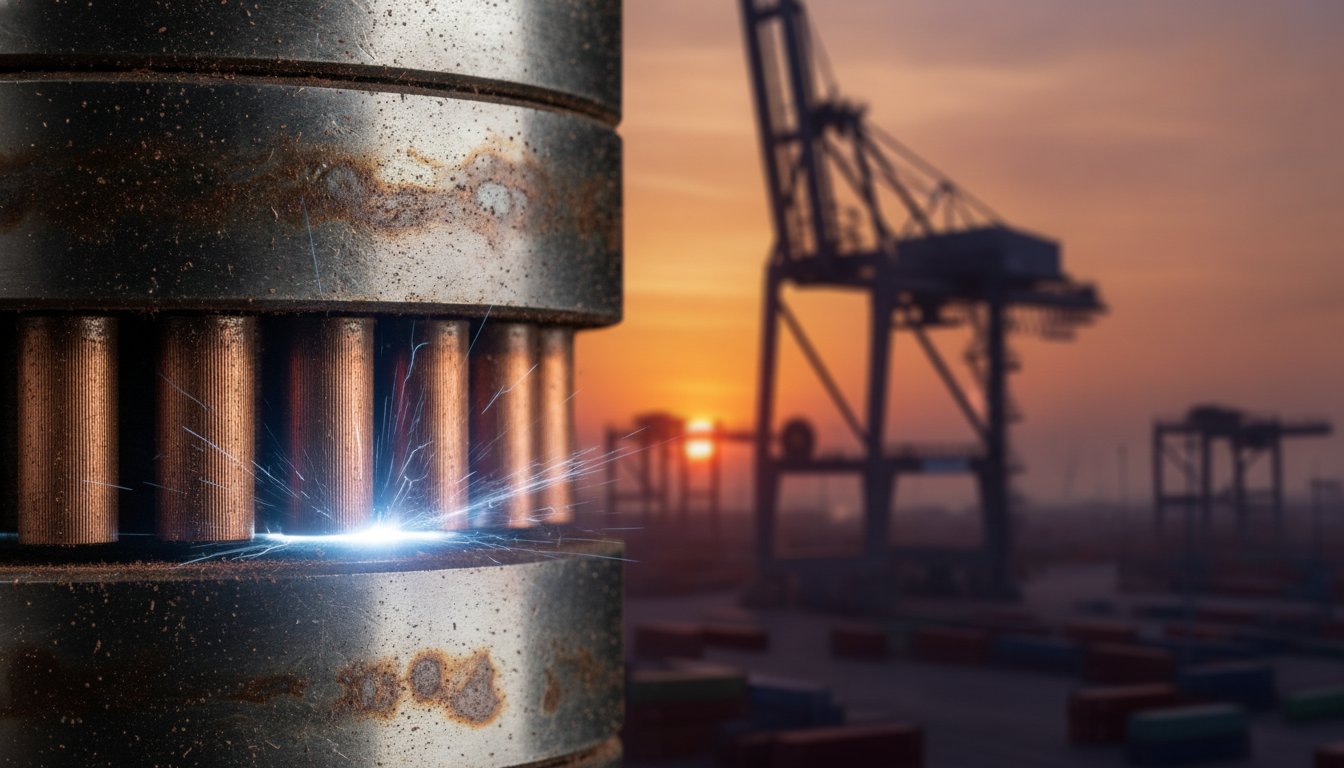
Electrical arcing occurs when the physical contact between the brush and ring is momentarily interrupted. This is frequently caused by insufficient contact pressure or high-frequency vibration within the machinery. Each micro-arc generates intense localised heat, vaporising small amounts of the contact material and leaving behind microscopic "pits". Over time, this pitting increases surface roughness, which in turn leads to more arcing and a snowball effect of degradation. High-voltage applications are particularly susceptible to dielectric breakdown, where the air between the rings becomes conductive, resulting in a sustained arc that can destroy the assembly in seconds.
Managing Signal Integrity in High-Speed Data
Traditional carbon or metal-graphite brushes often struggle with the low-voltage, high-frequency requirements of modern industrial automation. The sliding contact naturally creates "electrical noise" as the contact resistance fluctuates during rotation. For applications requiring precise data transfer with minimal packet loss, specifying Meridian Laboratory slip rings is a proven strategy to ensure high signal-to-noise ratios. Identifying these failures early involves monitoring for CRC errors or intermittent data dropouts rather than waiting for a total loss of signal. By matching the contact technology to the data rate, you can eliminate signal degradation as a primary failure mode in your facility.
Prevention Through Precise Technical Selection
Preventing the common causes of slip ring failure begins well before a component is integrated into a machine. It starts with a rigorous specification process that aligns the hardware with the actual operational duty cycle. One frequent mistake is failing to match the rotational speed (RPM) to the contact technology. A unit designed for high-speed operation may fail prematurely if run at very low speeds, as the brushes may not develop the necessary protective film. Conversely, exceeding the rated RPM leads to immediate thermal degradation. This is why professional slip ring application engineering is essential for ensuring long-term reliability in Australian industrial environments.
Contact material selection is another critical variable. Gold-on-gold interfaces provide exceptional resistance to oxidation and are the standard for low-voltage signal transmission. For high-current power applications, silver-graphite or copper-graphite brushes offer the necessary durability. You shouldn't assume that over-specifying current capacity is a "safe" bet. In some instances, running a high-current brush at a very low current density prevents the brush from properly seating on the ring, which eventually increases electrical noise and resistance. Precision in selection is always superior to over-engineering.
Liquid Metal vs. Traditional Brush Technology
Liquid metal technology provides a distinct advantage by addressing the mechanical causes of slip ring failure at their source. Unlike traditional brushes that physically rub against a ring, Mercotac slip rings utilise a pool of liquid metal to maintain electrical continuity. This design completely eliminates brush wear and the accumulation of conductive carbon dust. These units are the preferred solution for high-speed data transmission where signal noise must be virtually non-existent. While traditional brushes are still suitable for low-speed, high-power tasks, liquid metal is often the only viable long-term solution for precision automation.
Mounting Styles and Mechanical Alignment
The physical envelope and mounting method directly impact the lifespan of the assembly. Through-bore designs allow the slip ring to be mounted directly onto a drive shaft, which inherently reduces the risk of axial or radial misalignment. If the mounting is off-centre, it creates uneven contact pressure, leading to the mechanical fatigue and vibration issues discussed earlier. For custom or modular requirements, Prosper Rotation slip rings offer flexible configurations that can be integrated into diverse mechanical structures. Choosing the right mounting style ensures the unit remains stable throughout its operational life.
Verify your component selection by contacting our engineering team for a technical review before your next procurement cycle.
Maintenance Protocols and Component Replacement
A reactive approach to maintenance is one of the most common indirect causes of slip ring failure in high-utilisation facilities. Relying solely on time-based intervals often leads to either unnecessary downtime or, more dangerously, component failure between service windows. We recommend establishing a predictive maintenance schedule based on actual cycle counts and rotational hours. This data-driven method accounts for the varying duty cycles found in Australian industrial plants, ensuring that inspections occur before the contact interface reaches its wear limit.
When a component does fail, conducting a thorough post-mortem is essential for informing your future procurement. You should examine the failed unit for specific patterns. Uneven brush wear typically indicates a mechanical mounting error, while localised pitting on the ring surface suggests electrical arcing or insufficient contact pressure. By identifying the specific mode of degradation, you can adjust your specifications to prevent a recurrence, rather than simply replacing a mismatched part with an identical one.
Cleaning and Surface Restoration
Correct cleaning techniques are vital for maintaining low contact resistance. You should use only approved, residue-free solvents like high-purity isopropyl alcohol to remove oil and contaminants. Avoid using abrasive materials that can strip away the precious metal plating on high-performance rings. One of the most frequent errors in maintenance is over-lubrication. While it's tempting to add grease to a rotating assembly, excessive lubricant often traps conductive carbon dust and environmental grit, creating a grinding paste that accelerates wear. During routine checks, you must also verify brush tension and spring health. A weakened spring reduces contact pressure, which is a primary driver of micro-arcing and signal noise.
Implementing a Replacement Strategy
Knowing when to repair versus when to replace requires a clear cost-benefit framework. If the ring surface is deeply scored or the insulation has been compromised by carbon tracking, replacement is the only reliable option. To simplify your operations, we suggest standardising slip ring components across your site wherever possible. This reduces your spare parts inventory and ensures that your maintenance team is familiar with the specific requirements of each unit. If you're frequently dealing with premature failures, it may be time to move beyond like-for-like replacements. Consulting with an industrial slip ring supplier in Australia can help you identify modern upgrades, such as liquid metal or high-protection-rated units, that are better suited to your specific environment.
Optimising Rotary Reliability in Australian Industry
Achieving long-term operational stability requires a move from reactive repairs to a strategy of technical prevention. By understanding the mechanical, electrical, and environmental causes of slip ring failure, you can implement a robust system that withstands the unique challenges of the Australian industrial landscape. Key takeaways include the necessity of matching contact materials to your specific duty cycle and the importance of selecting appropriate IP ratings to exclude abrasive contaminants found in mining and coastal processing.
As an authorised Australian distributor for world-leading brands like Mercotac and Meridian Laboratory, TME Systems Pty Ltd brings over a decade of application engineering expertise to your facility. We provide specialist support for complex high-speed and high-current rotary connections, ensuring your equipment operates at peak efficiency with minimal signal noise. To eliminate unscheduled downtime and protect your data integrity, speak with a TME Systems Pty Ltd engineer for technical selection assistance. We're here to help you bridge the gap between complex hardware requirements and reliable, long-term performance.
Frequently Asked Questions
What are the first signs of slip ring failure in industrial machinery?
The earliest indicators of component degradation include intermittent signal dropouts and increased electrical resistance across the contacts. You might also notice visible carbon dust accumulation around the brush blocks or an unusual increase in operating temperature. These symptoms suggest that the contact interface is no longer maintaining a stable connection. Monitoring these warning signs allows for intervention before a total system shutdown occurs.
Can electrical arcing be prevented in high-voltage slip rings?
Prevention of electrical arcing requires maintaining consistent contact pressure and ensuring the rotational speed stays within the manufacturer's specified limits. High-voltage units must also have sufficient dielectric strength to prevent voltage from jumping the air gap between rings. Using specialised contact materials designed for high-current loads helps minimise the micro-interruptions that trigger arcing. Regular inspections of spring tension are vital to ensure the brushes don't bounce during rotation.
How does dust contamination specifically cause slip rings to short circuit?
Conductive dust, whether from external environmental ingress or internal brush wear, settles on the insulating surfaces between the rings. This creates a conductive tracking path that allows electricity to flow where it shouldn't. Over time, this path leads to short circuits that can permanently damage the unit's internal insulation. In many Australian mining applications, this is one of the most frequent causes of slip ring failure.
Why is signal noise a problem even if the slip ring still has continuity?
Continuity only confirms that electricity is passing through; it doesn't guarantee the quality of the data transmission. Signal noise occurs when contact resistance fluctuates, creating electrical noise that corrupts high-frequency data packets or sensitive sensor readings. In automated systems, this leads to CRC errors and intermittent system faults even while power is still being delivered. Matching the contact technology to the signal frequency is essential for data integrity.
How often should I inspect my slip rings for wear and tear?
Inspection intervals should be determined by rotational cycle counts and duty cycles rather than simple calendar dates. High-speed applications or those in harsh environments require more frequent audits to check for brush wear and particulate buildup. A standard starting point is often 50 million revolutions, but this varies significantly based on the technology used. Establishing a predictive maintenance schedule ensures that components are serviced before they reach their operational wear limits.
Is it possible to repair a slip ring that has significant surface pitting?
While minor surface oxidation can sometimes be cleaned, significant pitting usually indicates that the base material has been compromised by electrical arcing. Once the smooth contact surface is lost, any repair is likely to be temporary as the increased roughness will only accelerate further brush wear and arcing. In most industrial contexts, replacing the unit is the more cost-effective strategy to avoid the risk of recurring unscheduled downtime.
What is the difference between mechanical wear and electrical erosion?
Mechanical wear is the physical loss of material caused by friction between the brush and the ring during rotation. Electrical erosion, or pitting, is caused by micro-arcing that vaporises the contact material when the electrical connection is momentarily broken. Both issues contribute to the common causes of slip ring failure but require different prevention strategies. Mechanical wear is managed through RPM control, while electrical erosion is mitigated by ensuring stable contact pressure.
How do I choose the right IP rating for a slip ring in a marine environment?
Marine environments demand a high level of protection against saline moisture and spray. You should specify at least an IP67 rating, which ensures the unit is sealed against temporary immersion and dust ingress. For equipment that may be submerged or subject to constant heavy wash-downs, an IP68 rating is the appropriate choice. Proper sealing prevents internal electrolytic corrosion, which is a primary failure mode in Australian coastal processing and offshore facilities.