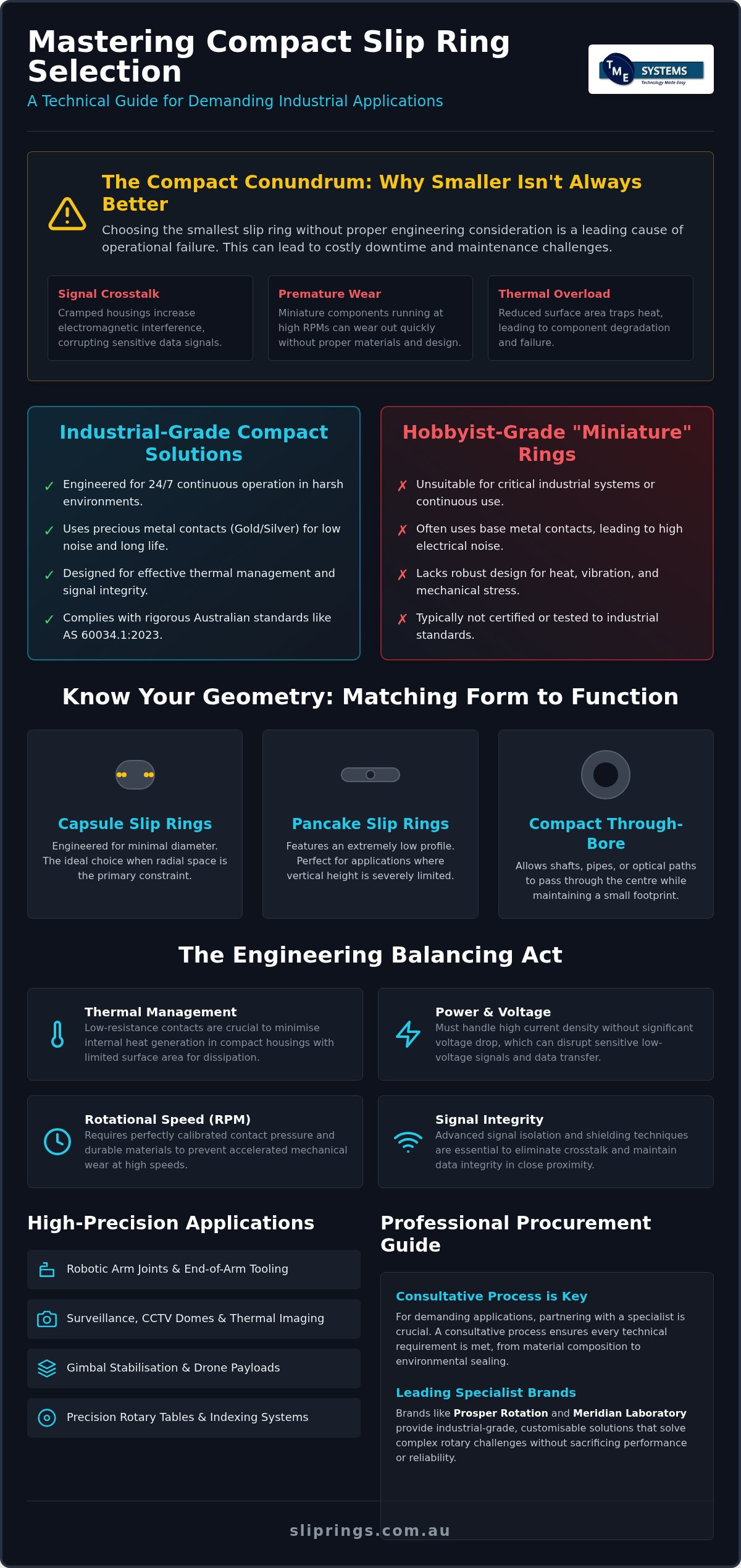
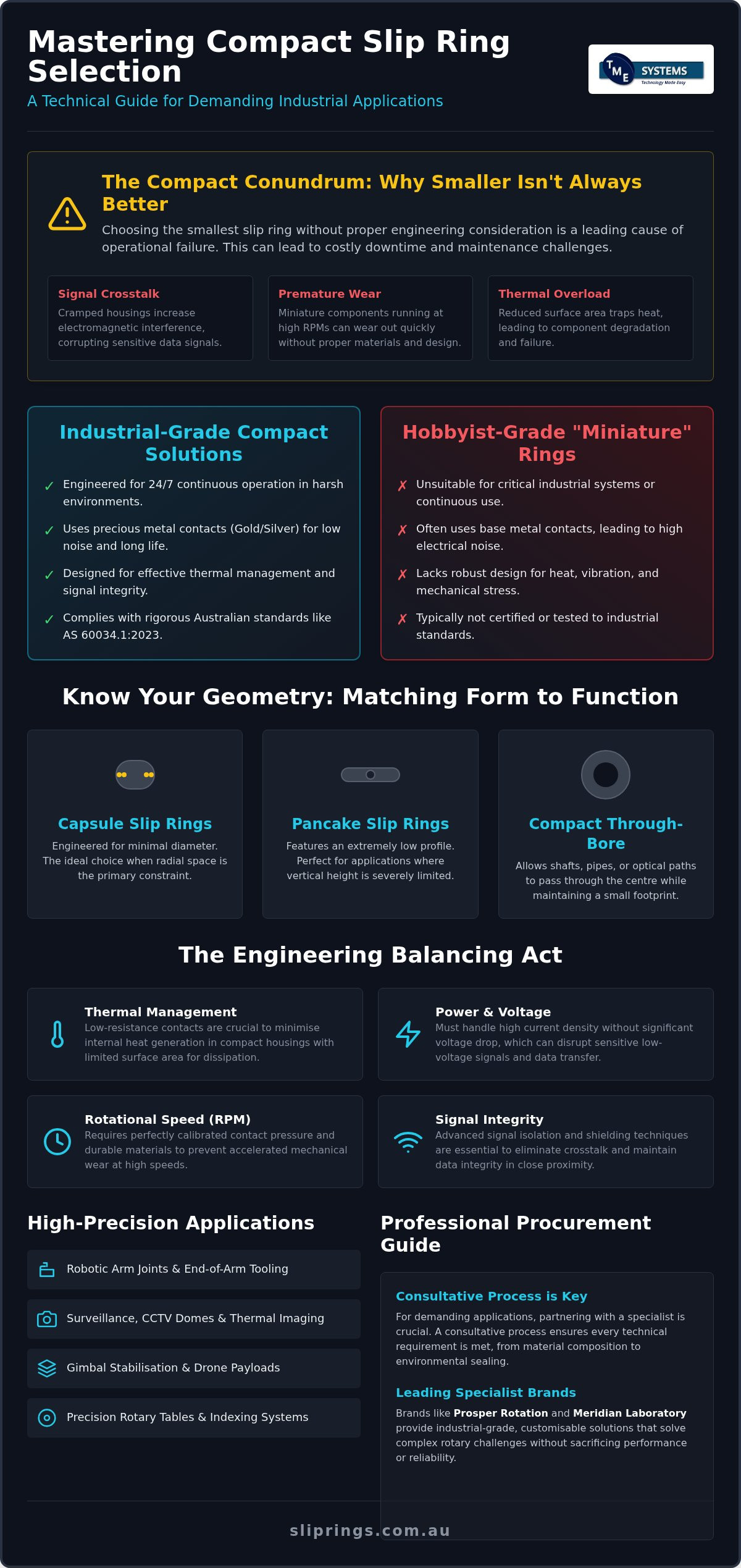
Selecting the smallest available compact slip ring often results in the largest operational failures on the factory floor. While the pressure to reduce equipment footprints is constant, simply shrinking a rotary joint can introduce a host of technical headaches. You've likely dealt with the frustration of signal crosstalk in cramped housings or the premature wear that plagues miniature components running at high RPMs. Finding industrial-grade hardware that meets Australian standards like AS 60034.1:2023 isn't always straightforward when local availability is limited.
We recognise that precision engineering requires a careful balance between mechanical constraints and electrical integrity. This guide provides the technical framework needed to master compact slip ring selection for your most demanding space-constrained applications. You'll learn how to optimise the ratio between circuit count and diameter while ensuring long-term reliability in remote industrial sites. We'll also examine how specialist offerings from brands like Prosper Rotation and Meridian Laboratory solve complex rotary challenges without sacrificing performance. By the end of this guide, you'll have the criteria necessary to specify a solution that maintains signal integrity in the tightest footprints.
Key Takeaways
- Understand the technical distinctions between capsule, miniature, and pancake geometries to select the most efficient footprint for your rotary application.
- Learn how to balance high current density with thermal management to prevent premature wear in restricted housings.
- Identify the specific IP ratings and material compositions required to ensure long-term component reliability in harsh Australian industrial environments.
- Master signal isolation techniques to eliminate crosstalk and maintain data integrity when integrating a compact slip ring into high-precision systems.
- Discover the benefits of a consultative procurement process when customising industrial-grade components from leading brands like Prosper Rotation and Meridian Laboratory.
Defining Compact Slip Rings and Their Industrial Utility
Industrial automation in Australia is moving toward higher density and smaller footprints. A compact slip ring is a specialised rotary joint designed to transmit electrical power and data through a rotating interface within a minimal physical envelope. Unlike standard units, these components are engineered to fit into tight assemblies where every millimetre of clearance is critical. To understand the foundational mechanics, one might ask: What is a Slip Ring? At its core, it's a bridge between stationary and rotating parts. In a compact format, however, the engineering challenge involves managing heat and signal interference in extremely close proximity. While many associate the term only with small capsule rings, it also includes short-length through-bore designs and low-profile pancake geometries that save vertical space.
Engineers must distinguish between hobbyist-grade "miniature" rings and industrial-grade compact solutions. While a consumer-grade unit might suffice for a basic gimbal, industrial applications demand high-performance materials and rigorous testing. Professional units must adhere to strict safety and performance benchmarks, such as AS 60034.1:2023 for rotating electrical machines. This ensures the component handles the thermal loads and mechanical stresses of a 24/7 production environment. Industrial-grade units, such as those from Prosper Rotation Slip Rings, utilise precious metal contacts to ensure low electrical noise and long service lives, even under continuous operation.
Spatial Constraints in Modern Engineering
Modern Australian manufacturing facilities are increasingly adopting modular, space-efficient designs. As machinery footprints shrink, the space allocated for cable management and rotary interfaces disappears. This shift forces a move toward integrated solutions like Meridian Laboratory Slip Rings that offer high circuit counts in a small diameter. The challenge lies in balancing this mechanical integration with maintenance access. A component that's impossible to reach once installed creates significant long-term risk for remote industrial sites. Selecting a design that fits the housing while remaining serviceable is a primary requirement for modern plant upgrades.
Primary Applications for Small-Scale Rotary Joints
Compact rotary joints are essential in several high-precision sectors where larger units simply won't fit. In medical imaging, they facilitate the rotation of sensors in restricted housings. In packaging, they power rotating carousels where vertical height is at a premium. Common applications include:
- Robotic arm joints: Providing power and feedback to end-of-arm tooling without restricting movement.
- Surveillance: Enabling 360-degree continuous rotation in compact CCTV domes and thermal imaging systems.
- Gimbal stabilisation: Maintaining signal flow in high-speed camera mounts and drone payloads.
- Rotary tables: Facilitating precision indexing in small-scale CNC machining and assembly lines.
Engineering Specifications: Balancing Size with Performance
Engineering a compact slip ring involves more than shrinking mechanical components; it requires managing the physics of power density. As housing volume decreases, the surface area available for heat dissipation shrinks faster than the internal heat generation from electrical resistance. This creates a thermal bottleneck. While standard industrial units tolerate higher heat loads due to larger thermal masses, compact versions rely on low-resistance contact materials like gold-on-gold or silver-on-silver to minimise heat at the source. Voltage drop is another critical factor. In miniature contact systems, even minor resistive increases can disrupt sensitive low-voltage signals or cause erratic data transfer.
Rotational speed ratings also shift in smaller footprints. While larger units are often limited by centrifugal forces or high linear brush speeds, compact units can achieve higher RPMs due to their small diameters. However, these high speeds accelerate mechanical wear if the contact pressure isn't perfectly calibrated. High-performance specifications are often derived from research into long-duration space applications, where reliability in tight, inaccessible environments is paramount. Applying these rigorous standards to industrial hardware ensures that miniaturisation doesn't come at the cost of service life.
Thermal Management in Small Enclosures
Small enclosures offer limited airflow, making conductive cooling through the mounting flange or shaft essential. In the Australian context, where ambient temperatures in industrial sheds can exceed 40°C, the thermal margin for a slip ring is significantly reduced. Using high-conductivity housing materials and specialised contact alloys helps maintain operating temperatures within safe limits. If the internal temperature exceeds the rating of the dielectric materials, the risk of a short circuit increases. For applications requiring specific RPM and thermal profiles, consulting on Prosper Rotation specifications ensures the hardware matches the operational environment.
Signal Integrity and Noise Reduction
High-density connectors face significant challenges with electromagnetic interference (EMI). When power and data circuits are placed within millimetres of each other, the risk of crosstalk increases. Contact resistance in compact units refers to the electrical resistance encountered at the interface between the rotating ring and the stationary brush, directly influencing signal noise and heat generation. Effective shielding and twisted-pair wiring within the slip ring assembly are necessary to preserve signal clarity. Engineers must ensure that high-frequency data signals are isolated from power lines to prevent corruption, particularly in robotics where feedback loops are sensitive to electrical noise.
Compact vs. Miniature vs. Pancake Slip Rings
While the terms are often used interchangeably in casual conversation, the mechanical geometry of a compact slip ring dictates its performance and suitability for specific industrial tasks. Choosing the wrong form factor can lead to premature mechanical failure or signal degradation. Capsule slip rings are the most common solution for applications requiring a small diameter. These units use an axial stacking method where rings are placed one after another along the central shaft. This design excels at protecting contacts from environmental contaminants within a sealed cylindrical housing, making it the standard for high-precision signal transfer in robotics and medical equipment.
Pancake slip rings offer an alternative for installations where vertical height is the primary constraint. These units use a radial arrangement where the conductive tracks are laid out as concentric circles on a flat platter. While they solve the problem of limited axial space, they introduce a significant mechanical trade-off. Because the outer rings have a larger circumference than the inner rings, the brushes on the outer tracks travel a greater distance per rotation. This results in uneven wear rates and typically a shorter overall service life compared to capsule designs. For specialised high-speed or high-wear applications, researchers have explored Contactless magnetic slip ring technology to bypass these mechanical limitations, though traditional precious metal contacts remain the industry standard for reliable power delivery.
Design Trade-offs and Selection Logic
Selecting between these geometries requires a logical progression through your equipment's spatial constraints. If your design allows for a longer component but requires a slim profile, a capsule or miniature unit is the superior choice for longevity. Through-bore compacts are necessary when the slip ring must mount around an existing drive shaft or accommodate fluid and pneumatic lines through the centre. These units provide a hollow internal diameter while maintaining a relatively small outer footprint. Your mounting style also influences this choice; flange-mounted units offer better stability in high-vibration environments, whereas end-of-shaft mounting is often simpler for basic rotary tables.
Circuit Density and Configuration
Modern manufacturing demands higher circuit density without increasing component size. Industrial-grade compact housings can now accommodate up to 56 circuits in a diameter of less than 25mm. Achieving this requires precise engineering to prevent crosstalk between power and data lines. Hybrid configurations are increasingly common, allowing a single unit to handle 10A power circuits alongside sensitive Ethernet or RS-485 signals. When your application requires this level of complexity in a restricted space, Prosper Rotation Slip Rings provide the necessary modularity to combine diverse signal types within a standardised compact frame. This eliminates the need for multiple connectors, further reducing the total footprint of your assembly.
Selection Criteria for Australian Industrial Environments
Australian industrial sites present unique challenges that go beyond simple spatial constraints. A compact slip ring must operate reliably in environments where fine iron ore dust, high ambient humidity, and significant temperature fluctuations are the norm. Selecting a unit based solely on its dimensions without accounting for these variables often leads to intermittent signal loss or total mechanical seizure. For mobile equipment used in transport or heavy industry, shock and vibration resilience are equally critical. Internal wiring must be securely potted or restrained to prevent fatigue failure at the contact points during high-intensity operations.
IP Ratings and Contaminant Protection
Sealing a compact rotary joint is technically demanding because traditional lip seals can introduce excessive torque and frictional heat in small-diameter housings. While IP54 protection is often sufficient for indoor automation, applications exposed to washdown or outdoor elements require IP67-rated enclosures. Achieving this level of ingress protection in a miniature footprint requires high-precision machining of the housing interfaces. For a deeper look at the standards required for local operations, refer to our guide on Industrial Slip Rings Australia: The Technical Procurement Reference. Protecting the internal contact surfaces from fine particulates is essential for maintaining signal integrity over the long term.
Contact Materials and Longevity
The choice between gold-on-gold and silver-on-silver contacts significantly impacts the service interval of a compact unit. Gold contacts are preferred for low-power signal and data transfer because they resist oxidation, ensuring low contact resistance over millions of rotations. Silver contacts may be used for higher current applications where cost-efficiency is balanced with performance. Because compact units are often sealed for life, maintenance is generally not possible; therefore, predicting lifecycle performance based on your specific duty cycle and RPM is the only way to avoid unplanned downtime.
Procurement should always involve a technical audit to ensure the hardware matches the site conditions. Having access to expert technical support within Australia allows for rapid troubleshooting and specification verification before an order is placed. This ensures that environmental ratings are correctly aligned with the rigours of the local climate. If you are unsure which environmental rating or contact material fits your application, contact our technical consultants for a detailed specification review.
Procuring Professional-Grade Compact Solutions
Procuring a compact slip ring is a technical exercise that extends beyond reviewing a standard datasheet. Because these components operate at the edge of thermal and electrical limits, off-the-shelf solutions frequently fail to account for the specific nuances of industrial machinery. TME Systems Pty Ltd acts as a technical intermediary, validating every specification against the application's actual operational demands before procurement begins. This consultative process ensures that the hardware is fit for purpose, preventing the costly downtime associated with selecting a unit that fits the physical space but lacks the necessary electrical resilience.
The Consultative Selection Process
A reliable technical quote depends on a comprehensive audit of the machine's architecture. Engineers need to provide specific data points, including the peak operating RPM, the required circuit count for both power and signal, and the dielectric strength needed for the system. Identifying potential failure points, such as heat accumulation in restricted housings, is a critical step in the pre-purchase phase. For applications requiring exceptional signal integrity and minimal maintenance, Meridian Laboratory Slip Rings provide high-performance technology that addresses the wear challenges common in traditional brush-based compact units.
Ensuring System Compatibility
Seamless integration with existing PLC and control systems is a priority for Australian engineering teams. A compact slip ring must facilitate data transfer without introducing packet loss or signal corruption, particularly when handling high-speed Ethernet or sensitive analogue feedback. Mounting configurations must also align with local machinery standards to ensure stability under continuous load. For a deeper technical analysis of these integration challenges, our reference on Slip Ring Application Engineering provides the framework needed to ensure mechanical and electrical compatibility.
Managing procurement timelines requires a proactive approach to project management. By coordinating factory-level customisations for Prosper Rotation and Meridian Laboratory units, we ensure that the hardware is purpose-built for the specific task. This eliminates the risks of using generic components that may require unreliable field modifications. Our technical support team, based within Australia, provides the expertise required to match these specialised specifications to your project's reality, ensuring a successful installation from the first rotation.
Optimising Rotary Performance in Restricted Footprints
Selecting the right compact slip ring requires a precise understanding of the trade-offs between mechanical dimensions and electrical integrity. Miniaturisation shouldn't compromise thermal management or signal isolation. By prioritising industrial-grade materials and appropriate IP ratings, you ensure that your rotary joints withstand the rigours of Australian industrial environments without premature failure. Successful integration depends on matching the specific demands of your control systems with the physical realities of your machinery housing.
TME Systems operates as a dependable partner in high-performance rotary electrical connectors. We provide expert technical support based in Australia and serve as an authorised distributor for leading brands like Prosper Rotation and Meridian Laboratory. Our consultative approach ensures that every component is validated against your specific operational stressors before installation. We're ready to assist you in navigating the complexities of circuit density and environmental resilience to ensure the success of your project.
Enquire about specialised compact slip rings from TME Systems to secure a reliable, technically validated solution for your next application.
Frequently Asked Questions
What is the difference between a compact and a miniature slip ring?
Compact designs generally focus on the total volume or the length-to-diameter ratio to fit restricted industrial housings. A compact slip ring is often a high-density unit engineered to provide a high circuit count within a limited footprint. Miniature units specifically denote the smallest possible overall dimensions. While both solve space constraints, compact models are typically more robust for industrial tasks, whereas miniature units are prioritised for precision instrumentation and small-scale robotics.
Can a compact slip ring handle high-voltage power circuits?
Yes, industrial-grade compact units can manage high-voltage power, provided they are specified with appropriate dielectric insulation and internal spacing. While many small-scale connectors are designed for low-power signals, specialised models can be configured to prevent arcing between tracks. It's essential to verify the peak voltage rating against Australian safety standards like AS 60034.1:2023 to ensure the component can safely manage the electrical load within its restricted internal enclosure.
How do I prevent signal interference in a high-density compact slip ring?
Preventing interference in high-density configurations requires effective electromagnetic shielding and the physical separation of power and data circuits. Using twisted-pair wiring and maintaining low contact resistance are essential steps for signal clarity. Selecting a compact slip ring with precious metal contacts, such as gold-on-gold, significantly reduces electrical noise. Proper grounding of the housing also plays a vital role in protecting sensitive data from external electromagnetic interference in cramped industrial environments.
Are pancake slip rings better than capsule designs for all tight spaces?
Pancake designs are only superior when axial length, or height, is the primary mechanical constraint. While they offer a very low profile, they require a significantly larger diameter and typically experience higher wear rates on the outer conductive tracks. Capsule designs are more efficient for applications where a small diameter is the priority. The choice depends entirely on your equipment's specific mounting geometry and the required service life of the rotary joint.
What is the typical lifespan of an industrial-grade compact slip ring?
Lifespan is determined by rotational speed, duty cycle, and contact materials, but industrial units typically achieve between 10 million and 100 million rotations. High-performance models using gold-on-gold contacts generally offer longer service intervals than those using standard alloys. Environmental factors such as ambient temperature and airborne contaminants also influence longevity. Consulting with a technical intermediary helps in predicting the expected lifecycle based on the specific rigours of your Australian industrial site.
Can compact slip rings be IP-rated for outdoor use in Australia?
Yes, many compact units can be manufactured with IP65 or IP67 ratings to protect against dust and moisture ingress. This level of protection is essential for Australian sites exposed to harsh weather or regular washdown procedures. Achieving high IP ratings in small form factors requires precision-engineered seals and ruggedised housings. You should always confirm that the sealing method does not exceed the torque or thermal limits required for your specific rotary application.
What data do I need to provide for a compact slip ring quote?
To receive an accurate technical quote, you must provide the following data points:
- Total circuit count for both power and signal.
- Current (Amps) and voltage requirements per circuit.
- Maximum operating RPM and duty cycle.
- Required mounting style, such as through-bore or flange mount.
- Environmental conditions, including IP ratings and operating temperature ranges.
How does RPM affect the performance of small-diameter rotary connectors?
Smaller diameters allow for higher rotational speeds because the linear velocity at the brush interface remains low. However, high RPM still increases frictional heat and mechanical wear within the housing. If the speed exceeds the manufacturer's rating, the contact surfaces may degrade prematurely, resulting in increased electrical noise or signal failure. It's critical to balance your speed requirements with the contact material's thermal limits to ensure consistent performance throughout the component's operational life.