A single failed contact in a crane's rotary joint can halt an entire site's operations, yet this critical component is often the last thing considered during a mid-life refit. You likely recognise that unplanned downtime caused by brush wear or signal noise is more than a minor nuisance. It's a costly risk in the corrosive coastal environments and high-humidity regions that characterise many Australian industrial sites.
Selecting the correct slip ring for crane applications requires a precise balance between high-ampacity power transfer and the protection of sensitive sensor data. This guide provides the technical framework needed to master these requirements, ensuring your machinery achieves reliable 360-degree rotation without compromising signal integrity. We will explore how to transition toward low-maintenance rotary connections, integrate modern automation data like CAT6 or fibre optics into older crane designs, and maintain strict compliance with Australian electrical and safety standards. By the end of this technical overview, you will have a clear pathway to reducing maintenance cycles and eliminating the interference issues that plague modern automated systems.
Key Takeaways
- Understand the mechanical role of the rotary interface in slewing mechanisms to ensure uninterrupted power and data flow between the stationary pedestal and rotating superstructure.
- Learn how to calculate peak ampacity and voltage ratings to specify a slip ring for crane operations that prevents electrical arcing and protects hoist motors.
- Evaluate environmental factors, including IP ratings and thermal derating, to ensure electrical components withstand the extreme heat and fine dust of Australian work sites.
- Assess the advantages of modular configurations for future circuit expansion compared to compact, integrated designs for cranes with restricted installation space.
- Identify the critical technical data points, such as RPM and duty cycles, required to streamline the procurement process and reduce the long-term cost of ownership.
Understanding the Role of Slip Rings in Crane Slewing Mechanisms
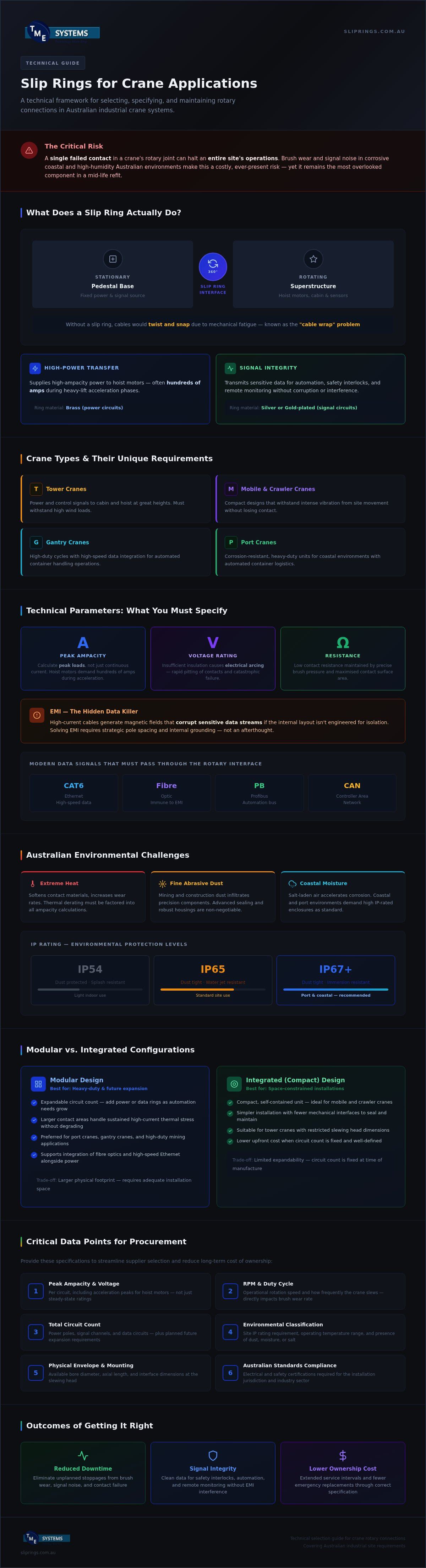
A slip ring for crane operations serves as the primary rotary interface that enables 360-degree continuous rotation. It's the critical engineering link that bridges the gap between the stationary pedestal and the rotating superstructure. Without this component, the electrical cables supplying power and control signals would quickly twist and snap due to mechanical fatigue. This "cable wrap" issue is a significant bottleneck that slip rings eliminate, allowing for the fluid movement required in heavy lifting and material handling.
The technology has moved far beyond simple copper-on-copper contacts. Modern slewing mechanisms now require the simultaneous transfer of high-ampacity power for hoist motors alongside sensitive data streams for automation and safety monitoring. In many Australian port and mining operations, these units must also facilitate remote monitoring and integrated sensor feedback. This evolution means that signal integrity is now just as vital as raw power delivery for maintaining site safety and operational efficiency.
Primary Components of a Rotary Connection
The internal architecture of a rotary joint determines its operational lifespan. The brush assembly is the heart of the connection, designed to maintain constant contact even during high-speed slewing. While the collector rings provide the conductive path, the choice of material is decisive for performance. Power circuits often utilise durable brass, while signal circuits require silver or gold-plated rings to reduce electrical noise. Robust housing and advanced sealing are non-negotiable, as they protect these precision components from the abrasive dust and moisture common on industrial sites.
Common Crane Applications for Rotary Connectors
Different crane types present unique engineering challenges that dictate slip ring selection. Tower cranes rely on these connectors to send power and control signals to the cabin and hoist at great heights, often under high wind loads. Mobile and crawler cranes need compact designs that can withstand the intense vibrations of site movement without losing contact. For gantry and port cranes, the focus shifts to high-duty cycles and the integration of high-speed data to support automated container handling. Specialist units, such as those from BGB Innovation, are frequently specified for these heavy-duty industrial environments due to their modular reliability.
Technical Parameters: Managing High Current and Data Integrity
Selecting a slip ring for crane operations starts with a rigorous assessment of peak electrical loads. Hoist motors demand significant ampacity during acceleration, often requiring several hundred amps to manage heavy lifts safely. You must calculate these peak loads rather than just the continuous running current to avoid thermal damage. Voltage ratings are equally critical. Insufficient insulation in high-voltage crane systems leads to electrical arcing, which causes rapid pitting of the contact surfaces and catastrophic system failure. Ensuring a high dielectric strength between circuits is the only way to prevent cross-phase shorting.
Modern cranes are rarely simple mechanical lifters. They require complex circuit counts to handle control signals, auxiliary power, and safety interlocks. The primary technical hurdle in hybrid units is Electromagnetic Interference (EMI). High-current cables generate magnetic fields that can corrupt sensitive data streams if the internal layout isn't engineered for isolation. Balancing these requirements requires a strategic approach to pole spacing and internal grounding to maintain signal clarity throughout the rotation.
High Current Power Transfer
Managing heat dissipation is vital in high-ampacity modular designs. Excessive heat softens contact materials and increases wear rates, leading to early failure. Reliable performance depends on precise brush pressure and maximised contact surface area to maintain low electrical resistance. Because of these requirements, BGB Innovation slip rings are preferred for heavy lifting applications. Their modular design allows for larger contact areas that handle the thermal stress of sustained high-current transfer without degrading the assembly.
Integrating Automation and Data Signals
Transferring Ethernet, Profibus, or CAN bus protocols through a rotating interface requires specialised shielding techniques. Physical separation between power and signal poles within the housing prevents cross-talk. Mercotac slip rings utilise a liquid metal conduction path to provide near-zero signal noise. This technology is particularly useful when integrating modern automation into older crane designs. If you're unsure about the configuration required for your data protocols, seeking technical application consulting can help define the optimal internal shielding for your specific site.
Environmental Durability: Meeting Australian Site Conditions
Operating a slip ring for crane applications in Australia presents environmental challenges that standard specifications rarely account for. Ambient temperatures during summer often exceed 40 degrees Celsius, necessitating a thorough understanding of thermal derating. As the external temperature rises, the ability of the internal components to dissipate heat generated by electrical resistance decreases. This means a unit rated for 200 amps at room temperature might only safely handle 150 amps in peak summer conditions. Ignoring this factor leads to accelerated insulation breakdown and premature contact failure.
Fine dust ingress is another critical variable, particularly in mining and inland construction sectors. While some manufacturers suggest IP54 protection is sufficient, the fine red dust prevalent on many Australian sites can penetrate these seals, creating an abrasive paste when mixed with contact lubricants. This leads to rapid wear of the collector rings and signal degradation. Vibration and shock from heavy lifting operations also place immense stress on internal contacts. Protecting these points requires robust mechanical housing and precision-engineered tensioning systems to maintain electrical continuity during sudden load shifts.
Ingress Protection (IP) Ratings Explained
- IP65: These units are completely dust-tight and protected against low-pressure water jets. This is the baseline requirement for most outdoor tower and mobile cranes.
- IP67: For cranes in flood-prone areas or those subject to high-pressure wash-downs, IP67 provides protection against temporary immersion. This level of sealing is essential for maintaining integrity in extreme tropical or coastal environments.
Selecting the right seal material is just as important as the rating itself. Seals must withstand intense UV exposure and extreme thermal cycling without becoming brittle or losing their profile. High-performance elastomers are typically required to ensure the enclosure remains airtight over years of service.
Material Selection for Harsh Environments
The choice of housing material directly impacts the unit's longevity. Anodised aluminium is a frequent choice for mobile crane applications because it offers a high strength-to-weight ratio and decent corrosion resistance. However, for coastal port environments where salt spray is constant, stainless steel housings are the industry standard for maximum chemical resilience. Internal contact plating also plays a role in durability. Gold-on-gold contacts are often specified for high-reliability signal circuits, as gold doesn't oxidise, ensuring that low-voltage data remains clear even after thousands of rotations in humid conditions. For heavy-duty power circuits, technical application consulting can assist in determining whether silver or specialised copper alloys are best suited for your site's specific corrosive profile.
Comparing Modular vs. Integrated Slip Ring Configurations
Deciding on the physical architecture of a slip ring for crane slewing involves more than checking electrical compatibility. The mechanical interface dictates how the unit integrates with the crane's structural shaft and how easily your team can perform routine inspections. You generally choose between through-bore and shaft-mounted designs. Through-bore configurations are necessary when hydraulic lines, pneumatic hoses, or the central structural pin must pass through the centre of the rotary joint. Shaft-mounted units are typically more compact and are often found on smaller mobile cranes where space is at a premium.
Maintenance access is a primary differentiator. If a technician has to disassemble the entire slewing assembly to inspect a single brush, your long-term ownership costs will escalate. High-quality designs prioritise external access points or transparent inspection windows. This allows for rapid assessment of brush wear and debris accumulation without requiring a full system teardown.
When to Choose Modular Systems
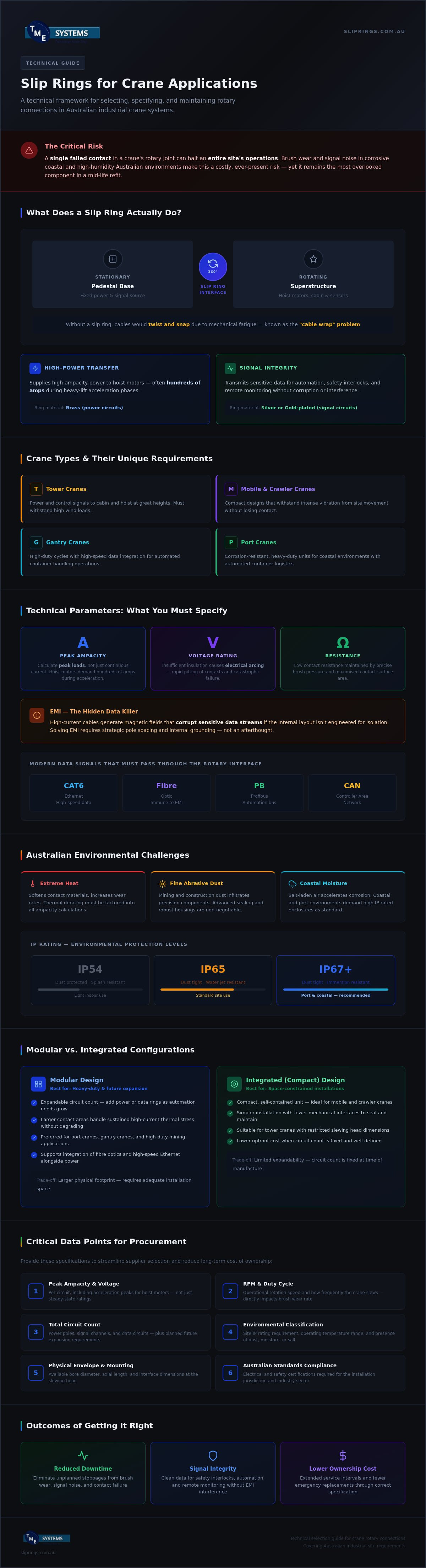
Modular systems offer the highest degree of flexibility for complex crane setups. These are the preferred choice for applications requiring high circuit counts, often exceeding 30 individual poles. Because each circuit is a separate module, you can replace individual poles if they become damaged or worn, rather than discarding the entire unit. This significantly reduces long-term maintenance costs and site downtime. The BGB Innovation range is a benchmark for this type of modular construction. These units are highly customisable, allowing you to mix high-current power circuits with low-voltage control signals in a single, serviceable stack. If your future operational requirements might involve adding new sensors or cameras, modular units provide the necessary expansion capacity.
Capsule and Compact Designs
Integrated capsule designs are the ideal solution for auxiliary cranes or smaller slewing platforms where mounting space is severely restricted. These units are fully enclosed and often come pre-wired, which facilitates a faster installation process during a refit or initial build. While they lack the individual pole serviceability of modular units, their compact footprint makes them indispensable for modern mobile cranes. Prosper Rotation slip rings offer a versatile range of these compact solutions, balancing durability with space efficiency. They provide a reliable 360-degree connection in a package that fits into tight mechanical housings. If you are unsure which configuration fits your specific machinery, request a technical consultation to ensure the mechanical interface matches your slewing requirements.
Procurement and Technical Support for Australian Crane Operators
Effective procurement of a slip ring for crane operations requires a detailed technical specification rather than a simple part number replacement. Australian procurement managers must provide precise data points to ensure the longevity of the rotary connection. These include the maximum RPM, the operational duty cycle, and the specific mounting style required for the slewing bearing. Without this data, you risk selecting a unit that cannot handle the mechanical stress or electrical load of your specific crane model. Accurate specification is the first step in avoiding the unplanned downtime that erodes project margins.
Technical application consulting plays a vital role in reducing the total cost of ownership. By auditing the application before purchase, you can identify potential points of failure, such as inadequate sealing or improper circuit separation. This proactive approach ensures that every unit complies with Australian electrical standards and safety regulations, protecting both your personnel and your capital equipment. Engineering a solution that fits the specific duty cycle of your machinery ensures that maintenance intervals are predictable and manageable.
The Technical Audit Process
Selecting the right rotary interface involves a methodical assessment of your machinery's requirements. This process begins with identifying the total circuit count, including power, control, and data signals. We then evaluate environmental stressors, such as the thermal derating factors and dust ingress risks discussed earlier. Relying on "off-the-shelf" solutions frequently leads to premature failure because these generic parts aren't engineered for the specific vibration profiles or high-humidity conditions found on many Australian sites. For a deeper look at this methodology, refer to our technical reference on Slip Ring Application Engineering.
Partnering with TME Systems Pty Ltd
TME Systems Pty Ltd operates as a technical bridge between global manufacturing expertise and local industrial needs. We provide national support and access to leading global brands like BGB Innovation and Meridian Laboratory. Our team offers specialised advice on selecting industrial slip rings in Australia, ensuring that every specification is tailored to the unique demands of your project. We focus on long-term reliability rather than quick wins, helping you avoid the hidden costs of frequent replacements. To discuss your project specifications or to request a detailed audit of your slewing mechanism, contact our engineering team for a technical consultation.
Optimising Crane Reliability and Operational Uptime
Reliable rotary performance in heavy lifting depends on the precise alignment of electrical capacity and environmental resilience. As discussed, failing to account for peak ampacity or the abrasive nature of site dust leads to avoidable downtime. By prioritising modular configurations and advanced sealing, you ensure that your machinery maintains signal integrity and power flow through every 360-degree rotation. Selecting the correct slip ring for crane applications is a critical step in securing the long-term viability of your fleet.
TME Systems Pty Ltd offers the specialised consulting needed to bridge the gap between complex specifications and site-ready hardware. With over 20 years of technical application expertise, we operate as an authorised distributor for BGB Innovation and Mercotac, supported by a national supply chain. Our focus remains on providing engineering solutions that reduce maintenance overheads and prevent signal interference.
Request a Technical Consultation for Crane Slip Rings to review your current requirements and implement a high-performance rotary connection. We look forward to assisting with your next technical refit.
Frequently Asked Questions
How long do crane slip rings typically last before maintenance is required?
Lifespan varies significantly based on the duty cycle and the specific environment of the site. In standard industrial applications, carbon brush assemblies typically require a visual inspection every six to twelve months to check for wear and debris buildup. High-performance units, such as those from BGB Innovation, are engineered for millions of rotations, often extending service intervals. However, the extreme heat and fine dust common on Australian sites may necessitate more frequent maintenance audits to ensure optimal contact.
Can I transmit high-definition video signals through a crane slip ring?
High-definition video transmission is achievable through specialised rotary interfaces designed for high-bandwidth data. To maintain signal integrity and avoid jitter, you should select a unit with low electrical noise, such as a Mercotac liquid metal connector. These units provide a stable connection for HDMI or SDI signals. If your application involves significant distances or electromagnetic interference, integrating a fibre optic rotary joint (FORJ) within the slip ring assembly is often the most reliable solution.
What happens if a slip ring brush wears out during a lift?
If a brush wears out during operation, you will likely experience intermittent power loss or signal corruption. This can lead to erratic hoist behaviour or the triggering of safety interlocks, potentially halting the lift mid-operation. To prevent this, modern cranes often utilise modular designs that allow for individual brush monitoring. Specifying a high-quality slip ring for crane use ensures that brush materials are matched to the ring surface, reducing the risk of sudden, catastrophic contact failure.
Are there mercury-free alternatives for crane rotary connectors?
Several mercury-free alternatives exist for Australian crane operators who must comply with specific environmental or safety mandates. Meridian Laboratory offers the ROTO-CON series, which uses a unique contact leaf technology rather than liquid mercury. Additionally, brands like BGB Innovation and Prosper Rotation utilise advanced carbon or precious metal brush configurations. These mechanical contacts provide reliable power and data transfer without the environmental handling requirements associated with liquid metal components, making them suitable for diverse industrial applications.
How do I determine the required IP rating for a port crane in Australia?
Determining the correct Ingress Protection (IP) rating requires an assessment of both moisture and particulate risks. For port cranes exposed to constant salt spray and high-pressure wash-downs, a minimum of IP66 is recommended to prevent corrosive brine from entering the housing. If the unit is located in a position prone to temporary submersion or extreme tropical downpours, upgrading to IP67 provides an additional layer of security. Always ensure the seals are UV-stabilised to withstand the intense Australian sun.
Can a slip ring handle both AC and DC power simultaneously?
A single rotary joint can handle both AC and DC power provided the internal architecture is designed with sufficient dielectric isolation between circuits. You must ensure that the voltage ratings for each pole are correctly specified to prevent cross-talk or arcing. This is common in cranes where AC drives the primary hoist motors while DC power is used for control sensors and auxiliary electronics. Proper internal grounding is essential to maintain safety and prevent interference between the different power types.
Is it possible to retrofit a modular slip ring into an older tower crane?
Retrofitting a modular slip ring into an older tower crane is a common way to extend the machinery's service life and add modern data capabilities. The primary challenge is ensuring the mechanical footprint and mounting flange match the existing slewing structure. You will need to verify the shaft diameter and available vertical clearance before selection. Technical application consulting is often required to map the existing wiring to a new modular stack, ensuring a seamless transition without extensive structural modifications.
What is the maximum RPM rating for a typical crane slewing slip ring?
Most crane slewing operations occur at relatively low speeds, typically between one and five RPM. While standard industrial slip rings can often handle hundreds or even thousands of RPM, crane-specific units are engineered for high torque and environmental robustness rather than raw speed. If your application involves high-speed rotation, such as in a winch drum, you must specify a unit rated for those higher velocities to prevent centripetal forces from affecting brush contact pressure and increasing wear.