A high-spec CAT6 rating is effectively useless if your rotating interface cannot maintain shielded continuity under constant mechanical stress. In high-vibration Australian industrial environments, even a microscopic interruption in contact can lead to catastrophic signal dropouts or data corruption. Selecting the right ethernet slip ring involves more than simply matching a data rate; it requires a deep understanding of how material science and electromagnetic interference (EMI) interact within a moving housing.
We recognise that your primary objective is achieving zero-packet-loss transmission while ensuring your hardware survives millions of revolutions without requiring frequent maintenance. This guide provides a pragmatic framework for mastering the technical requirements of high-speed data transfer in rotating systems. We will examine the critical role of contact materials, the necessity of internal shielding for hybrid power and data circuits, and the specific configurations required to meet evolving IEEE 802.3 standards. By the end of this selection guide, you will have the technical foundation to specify a robust solution that maintains signal integrity in the most demanding conditions.
Key Takeaways
- Identify the critical technical parameters for high-speed data transfer to ensure signal integrity and long-term reliability in rotating equipment.
- Evaluate the mechanical advantages of capsule and through-bore configurations to optimise the footprint and integration within your existing systems.
- Learn how to specify a robust ethernet slip ring capable of delivering zero-packet-loss performance in high-vibration and corrosive Australian environments.
- Understand the impact of electromagnetic interference and material science on data transmission to prevent signal dropouts and premature wear.
- Discover how a consultative approach to technical specifications ensures your hardware meets both electrical requirements and specific environmental demands.
The Fundamentals of Ethernet Slip Rings: Managing Data in Motion
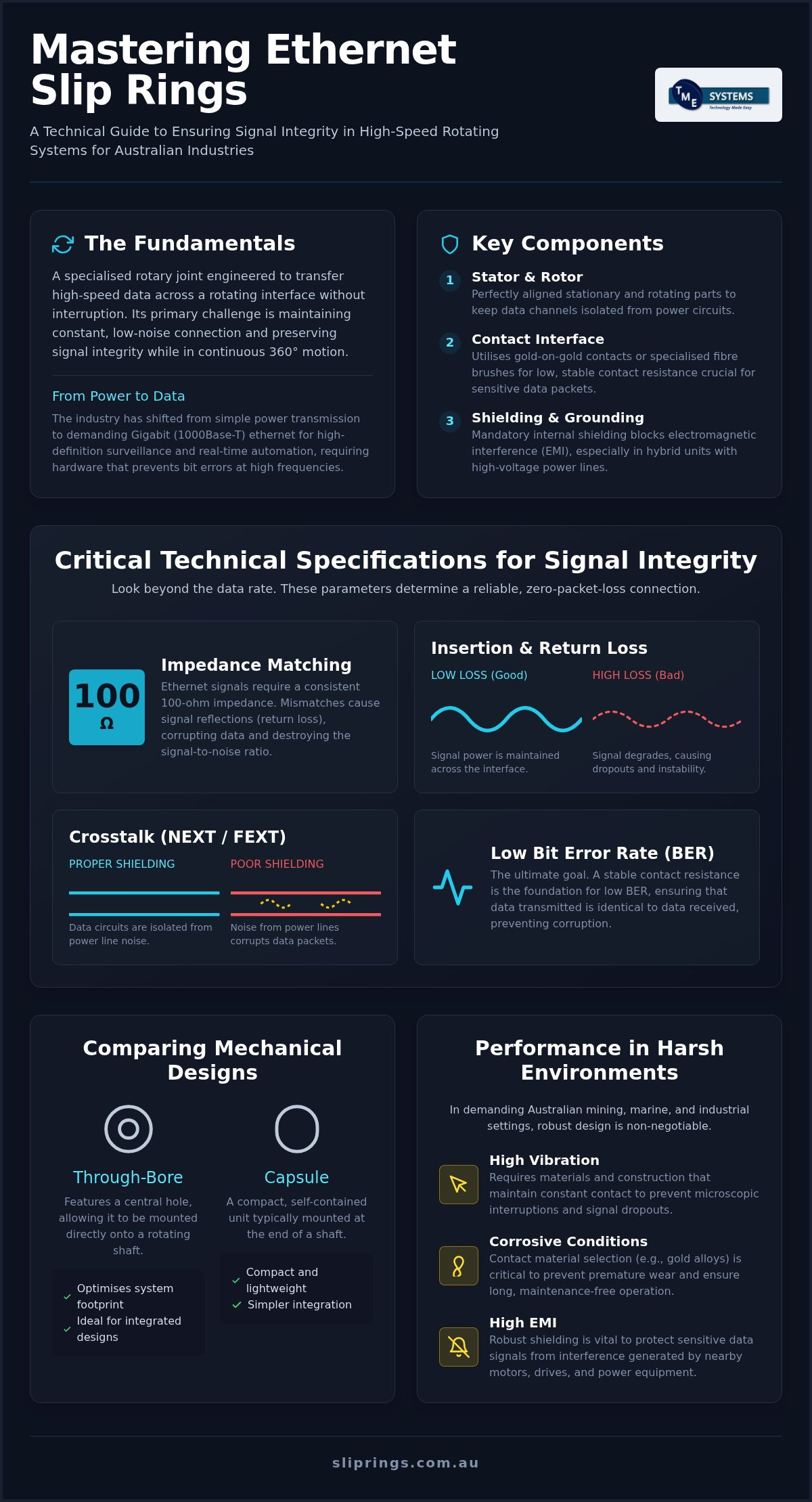
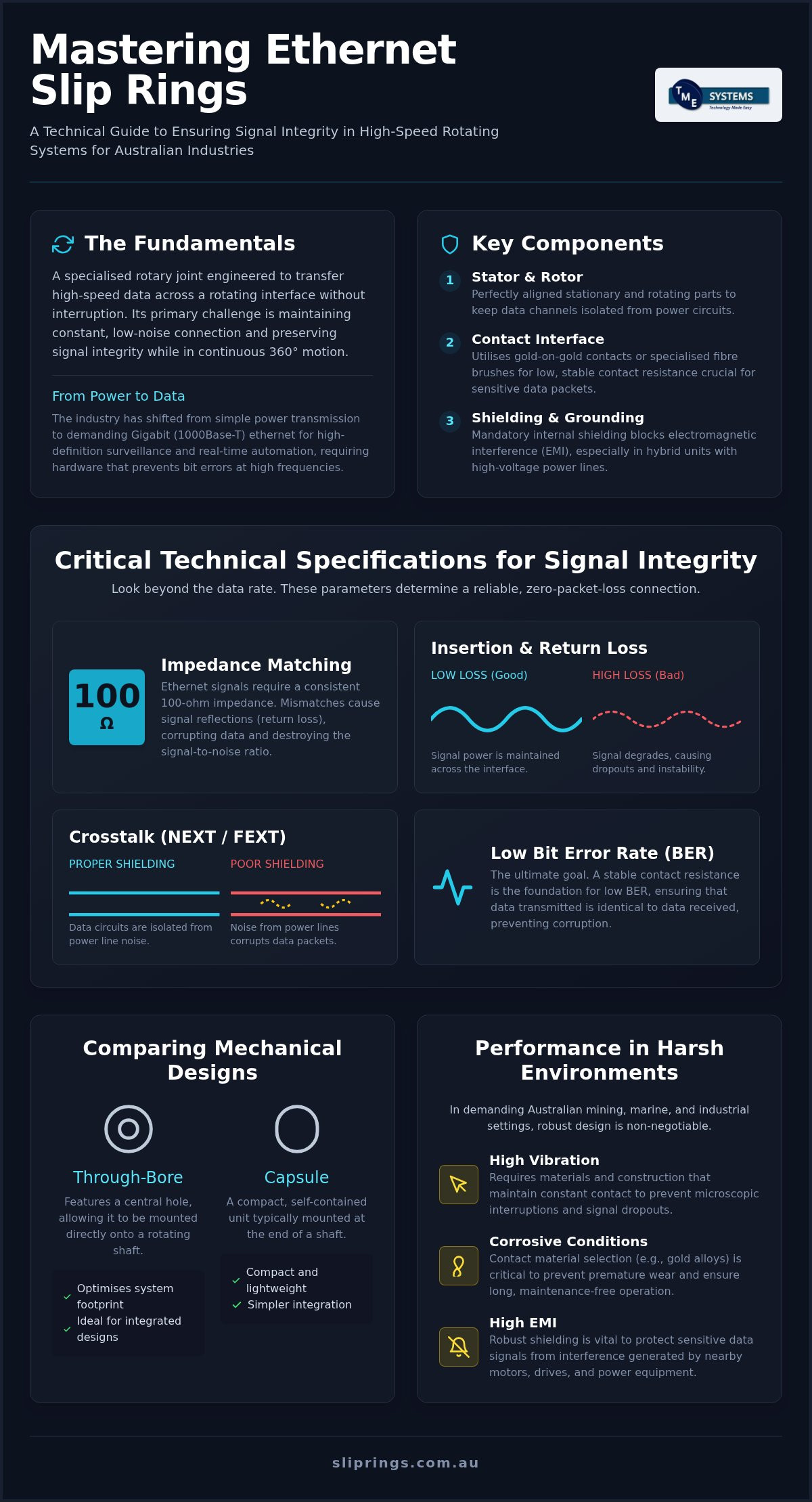
An ethernet slip ring is a specialised rotary joint engineered to transfer high-speed data protocols across a rotating interface without interruption. Unlike standard electrical connectors, these units must maintain a constant, low-noise connection while spinning continuously through 360 degrees. The primary engineering challenge is the physical contact point. In any rotating system, fluctuations in contact resistance or a break in the shielded path result in immediate data corruption or packet loss. It's not just about passing electricity; it's about preserving the integrity of a high-frequency digital signal while the hardware is in motion.
Standard slip rings often fail in these applications because they don't account for impedance mismatching. Ethernet signals require a consistent 100-ohm impedance to prevent signal reflections. When a high-frequency signal hits a standard copper ring designed for power, the change in geometry and material causes a "bounce" known as return loss. This destroys the signal-to-noise ratio. To prevent this, an ethernet slip ring uses precision-engineered internal wiring and high-frequency shielding to maintain the integrity of the differential pairs throughout the entire rotation.
The Evolution from Power to High-Speed Data
Historically, rotary unions were used for simple power transmission or low-speed analogue signals. Modern Australian industrial sites now demand far more. We've seen a rapid transition from 10/100 Mbps systems to Gigabit (1000Base-T) requirements, driven by high-definition IP surveillance and real-time sensor feedback in automated lines. This shift requires hardware that can handle higher frequencies without introducing bit errors. For high-speed laboratory or testing environments, Meridian Laboratory offers brushless designs that virtually eliminate the electrical noise associated with traditional contact surfaces.
Key Components of a Rotary Ethernet Interface
The internal architecture of an ethernet-ready unit is significantly more complex than a basic brush-and-ring assembly. Several critical components work together to ensure data stability:
- Stator and Rotor: These stationary and rotating parts must be perfectly aligned to ensure the data channels remain isolated from power circuits.
- Contact Interface: High-performance units often use gold-on-gold contact materials or specialised fibre brushes. These materials provide the low contact resistance necessary for sensitive data packets.
- Shielding and Grounding: Robust internal shielding is mandatory to block electromagnetic interference (EMI). This is vital when data lines are bundled with high-voltage power circuits in a hybrid configuration.
Proper grounding techniques are also essential. Without a dedicated path for interference to dissipate, the ethernet signal can be overwhelmed by noise from adjacent motors or drives. In many Australian mining or marine applications, selecting the right contact material is the difference between a six-month replacement cycle and years of maintenance-free operation. Brands like BGB Innovation have developed specialised lines to meet these Gigabit standards while surviving ruggedised industrial environments.
Critical Technical Specifications: Ensuring Signal Integrity and Bandwidth
To maintain a reliable link, you must look beyond the basic data rate. Factors like insertion loss and return loss are critical for performance. Insertion loss measures the reduction in signal power as it traverses the rotary interface; excessive loss leads to signal degradation, especially over long cable runs. Return loss is equally vital, as it quantifies the signal reflected back to the source due to impedance mismatches at the contact point. Even a minor mechanical misalignment can cause reflections that diminish the signal-to-noise ratio, leading to dropped packets and network instability.
In hybrid configurations where power and data share a housing, managing Near-End Crosstalk (NEXT) and Far-End Crosstalk (FEXT) is essential. High-voltage spikes from adjacent power lines can bleed into data circuits, causing significant packet corruption. Stable contact resistance is the foundation of a low Bit Error Rate (BER). If the resistance fluctuates during rotation, the resulting electrical noise creates "jitter" that disrupts the digital timing. This is particularly problematic in precision robotics where real-time feedback is mandatory for safety and accuracy.
Material Science: Gold, Silver, and Liquid Metal
Choosing the right contact material is a balance of electrical performance and environmental resilience. Gold-on-gold contacts are the industry standard for low-voltage data because gold doesn't oxidise, ensuring a clean signal path for years. Silver-on-silver is a robust alternative for specific industrial settings where higher currents might be present alongside the data lines. For applications requiring the absolute lowest possible signal noise, Mercotac liquid metal connectors provide a unique brushless interface that delivers near-zero electrical resistance and exceptional signal clarity.
CAT Ratings and Bandwidth Limits
The selection between CAT5e, CAT6, or CAT6a depends on your specific bandwidth requirements. While CAT5e supports Gigabit speeds at 100 MHz, CAT6a is often necessary for 4K video streaming or high-speed industrial fieldbuses that operate at 500 MHz. The available frequency bandwidth, measured in Megahertz, directly determines the maximum data throughput capacity of the ethernet slip ring. Identifying the correct category ensures your system can handle future data loads without hardware upgrades. If you're designing a system for high-resolution imaging or complex automation, BGB Innovation provides robust ethernet solutions tailored for these high-bandwidth demands.
Comparing Mechanical Designs: Through-Bore vs Capsule Configurations
Mechanical integration is often the most significant hurdle when specifying a rotary interface. The choice between different housing styles depends entirely on the physical constraints of your machinery and the path of your cabling. While electrical performance is non-negotiable, the mechanical configuration determines the long-term durability of the installation. Selecting an ethernet slip ring that doesn't align with your shaft design or space availability leads to premature cable fatigue and signal degradation.
- Capsule Slip Rings: These are compact, fully enclosed units designed for space-constrained applications like high-definition CCTV or small-scale robotics. Their small diameter allows for high rotational speeds, though they are typically limited in circuit count compared to larger models.
- Through-Bore Slip Rings: Featuring a hollow centre, these units are engineered to integrate around an existing drive shaft or to allow for the passage of hydraulic and pneumatic lines. This design is common in large-scale industrial turntables and packaging machinery.
- Pancake Slip Rings: When vertical height is restricted but horizontal space is available, pancake designs provide a low-profile solution. They utilise a flat disc arrangement, though they require careful consideration regarding brush wear and capacitance.
- Modular Systems: For complex machinery, modular configurations allow you to customise the stack. You can combine dedicated ethernet channels with high-current power rings and fluid rotary unions in a single, unified assembly.
Mounting Style and Integration
Stability is paramount for maintaining data integrity. Flange mounting provides a secure, bolted interface for high-vibration environments, while shaft mounting offers a more compact, keyed fit for precision drives. Proper cable management is the most overlooked aspect of integration. You must ensure adequate strain relief for the ethernet leads; constant tugging on the rotating wires will eventually cause internal fractures that lead to intermittent packet loss. For a deeper look at physical installation, review our guide on slip ring mounting options to ensure your hardware is secured correctly.
Hybrid Solutions: Combining Power and Ethernet
Modern automated systems rarely require data in isolation. Hybrid designs that combine power and ethernet are becoming the industry standard, but they require sophisticated isolation techniques. Internal shielding must be robust enough to prevent high-voltage surges from inducing noise into the sensitive twisted pairs. Managing heat dissipation is also critical in these compact hybrid units, as thermal buildup from power circuits can affect the electrical properties of the data contacts. If you're implementing Power over Ethernet (PoE), the slip ring must be rated to handle the continuous DC current without compromising the high-frequency signal path.
Australian Industrial Applications: Performance in Harsh Environments
Australian industrial sectors present environmental challenges that would compromise standard networking hardware. In these settings, an ethernet slip ring isn't just a component; it's a critical link that must be ruggedised against dust, moisture, and extreme thermal cycling. Mining and quarrying operations require housings that prevent the ingress of fine particulate matter while withstanding the constant vibration of heavy-duty machinery. Without high contact pressure and specialised enclosures, dust ingress can quickly lead to signal degradation or mechanical failure.
Marine and offshore environments demand salt-spray resistance and strict sealing to prevent internal corrosion. For high-speed manufacturing centres, the focus shifts to high-RPM performance and long-term wear resistance in automated lines. Defence and surveillance sectors prioritise secure, low-noise transmission for radar and high-definition CCTV. In these applications, even minor signal interference is unacceptable, as it can lead to data corruption in critical monitoring systems. Maintaining signal integrity in these conditions requires a design that accounts for both electrical and physical resilience.
Environmental Sealing and IP Ratings
IP ratings are the first line of defence for any rotary interface exposed to the elements. In Australian outdoor environments, IP65 or IP67 protection is often necessary to guard against heavy rain and dust storms. Sealing materials must also be UV-stabilised to prevent degradation under intense solar radiation. For these demanding environments, BGB Innovation Slip Rings provide the necessary ingress protection and material durability to ensure continuous operation in coastal and industrial locations.
Vibration and Shock Resistance
Heavy-duty mobile equipment subjects internal components to significant shock and vibration. Rotating crane booms are a prime example where signal stability is tested by sudden mechanical loads. Maintaining consistent contact pressure is vital to prevent brush bounce, which causes instantaneous data loss and packet corruption. Military-grade testing protocols often involve rigorous shock tests to verify that the data path remains secure under extreme conditions. If you're designing for high-vibration environments, it's essential to consult with a technical specialist to ensure your selection matches the mechanical reality of your application.
Selecting Your Ethernet Solution: The TME Systems Pty Ltd Consultative Approach
Procuring an ethernet slip ring is a critical engineering decision that shouldn't be reduced to a part number in a catalogue. A successful installation depends on the synergy between signal frequency, rotational speed, and environmental resilience. At TME Systems Pty Ltd, we prioritise technical accuracy over standard product sales. We understand that a failure in a rotating data interface can halt an entire production line or compromise a critical surveillance link. Our consultative approach ensures that every variable is accounted for before hardware is even selected.
This process brings global manufacturing excellence from brands like Mercotac, BGB Innovation, and Meridian Laboratory directly to the Australian market. By combining these international technologies with local technical expertise, TME Systems Pty Ltd helps engineers avoid the pitfalls of impedance mismatching and mechanical fatigue. We don't just supply hardware; we provide the technical confidence that your data will remain intact through every revolution.
The Technical Audit Process
Our selection framework is built on a methodical audit of your system's specific requirements. We move through a logical progression to eliminate ambiguity:
- Step 1: Protocol and Electrical Requirements: We define the data rate, circuit count, and voltage needs. This includes determining if the system requires Power over Ethernet (PoE) or hybrid power channels to ensure the internal shielding is adequate.
- Step 2: Physical and Environmental Envelope: We evaluate the available mounting space, shaft diameter, and potential exposure to dust or moisture. This step is vital for determining the correct IP rating for Australian conditions.
- Step 3: Contact Technology Selection: We match the application to the best material science. This might involve gold-on-gold contacts for low-voltage signals or liquid metal interfaces for applications requiring near-zero electrical noise.
Partnering for Long-Term Reliability
Generic, "off-the-shelf" solutions often fail because they aren't designed for the specific mechanical loads of your machinery. A slip ring that performs well in a clean laboratory might fail within months on a high-vibration mining site or in a corrosive marine environment. TME Systems Pty Ltd offers specialised support to ensure your choice is fit for purpose. For a comprehensive look at how we tailor solutions to your needs, explore our reference on slip ring application engineering. This consultative partnership is what allows our clients to achieve maintenance-free operation over several million revolutions, ensuring the long-term success of their automation projects.
Securing Your Rotary Data Infrastructure
Achieving zero-packet-loss data transmission in rotating systems requires a precise alignment of material science and mechanical engineering. Selecting the correct ethernet slip ring involves more than checking a CAT rating; it's about ensuring your hardware can withstand the specific vibrations of a mining site or the corrosive salt spray of a marine environment while maintaining stable contact resistance. By prioritising technical specifications like return loss and internal shielding, you protect your system from costly data corruption and premature mechanical wear.
TME Systems Pty Ltd operates as an authorised distributor for world-leading brands including Mercotac and BGB Innovation. We provide expert technical selection advice tailored to the unique demands of Australian industry. Our proven performance in the mining, defence, and marine sectors ensures that your rotary interface is fit for purpose and engineered for longevity. Consult with our technical team for your Ethernet slip ring requirements to ensure long-term reliability and signal integrity in your next automation project. We're ready to help you solve your most complex rotation challenges with precision and expertise.
Frequently Asked Questions
What is the maximum data speed for an Ethernet slip ring?
Gigabit Ethernet (1000Base-T) is the standard for most industrial applications, but specialised hardware can support 10 Gbps. The maximum speed is determined by the internal shielding and the category rating of the unit. For most Australian automation projects, a CAT6a rated ethernet slip ring provides the necessary bandwidth for 4K video or high-frequency sensor data. Choosing a speed that matches your network infrastructure prevents bottlenecks and ensures the rotary joint doesn't become a point of failure.
Can I run power and Ethernet through the same slip ring?
Hybrid configurations allow you to run both power and data through the same assembly. These units include dedicated shielding to isolate the sensitive twisted pairs from the electromagnetic interference generated by adjacent power circuits. This is particularly effective in compact machinery where space is limited. Alternatively, Power over Ethernet (PoE) can be used to deliver DC power directly through the data channels, provided the slip ring is rated for the continuous current load.
Do Ethernet slip rings require regular maintenance?
Maintenance needs are determined by the contact interface. Traditional fibre brush systems may require periodic removal of debris to ensure consistent electrical contact. However, brushless designs from Meridian Laboratory or liquid metal connectors from Mercotac are designed for maintenance-free operation over millions of revolutions. Selecting a low-maintenance ethernet slip ring is essential for remote Australian mining sites or offshore platforms where regular servicing is logistically difficult and expensive.
What is the difference between CAT5e and CAT6 slip rings?
CAT5e and CAT6 slip rings differ in their frequency bandwidth and crosstalk management. While CAT5e is sufficient for Gigabit speeds at 100 MHz, CAT6 is rated for 250 MHz and features more stringent specifications for Near-End Crosstalk (NEXT). In high-interference environments, the superior shielding of a CAT6a unit ensures better signal integrity. It's vital to maintain a consistent 100-ohm impedance across the rotary interface to prevent signal reflections that occur with lower-category hardware.
How does rotational speed (RPM) affect Ethernet signal quality?
As rotational speed increases, the mechanical stability of the contact interface becomes more critical. High RPMs can cause brush bounce, leading to momentary breaks in the electrical circuit that result in packet loss. For high-speed manufacturing centres, we typically recommend liquid metal or specialised gold-on-gold interfaces. These technologies provide the stable contact resistance required to maintain a low Bit Error Rate even when the system is spinning at several hundred revolutions per minute.
Are there mercury-free options for Ethernet data transmission?
Multiple mercury-free options are available for applications where liquid metal is restricted. Gold-on-gold contact technology provides a highly reliable, low-noise alternative for data transmission in food processing or pharmaceutical environments. Brands like BGB Innovation specialise in these dry-contact solutions, offering robust performance without the environmental constraints of mercury. These units are engineered to meet the same Gigabit standards as liquid metal connectors while ensuring compliance with strict site safety regulations.
How much signal noise is acceptable for Gigabit Ethernet?
Gigabit Ethernet requires extremely low electrical noise to function correctly. Specifically, contact resistance variations should not exceed 10 milliohms during rotation. If noise levels rise above this threshold, the resulting jitter disrupts the digital timing of the ethernet packets. This leads to increased packet retransmissions and a noticeable drop in network speed. Ensuring your hardware meets these noise specifications is the only way to achieve zero-packet-loss performance in real-time industrial control systems.