In an explosive atmosphere, the difference between a reliable rotary connection and a catastrophic ignition event often depends on a single certification mark. For engineers and procurement managers, the task of sourcing hazardous area slip rings Australia can feel like a high-stakes balancing act between regulatory compliance and operational performance. You're likely aware that the 2022 revision of the AS/NZS 60079 series has introduced stricter equipment marking and inspection guidelines, making the selection process more complex than it was only a few years ago.
We understand that ensuring signal integrity in harsh environments while navigating the nuances of IECEx and local standards is a significant burden for any technical team. This guide will help you master the technical requirements and compliance standards for selecting explosion-proof slip rings in Australian industrial environments. We'll examine how to identify a compliant rotary connector for Zone 1 or Zone 2, address the challenges of high-circuit count configurations, and provide strategies to minimise maintenance downtime in restricted zones. By the end of this article, you'll have a clear pathway to securing hardware that satisfies both the regulator and your site's operational demands.
Key Takeaways
- Learn how the AS/NZS 60079 series governs compliance for explosive atmospheres and why IECEx certification is the preferred framework for Australian site safety.
- Identify the essential mechanical and electrical specifications, such as circuit count and IP ratings, needed to secure high-performance hazardous area slip rings Australia.
- Understand the critical role of material selection, including stainless steel and marine-grade aluminium, in maintaining signal integrity within corrosive or dusty environments.
- Discover how to align your procurement process with site-specific needs in the mining, grain handling, and oil and gas sectors to minimise maintenance downtime.
- Explore the benefits of technical application consulting when sourcing specialised rotary connectors from leading manufacturers like BGB Innovation and Mercotac.
Understanding Hazardous Area Slip Rings in Australian Industry
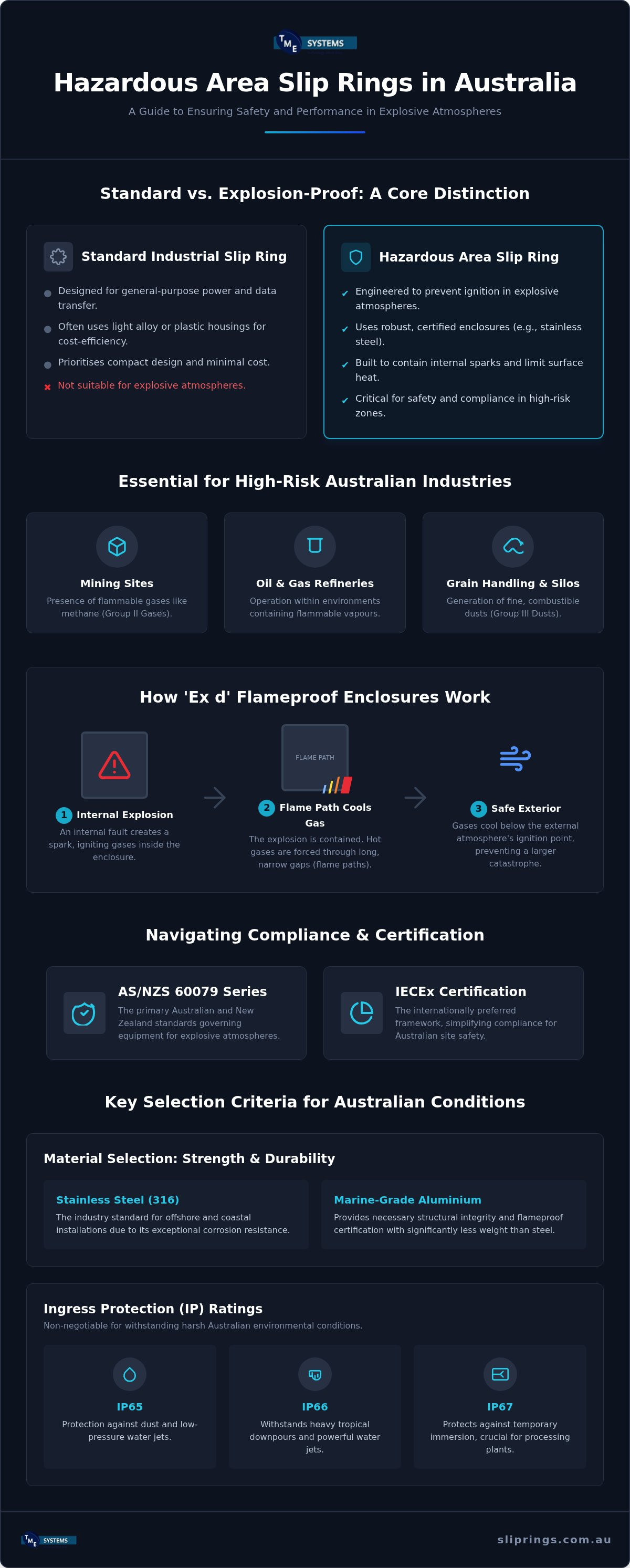
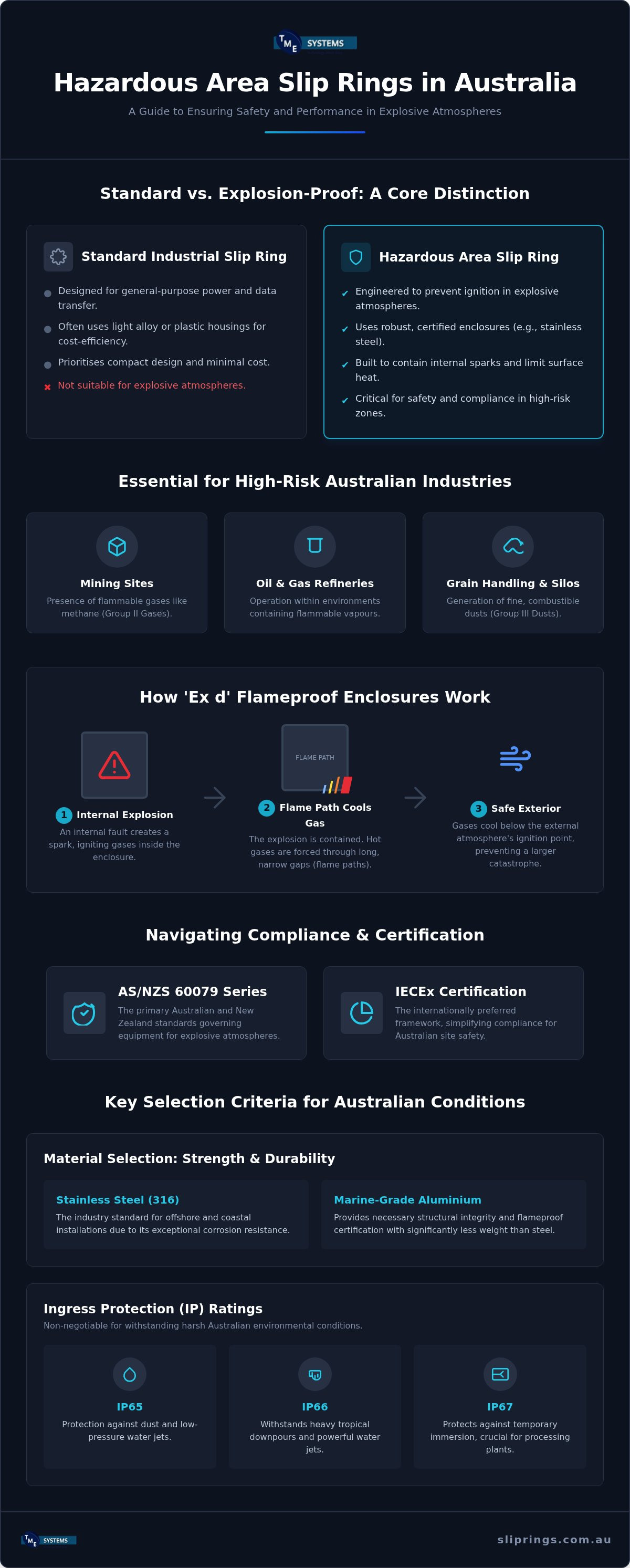
A hazardous area slip ring is a specialised rotary connector engineered to maintain electrical continuity while preventing the ignition of surrounding explosive atmospheres. While standard industrial slip rings are designed for general-purpose power or data transfer, explosion-proof variants are built to contain internal sparks or limit surface temperatures to safe levels. These components are critical for the safe operation of rotating machinery in environments where a single spark could lead to catastrophic failure.
In Australian industry, these devices are essential across several high-risk sectors. Grain silos, for example, produce fine combustible dusts that can reach explosive concentrations within enclosed spaces. Similarly, refineries and mining sites often operate in the presence of flammable gases and vapours. Sourcing hazardous area slip rings Australia involves matching the equipment to specific hazardous area classifications. The primary hazards addressed by these connectors include Group II gases, such as methane or hydrogen, and Group III dusts, including flyings and conductive particles.
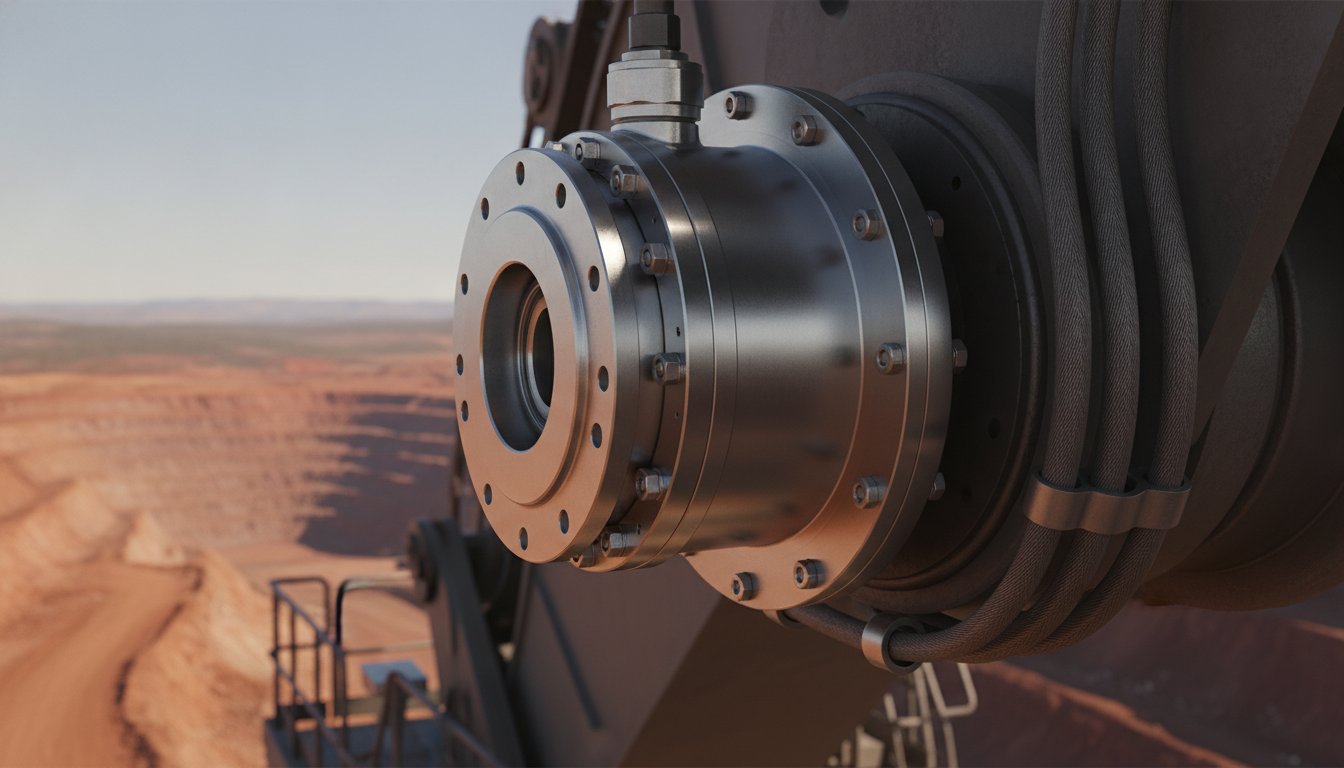
The fundamental difference between a standard slip ring and an explosion-proof version is the enclosure's ability to manage thermal energy and internal faults. Standard connectors prioritise compact design and cost, often using light alloy or plastic housings. In contrast, hazardous area variants use robust, certified enclosures made from materials like stainless steel or marine-grade aluminium, specifically designed to withstand internal pressure and environmental stress.
The Mechanics of Explosion Protection
Flameproof enclosures, designated as Ex d, operate on the principle of containment. They're designed to withstand an internal explosion without allowing the flame to propagate into the external atmosphere. This is achieved through precision-machined flame paths. A flame path is the controlled gap between mating parts of an enclosure. These paths are engineered to be long and narrow, cooling any escaping hot gases below the ignition temperature of the surrounding environment before they reach the outside.
Rotary Signal Integrity in Volatile Zones
Maintaining signal integrity is a significant challenge when using heavy-duty explosion-proof housings. The robust sealing and increased mass required for compliance can sometimes introduce mechanical vibration or electrical noise. Standard connectors often fail in harsh Australian conditions because they can't handle the combination of high ambient heat and fine dust ingress. Choosing high-performance options from manufacturers like BGB Innovation ensures that the electrical contact surfaces remain stable. This stability is crucial for sensitive data signals that must remain clear even within a rugged, certified assembly.
Engineering for Explosive Atmospheres: Design and Sealing Standards
Designing hazardous area slip rings Australia relies on selecting materials that survive both the internal electrical stresses and the external environmental pressures. Stainless steel (Grade 316) is the industry standard for offshore and coastal installations due to its exceptional corrosion resistance. For applications where weight is a factor, marine-grade aluminium provides the necessary structural integrity to maintain flameproof certifications without the mass of steel. These materials are chosen not just for strength, but for their ability to facilitate heat dissipation in a sealed environment.
Ingress Protection (IP) ratings are a non-negotiable part of the specification process for Australian outdoor installations. While IP65 provides protection against dust and low-pressure water jets, many local sites require IP66 or IP67 to withstand heavy tropical downpours or high-pressure washdowns in processing plants. These seals must remain pliable and effective across extreme temperature ranges, from the sub-zero nights in the desert to the 50-degree Celsius peaks of a Pilbara summer. Failure to maintain these seals can lead to the ingress of moisture, which increases the risk of internal short circuits and corrosion.
A critical design element often overlooked is the selection of contact materials. In a hazardous zone, reducing friction and electrical noise is a safety requirement, not just a performance goal. Gold-on-gold contacts are preferred for low-voltage signal circuits because they provide a stable, low-resistance path that resists oxidation. For high-current power transfer, silver-graphite brushes are the superior choice. They offer excellent conductivity while minimising the micro-sparking that can occur during rotation, which is vital when managing equipment in environments containing Group IIC gases like Hydrogen or Acetylene.
Sealing Against Ingress and Internal Arcing
Engineers often specify a dual-chamber design to separate power and signal circuits within the same assembly. This physical barrier prevents high-voltage arcing in the power section from inducing noise or thermal spikes in the sensitive data lines. Specialised rotary seals are used to block the entry of corrosive salt spray or fine, conductive iron ore dust. These contaminants don't just cause wear; they can create tracking paths that lead to internal short circuits, potentially compromising the explosion protection rating of the entire unit.
Contact Technology in BGB Innovation Systems
BGB Innovation slip rings are specifically engineered for the rigours of heavy industry. Their systems utilise high-quality brush gear designed to maintain constant pressure on the rings, which significantly reduces electrical interference and the risk of sparking. This level of precision is essential for maintaining the integrity of the flameproof enclosure over thousands of operational hours. If you're unsure which contact material suits your specific gas group, technical application consulting can help align your hardware with site safety requirements.
Thermal management is the final pillar of explosion-proof design. Because these housings are unventilated to maintain their Ex d or Ex t ratings, heat generated by friction and electrical resistance has nowhere to go. Designers must ensure the external surface temperature of the housing remains below the ignition point of the surrounding atmosphere, a value known as the T-rating. This involves careful calculation of current loads and rotational speeds to prevent the unit from becoming an ignition source itself.
Compliance and Certification: AS/NZS 60079 and IECEx Frameworks
Achieving regulatory compliance for hazardous area slip rings Australia requires a thorough understanding of how international frameworks align with local law. While many components arrive in Australia with European ATEX markings, these certifications don't automatically satisfy Australian safety regulations. Instead, our regulatory landscape relies on the AS/NZS 60079 series. The 2022 revision of AS/NZS 60079, specifically parts 10.1 and 14 published in July 2022, is the definitive standard for explosive atmospheres in Australia, mandating strict equipment marking and personnel competency.
The primary differentiator is the hierarchy of acceptance. ATEX is a regional European directive, whereas IECEx is a global certification scheme. Because Australia is a member of the IECEx system, equipment with a valid IECEx Certificate of Conformity is generally accepted across all states and territories. This alignment ensures that hardware meets the rigorous safety benchmarks required for high-risk industrial sites without the need for redundant local testing. It provides a level of transparency that regional standards often lack.
Before procurement, you must verify that the equipment marking matches your site's specific hazardous area classification. A typical marking such as "Ex d IIC T5 Gb" provides essential data for your safety audit. "Ex d" indicates a flameproof enclosure, "IIC" specifies the gas group, "T5" defines the maximum surface temperature, and "Gb" denotes the Equipment Protection Level. Never rely on marketing claims alone. Always verify the "Certificate of Conformity" through the official IECEx website to ensure the certification is current and covers the specific model you're installing.
Navigating Zone 1 and Zone 2 Requirements
Zone 0 represents areas where an explosive atmosphere is present continuously. Slip rings are rarely placed here. Most industrial applications focus on Zone 1 and Zone 2. In Zone 1, an explosive atmosphere is likely to occur during normal operation, requiring slip rings with robust enclosures and rigorous testing. Zone 2 is for areas where explosive atmospheres are unlikely to occur, but if they do, they'll only persist for a short time. While Zone 2 requirements are less stringent, using higher-rated Zone 1 equipment can often provide an additional safety margin and simplify site-wide maintenance programmes.
The Role of IECEx in Australian Compliance
IECEx certification simplifies the path to compliance by providing a standardised, transparent verification process that Australian engineers recognise. It removes the ambiguity often found when translating regional standards into local site requirements. While ATEX is common, IECEx is the preferred international pathway for Australian mining and gas sites.
Key Selection Criteria for Hazardous Zone Rotary Connectors
Selecting hazardous area slip rings Australia requires a methodical approach to both electrical and mechanical variables. It's not enough to simply match a certificate to a zone; you must conduct a precise audit of your machinery's interfaces. The first step involves defining the primary electrical parameters. This includes the total circuit count, the maximum operating voltage, and the continuous current required per circuit. These factors directly dictate the internal architecture and the physical dimensions of the certified enclosure.
Data transmission needs are increasingly complex in modern Australian industrial environments. Many sites now require the seamless integration of Ethernet, Profibus, or high-speed fibre optic signals alongside traditional power circuits. Maintaining signal integrity for these digital protocols within a heavy-duty, explosion-proof housing requires specialised shielding and low-noise contact technology. You also need to assess mechanical constraints such as rotational speed (RPM), mounting orientation, and shaft size. Environmental stressors, including extreme vibration levels and potential chemical exposure, must be identified early to ensure the unit survives its intended service life without compromising safety.
Specifying Circuit Count and Voltage
Over-specifying your circuit count is a frequent mistake that leads to unnecessary enclosure bulk and increased procurement costs. Because explosion-proof housings must maintain specific wall thicknesses and flame path lengths, every additional circuit adds significant mass. High-voltage transfer presents further challenges in compact hazardous area designs. Internal clearance and creepage distances must be strictly maintained to prevent arcing within the sealed, unventilated environment, which often requires a larger footprint than standard industrial variants.
Environmental and Speed Constraints
Rotational speed is a primary driver of internal heat generation. High RPMs can significantly affect the temperature class (T-rating) of an explosion-proof slip ring. Friction from the brush gear and bearings generates thermal energy that cannot easily escape the sealed housing. If your application involves high-speed rotation in a temperature-sensitive zone, you should refer to our Technical Application Consulting pillar for guidance on complex configurations. For a detailed review of your site's specific mechanical and electrical requirements, you can request a technical consultation with our engineering team to ensure your hardware selection is both safe and efficient.
Procuring High-Reliability Hazardous Area Solutions via TME Systems Pty Ltd
TME Systems Pty Ltd serves as a specialised Australian distributor with deep expertise in rotary electrical connectors, specifically focused on the technical demands of high-risk environments. When sourcing hazardous area slip rings Australia, the procurement process involves more than just selecting a part number from a catalogue. It requires a partner who understands the intersection of electrical performance and safety compliance. We provide access to industry-leading hardware from BGB Innovation and Mercotac, ensuring that your site-specific requirements are met with precision-engineered components.
The value of our service lies in the technical application consulting we include in the procurement cycle. We act as a knowledgeable intermediary between international manufacturing capabilities and the unique environmental variables of Australian industrial sites. This approach ensures that every rotary connector is vetted for its intended application, whether it's a high-speed data link in a refinery or a heavy-duty power transfer system in a remote mining operation. Our procurement process is methodical, moving from initial technical specification through to national delivery across Australia, ensuring that all documentation and certifications are verified before the equipment arrives on site.
Consultative Technical Selection
TME Systems Pty Ltd assists engineers in the critical task of matching circuit requirements to certified enclosure sizes. This is particularly important when managing high-circuit counts or complex signal types that require specific shielding. Where standard off-the-shelf units may not suffice, we provide support for custom configurations. This consultative process reduces the risk of over-specifying hardware, which can lead to unnecessary costs and installation challenges due to oversized enclosures. We focus on providing the most efficient, compliant solution for your specific electrical and mechanical footprint.
Ensuring Long-Term Operational Reliability
Selecting brands with proven track records is essential for minimising maintenance downtime in restricted zones. In Australian conditions, where ambient temperatures and dust levels are extreme, the reliability of the internal brush gear and sealing systems is paramount. For further technical insights into selecting hardware for these volatile environments, you can read our support article on Explosion Proof Slip Rings for Hazardous Zones. By choosing components engineered for durability, you ensure that signal integrity remains stable over the long term, reducing the frequency of hazardous area entries for repairs. Our goal is to provide hardware that satisfies both the immediate safety audit and the long-term operational goals of your facility.
Securing Your Site with Certified Rotary Solutions
Selecting hazardous area slip rings Australia involves balancing stringent AS/NZS 60079 compliance with the mechanical realities of your site's environment. You've seen that material choice, IP ratings, and precise circuit configurations are not just performance metrics; they're fundamental safety requirements for Zone 1 and Zone 2 installations. By prioritising IECEx-certified hardware and high-quality contact materials, you protect your infrastructure against the risks of explosive atmospheres and environmental ingress.
As an authorised distributor for BGB Innovation and Mercotac, TME Systems Pty Ltd provides the engineering expertise needed to navigate these complex specifications. We offer expert technical application consulting for Australian industry to ensure your rotary connectors satisfy every safety audit and operational demand. It's about finding the right fit for your specific gas or dust group without over-specifying and inflating costs. To get started on your next project, you can consult with our technical team for hazardous area slip ring selection. We're here to help you achieve a safe, reliable installation that stands up to the toughest local conditions.
Frequently Asked Questions
Is ATEX certification accepted for slip rings in Australia?
ATEX certification isn't automatically accepted in Australia because it's a European regional directive. For legal compliance on local sites, equipment must meet the AS/NZS 60079 series standards. The most straightforward path is using hardware with an IECEx Certificate of Conformity. This international framework is recognised by Australian regulators and ensures your hazardous area slip rings Australia satisfy site safety requirements without needing costly secondary testing.
Can I use a standard slip ring in a Zone 2 hazardous area if it's inside another enclosure?
You can't simply use a standard industrial slip ring in a Zone 2 area by placing it inside a general-purpose enclosure. Any housing used in a hazardous zone must be specifically certified for that environment, such as an Ex d or Ex t enclosure. If the internal component isn't rated, the entire pressurised or flameproof assembly must be tested and certified as a single unit to ensure it doesn't become an ignition source.
What's the difference between Ex d and Ex e protection for slip rings?
Ex d protection, or "flameproof," is designed to contain an internal explosion and cool escaping gases through flame paths. Ex e, or "increased safety," focuses on preventing sparks or high temperatures from occurring. Because slip rings involve sliding electrical contacts that naturally produce micro-sparks, they almost exclusively rely on Ex d enclosures. This ensures that any internal ignition is contained and doesn't reach the external atmosphere.
How much does the rotational speed (RPM) affect the safety rating of a hazardous area slip ring?
Rotational speed has a direct impact on the safety rating because friction and electrical resistance generate heat within the sealed enclosure. If the RPM is too high, the surface temperature of the housing may exceed its T-rating, or temperature class. This could potentially ignite surrounding gases or dusts. Engineers must calculate the heat rise at maximum speed to ensure the unit remains within safe operational limits for the site.
What maintenance is required for explosion-proof slip rings on Australian sites?
Maintenance for these units involves periodic inspections of the flame paths, seal integrity, and brush wear as mandated by AS/NZS 60079.17. It's critical to ensure that the precision-machined gaps of an Ex d housing aren't damaged, painted over, or corroded. Technicians should also check for internal dust accumulation and ensure that all cable glands remain tight to prevent moisture ingress in harsh Australian conditions like the Pilbara or tropical Queensland.
Can hazardous area slip rings transmit high-speed data like Ethernet or Fibre Optic signals?
Yes, modern hazardous area slip rings Australia can be configured to transmit Ethernet, Profibus, and Fibre Optic signals alongside power. This is achieved by integrating specialised high-frequency shielding or Fibre Optic Rotary Joints (FORJs) within the certified housing. These configurations allow for real-time data monitoring and control in volatile zones. It's a reliable way to maintain signal integrity without compromising the explosion protection rating of the assembly.
What happens if the IP rating of my slip ring is insufficient for a mining environment?
An insufficient IP rating in a mining environment leads to the ingress of fine iron ore dust or moisture, which causes internal electrical tracking and arcing. This doesn't just damage the equipment; it creates a significant safety risk by potentially bypassing the explosion protection measures. For most Australian mining sites, an IP66 or IP67 rating is required to withstand high-pressure washdowns and the constant presence of abrasive dust particles.
Is there a limit to the number of circuits available in an explosion-proof slip ring housing?
There's no theoretical limit to circuit counts, but physical enclosure sizes and thermal management create practical boundaries. As the number of circuits increases, the housing must grow to maintain required clearances and dissipate heat effectively. For high-circuit count needs, engineers often use modular designs or larger certified enclosures. This increases the overall mass and footprint, so it's essential to match the circuit count strictly to your operational requirements.