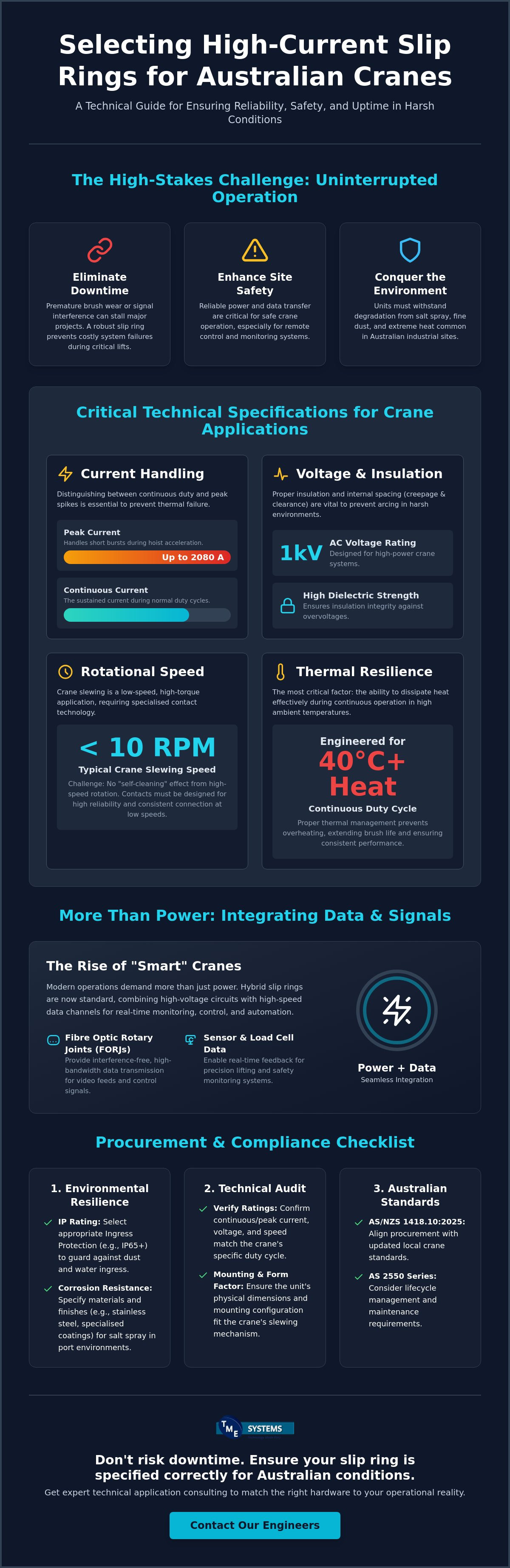
For an Australian crane operator, the most critical specification of a high current slip ring for cranes isn't the peak amperage listed on a data sheet; it's the unit's ability to shed heat during a continuous duty cycle in 40-degree heat. You likely know that unplanned downtime caused by premature brush wear or signal interference in hybrid power and data units can stall a major project and compromise site safety. It's a frustrating reality when environmental degradation from salt spray or fine dust leads to a total system failure during critical lifts.
This guide explains how to specify high-current rotary connectors that withstand the rigorous duty cycles and harsh environmental demands of local operations. You'll learn how to align your procurement with the updated AS/NZS 1418.10:2025 standards and the lifecycle management requirements of the AS 2550 series. We will outline the essential technical criteria for achieving reliable 360-degree power transfer, focusing on thermal resilience, IP ratings, and the integration of data transmission without signal loss.
Key Takeaways
- Understand the critical role a high current slip ring for cranes plays in maintaining reliable power transfer during continuous 360-degree slewing operations.
- Learn to distinguish between continuous and peak amperage requirements to ensure your rotary connector survives heavy-duty cycles without thermal failure.
- Compare the performance characteristics of BGB Innovation and Meridian Laboratory units to match the right technology to your specific mechanical and electrical constraints.
- Identify the correct Ingress Protection (IP) ratings and material finishes required to prevent corrosion in harsh Australian port and construction environments.
- Establish a clear technical audit process for procurement, focusing on voltage, speed, and mounting factors to reduce the risk of unplanned downtime.
The Role of High Current Slip Rings in Crane Slewing Mechanisms
In heavy lifting, 360-degree rotation is a baseline requirement for operational efficiency. Without a reliable way to pass power from the stationary base to the rotating superstructure, a crane's utility is severely limited. Historically, engineers relied on cable reeling systems, but these were prone to mechanical fatigue and restricted the number of turns before needing to "unwind". The modern high current slip ring for cranes has replaced these cumbersome setups, providing a sophisticated solution for continuous, unlimited rotation.
This technology is ubiquitous across the Australian industrial landscape. You'll find them in tower cranes over Sydney's skyline, mobile cranes in Western Australian mine sites, and massive ship-to-shore units at our major ports. These machines require immense power to drive hoist motors and hydraulic pumps, often exceeding several hundred amps. An electrical slip ring acts as the critical bridge, ensuring that power remains constant regardless of the boom's position or the number of rotations completed.
Beyond the internal electrical components, the physical movement of these massive assets between project sites requires specialised logistics. For those managing heavy equipment relocations in Queensland, you can visit Done Wright Towing & Transport to learn more about their professional machinery transport and recovery services.
Continuous Rotation and Power Transfer
Modern crane operations demand speed and precision. If a slewing mechanism has to stop to avoid tangling cables, productivity drops. A high current slip ring for cranes eliminates this downtime. The primary mechanical challenge involves maintaining consistent electrical contact during high-torque slewing. Because cranes operate at variable speeds and carry heavy loads, the contact surfaces must handle high current density without overheating. A crane slip ring is a rotary interface capable of transferring hundreds of amps across a rotating axis. This allows for seamless power delivery to the upper works while the operator focuses on the lift.
Power, Signal, and Data Integration
The push toward automated ports and "smart" cranes has changed what we expect from rotary connectors. It's no longer enough to just move power. Operators now require real-time feedback from sensors, load cells, and monitoring systems. Hybrid units are now the standard, combining high-voltage power circuits with fibre optic rotary joints (FORJs) to ensure data reaches the control centre without interference. This is particularly vital for remote-controlled ship-to-shore units where high-definition video feeds are essential. For those integrating monitoring hardware, our technical guide for CCTV cameras provides deeper insights into managing signal integrity in rotating environments.
Technical Specifications for High Current Applications
Specifying a high current slip ring for cranes requires more than just matching a nameplate amperage. Engineers must distinguish between the continuous current needed for normal duty cycles and the peak current spikes experienced during hoist acceleration. In Australian heavy industry, these units often handle up to 2080 A and voltages reaching 1 kV AC. While high amperage is the primary focus, the rotational speed of a crane slewing mechanism is typically low, often under 10 RPM. This low speed presents a unique challenge; the contact surfaces must maintain high-torque reliability and consistent electrical contact without the self-cleaning effect found in high-speed rotary applications.
Adherence to international maintenance standards, such as the NFPA 70B standard, is essential for ensuring long-term reliability in these high-voltage systems. This standard emphasises that electrical equipment must be maintained through regular testing and inspection to prevent catastrophic failure. For crane operators, this means selecting slip rings designed for accessibility and clear technical auditing. If you are unsure about the specific requirements for your machine, seeking expert technical application consulting ensures your hardware matches your operational reality.
Voltage Ratings and Insulation
Voltage management in crane slip rings is as much about physical distance as it is about material quality. Managing creepage and clearance distances within the compact housings of a slewing ring is vital to prevent arcing, especially in humid or dusty environments. Dielectric strength must be verified through rigorous testing to ensure the insulation can withstand transient overvoltages. For a deeper dive into these requirements, see our guide on Understanding Slip Ring Voltage Rating. Proper insulation prevents leakage currents that can interfere with sensitive control signals.
Thermal Management and Amperage Derating
Heat is the primary enemy of high-current electrical contacts. While many standard units are rated for a maximum ambient temperature of 40°C, Australian summers frequently exceed this limit in mining and port environments. Amperage capacity must be calculated based on the maximum operating temperature of the slewing ring. When ambient temperatures rise, the ability of the slip ring to dissipate heat generated by electrical resistance decreases.
This necessitates amperage derating, where the allowable current is reduced to prevent the internal components from reaching their thermal limits. The choice of contact materials plays a significant role here. Silver-graphite brushes offer excellent conductivity and lower friction than traditional copper-gold contacts, which helps reduce the total thermal load on the assembly. For heavy-duty construction projects, selecting a robust BGB Innovation Slip Ring ensures the unit can handle these thermal stresses while maintaining performance.
Comparing High Current Technologies: BGB vs. Meridian Laboratory
Choosing the correct high current slip ring for cranes often comes down to a trade-off between mechanical serviceability and electrical precision. While the power requirements remain constant, the method of transferring that energy across the rotating interface significantly impacts long-term maintenance costs and signal reliability. For Australian operators, the choice typically narrows down to two distinct technologies: modular carbon brush systems and brushless liquid metal interfaces. Each serves a specific niche within the crane industry, from rugged construction sites to high-precision automated ports.
The decision between "off-the-shelf" modular units and custom-engineered solutions depends on your specific mounting constraints and the complexity of your power-plus-data requirements. While power is the primary driver, the integration of data often dictates which technology is superior for a modern, connected crane fleet.
Heavy Duty Modular Systems (BGB)
Engineers often favour BGB Innovation Slip Rings for tower cranes and heavy-duty construction equipment. The primary advantage of these units is their modularity. In high-vibration environments, mechanical wear is inevitable, but BGB's design allows for the replacement of individual brush grades without a total unit disassembly. This reduces downtime during routine inspections required by AS 2550 standards. These systems are highly scalable; you can easily add circuits for auxiliary power or basic control signals, making them a versatile choice for machines that might undergo future upgrades or modifications.
Precision High Current Solutions (Meridian Laboratory)
When the application demands near-zero electrical noise and maximum efficiency, Meridian Laboratory Slip Rings are the superior technical choice. Utilising patented Rotocon technology, these units replace traditional brushes with a liquid metal interface. This results in an incredibly stable connection with 95% efficiency in power transfer, which directly addresses the thermal management issues discussed in the previous section. Because there's no mechanical friction between moving parts, these units are virtually maintenance-free and offer the signal integrity required for integrated fibre optic rotary joints. They're ideal for high-precision lifting where even minor electrical interference could compromise automated control systems.
The decision between these two often hinges on the project's technical audit. If the crane operates in a remote area with limited specialised support, the modularity of a BGB system is a safer bet. However, for port-side cranes requiring high-speed data integration and low thermal signatures, the precision of a Meridian Laboratory unit provides a lower total cost of ownership over the machine's lifecycle. Balancing these factors ensures the high current slip ring for cranes you select is fit for purpose and capable of meeting the rigorous demands of the Australian climate.
Environmental Resilience in Australian Conditions
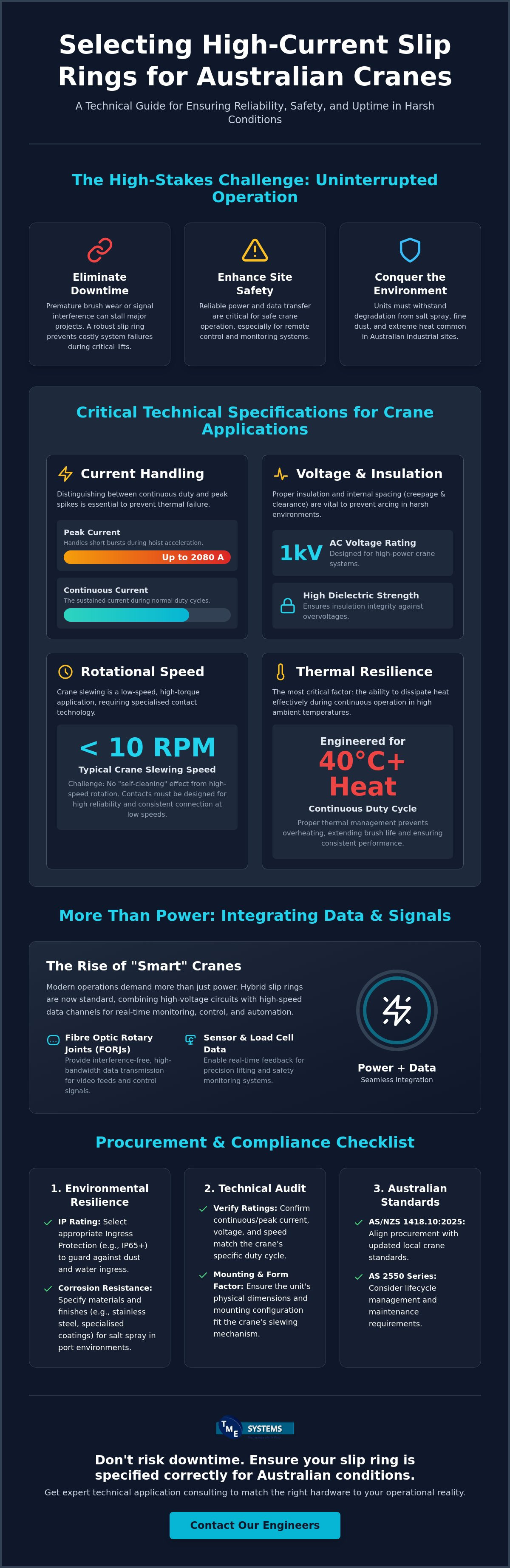
Australian crane sites present some of the harshest operating conditions globally. From the salt-laden air of the Pilbara coast to the fine, abrasive dust of the Bowen Basin, a high current slip ring for cranes must be specified with enclosure materials and sealing systems that go beyond standard European industrial ratings. Failure to account for these variables leads to rapid ingress, electrical tracking, and eventual component failure. Reliability in these environments is not a matter of luck; it is a result of precise material selection and enclosure engineering.
IP Ratings and Enclosure Design
Ingress Protection (IP) ratings are the baseline for outdoor crane applications. While IP65 is often cited as the minimum requirement to protect against dust and low-pressure water jets, it's only half the story. Enclosure design must also manage internal atmospheric conditions. In tropical regions like Queensland or the Northern Territory, the temperature differential between day and night causes internal condensation. We recommend integrating breather drains or internal heaters to manage this moisture, preventing it from compromising the dielectric strength of the insulation. For machines operating in hazardous or explosive zones, such as fuel terminals, custom enclosures with specific certification levels are mandatory to ensure site safety.
Contact Surface Longevity
Environmental resilience also extends to the internal contact surfaces where the actual power transfer occurs. Fine particulates, such as iron ore or coal dust, act as abrasives that accelerate brush wear and increase contact resistance. This leads to the heat buildup discussed in earlier technical sections. For mining applications, a lubrication-free contact system is often preferred to prevent dust from "clumping" on the rings and creating a grinding paste. Additionally, any exposed housing components must be treated for high UV exposure to prevent the degradation of seals and polymer insulators over a 10-year service life.
Material choice for the housing is equally critical. For port-side ship-to-shore units, 316-grade stainless steel is the industry standard for resisting chloride-induced pitting. In contrast, anodised aluminium offers a lightweight and cost-effective alternative for inland tower cranes, provided the anodising layer is sufficient to resist atmospheric corrosion. To ensure your hardware is specified for long-term resilience in these conditions, contact our technical consultants for a site-specific audit of your requirements.
Technical Selection and Procurement with TME Systems
Selecting a high current slip ring for cranes is a complex engineering task that goes beyond simply matching a part number from a legacy manual. A successful installation requires a thorough understanding of the machine's duty cycle, electrical load, and mechanical constraints. TME Systems provides the technical application consulting necessary to bridge the gap between manufacturer specifications and real-world Australian operating conditions. By taking an engineering-led approach, we ensure that the chosen rotary connector doesn't just fit the housing; it must also survive the thermal and environmental stresses inherent in heavy lifting.
The Technical Audit Process
A comprehensive technical audit is the first step in any procurement or upgrade project. This process involves defining the precise circuit counts required for high-voltage power, control signals, and grounding. Beyond electrical specs, we must evaluate the physical mounting constraints. Many modern cranes require a through-bore design to accommodate central shafts or hydraulic lines that pass through the centre of the slewing ring. While crane requirements differ from the high-speed precision found in industrial robotics, our guide on Selecting a Slip Ring for Robotic Arms offers useful comparisons regarding how automation impacts rotary interface selection.
Procurement and Local Support
Accessing world-class hardware like Mercotac Slip Rings or Prosper Rotation Slip Rings is simplified through a local distribution partner. The value of this partnership lies in technical selection advice rather than simple order fulfilment. We help you navigate the trade-offs between different contact technologies and enclosure materials, ensuring your procurement aligns with the AS 2550 lifecycle management standards mentioned earlier. This support is vital for maintenance managers who need to ensure audit-ready compliance without the lead times often associated with international shipping.
If you are upgrading an older machine or specifying a high current slip ring for cranes for a new project, the next step is to gather your operational data. We require details on peak current, nominal voltage, maximum RPM, and the specific environmental hazards of your site. This data allows us to provide a solution that reduces unplanned downtime and extends the service life of your equipment. For a detailed review of your application, contact TME Systems for a technical consultation and ensure your crane remains operational in the most demanding conditions.
Optimising Crane Lifecycle and Performance
Selecting a high current slip ring for cranes requires a careful balance between peak electrical capacity and the physical realities of the Australian climate. We've examined how thermal derating, precise IP ratings, and the choice between modular or brushless technologies dictate long-term reliability. Prioritising an engineering-led approach over simple part replacement ensures your equipment meets modern safety standards while minimising the risk of costly, unplanned downtime on-site.
TME Systems serves as an authorised Australian distributor for industry leaders including BGB, Meridian Laboratory, and Mercotac. We provide specialist technical application consulting alongside national supply and support across Australia to ensure your hardware is fit for purpose. Our focus is always on delivering a solution that matches your machine's exact duty cycle and environmental exposure, from port-side salt spray to outback dust.
To secure the technical integrity of your next lifting project, Request a Technical Consultation for Crane Slip Rings today. We look forward to helping you achieve a reliable, high-performance operation that stands up to the most rigorous industrial demands.
Frequently Asked Questions
How much current can a standard crane slip ring handle?
Standard designs typically accommodate currents up to 2080 A and voltages up to 1 kV AC. For extreme industrial requirements, customised solutions can reach up to 13000 A. It's essential to specify whether these figures represent continuous or peak current to ensure the hardware survives the duty cycles of heavy lifting without overheating in high ambient temperatures.
Can I integrate a fibre optic rotary joint into a high-current slip ring?
Yes, modern units frequently combine high-power circuits with fibre optic rotary joints (FORJs) within a single housing. This hybrid configuration allows for the simultaneous transfer of hundreds of amps alongside high-speed data for automated control systems or high-definition monitoring. Using a hybrid high current slip ring for cranes ensures that signal integrity remains uncompromised by electromagnetic interference from the power lines.
What is the typical lifespan of a high-current slip ring in a construction environment?
The service life typically ranges from 10 to 20 years, provided the unit is maintained in accordance with AS 2550 standards. Environmental factors like fine dust or salt spray can accelerate wear if the IP rating is insufficient. Brushless liquid metal units generally offer a longer lifespan with lower maintenance compared to traditional carbon brush systems in high-vibration construction settings.
Do high-current slip rings require regular maintenance?
Yes, regular inspections are mandatory under Australian safety standards to prevent unplanned downtime. For traditional units, maintenance involves checking brush wear, removing carbon dust, and ensuring contact surfaces remain clean. Brushless designs, such as those from Meridian Laboratory, significantly reduce this requirement, though periodic housing and seal checks are still necessary to ensure environmental protection remains intact.
How do I prevent signal noise when transferring power and data through the same slip ring?
Signal noise is prevented through physical separation of circuits, internal shielding, and the use of low-noise contact materials like silver-graphite. For critical data, integrating a fibre optic rotary joint provides total immunity to electromagnetic interference. Additionally, brushless liquid metal interfaces provide a much cleaner electrical connection than traditional brushes, which is vital for high-precision lifting operations.
Is it possible to replace individual brushes on a crane slip ring while it is installed?
Yes, modular systems like those from BGB Innovation are designed specifically for on-site serviceability. Maintenance teams can replace individual brush grades without total unit disassembly, which drastically reduces project delays. This modular approach is a primary reason why these units are favoured for tower cranes where accessibility is difficult and downtime must be kept to an absolute minimum.
What IP rating is required for a port-side crane slip ring?
An IP65 rating is the absolute minimum requirement, but port-side environments usually demand IP66 or IP67 to resist high-pressure water jets and salt-laden air. Material selection is equally important in these locations. Specifying a 316-grade stainless steel enclosure alongside the appropriate IP rating ensures the high current slip ring for cranes resists the corrosive effects of chloride-rich maritime climates.
Can TME Systems help with custom mounting configurations for older cranes?
Yes, TME Systems provides technical application consulting to adapt modern rotary connectors to legacy mounting configurations. We assist in defining through-bore requirements and circuit counts to ensure a seamless integration with older machines. This engineering-led approach allows operators to upgrade their power and data capabilities without the need for extensive structural modifications to the crane's slewing mechanism.