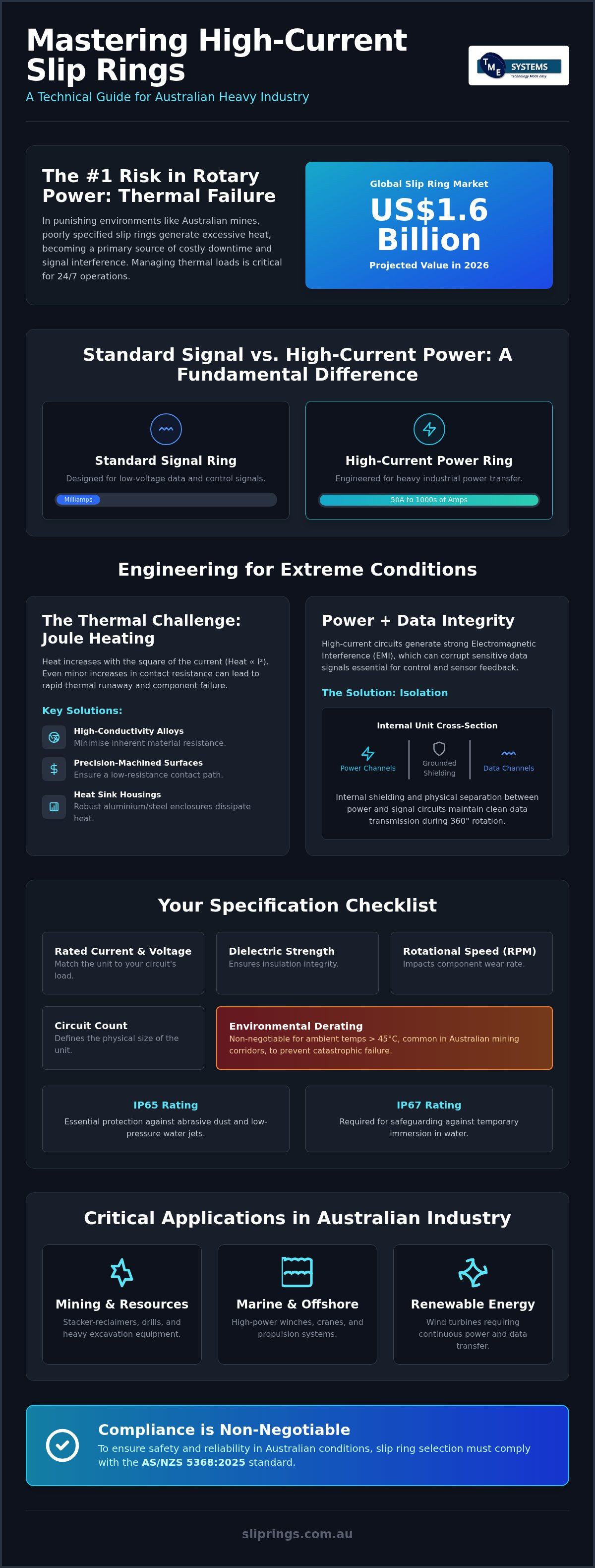
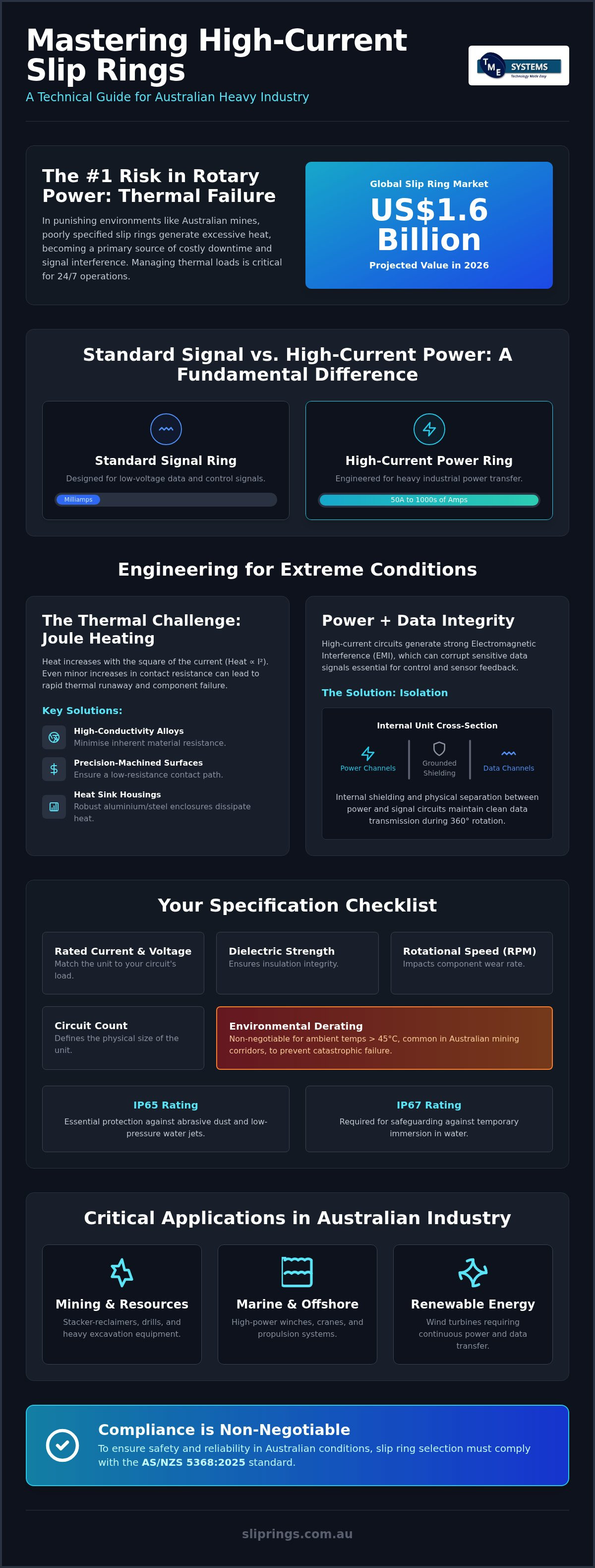
The global slip ring market is projected to reach a value of US$1.6 billion in 2026, yet many industrial facilities still face the same critical failure point: the inability to manage thermal loads in rotary power transfers. In the punishing heat of an Australian mine or the corrosive environment of a coastal processing plant, a poorly specified high current slip ring doesn't just wear out; it becomes a primary source of downtime through excessive heat and signal interference. You've likely seen how contact resistance can quickly escalate into a costly maintenance cycle that threatens your 24/7 operational targets.
We understand that engineering for high amperage requires a move away from generic components toward precision-engineered solutions. This technical guide outlines the requirements for mastering high-amperage connections to ensure stable power delivery in heavy industrial settings. You'll learn how to reduce your thermal footprint and extend maintenance intervals while remaining compliant with the AS/NZS 5368:2025 standard. We will examine the critical intersection of material science, IP-rated sealing, and advanced contact technologies to help you build a more resilient electrical architecture.
Key Takeaways
- Learn to distinguish between standard signal rings and high-amperage interfaces to prevent excessive heat generation in heavy industrial circuits.
- Evaluate the technical advantages of mercury-wetted contacts versus carbon brush systems for maintaining low electrical noise and high current stability.
- Master the selection criteria for a high current slip ring to ensure compliance with AS/NZS 5368:2025 standards in challenging Australian conditions.
- Understand how to balance RPM limits with dielectric strength and rated current to maximise the service life of your rotary power components.
- Identify the essential IP65 and IP67 ingress protection ratings needed to safeguard power transmission against the abrasive dust and moisture common in mining operations.
What is a High Current Slip Ring and Why is it Critical?
To understand the necessity of these components, we must first define what is a slip ring? at its most basic level: an electromechanical interface that allows the transmission of power and electrical signals from a stationary to a rotating structure. A high current slip ring, however, is a significantly more robust iteration of this technology. While standard rings might manage low-voltage data or signal currents measured in milliamps, these specialised power rings are engineered to handle loads starting at 50 Amps and scaling up to several thousand Amps.
In the Australian industrial sector, these units are the backbone of heavy machinery, from massive stacker-reclaimers in the Pilbara to offshore winches and wind turbines. The distinction between a signal ring and a power ring is not merely one of scale; it's a fundamental shift in mechanical configuration. High-amperage transfer demands unique material science to manage the physical stresses of constant rotation while maintaining a low-resistance electrical path. Without this specialised engineering, the electrical load would quickly destroy the contact surfaces.
Power Transmission vs. Signal Integrity
Many modern industrial systems require hybrid configurations that transmit both raw power and sensitive control data through a single assembly. High current circuits generate substantial electromagnetic interference (EMI), which can easily corrupt data packets if the unit isn't designed with proper isolation. Engineers resolve this by using internal shielding and physical separation. By placing grounded metallic barriers between the power and signal tracks, it's possible to maintain a stable electrical path and clean data transmission even during 360-degree continuous rotation. This is vital for equipment that relies on real-time sensor feedback while drawing significant power.
The Thermal Challenge of High Amperage
Thermal management is the primary constraint in high-power rotary design. Joule heating occurs when electrical current passes through a conductor, and this heat increases proportionally to the square of the current. Because contact resistance is the primary enemy of these systems, even a minor increase in resistance can lead to rapid thermal runaway. Manufacturers like BGB Innovation and Meridian Laboratory utilise high-conductivity alloys and precision-machined surfaces to keep resistance at a minimum. The housing material also serves a functional purpose; robust aluminium or stainless steel enclosures act as heat sinks to dissipate thermal energy, ensuring the unit operates within safe temperature margins during 24/7 service.
Engineering Specifications for High Current Rotary Connectors
Specifying a high current slip ring requires a rigorous analysis of electrical and mechanical parameters that go far beyond simple amperage ratings. The primary metrics include rated current, operating voltage, and dielectric strength, which defines the unit's ability to withstand voltage without an insulation breakdown. In Australian industrial environments, particularly in the northern mining corridors, ambient temperatures often exceed 45°C. This necessitates a calculated derating of the nominal current capacity. If the internal temperature exceeds the thermal class of the insulation materials, the risk of catastrophic failure increases, making environmental derating factors a non-negotiable part of the procurement process.
Circuit count also plays a decisive role in the physical footprint of the assembly. Increasing the number of power circuits typically requires a larger diameter unit, which in turn increases the surface speed at the contact point for any given RPM. This relationship between physical size and rotational velocity directly impacts the wear rate of the internal components. For complex installations, performing a technical audit before purchasing ensures that the balance between power requirements and space constraints is maintained without compromising the unit's service life.
Amperage, Voltage, and Contact Resistance
The efficiency of power transfer is determined by the voltage drop across the rotary interface, calculated by multiplying the contact resistance by the operating amperage. To keep this drop at a minimum, high-performance units utilise materials such as silver, gold, or liquid metal alloys. Liquid metal interfaces, found in Mercotac and Meridian Laboratory designs, offer the lowest possible contact resistance, which is essential for maintaining 24/7 power stability. When specifying these units, it's vital to distinguish between peak current, which the ring might handle for short durations, and continuous duty cycles that define the long-term thermal load.
RPM Limits and Mechanical Durability
Rotation speed is a primary driver of frictional heat, which compounds the Joule heating already present from the electrical load. High RPM applications require a delicate balance; the contacts must be robust enough to carry hundreds of amps while remaining light enough to maintain contact at speed. This challenge is particularly evident in high-current slip ring assemblies in wind turbines, where variable speeds and high power loads coexist. The critical speed represents the rotational velocity threshold where centrifugal forces or mechanical vibration cause the contacts to bounce, leading to destructive electrical arcing. If your application approaches these mechanical limits, seeking Technical Application Consulting is the most effective way to ensure your hardware choice matches your operational reality.
Comparing Contact Technologies for Power Transfer
Selecting the right contact interface is the most critical decision in the design of a high current slip ring. The choice between liquid metal connectors and traditional brush-based systems determines not only the electrical efficiency of the unit but also its long-term maintenance requirements. In heavy industrial applications, the contact technology must facilitate a near-perfect electrical path while surviving the mechanical stresses of continuous rotation. While one technology may excel in high-speed data environments, another might be necessary for the high-vibration conditions found in Australian mineral processing plants.
Liquid Metal Connectors for High Power
Mercotac slip rings are frequently specified as the preferred solution for applications where low electrical noise and maintenance-free operation are paramount. These units use a pool of liquid metal as the conductor, which provides a stable, low-resistance connection that doesn't degrade over time like solid contacts. This technology is particularly effective for slip ring technology for smart grid applications, where high efficiency and the ability to scale power transmission are essential. Because there are no brushes to wear down, these connectors don't produce conductive dust, making them ideal for sensitive environments. However, they require precise environmental sealing to comply with Australian safety standards and are often restricted in applications involving high-speed vertical rotation or specific food-grade requirements.
Heavy-Duty Brush Systems
For environments where mechanical shock is a factor or mercury use is restricted, BGB Innovation slip rings offer a robust alternative using advanced brush gear. These systems rely on carbon, graphite, or precious metal brushes that are held against the rotating rings with calibrated spring tension. In remote Australian mining sites, these brush systems are valued for their reliability and ease of field service. Although they require planned maintenance intervals to clear carbon deposits and check brush wear, they're capable of managing massive amperage loads that might overwhelm smaller liquid metal units. To reduce electrical noise and brush wear, engineers often use silver-plated rings and multi-point contact designs, which increase the surface area and distribute the thermal load more evenly across the interface.
Mercury-free liquid metal alternatives are also becoming more prevalent for sensitive applications that demand the performance of a liquid interface without the regulatory hurdles of mercury. These units often use gallium-based alloys to provide a stable electrical path. When choosing between these technologies, you must consider the specific vibration profile of your machinery and the availability of maintenance staff at your facility. A well-specified contact system will ensure that your power transfer remains stable for years, rather than months, of continuous operation.
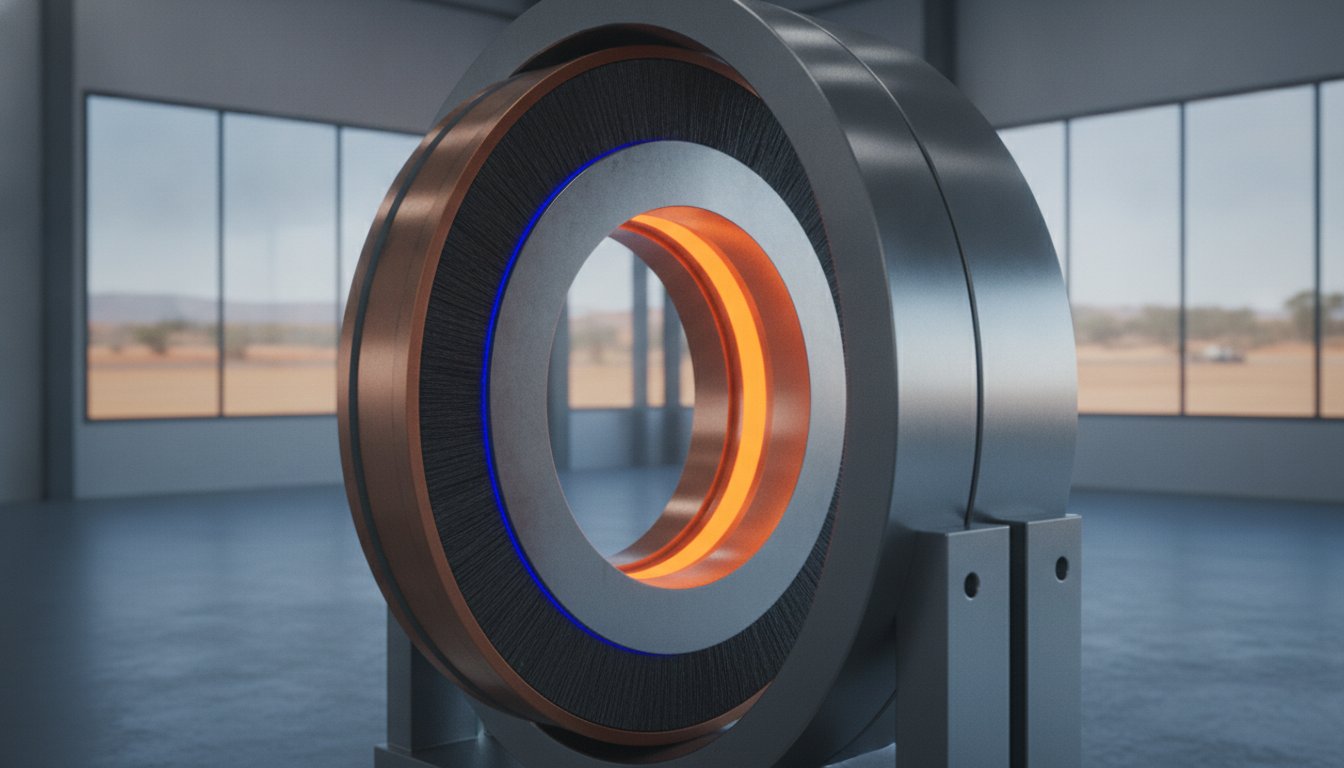
Critical Applications for High Current Transfer in Australia
The Australian industrial landscape presents some of the most demanding operational environments for power transfer systems. Whether it's a stacker-reclaimer in the Pilbara or a wind turbine in the Southern Ocean, the requirement for a reliable high current slip ring is absolute. In these settings, failure is not just an inconvenience; it's a significant financial risk. The integration of high-amperage rotary connections allows for the 360-degree operation of massive equipment while maintaining the integrity of the power supply to high-torque motors and control systems.
Renewable energy has become a primary driver for these technologies. As of 2025, wind turbines account for nearly a quarter of the global slip ring revenue share. Within these turbines, high current is essential for both power take-off and the active pitch control systems that adjust the blades to manage wind loads. Similarly, in industrial automation, rotary indexing tables and high-speed packaging lines rely on these components to deliver power to heaters and actuators without the risk of cable fatigue or entanglement.
Heavy Lifting and Crane Operations
Tower and gantry cranes used in Australian port infrastructure require seamless power delivery to manage high-torque lifting cycles. The Slip ring for crane category must be engineered to withstand the corrosive effects of salt spray and high humidity. Weatherproofing to IP66 or higher is standard for these exposed port environments. This ensures that the electrical contacts remain free from moisture ingress, which could otherwise lead to short circuits or accelerated oxidation during ship-loading operations.
Mining Excavators and Processing Plants
Mining operations represent the pinnacle of mechanical stress for rotary connectors. Excavators and rotating shovels operate in environments saturated with abrasive dust and constant high-frequency vibration. In these conditions, heavy duty slip rings are essential to maintain 24/7 production schedules. For example, a rotating drill rig depends on a constant power path to its primary drive motors. Any interruption in contact integrity due to dust ingress or vibration-induced bounce can lead to immediate equipment shutdown. Robust housing and advanced sealing are non-negotiable for these processing plant applications.
If you're designing or maintaining heavy rotating machinery, ensure your specifications meet the rigours of the Australian environment by contacting our team for Technical Application Consulting.
Procurement and Selection: Getting the Specification Right
Successful procurement of a high current slip ring begins with a comprehensive technical audit. This process involves more than just matching amperage; it requires a detailed review of your system's duty cycle, rotational speed, and physical environment. Selecting a unit based on nominal ratings alone often leads to premature failure because it ignores the thermal realities of continuous operation. By engaging in Technical Application Consulting, you can identify these variables early and avoid the significant costs associated with specification errors and unplanned downtime.
The mechanical integration of the unit is equally important. You'll need to decide between a through-bore design, which allows for the passage of shafts or hydraulic lines, and a flange-mounted configuration for direct attachment to a housing. Each choice impacts the ease of installation and future maintenance access. For complex setups, ensuring the mounting orientation doesn't impede heat dissipation is a critical engineering requirement that must be addressed during the initial design phase.
Environmental Ratings and Sealing
In Australia, the environment is often as challenging as the electrical load itself. Coastal facilities and humid tropical zones require advanced sealing to prevent salt spray and moisture from corroding internal contacts. Specifying IP65 or IP67 ratings is standard practice for outdoor or washdown environments, while hazardous areas may require explosion-proof enclosures. High-precision Meridian Laboratory slip rings are often utilised in environments where maintaining a clean, low-resistance path is essential despite external contaminants. The enclosure must be robust enough to block ingress while still allowing for the dissipation of internal heat generated by the high-amperage load.
Partnering with an Australian Specialist
Working with a local distributor provides distinct advantages in technical support and procurement lead times. A specialist can help you navigate custom configurations, such as those available with Prosper Rotation slip rings, to fit unique shaft sizes or complex circuit counts. This local expertise ensures your equipment remains compliant with Australian safety standards while meeting specific operational demands.
Before finalising your selection of a high current slip ring, use this checklist to verify your requirements:
- Confirm the continuous versus peak amperage ratings for all circuits.
- Verify the IP rating matches the installation site's ingress risks.
- Ensure the RPM limit exceeds the machinery's maximum operating speed.
- Check that the mounting geometry matches your existing mechanical interface.
- Assess the maintenance access requirements for brush-based systems.
Optimising Rotary Power for Long-Term Reliability
Selecting the correct high current slip ring is a balance between managing thermal dissipation and ensuring mechanical durability. This guide has detailed how contact resistance serves as the primary driver of heat and why specifying the right IP rating is essential for survival in Australia's harsh mining and port environments. Whether your application requires the low-noise performance of a liquid metal connector or the ruggedness of a heavy-duty brush system, the success of your project depends on technical accuracy during the procurement phase.
As an authorised distributor for world-leading brands like Mercotac and BGB Innovation, TME Systems Pty Ltd provides the technical expertise needed to navigate these complex engineering challenges. We offer a comprehensive range of both mercury-free and liquid metal solutions tailored to your specific circuit counts and environmental variables. Don't leave your power transfer to chance; get the right specification from the start. Contact TME Systems Pty Ltd for expert high current slip ring consultation to ensure your industrial machinery remains operational and efficient for years to come. We look forward to helping you solve your most demanding rotary power challenges.
Frequently Asked Questions
What is the maximum current a standard slip ring can handle?
Standard signal-grade rings usually top out at 2 to 10 Amps per circuit. In contrast, a high current slip ring is engineered to manage loads starting at 50 Amps and scaling to several thousand Amps for heavy industrial applications. While off-the-shelf power rings often handle up to 600 Amps, higher requirements typically necessitate custom-engineered solutions from specialists like BGB Innovation to manage the significant thermal and mechanical stresses involved.
How does heat affect the performance of a high current slip ring?
Excessive heat increases electrical resistance, which triggers a cycle of further heat generation known as Joule heating. If the unit operates above its rated thermal limit, the internal insulation can degrade and contact surfaces may oxidise. This leads to unstable power delivery and eventual component failure. Selecting the correct housing material and contact technology is vital to dissipate this energy effectively and maintain a safe operating temperature during continuous rotation.
Are mercury-wetted slip rings allowed in Australian industrial sites?
Mercury-wetted rings are permitted on Australian sites provided they comply with relevant environmental and safety standards. Brands like Mercotac are frequently used for their low resistance and signal stability. These units must be installed in a specific orientation to ensure the liquid metal remains contained. For facilities with strict no-mercury policies, mercury-free liquid metal or advanced brush-based systems serve as effective alternatives for reliable 24/7 power transmission.
How often do high current brush-based slip rings require maintenance?
Maintenance intervals for brush-based systems typically range from 6 to 12 months depending on the duty cycle. In abrasive Australian mining environments, more frequent inspections are necessary to clear conductive carbon dust and monitor brush wear. It's also vital to check spring tension during these audits to ensure consistent contact. Neglecting these intervals can lead to increased electrical noise and permanent damage to the rotating rings, resulting in costly downtime.
Can I combine high current power and high-speed data in one slip ring?
You can combine high-amperage power circuits with high-speed data channels like Ethernet or Fibre Optic in a single hybrid assembly. To protect signal integrity, these units utilise internal electromagnetic shielding and physical isolation to prevent power noise from corrupting data packets. This configuration is standard in wind turbines and advanced robotics where both raw power and precise control signals must pass through the same rotary interface without interference.
What are the signs that a high current slip ring is beginning to fail?
Common failure indicators include fluctuating voltage levels, increased electrical noise, and visible discolouration of the housing due to overheating. You may also observe excessive carbon dust accumulation or scoring on the contact surfaces. If the unit produces audible arcing sounds or unusual mechanical vibrations, the contact interface has likely degraded. Prompt technical assessment is required to identify the root cause and prevent a total loss of power to your machinery.
How do I protect a high current slip ring from dust and moisture in mining?
Protection is achieved by specifying an assembly with a high Ingress Protection rating, such as IP65 or IP67. These units feature specialised seals and gaskets designed to block the abrasive dust and moisture common in Australian mining zones. Using robust stainless steel or aluminium enclosures further protects the internal contacts from physical damage. It's also important to ensure the mounting orientation prevents debris from accumulating around the seal interfaces.
What is the difference between a collector ring and a high current slip ring?
A collector ring is a rudimentary term often applied to basic power transfer in large motors or generators. A high current slip ring refers to a more sophisticated electromechanical assembly engineered for precision applications. While both facilitate rotary power transfer, the latter offers advanced features like multiple circuit integration, high-speed data compatibility, and superior environmental sealing. Collector rings generally lack the refined signal integrity and robust housing required for modern industrial automation.