Why do so many Australian engineering teams accept frequent rotary connector failures as an unavoidable cost of doing business in harsh environments? When dust contamination or moisture ingress leads to signal noise and short circuits, the root cause is often an overlooked mismatch between hardware specifications and the actual operating conditions. Selecting the correct IP65 slip ring is not just about ticking a box; it's about ensuring that your machinery remains operational and compliant with the updated AS 60529:2025 standards.
It's a common frustration to find that standard components simply don't survive the intensive wash-down cycles or abrasive grit of a local industrial site. This article serves as a comprehensive technical reference for specifying and implementing IP65-rated connectors that are built for long-term reliability. We'll analyse how to identify the correct protection levels for your specific application, reduce maintenance-related downtime, and ensure your hardware meets the rigorous demands of the Australian industrial sector.
Key Takeaways
- Understand how the IP65 rating provides total dust protection and resistance to water jets in accordance with the AS 60529:2025 standard.
- Learn why selecting specific seal materials like Viton or PTFE is critical for maintaining a reliable barrier during continuous 360-degree rotation.
- Determine when an IP65 slip ring is the more efficient choice compared to IP67 by reducing mechanical friction in high-speed industrial machinery.
- Identify how to mitigate the "seal penalty" by accounting for increased torque and heat generation within your system's operational parameters.
- Gain a methodical framework for specifying rotary connectors that aligns your electrical circuit requirements with long-term environmental resilience.
Understanding IP65 Ratings for Rotary Electrical Connectors
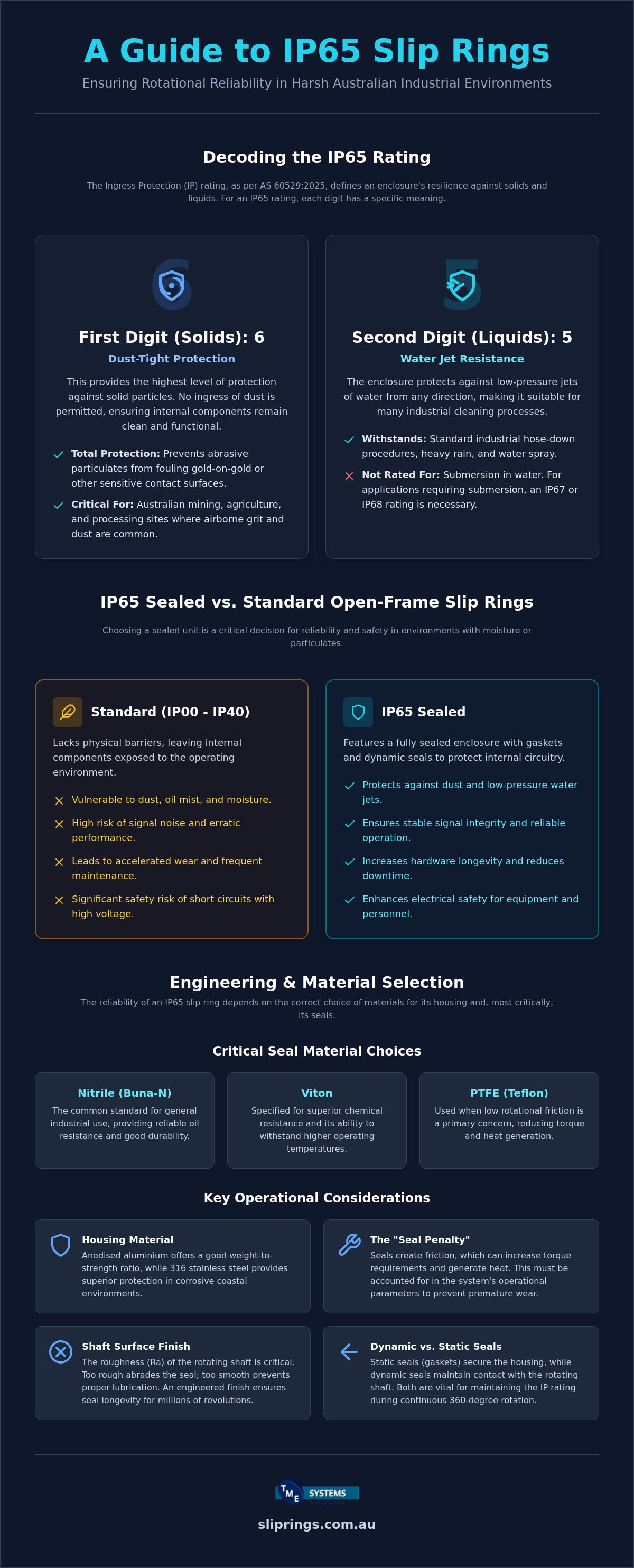
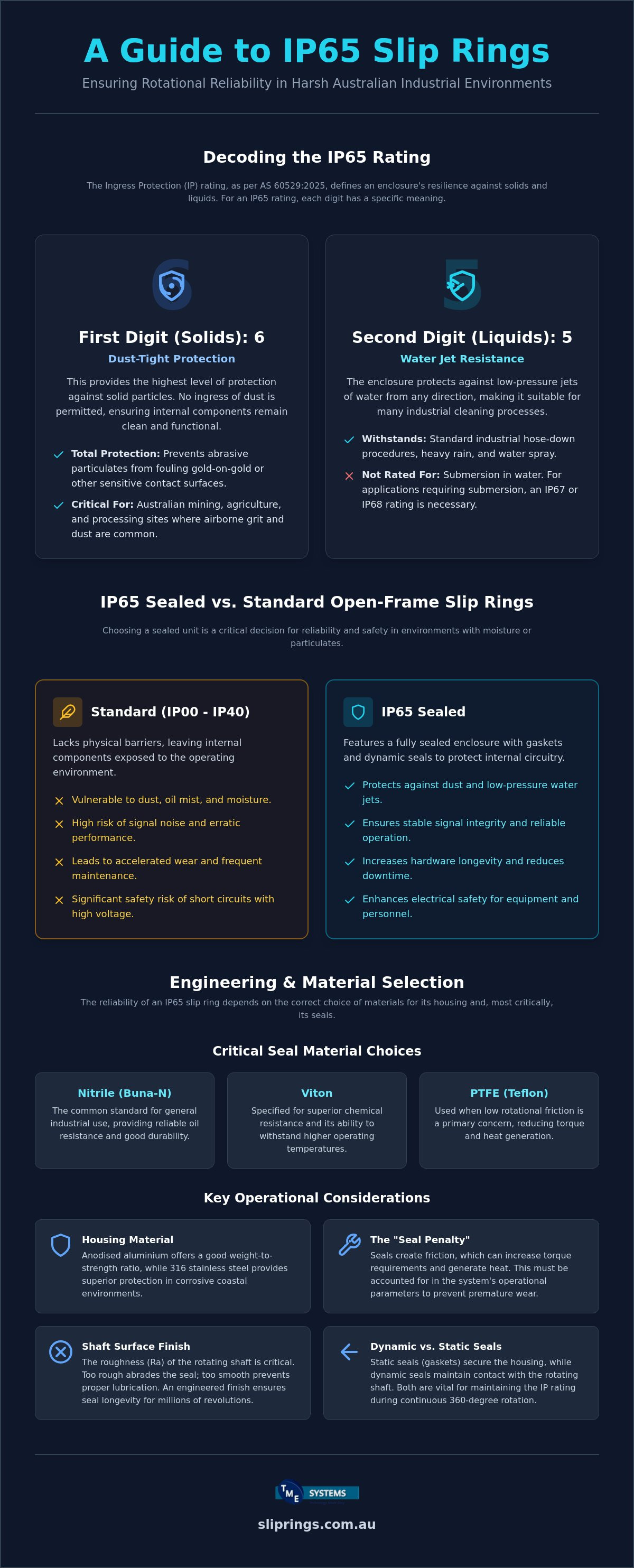
The IP Code, or Ingress Protection rating, is a formalised system defined by international standards like IEC 60529 and the local AS 60529:2025. It provides a precise metric for how well an enclosure protects its internal electrical components from external elements. For an IP65 slip ring, these two digits represent a specific threshold of environmental resilience. The first digit, 6, indicates that the unit is "dust-tight". This means no ingress of dust is possible after a vacuum test of up to eight hours. In the context of Australian mining or agricultural sites, this level of protection is vital to prevent abrasive particulates from fouling the internal gold-on-gold or silver-on-graphite contact surfaces.
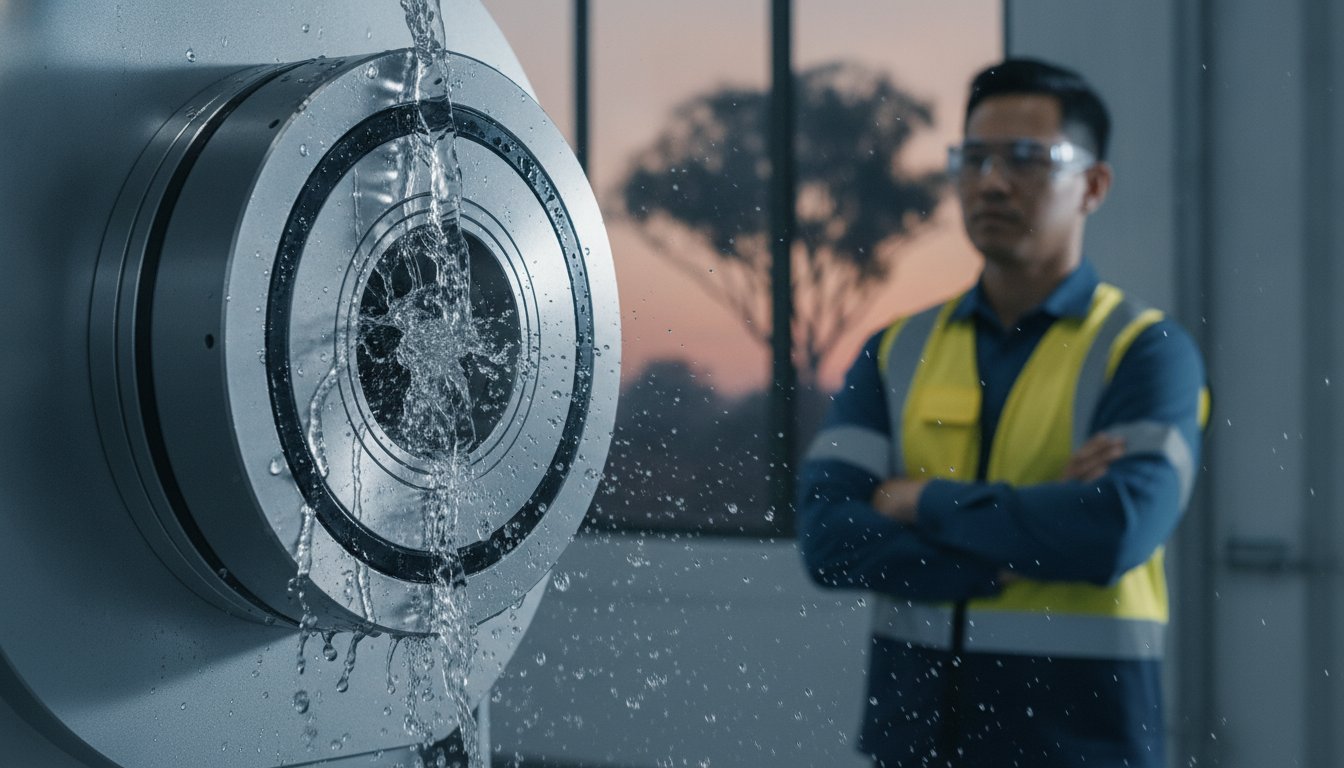
The second digit, 5, specifies protection against low-pressure water jets from any direction. It's often where terminology becomes imprecise. While many vendors use the term "waterproof", this is technically misleading for industrial hardware. An IP65 rating doesn't permit submersion; rather, it ensures the internal circuitry remains dry during standard hose-down procedures or heavy rain. If your application requires the component to sit underwater, you'll need to look toward IP68 solutions. For most factory floors and outdoor rotatory platforms, however, IP65 offers the optimal balance between protection and mechanical efficiency.
The Anatomy of an IP65 Sealed Slip Ring
Maintaining a seal while a shaft rotates continuously presents a significant engineering challenge. We categorise these into static and dynamic interfaces. Static seals, such as specialised gaskets and O-rings, secure the non-moving housing parts. Dynamic seals are more complex, as they must maintain contact with the rotating shaft without creating excessive friction or heat. Common housing materials include anodised aluminium for its weight-to-strength ratio or 316 stainless steel for corrosive coastal environments. High-performance units, such as those from Meridian Laboratory Slip Rings, utilise advanced sealing technologies to ensure these interfaces don't degrade under high-speed operation.
IP65 vs Standard Open-Style Slip Rings
Moving from an IP00 or IP40 "open-frame" component to an IP65 slip ring is a logical step when the operating environment contains moisture or fine particulates. Standard components lack the physical barriers required to prevent oil mist or dust from settling on the conductive rings. Once contaminants enter the contact zone, they cause erratic signal noise and accelerated wear. Beyond hardware longevity, there's a clear safety incentive. For high-voltage rotary transfers, an ingress of moisture can lead to tracking or catastrophic short circuits. Ensuring a sealed enclosure protects both the equipment and the personnel working in proximity to the machinery.
The Engineering Behind IP65 Sealing and Ingress Protection
Engineering a reliable IP65 slip ring requires solving the inherent conflict between a stationary seal and a rotating shaft. While a static enclosure is simple to protect, the 360-degree continuous rotation of a slip ring introduces mechanical wear that can degrade ingress protection over time. Designers must adhere to the IEC 60529 standard while managing the heat and friction generated at the sealing interface. If the engineering fails to account for these variables, the seal will eventually allow moisture or particulates to bypass the housing, leading to the electrical failures discussed previously.
Material selection for these seals is a critical decision point for any project manager. Nitrile (Buna-N) is the common standard for general industrial use, providing reliable oil resistance and durability. However, Australian sites often demand more resilient materials. Viton is frequently specified for its superior chemical resistance and ability to withstand higher temperatures, while PTFE (Teflon) is used when low rotational friction is a priority. The choice depends on the specific environmental stressors of your facility, such as exposure to hydraulic fluids or extreme ambient heat.
The longevity of any seal depends heavily on the surface finish of the rotating shaft it contacts. A surface that is too rough will quickly abrade the seal material, while one that is too smooth may not allow for a necessary microscopic lubricant film. Engineers typically aim for a specific Ra (roughness average) value to ensure the seal performs as intended for millions of revolutions. Additionally, sealed units must manage internal pressure. As the slip ring operates, internal friction generates heat, which causes the air inside to expand. Without proper thermal management, this pressure can compromise the seal's integrity.
Dynamic Sealing Mechanisms
Rotary shaft seals work by maintaining a precise contact pressure against the rotating component. There is a direct trade-off here: a tighter seal provides better protection but increases rotational friction and heat. For high-duty cycle applications, this friction can lead to premature seal failure if not properly lubricated. Some high-performance designs use labyrinth seals or multiple-lip configurations to provide redundant layers of protection without excessively increasing the torque required to turn the shaft.
Housing and Cable Exit Protection
The housing itself must be as robust as the internal seals. Cable entry points are common failure zones, so using high-quality cable glands or NPT (National Pipe Thread) connections is essential. For heavy-duty industrial applications, BGB Innovation slip rings are often selected for their rugged housing designs that stand up to corrosive chemical environments. If you are unsure which configuration best suits your equipment, our team can provide technical application consulting to help you select a solution that balances protection with mechanical performance.
IP65 vs IP67: Selecting the Correct Protection Level
Many engineers default to the highest possible IP rating, assuming more protection is always better. However, in the context of rotary electrical connectors, over-specifying can lead to unnecessary mechanical resistance. The primary boundary lies between an IP65 slip ring, designed to withstand low-pressure water jets (splash-proof), and an IP67 unit, which is rated for temporary immersion up to one metre. While the jump in protection seems logical, the mechanical trade-offs are significant and often counterproductive for high-speed machinery.
Choosing an IP65 rating is often the more pragmatic engineering choice for high-speed applications. Because an IP67 or IP68 seal must withstand hydrostatic pressure when submerged, it requires a much tighter fit against the rotating shaft. This increased contact pressure results in higher rotational friction, greater breakaway torque, and more internal heat generation. For a system spinning at 500 RPM or higher, this "seal penalty" can lead to premature wear or even thermal failure of the internal contacts. By selecting the correct level, you ensure reliability without introducing these mechanical burdens.
In Australian industrial facilities, it's essential to categorise zones based on actual risk rather than hypothetical extremes. Identifying "wash-down" areas versus "flood-risk" zones allows for a more efficient hardware selection while still adhering to Australian electrical safety regulations. Over-specifying to IP67 when IP65 is sufficient adds unnecessary capital expenditure and increases long-term maintenance requirements due to the aggressive nature of immersion-grade seals. It's about finding the "sweet spot" where protection meets performance.
When IP65 is the Right Choice
An IP65 slip ring is the industrial standard for most packaging machinery and food processing lines where indirect wash-downs occur. It's also ideal for outdoor equipment like revolving signage or crane pedestals that face heavy rain but won't be submerged. In dust-heavy environments, such as grain handling facilities or cement plants, the "6" in the rating provides the total dust-tight seal needed to protect internal conductive paths without the friction overhead of higher-rated components.
When to Upgrade to IP67 or IP68
Upgrading becomes necessary when the component faces a genuine risk of being underwater. This includes marine applications on offshore platforms or equipment used in wastewater treatment where submerged pumps are common. For a critical signal slip ring operating in high-humidity zones or areas prone to flash flooding, the added security of an immersion-rated seal ensures data integrity isn't compromised by moisture ingress. In these specific cases, the mechanical trade-offs are a necessary compromise for operational survival.
Operational Considerations: Torque, RPM, and Maintenance
Integrating an IP65 slip ring into an industrial system requires a clear understanding of the mechanical trade-offs involved. While the sealing provides essential protection, it introduces a "seal penalty" that manifests as increased torque. This resistance is categorised into breakaway torque, the force needed to start rotation, and running torque, the force required to maintain it. In precision applications, such as robotics or sensitive sensors, this additional drag must be accounted for during the initial design phase to ensure the drive motor is correctly sized for the load.
Rotational speed is another critical factor limited by the presence of a seal. Friction at the sealing interface generates heat, and as the RPM increases, the temperature of the seal lip rises. If the speed exceeds the manufacturer's specified limit, the seal material can harden or melt, leading to an immediate loss of ingress protection. While some open-frame units can spin at several thousand RPM, a sealed IP65 slip ring typically operates within a more conservative range to preserve the integrity of the dynamic interface. Engineers must balance the need for speed with the necessity of environmental shielding.
Routine inspection protocols are the most effective way to prevent catastrophic failure. Signs of seal degradation often appear before the unit stops functioning. Technicians should monitor for increased electrical noise or signal erraticism, which often indicates that moisture or dust has bypassed the seal and fouled the internal contacts. Visually inspecting the housing for any weeping of internal lubricants or signs of external moisture ingress can provide early warning of a compromised enclosure.
Managing Rotational Friction
Seal friction is not a constant value; it fluctuates based on ambient temperature and rotational speed. As the system warms up, some seal materials become more pliable, which can slightly reduce running torque. For applications involving sensitive instrumentation, it is vital to select low-torque designs that utilise specialised seal geometries or PTFE coatings. This drag does not just affect performance; it also impacts energy consumption. In large-scale operations with hundreds of rotating interfaces, the cumulative energy required to overcome seal friction can be a measurable operational cost.
Maintenance and Service Life
The question of whether seals can be replaced in the field depends on the specific architecture of the slip ring. Many compact or capsule-style units are factory-sealed and must be replaced entirely if the seal fails. Environmental factors common in Australia, such as high UV levels on outdoor sites or exposure to caustic cleaning agents in food plants, can accelerate the perishability of nitrile or viton components. Proper seal maintenance can extend slip ring life by up to 300%. If you need to verify the torque requirements or RPM limits for your specific application, you can view Mercotac slip ring specifications to compare performance data.
Specifying IP65 Slip Rings for Australian Industrial Projects
Specifying the correct IP65 slip ring for an Australian project involves more than matching a part number from a catalogue. It requires a methodical audit of the mechanical and environmental variables that will define the component's service life. When procurement and engineering teams collaborate on these specifications, they reduce the risk of premature failure and ensure the hardware remains compliant with local standards like AS 60529:2025. Following a structured selection process is the most reliable way to balance protection with operational efficiency.
The specification process should follow these four critical steps:
- Step 1: Define electrical circuit requirements. Determine the mix of power and signal circuits needed. High-current power transfers have different thermal profiles than sensitive Ethernet or sensor data signals, which can be affected by the electrical noise sometimes associated with sealed units.
- Step 2: Determine maximum operational RPM and duty cycle. As established, the seal introduces friction. You must verify that your required rotational speed doesn't exceed the thermal limits of the seal material during continuous operation.
- Step 3: Assess the specific contaminants. Are you defending against fine silica dust in a mining application, low-pressure water jets in a food plant, or oil mist in a machine shop? The nature of the contaminant dictates the seal material choice, such as Viton for chemical resistance or PTFE for low friction.
- Step 4: Consult with a specialist for custom requirements. Standard units don't always fit unique mounting footprints or specific cable exit needs. Consulting an expert ensures the final assembly integrates seamlessly with your existing machinery.
Industry-Specific Applications in Australia
In the Australian food and beverage sector, hygiene and wash-down resilience are paramount. We frequently recommend sealed Prosper Rotation slip rings to meet these rigorous standards while protecting internal contacts from cleaning agents. For material handling and dusty warehouse environments, the focus shifts to total dust exclusion to prevent signal degradation in automated sorting systems. In the most extreme conditions, such as Western Australian mine sites or offshore platforms, leveraging BGB slip rings Australia provides the heavy-duty housing and robust sealing required for survival in high-vibration and abrasive settings.
The TME Systems Technical Advantage
Our role is to act as a technical intermediary, helping you cross-reference IP ratings with the mechanical realities of your application. We provide access to specialised global brands, including Meridian Laboratory, known for high-performance sealing technologies that don't compromise on electrical signal integrity. By focusing on long-term reliability rather than just the initial purchase price, we help Australian businesses solve complex rotary transfer challenges. Whether you're designing a new system or retrofitting an existing one, our consulting approach ensures your IP65 slip ring is fit for purpose and built to last.
Optimising Rotary Reliability for Australian Industry
Selecting the right hardware is the first step toward eliminating preventable equipment failure in harsh operating conditions. We've analysed how the correct IP65 slip ring balances robust ingress protection with the mechanical realities of torque and RPM. By adhering to the AS 60529:2025 standard and following a methodical specification process, you can ensure your machinery remains operational while significantly reducing maintenance-related downtime.
As an authorised distributor for global leaders including Mercotac, BGB, and Meridian Laboratory, we offer more than just hardware. We provide specialised technical assistance for complex Australian industrial projects, ensuring that every component matches your specific environmental stressors and electrical requirements. Our extensive range of sealed and heavy-duty rotary solutions is designed to bridge the gap between manufacturing capabilities and real-world engineering needs.
Consult with TME Systems for technical selection support to identify the precise configuration for your next project. Taking the time to verify these technical parameters today ensures a more resilient and efficient facility tomorrow.
Frequently Asked Questions
Is an IP65 slip ring completely waterproof?
No, an IP65 slip ring is not designed for submersion. It is rated as "splash-proof," which means it can withstand low-pressure water jets from any angle without ingress. This level of protection is ideal for heavy rain or standard industrial wash-down procedures. If your application involves the component being underwater or in areas prone to flash flooding, you must specify an IP67 or IP68 rated unit instead.
How does an IP65 rating affect the maximum RPM of a slip ring?
An IP65 rating generally reduces the maximum allowable RPM compared to an unsealed unit. The physical contact between the dynamic seal and the rotating shaft creates friction, which generates heat during operation. If the rotation speed is too high, this thermal energy can degrade the seal material or cause it to fail prematurely. Most sealed units operate most reliably at speeds below 500 RPM, depending on the seal diameter.
Can I use an IP65 slip ring in a marine environment?
You can use an IP65 slip ring in marine environments for above-deck applications where protection from salt spray and rain is the primary concern. It is not suitable for equipment that faces heavy wave impact or temporary submersion. For offshore platforms or shipboard machinery exposed to the open sea, we often recommend upgrading to an IP67 rating to ensure the internal contacts are protected from corrosive salt-water ingress.
What is the difference between IP65 and IP66 for rotary connectors?
The primary difference lies in the intensity of the water protection. While both ratings are "dust-tight," an IP65 unit is tested against low-pressure water jets, whereas an IP66 rating must withstand high-pressure, heavy seas or powerful jets. For the majority of Australian factory wash-down procedures, IP65 is sufficient. If your cleaning protocol involves high-pressure hoses aimed directly at the connector, an IP66 enclosure provides a necessary extra layer of security.
Do IP65 slip rings require more maintenance than unsealed units?
They generally require less frequent internal maintenance because the sealed housing prevents dust and grit from fouling the conductive paths. However, they do require regular external inspections of the seal's physical condition. Unsealed units often fail due to contaminant accumulation, while a sealed unit's longevity depends entirely on the integrity of the dynamic interface. Monitoring for seal wear, hardening, or weeping of internal lubricants is essential to prevent downtime.
Can an IP65 rating protect against chemical wash-downs in food processing?
Yes, an IP65 rating provides the physical barrier against fluid ingress, but the seal material must be compatible with your specific cleaning chemicals. Standard nitrile seals may degrade when exposed to the caustic agents or acidic sanitisers used in food processing. In these environments, we specify Viton or PTFE seals to ensure the barrier remains effective. Always cross-reference your facility's chemical profile with the seal's material properties before installation.
How do I ensure the cable entry remains IP65 rated?
You must use high-quality, correctly sized cable glands or NPT connectors to maintain the rating at the entry point. The housing is only as secure as its weakest interface. If the cable entry isn't sealed with a compression fitting that matches the cable diameter exactly, moisture and dust will bypass the housing. Ensuring a tight, mechanical seal at every exit point is critical for the overall environmental resilience of the system.
Does an IP65 housing increase the electrical noise of the slip ring?
An IP65 housing does not directly increase electrical noise, but the heat generated by seal friction can indirectly impact signal integrity. If the internal temperature rises significantly due to high-speed rotation, it can affect contact resistance or the viscosity of internal lubricants. Selecting a high-performance unit with low-friction seals ensures that signal-to-noise ratios remain within acceptable limits for Ethernet or other sensitive data protocols used in Australian industry.