A single ingress of abrasive dust or a persistent humid mist can bring an entire production line to a standstill, turning a high-performance rotary system into a costly liability. Most engineers recognise that while standard enclosures might suffice in controlled settings, the reality of Australian industrial sites demands a far more rigorous approach to ingress protection. You've likely experienced the frustration of premature contact corrosion or signal degradation caused by fine particulates bypassing an inadequate seal.
This technical reference provides the engineering clarity needed to specify an IP65 slip ring that actually survives the local environment. We'll help you master the technical requirements to ensure your equipment maintains signal integrity and mechanical reliability in the face of dust and low-pressure water jets. You'll learn how to balance sealing integrity with mechanical performance to ensure long-term reliability and reduced maintenance. We'll examine the precise differences between IP65 and higher ratings, the impact of sealing on rotational torque, and the selection criteria for components from manufacturers like BGB Innovation and Prosper Rotation.
Key Takeaways
- Understand the IEC 60529 standard to differentiate between "dust-tight" protection and various levels of moisture ingress.
- Identify the critical trade-offs between IP65 and IP67 ratings, specifically how higher protection levels can increase rotational torque and affect system efficiency.
- Learn how to select an IP65 slip ring that withstands the unique challenges of Australian mining and food processing environments, from fine ore dust to high-pressure washdowns.
- Evaluate dynamic sealing challenges and material compatibility to prevent seal degradation caused by chemical exposure or UV radiation.
- Leverage technical consulting to access specialised hardware from world-leading brands like BGB Innovation and Mercotac for long-term reliability.
What is an IP65 Slip Ring? Defining Ingress Protection for Rotation
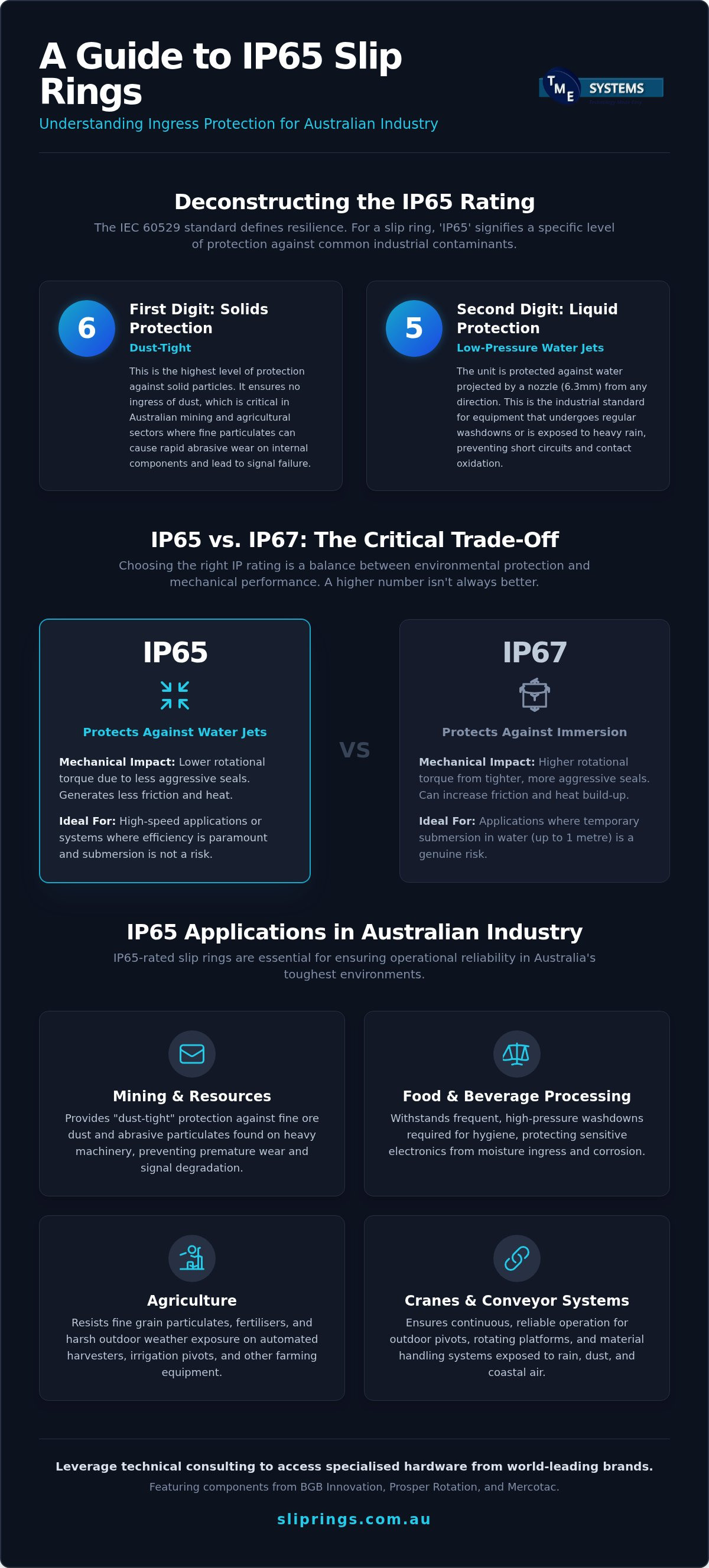
The IP Code, defined by the IEC 60529 standard, provides a framework for identifying the environmental resilience of electrical hardware. For a rotating component like an IP65 slip ring, these digits signify a specific level of protection against the elements commonly found on Australian worksites. While a static electrical box is relatively simple to seal, protecting a rotating interface requires an advanced understanding of mechanical tolerances and material science. This rating ensures that the internal electrical contacts remain isolated from external contaminants while the unit maintains continuous motion.
The First Digit: Total Protection Against Solid Particles
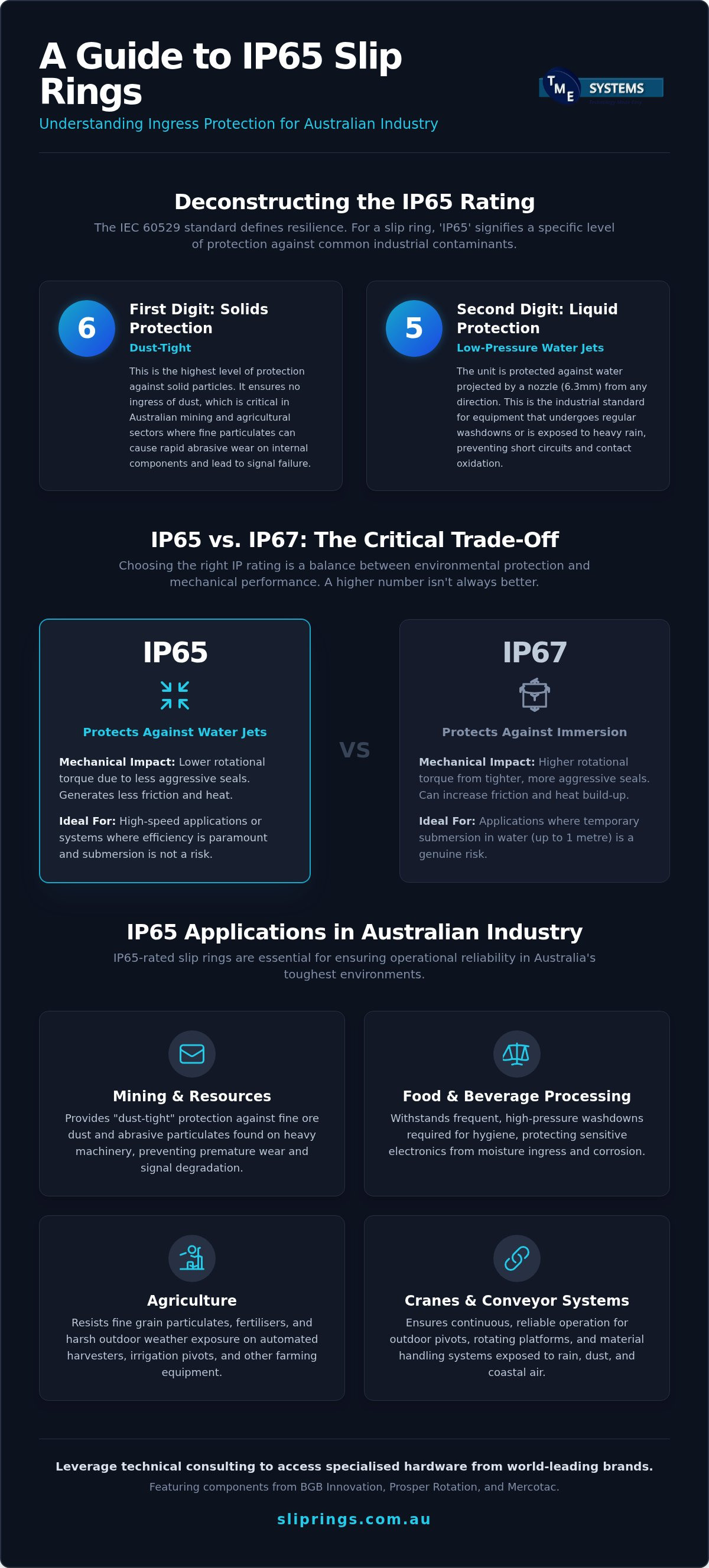
In the context of an IP65 rating, the first digit "6" represents the highest level of protection against solid ingress. This "dust-tight" status is vital for Australian mining and agricultural sectors, where fine silica dust or grain particulates can easily penetrate unsealed housings. Once inside, these abrasive particles act like sandpaper on the internal brush-and-ring interface, leading to rapid wear, increased electrical noise, and eventual signal failure. Testing for the digit 6 involves placing the device in a vacuum chamber for up to eight hours with circulating talcum powder to ensure no dust enters the enclosure.
The Second Digit: Resisting Water Ingress in Industrial Environments
The second digit "5" indicates that the enclosure can withstand low-pressure water jets from any direction. This is a critical distinction for equipment that undergoes regular washdowns or operates in heavy rain without being fully submerged. An IP65 slip ring is designed to prevent ingress from a 6.3mm nozzle delivering 12.5 litres of water per minute. This makes it the industrial standard for outdoor conveyor systems, packaging machinery, and crane pivots where environmental exposure is inevitable but submersion is unlikely. It provides a reliable barrier against moisture that could otherwise cause short circuits or contact oxidation.
Why Rotation Complicates Ingress Protection
Maintaining an IP rating on a rotating shaft is significantly more complex than sealing a stationary enclosure. Static seals rely on simple compression, but a slip ring must maintain a "dynamic seal" that stays intact during continuous 360-degree movement. This requires specialised components, such as those found in BGB Innovation slip rings or Prosper Rotation slip rings, which use precision-engineered O-rings or lip seals. These seals must provide enough pressure to keep out contaminants without generating excessive friction. If the seal is too tight, it increases rotational torque and heat; if it's too loose, the environmental protection is compromised. Achieving this balance is what separates a high-performance industrial slip ring from a standard commercial alternative.
IP65 vs. IP67: Deciphering Protection Levels for Rotary Connectors
Selecting the correct ingress protection rating requires more than just picking the highest number available. While an IP65 slip ring is engineered to withstand low-pressure water jets, an IP67 rating signifies protection against temporary immersion in water up to one metre deep. According to the International Electrotechnical Commission (IEC), the jump from digit 5 to digit 7 represents a fundamental change in testing and sealing requirements. For many Australian industrial applications, the choice between these two levels dictates not just environmental survival, but the long-term mechanical health of the system.
Mechanical Implications of Higher IP Ratings
Achieving an IP67 rating often involves the use of more aggressive contact seals, such as heavy-duty O-rings or radial lip seals. These components create a tighter interface between the stationary and rotating parts of the housing. This increased seal pressure directly translates into higher rotational torque. If your application involves high-speed rotation, the friction generated by these seals can lead to significant heat build-up. Excessive heat doesn't just degrade the seal material; it can also affect the electrical properties of the internal contacts, leading to signal instability. When specifying high-protection units, choosing stainless steel housings can help with thermal management and structural integrity.
Choosing the Right Rating for Your Application
Over-specifying to IP67 when an IP65 slip ring is sufficient can be a costly mistake. In high-speed machinery, the constant friction of an immersion-grade seal can cause premature wear, leading to seal failure faster than a lighter IP65 seal would. A practical decision framework should focus on the nature of water exposure. If the unit is subject to regular washdowns or outdoor rain, IP65 is typically the most efficient choice. However, if there is any risk of the unit being submerged due to flooding or process requirements, the upgrade to IP67 or even IP68 is mandatory. For heavy-duty applications requiring robust environmental seals, BGB Innovation slip rings provide a range of solutions engineered for these specific trade-offs. If you're unsure which rating balances protection with performance, you can consult our technical specialists to review your specific operational parameters.
Industrial Applications for IP65 Rated Slip Rings in Australia
Australian industries operate in some of the world's most unforgiving environments. From remote iron ore mines to high-humidity food processing plants, the demand for an IP65 slip ring is driven by a need for operational continuity. Adhering to standards like BS EN 60529 ensures that these components can withstand the ingress of fine solids and low-pressure water jets, which are common across diverse sectors. In the agricultural sector, centre-pivot irrigation systems rely on sealed rotary unions to maintain power and control signals while exposed to constant UV radiation and water spray. Similarly, the food and beverage industry requires equipment that meets strict hygiene standards. Frequent washdown cycles involve low-pressure water jets that would quickly compromise an unrated connector. An IP65 rating provides the necessary barrier to keep moisture away from sensitive electrical contacts without the mechanical overhead of fully submersible seals.
Heavy Industry and Mining Requirements
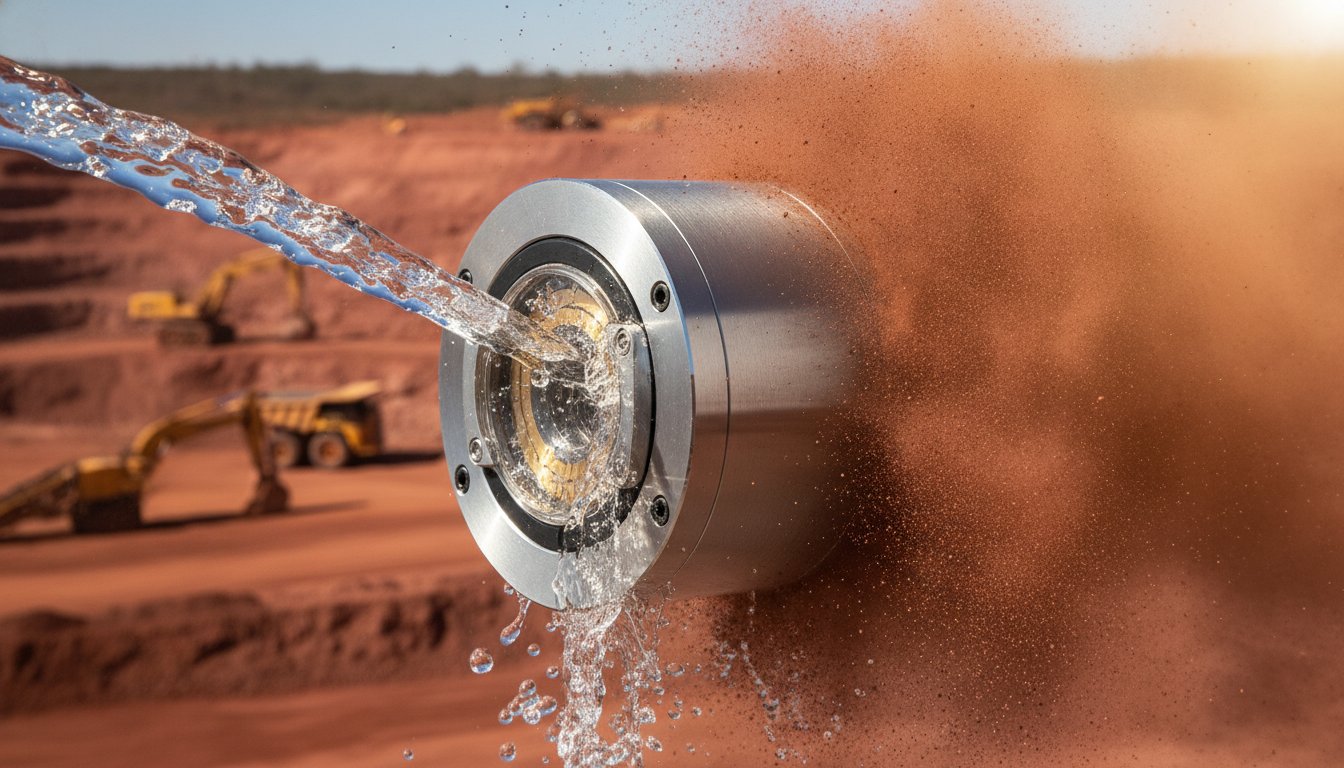
Mining and quarrying operations present perhaps the greatest challenge to rotary equipment. Fine, abrasive ore dust can infiltrate standard housings, causing electrical noise and signal degradation. This interference is particularly problematic when transmitting sensitive data or control signals. To combat this, BGB Innovation slip rings are frequently specified for their robust construction and superior sealing capabilities. These units are designed to handle the vibratory loads and environmental stressors found on heavy-duty sites. For more details on these applications, see our guide on Heavy Duty Solutions for Industrial Rotation. In these settings, the "dust-tight" nature of the 6-digit rating is more than a specification; it's a prerequisite for preventing abrasive wear on internal contact surfaces.
Outdoor and Marine-Adjacent Applications
Coastal and marine-adjacent sites face the additional threat of salt-laden air, which accelerates the corrosion of standard metallic components. An IP65 slip ring used in radar pedestals or CCTV systems must utilise non-corrosive housing materials, such as high-grade stainless steel or specialised polymers, to maintain structural integrity. This level of protection is also essential for renewable energy projects. Wind turbines and solar tracking systems require continuous rotation in outdoor environments where rain and wind-blown debris are constant factors. By ensuring the enclosure is both dust-tight and jet-proof, engineers can significantly extend the time between service intervals and prevent the catastrophic failure of critical infrastructure. This pragmatic approach to sealing ensures that signal integrity remains high even when the external conditions are at their most volatile.
Key Technical Considerations When Specifying Sealed Slip Rings
Specifying an IP65 slip ring requires a deeper analysis of the mechanical interface than simply checking a datasheet. The primary challenge is dynamic sealing. While a static gasket only needs to maintain pressure, a rotary seal must manage the friction and heat generated by a shaft moving at significant speeds. Over time, this friction can degrade the seal material, leading to a loss of ingress protection even if the housing remains intact. Selecting a seal material that matches both the rotational speed and the external environmental stressors is critical for long-term reliability.
Signal Integrity in Sealed Environments
Internal condensation is a common but overlooked cause of signal failure. Even with a robust IP65 seal, temperature fluctuations can cause moisture to drop out of the air inside the housing. Using internal desiccants or specifically engineered venting systems can mitigate this risk. For applications where signal noise must be kept to an absolute minimum despite environmental challenges, Mercotac slip rings utilise liquid metal contact technology. This design offers exceptionally low resistance and remains stable even when the external environment is volatile.
Mounting and Installation Best Practices
The integrity of the entire system is only as strong as its weakest point. Cable entry is frequently where ingress occurs. You must ensure that all cable glands and connectors carry a matching or superior rating to the slip ring itself. Mounting orientation also plays a vital role. If a unit is installed with the seal facing upwards in an outdoor environment, water can pool against the seal, increasing the likelihood of ingress over time. Always organise the installation so that moisture naturally sheds away from the rotary interface.
Chemical compatibility is another vital factor. Standard nitrile seals may fail quickly if exposed to certain industrial oils or cleaning agents used in food processing. Always verify that the seal and housing materials resist the specific chemicals present on your site. Regular inspection should focus on identifying signs of seal wear, such as fine debris around the shaft or changes in rotational torque. If you require assistance in matching a specific chemical environment to the right hardware, you can consult our technical team for a detailed application review.
Sourcing High-Performance Protected Slip Rings from TME Systems
TME Systems Pty Ltd serves as the technical bridge between global manufacturing expertise and the specific demands of Australian industry. Selecting an IP65 slip ring involves more than a simple transaction; it requires a deep understanding of how environmental sealing interacts with electrical performance. We provide access to high-performance hardware from world-leading brands, including Mercotac, Meridian Laboratory, BGB Innovation, and Prosper Rotation. This ensures that whether your project requires low-noise liquid metal connectors or heavy-duty collector rings for mining, the solution is technically verified for the application before it reaches your site.
The TME Systems Technical Advantage
Our consultative approach focuses on identifying potential failure points before procurement occurs. We evaluate circuit counts, current requirements, and environmental ratings to ensure the chosen hardware matches the operational reality. Many engineers face challenges with over-specifying IP ratings, which can lead to unnecessary torque and heat as discussed in previous sections. We help you navigate these trade-offs to maximise equipment lifespan and reduce maintenance intervals. For a deeper look at our specialised selection process, refer to our guide on Industrial Slip Rings Australia: The Technical Procurement Reference.
Get Expert Advice for Your Next Project
Early-stage involvement in the design cycle is the most effective way to ensure signal integrity and mechanical reliability. Our team provides technical assistance across the country, ensuring that regional mining sites and metropolitan processing plants receive the same level of specialist support. This national expertise is vital when customising a solution for unique environmental challenges, such as extreme UV exposure or specific chemical washdowns. We manage the complexities of international sourcing and technical verification so you can focus on the broader engineering goals of your project.
When requesting a quote, providing specific data points such as rotational speed, duty cycle, and the nature of external contaminants allows us to provide a more accurate recommendation. We offer national delivery and technical support to ensure your installation remains on schedule and performs as expected. You can Contact TME Systems for technical assistance with IP65 slip rings to discuss your specific environmental requirements and performance goals. Our objective is to ensure that your rotary electrical connections provide stable, long-term performance in the most demanding Australian conditions.
Optimising Rotary Performance in Harsh Environments
Choosing the right IP65 slip ring is a technical decision that balances environmental resilience with mechanical efficiency. You've seen that while a dust-tight and jet-proof rating is essential for Australian mining and manufacturing, over-specifying can lead to unnecessary friction and heat. The key is to match the sealing technology to your specific operational parameters, whether you're managing fine ore dust or frequent washdown cycles. Signal integrity doesn't have to be a casualty of harsh conditions if the hardware is correctly specified from the start.
As the official Australian distributor for BGB Innovation and Mercotac, TME Systems provides the technical consulting necessary to navigate these complexities. We offer specialised solutions for mining, marine, and manufacturing based on decades of industrial experience. Our team helps you avoid common specification errors and ensures your rotary systems maintain long-term reliability.
Consult with TME Systems for Professional Slip Ring Selection to secure the most dependable components for your next project. We look forward to helping you solve your most difficult environmental challenges with precision-engineered hardware.
Frequently Asked Questions
Can an IP65 slip ring be used underwater for short periods?
No, an IP65 rated unit is not designed for submersion. The "5" in the rating indicates protection against low-pressure water jets from any direction; however, it does not certify the component for temporary or continuous immersion. If your application involves underwater operation, you must specify an IP67 or IP67 rated component. Submerging a standard IP65 unit will likely lead to immediate water ingress and catastrophic electrical failure.
How does an IP65 rating affect the maximum RPM of a slip ring?
An IP65 rating typically reduces the maximum RPM compared to an unsealed unit. The contact seals required to maintain a dust-tight and jet-proof barrier create mechanical friction against the rotating shaft. This friction generates heat and increases rotational torque. If you operate at high speeds, this heat can degrade the seal material or internal contacts. Engineers should consult technical datasheets to ensure the seal's surface speed limit matches the operational RPM.
Do IP65 slip rings require more maintenance than unsealed versions?
Sealed slip rings generally require less frequent internal cleaning because the enclosure prevents the buildup of external contaminants. However, the seals themselves become a critical maintenance item. You should regularly inspect the rotary interface for signs of wear, such as seal debris or hardening. While an unsealed unit might fail due to dust ingress, an IP65 slip ring usually fails because a worn seal was not replaced during a scheduled service interval.
What is the difference between IP65 and IP66 for rotating equipment?
The primary difference lies in the intensity of water exposure. IP65 protects against low-pressure water jets, while IP66 is rated for powerful water jets, such as those used in heavy-duty washdown environments. For rotating equipment, achieving an IP66 rating requires significantly more aggressive sealing pressure. This often results in higher rotational torque and more restricted thermal dissipation compared to a standard IP65 configuration, making it less suitable for high-speed applications.
Are all Mercotac slip rings rated for IP65 protection?
Not all Mercotac models are IP65 rated by default. Many standard Mercotac liquid metal connectors carry an IP51 or IP54 rating, which is suitable for controlled industrial environments. To achieve an IP65 slip ring specification with Mercotac technology, you often need to select a model from their protected series or utilise a secondary specialised housing. TME Systems provides technical consulting to help you determine which Mercotac configuration suits your specific environmental stressors.
How do I ensure the cable entry into the slip ring remains IP65 compliant?
Maintaining compliance requires the use of IP65 rated cable glands that match the outer diameter of your cabling. The seal is only as effective as its weakest point; an unsealed cable entry provides a direct path for moisture and dust. You must ensure the glands are tightened correctly and that the mounting surface is flat. Using drip loops in your cable runs also prevents water from tracking along the wire and pooling at the entry point.
Can fine mining dust penetrate an IP65 rated seal over time?
The "6" in IP65 indicates the unit is dust-tight, meaning no ingress should occur under standard testing conditions. However, the abrasive nature of Australian mining dust can cause physical wear on the seal lip over time. If a seal becomes brittle or worn, fine particulates may eventually bypass the barrier. Regular visual inspections and selecting robust hardware from brands like BGB Innovation are essential for maintaining protection in high-dust environments.
What housing materials are best for IP65 slip rings in coastal environments?
For coastal or marine-adjacent sites, 316-grade stainless steel is the preferred housing material. Standard aluminium or lower-grade steels can suffer from rapid pitting and galvanic corrosion when exposed to salt-laden air. Specialised engineering polymers are also an effective alternative for certain applications. These materials ensure that the housing maintains its structural integrity and that the IP65 seals remain properly seated and compressed throughout the service life of the component.