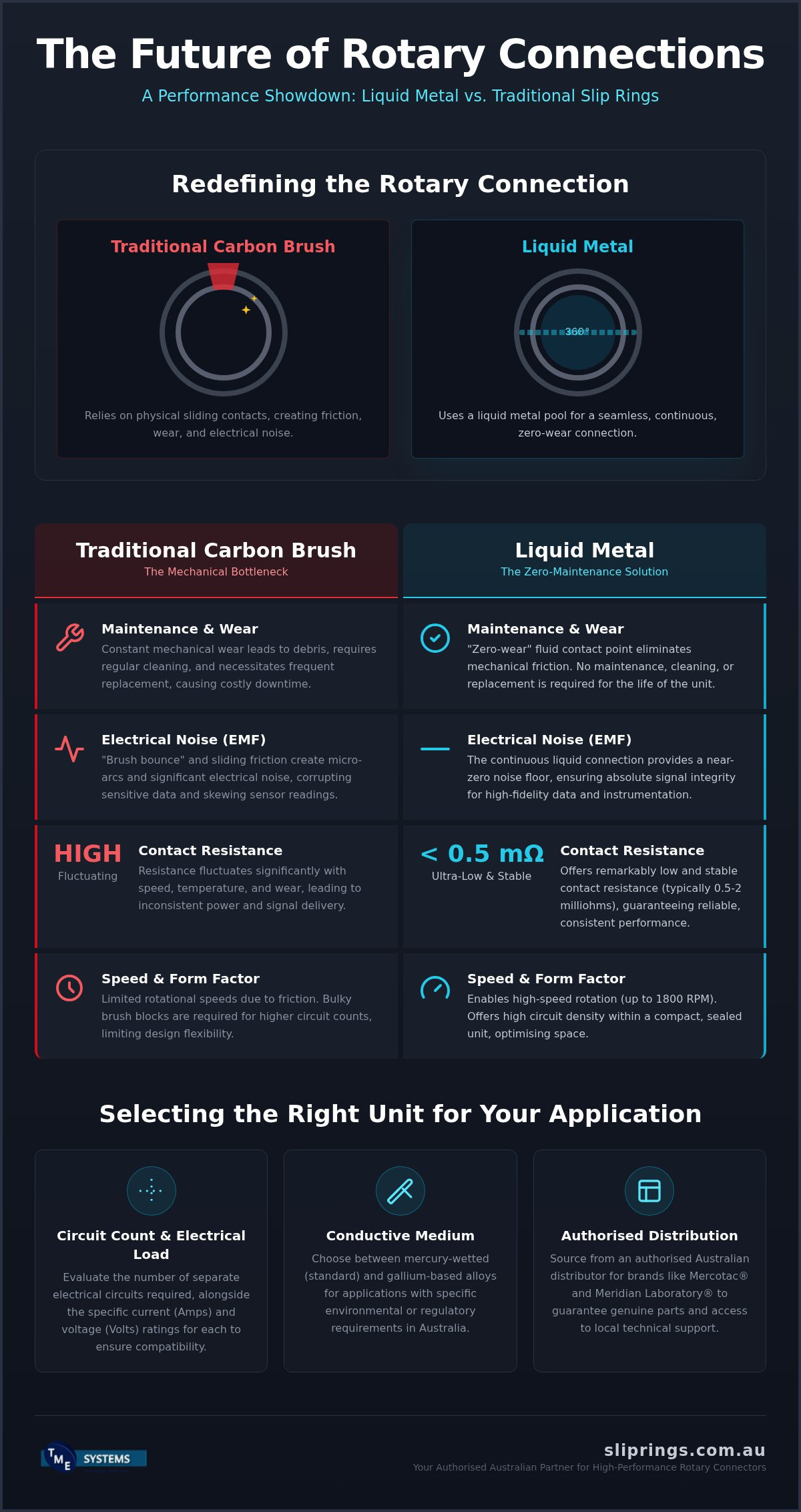
Traditional carbon brushes are often the weakest link in a rotating system, turning high-precision engineering into a repetitive cycle of maintenance and signal degradation. If you've managed industrial machinery, you've likely dealt with the frustration of electrical noise disrupting sensitive data or the recurring cost of downtime required to replace worn contacts. These mechanical limitations aren't just an inconvenience; they're a bottleneck for high-performance applications that require absolute signal integrity.
Integrating a liquid metal slip ring into your system changes the fundamental physics of the rotary connection. By replacing sliding friction with a pool of conductive liquid metal, you can achieve contact resistance as low as 0.5 milliohms and virtually eliminate electrical noise. This technical guide explores how these connectors provide a zero-maintenance solution for high-speed rotation and sensitive data transmission. We will detail the performance differences between mercury and gallium-based alloys, discuss compliance with Australian safety standards, and provide a framework for selecting the right Mercotac or Meridian Laboratory unit to optimise your specific industrial application.
Key Takeaways
- Understand why a liquid metal slip ring is the only viable solution for high-fidelity signal transmission and high-speed rotation without mechanical wear.
- Compare mercury-wetted and gallium-based conductive mediums to determine the best fit for your application's environmental and regulatory requirements.
- Learn how to evaluate circuit counts, current ratings, and voltage specifications to ensure your rotary connector handles the specific electrical load of your machinery.
- Gain insights into the zero-maintenance advantages of liquid metal technology, reducing the frequency of downtime associated with traditional brush systems.
- Discover the importance of authorised Australian distribution and technical consulting when selecting specialised hardware from brands like Mercotac or Meridian Laboratory.
What is a Liquid Metal Slip Ring?
A slip ring is a fundamental electromechanical device, but the liquid metal variant represents a significant technological leap. A liquid metal slip ring functions as a rotary electrical connector that uses a pool of conductive liquid metal to maintain a bridge between stationary and rotating components. Unlike traditional designs that rely on physical sliding brushes, these units use a liquid interface to facilitate the flow of current. You'll often hear them referred to as mercury-wetted slip rings or liquid metal rotary connectors in technical specifications. The core function remains the same: providing a continuous electrical connection between a stationary stator and a rotating rotor without the need for wires that would eventually tangle or snap.
The elimination of physical friction is the primary driver for adoption in Australian industrial environments. In a standard brush-based system, the mechanical contact eventually leads to material degradation, debris buildup, and fluctuating resistance. By using a liquid medium, you achieve a "zero wear" contact point. This provides near-constant electrical resistance, typically measured between 0.5 and 2 milliohms. It ensures long-term reliability without the maintenance overhead of traditional alternatives. This revolution in component longevity means that once a unit is installed, the cycle of routine brush replacement and cleaning is effectively removed from the maintenance schedule.
The Evolution of Rotary Electrical Connectors
Industrial requirements have shifted. While carbon brushes were sufficient for simple power transmission, modern automation relies on high-fidelity data and sensitive instrumentation signals. Traditional brushes often suffer from "brush bounce" and electrical noise, which can corrupt data packets or skew sensor readings. Liquid metal interfaces solve this by providing a continuous, stable connection. This transition allows engineers to scale up rotational speeds and data rates simultaneously, meeting the demands of high-speed manufacturing and precision robotics. The liquid medium also assists in heat dissipation, preventing the thermal issues often associated with high-current sliding contacts.
Key Components and Construction
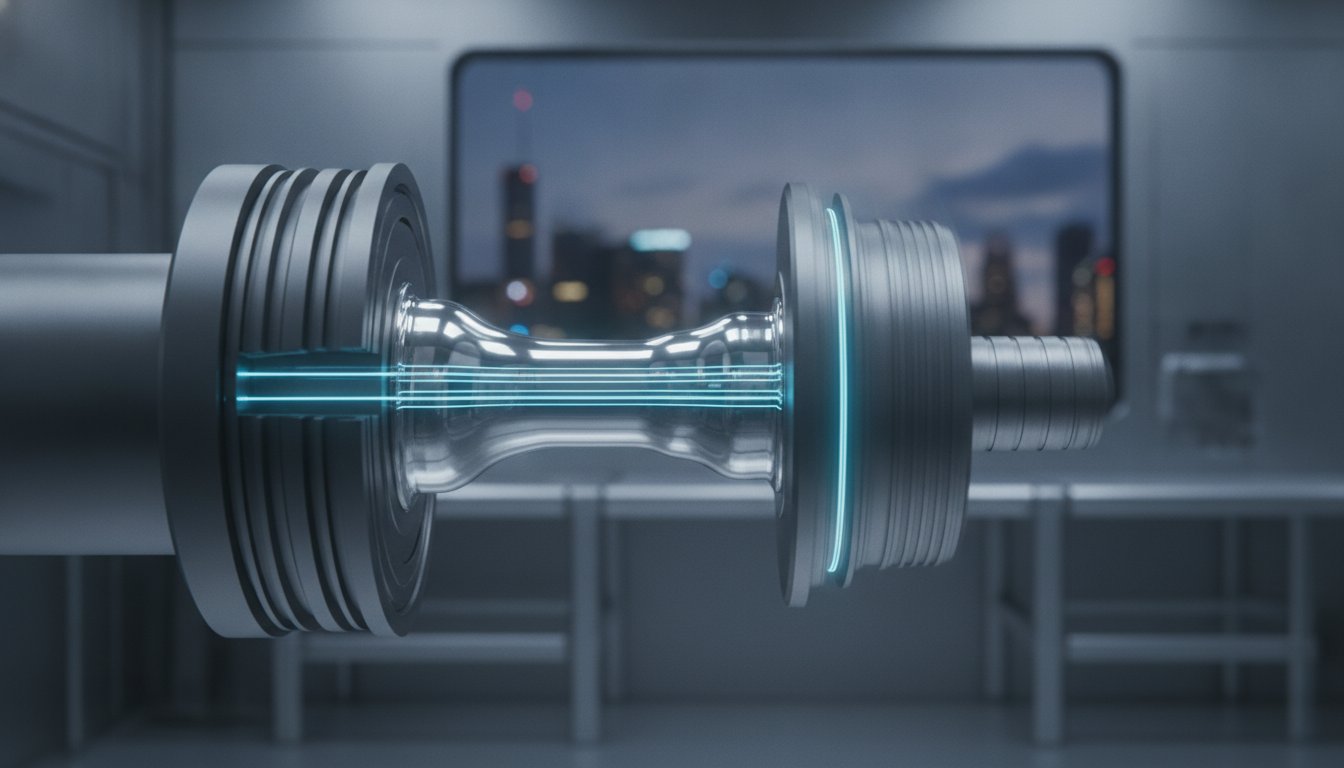
The construction of these units is remarkably robust. Every Mercotac slip ring or Meridian Laboratory unit consists of an internal rotor and stator housed within a precision-sealed enclosure. These components are designed to interact through a specific conductive medium, usually a mercury or gallium-based alloy, which creates a 360-degree contact surface. Advanced sealing technologies are critical here, ensuring the housing remains leak-proof even in high-vibration environments. This configuration ensures that the electrical path remains unbroken, even at speeds reaching 1800 RPM, providing a level of performance that solid contacts simply cannot match.
The Engineering Advantages of Liquid Metal Contacts
Transitioning to a liquid metal slip ring addresses the fundamental mechanical constraints of traditional rotary connectors. Because these units use a fluid conductive path, they offer significantly higher circuit densities within a smaller physical footprint. This compact form factor allows engineers to integrate complex power and data channels into tight spaces where bulky brush blocks simply wouldn't fit. Beyond spatial efficiency, the primary engineering draw is the total elimination of wear-related maintenance. You don't need to clean carbon dust, apply lubrication, or schedule downtime for brush replacements. This reliability is particularly valuable in remote Australian industrial sites where frequent technician visits are costly.
Eliminating Electrical Noise (EMF)
The stability of electrical resistance is where liquid metal truly outperforms solid contacts. Traditional brushes create micro-arcs and fluctuating resistance as they slide, leading to signal degradation. In contrast, liquid metal maintains a constant contact resistance, often staying within the 0.5 to 2 milliohm range. This level of precision is vital for high-fidelity signals in robotics and medical imaging, where even minor interference can lead to data corruption. The signal-to-noise ratio in a rotary joint is the measure of desired signal strength relative to background electrical interference generated by contact friction. For sensitive applications like thermocouples, this near-zero noise floor ensures that data remains accurate regardless of the rotational environment.
Performance at High Rotational Speeds
High-speed applications, such as centrifuges and packaging machinery, highlight the limits of traditional hardware. At high RPM, centrifugal forces and mechanical vibrations cause "brush bounce," where the solid contact momentarily lifts off the ring. A liquid metal slip ring maintains a 360-degree connection because the fluid medium naturally fills the contact gap regardless of speed. Early NASA development of liquid metal slip rings confirmed that these interfaces could operate reliably at speeds where solid brushes would suffer from excessive heat and friction. While larger units face turbulence limits, specialised models can operate effectively up to 1800 RPM. Mercotac slip ring units are often the preferred choice for these high-speed Australian production lines due to their proven stability under load. If you're managing a system where data dropouts occur during peak operation, reviewing your rotary connector's RPM rating is a logical first step in your technical audit.
Mercury vs. Gallium: Choosing the Right Conductive Medium
Selecting the appropriate conductive medium for a liquid metal slip ring requires a balance between electrical performance and environmental constraints. While both mercury and gallium alloys provide the "zero wear" advantage discussed earlier, their physical properties dictate their suitability for specific Australian industrial sectors. Mercury has long been the primary choice due to its exceptional conductivity and liquid state across a broad temperature range. However, the rise of stringent safety protocols in food and pharmaceutical production has accelerated the adoption of gallium-based alternatives. Integrating a liquid metal slip ring into your machinery requires a clear understanding of how these internal conductive mediums interact with your operating environment.
When to Specify Mercury-Wetted Connectors
Mercury-wetted units are the industry standard for applications demanding maximum circuit life and the lowest possible electrical resistance. They are frequently found in heavy-duty equipment like cable reels and packaging machinery where high current loads are common. A historical Liquid metal slip ring experiment highlighted that mercury's low viscosity allows for stable connections even under significant rotational stress. Within this category, Mercotac slip rings are widely specified for their reliable sealing and high-speed capabilities. These units are self-contained and require no internal maintenance, provided they are operated within their thermal and electrical limits. They remain the benchmark for high-power transmission where environmental toxicity is not a restricted variable.
The Rise of Mercury-Free Gallium Alloys
For industries where mercury is prohibited, such as food processing or pharmaceutical manufacturing, gallium-based alloys provide a viable alternative. These "mercury-free" models typically use Galinstan, a eutectic alloy of gallium, indium, and tin. This medium allows manufacturers to comply with RoHS (Restriction of Hazardous Substances) directives, which Australia follows to align with international trade standards. While gallium alloys have a slightly higher electrical resistance and a narrower operating temperature range than mercury, they offer the same low-noise benefits essential for sensitive instrumentation. You must consider that gallium-based alloys can become more viscous at lower temperatures, which may increase rotational torque in cold storage environments.
Safety and handling remain paramount when managing any liquid metal component. Australian safety standards require that mercury-containing devices are disposed of through specialised hazardous waste channels at the end of their service life. Gallium is significantly easier to handle and transport, making it the preferred choice for organisations with strict environmental and sustainability policies. It doesn't carry the same toxicity risks, which simplifies site-specific risk assessments. When choosing between the two, we recommend evaluating the sensitivity of your end product and your facility's specific environmental compliance requirements.
Technical Specification and Selection Guide
Selecting a liquid metal slip ring requires a precise audit of your system's operational parameters. It's not a one-size-fits-all component; you must match the hardware to the specific electrical and mechanical load of your machinery. Start by defining the required circuit count and current rating. Modern industrial units are engineered to handle a broad spectrum of loads, ranging from 1A for sensitive data signals up to 1000A for heavy power transmission. Voltage specifications are equally critical to ensure dielectric strength. In Australia, your selection must be compatible with standard nominal voltages, such as 230V for single-phase or 400V for three-phase systems, as defined by AS IEC 60038:2022.
Mechanical integration depends largely on the mounting style of the unit. You can specify compact capsule designs for restricted spaces, flange mounts for simplified installation, or through-bore models if you need to pass a central shaft or pneumatic lines through the assembly. Environmental protection is another vital consideration. For equipment operating in exposed or high-debris Australian environments, look for high IP ratings to ensure the housing effectively prevents dust and moisture ingress from compromising the internal liquid metal pool.
Calculating Your RPM and Duty Cycle
Your rotational speed directly dictates the choice of internal bearings and seal types. While high-performance models can operate at speeds up to 1800 RPM, continuous high-speed operation generates different thermal profiles than intermittent rotation. Integrating Meridian Laboratory slip rings is often the preferred route for precision RPM requirements where rotational stability is paramount. Component life is significantly extended when the duty cycle is correctly matched to the seal's thermal threshold, preventing premature degradation of the conductive medium.
Environmental and Temperature Variables
Operating temperature ranges vary between different liquid metal alloys. You must ensure the freezing and boiling points of the conductive medium align with your site's ambient conditions to prevent the metal from solidifying or expanding excessively. If your machinery is subject to high vibration or mechanical shock, the housing material becomes a priority. Aluminium offers a lightweight solution for standard automation, while stainless steel is essential for corrosion resistance in chemical processing or coastal environments. Selecting the wrong housing material can lead to accelerated wear or housing failure in aggressive operating conditions.
Choosing the correct specifications ensures long-term reliability and prevents costly integration errors. If you're unsure which parameters are most critical for your system, you can request a technical consultation to review your application requirements with a specialist.
Procuring Liquid Metal Slip Rings in Australia
Procuring a liquid metal slip ring in Australia requires more than just selecting a part number from a digital catalogue. Because these components are precision-engineered for specific electrical and mechanical environments, obtaining hardware through authorised distribution channels is essential. This ensures you receive genuine parts from brands like Mercotac and Meridian Laboratory, backed by the manufacturer's full technical support. Unauthorised or grey-market alternatives often lack the rigorous sealing and conductive medium purity required to maintain the high-performance standards discussed in previous sections. Working with an authorised partner guarantees that the internal components meet the exact specifications required for your industrial application.
Why Technical Consultation Matters
Selecting the wrong unit often leads to circuit count errors or dielectric breakdown if voltage ratings aren't strictly observed. Engaging with industrial slip ring suppliers in Australia allows you to bridge the gap between factory specifications and your specific site conditions. Technical consultants can assist with unique mounting configurations or environmental constraints, such as the need for specialised stainless steel housings in corrosive coastal environments. This collaborative approach prevents common pitfalls that lead to system failure or expensive retrofitting. It's about finding a solution that fits your specific mechanical envelope while meeting all electrical load requirements without compromise.
Proper slip ring application engineering provides a framework for ensuring total system compatibility. This process involves a thorough review of rotational speeds, duty cycles, and signal types, whether you're transmitting high-amperage power or sensitive data packets. By auditing these variables before procurement, you ensure the chosen liquid metal slip ring integrates seamlessly with your existing PLC or motor control systems. This engineering-first mindset reduces the risk of signal noise or mechanical interference during the commissioning phase of your project.
National Supply and Support
TME Systems provides national supply and technical assistance from its Australian head office, streamlining the procurement process for both new builds and replacement parts. Having local stock and expertise available reduces lead times and ensures that technical queries are resolved within Australian business hours. This local presence is vital for maintaining the operational uptime of high-speed production lines and heavy machinery where every hour of downtime carries a significant cost. It allows for a more responsive service model compared to dealing with overseas manufacturers directly. To start specifying a solution for your next project, you can contact TME Systems for a specialised technical audit of your rotary electrical requirements.
Optimising Your Rotating Systems for Long-Term Reliability
Transitioning to advanced rotary connectors represents a strategic shift from reactive maintenance to sustained operational excellence. By replacing physical brushes with a conductive fluid, you eliminate the friction that causes data corruption and mechanical failure. Whether your application requires the high-current capacity of mercury or the environmental compliance of gallium-based alloys, selecting the right hardware is a matter of precise technical auditing. It's essential to match circuit counts, RPM limits, and voltage requirements to ensure your system remains stable under demanding industrial loads.
As an authorised distributor for Mercotac and Meridian Laboratory, TME Systems provides the specialised engineering support needed to navigate these variables. Our national team offers application consulting and delivery to ensure your rotary connections meet Australian standards. We're ready to help you eliminate the bottlenecks of traditional brush systems and achieve true signal integrity for your rotating machinery.
Consult with our technical team for specialised liquid metal slip ring selection to ensure your next project is engineered for success.
Frequently Asked Questions
What is the main advantage of a liquid metal slip ring over a carbon brush type?
The primary advantage of a liquid metal slip ring is the total elimination of mechanical friction between sliding contacts. Traditional carbon brushes generate debris and electrical noise as they wear down over time. In contrast, a liquid metal interface maintains a constant, low-resistance path that doesn't degrade. This results in near-zero signal interference and significantly longer operational intervals without the maintenance downtime typically required for brush-based rotary connectors.
Are mercury-wetted slip rings legal for use in Australia?
Mercury-wetted slip rings are legal for industrial use in Australia, provided they are managed according to safety and environmental standards. While the country follows RoHS guidelines which restrict hazardous substances, specialised industrial components are often permitted in sealed configurations. You must ensure compliance with site-specific policies, especially in food or pharmaceutical sectors where mercury-free gallium alloys are usually preferred to mitigate contamination risks if a housing breach occurs.
Can I use a liquid metal slip ring for high-speed data transmission like Ethernet?
You can certainly use these connectors for high-speed data transmission, including Gigabit Ethernet. Because the liquid metal medium provides a continuous 360-degree contact without the "brush bounce" found in solid contacts, electrical noise is virtually eliminated. This stability is critical for maintaining signal integrity and preventing packet loss in sensitive data streams. Brands like Meridian Laboratory specialise in these high-fidelity applications where traditional sliding contacts would cause unacceptable signal degradation.
What happens if a liquid metal slip ring leaks?
A leak in a liquid metal slip ring is a rare but serious event that requires immediate containment and specialised cleanup. Because these units are precision-sealed in robust housings, leaks usually only occur due to severe mechanical damage or operating far beyond rated RPM and temperature limits. If a breach occurs, you must follow Australian hazardous waste protocols for mercury or standard chemical safety procedures for gallium alloys to prevent environmental contamination.
Do liquid metal slip rings require regular maintenance or lubrication?
These units are designed as zero-maintenance components and don't require regular lubrication or cleaning. Unlike traditional slip rings that need periodic carbon dust removal and brush replacement, liquid metal models are permanently sealed at the factory. This makes them ideal for installation in hard-to-reach locations or high-speed production lines where frequent maintenance access is impractical. Once installed, the unit operates until it reaches the end of its rated mechanical service life.
How do I choose between a mercury and a gallium-based slip ring?
Choosing between the two depends on your specific application requirements and environmental constraints. Mercury-wetted units generally offer lower electrical resistance and a wider operating temperature range, making them the standard for high-power industrial tasks. Gallium-based alloys are the preferred choice for food, beverage, and medical industries where non-toxic materials are a regulatory requirement. We recommend a technical consultation to audit your site's safety standards before finalising your selection.
What is the typical lifespan of a liquid metal rotary connector?
The typical lifespan of these connectors is determined by the internal bearing life rather than the contact surface. While traditional brushes wear out through friction, the liquid metal interface remains intact indefinitely. Most industrial units are rated for hundreds of millions of revolutions, often outlasting the machinery they're installed in. Factors like rotational speed, vibration levels, and operating temperature will ultimately dictate the total service life of the internal seals and bearings.
Are there temperature limitations for liquid metal slip rings?
Yes, temperature limitations are critical because they affect the physical state of the conductive medium. If a unit operates below the freezing point of the alloy, the liquid metal will solidify, potentially causing mechanical failure or a loss of electrical continuity. Conversely, exceeding the maximum rated temperature can lead to seal degradation or internal pressure buildup. You must match the slip ring's thermal specifications to your environment, particularly in cold storage or high-heat zones.