How would your operations be affected if your most sensitive data circuits were suddenly compromised by avoidable signal noise or unexpected regulatory shifts? For many Australian engineers, the traditional carbon brush slip ring is no longer a viable solution due to its high maintenance requirements and electrical interference. You likely recognise that maintaining signal integrity in compact, high-speed machinery requires a more sophisticated approach to rotary conduction.
This Mercotac slip ring selection guide serves as a definitive technical reference to help you identify the optimal liquid metal connector for your specific application. We understand that the Australian industrial landscape is changing, particularly with the new mercury regulations effective from 1 July 2026. This guide provides a clear pathway for navigating these compliance standards while achieving near-zero electrical noise. We will detail the critical parameters for selection, including circuit count, current capacity, and mechanical constraints. By the end of this article, you will have the engineering data required to implement a maintenance-free rotary connection that ensures long-term operational reliability in your facility.
Key Takeaways
- Understand how liquid metal conduction paths eliminate the maintenance cycles and electrical noise inherent in traditional sliding brush slip rings.
- Utilise this Mercotac slip ring selection guide to accurately define circuit counts and electrical load requirements for high-reliability data and power transfer.
- Evaluate critical mechanical integration factors, such as mounting orientation and high-RPM performance, to ensure long-term operational stability in compact machinery.
- Identify the implications of the 1 July 2026 Australian mercury ban and learn how to determine if your specific application qualifies for essential use exemptions.
- Discover how technical application consulting through an authorised Australian distributor can streamline the transition from a part number to a complete engineering solution.
Understanding the Mercotac Advantage: Liquid Metal vs Traditional Brushes
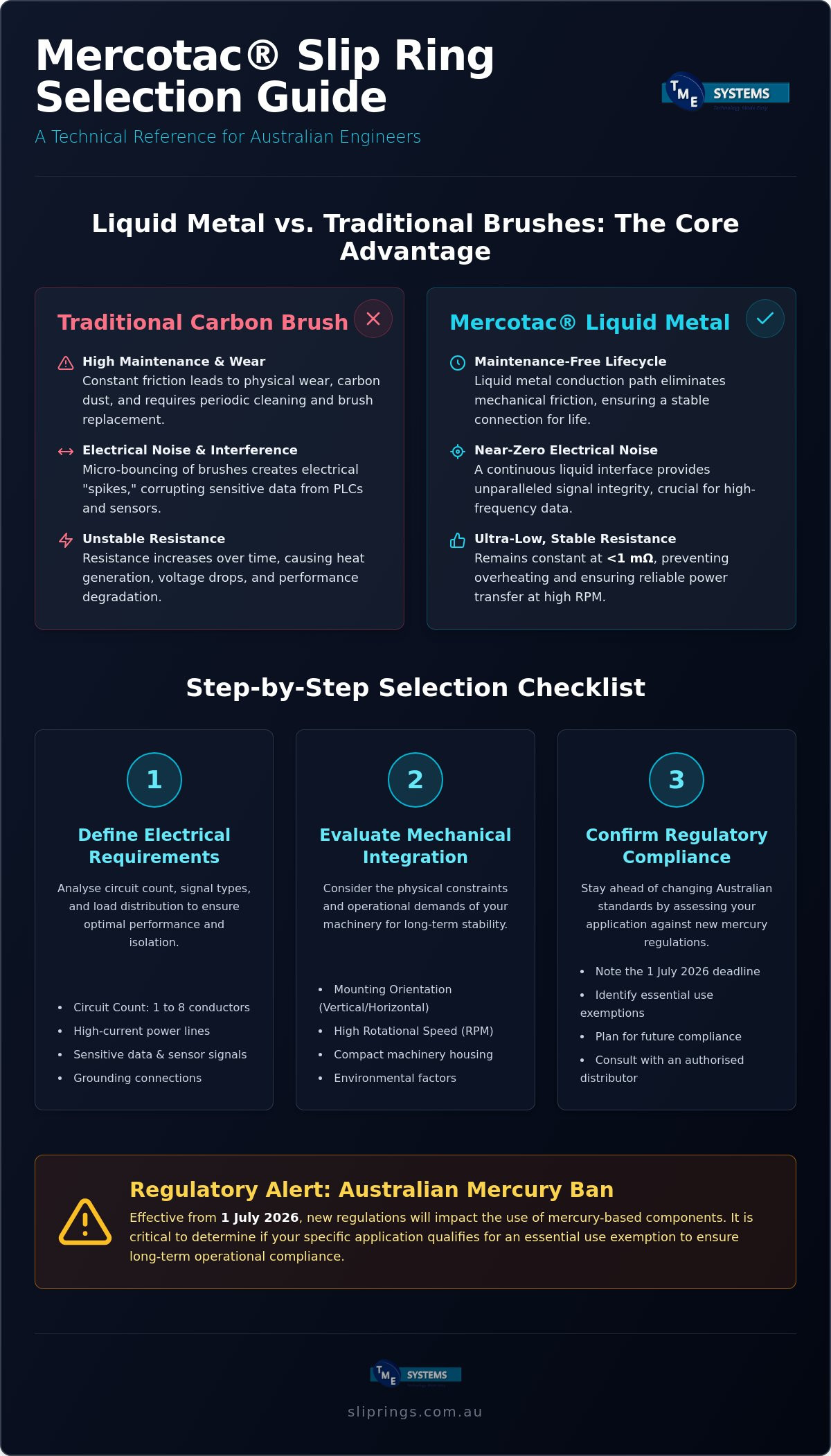
A traditional Slip ring employs carbon brushes that slide against a rotating metal ring to transfer electrical signals and power. This mechanical friction inevitably leads to physical wear, carbon dust accumulation, and fluctuating electrical resistance. In contrast, Mercotac rotary connectors utilise a pool of liquid metal as the conduction path. This design creates a molecular bond between the stationary and rotating components, effectively removing the mechanical friction found in brush-based systems. For engineers using this Mercotac slip ring selection guide, the primary advantage is a connection that remains stable and maintenance-free throughout its operational life.
The use of mercury-wetted contacts ensures that the conducting surfaces are always in perfect contact. Because there are no brushes to bounce or wear down, the electrical noise generated is nearly non-existent. While traditional slip rings can produce significant interference as they age, Mercotac units maintain a noise level of less than 1 milliohm. For those researching high-performance alternatives, Mercotac slip rings offer a distinct departure from conventional mechanical designs, providing a lifecycle that does not require the periodic cleaning or brush replacements common in Australian industrial plants.
Why Low Electrical Noise Matters for Modern Machinery
In modern automated environments, signal integrity is a critical requirement for sensitive PLC and sensor data. High-frequency signals are particularly susceptible to the electrical "spikes" caused by the micro-bouncing of carbon brushes. This interference can lead to data corruption or false triggering in control circuits. Mercotac connectors preserve signal clarity by providing a continuous, liquid interface that eliminates these spikes. This level of precision is non-negotiable in industries such as high-speed packaging and precision test equipment, where even a millisecond of signal loss can result in significant production errors or equipment downtime.
The Role of Contact Resistance in Power Transfer
Contact resistance is the electrical resistance encountered at the liquid metal interface, which remains exceptionally stable at less than 1 milliohm throughout the unit's life. In traditional rotary joints, increasing resistance leads to heat generation and potential voltage drops, which can damage sensitive components or reduce motor efficiency. The liquid metal path in a Mercotac unit ensures a constant, low-resistance connection even at high RPM. This stability prevents the thermal expansion issues often seen in mechanical contacts, allowing the connector to operate reliably in demanding Australian environments without the risk of overheating or performance degradation over time.
Technical Specification: Circuit Count and Electrical Load
Mapping the electrical path is the first critical step in any Mercotac slip ring selection guide. It's not merely a matter of counting wires. You must account for electrical isolation, load distribution, and the specific nature of the signals being transmitted. Early research, such as this NASA report on liquid metal slip ring development, highlights how liquid metal interfaces provide superior dielectric strength and shock resistance compared to mechanical alternatives. This technical foundation ensures that even as circuit complexity increases, the reliability of the connection remains high across varied industrial loads.
Selecting the Correct Circuit Count
Mercotac units are available in configurations ranging from single-conductor to eight-conductor models. Single-conductor units are frequently specified for high-current grounding or specialised welding applications where a robust, low-resistance path is required. For more complex automation, you can explore the full range of Mercotac Slip Rings to find 4, 6, or 8-circuit models. These multi-conductor units allow for the simultaneous transfer of power and data. We recommend grouping similar signal types together and maintaining physical separation between high-voltage power lines and sensitive data circuits. This practice minimises the risk of electromagnetic interference, which is vital for maintaining the integrity of high-frequency communication protocols used in modern Australian factories.
Voltage and Current Considerations for Australian Operations
Electrical load calculations must distinguish between peak and continuous current. Continuous current is the maximum load the unit can handle indefinitely, while peak current refers to short-term surges. Exceeding these ratings, or the specified voltage limit, can lead to dielectric breakdown. This occurs when the insulating materials between conductors fail, potentially causing a catastrophic short circuit within the rotary joint. Thermal management is equally vital. In Australian industrial environments, where ambient temperatures in non-conditioned spaces can fluctuate significantly, the current-carrying capacity may need to be derated. High heat affects the viscosity and internal pressure of the liquid metal conduction path. Ensuring your selection accounts for the maximum expected environment temperature is essential for preventing premature failure and maintaining site safety standards.
If you are unsure how to consolidate multiple circuits into a single rotary joint, our team provides technical application consulting to assist with your specific hardware configuration.
Mechanical Integration: RPM, Mounting, and Housing
Mechanical integration is the stage where theoretical electrical requirements meet the physical constraints of your machinery. This Mercotac slip ring selection guide prioritises two factors: rotational speed and mounting precision. While traditional brush-based systems often struggle with contact bounce and accelerated wear at high speeds, Mercotac connectors maintain a stable connection through their liquid metal interface. However, achieving this performance requires a thorough understanding of how mechanical forces interact with the unit's internal components.
RPM Limits and Heat Dissipation
Rotational speed is a primary driver of internal heat generation. As the unit spins, the friction within the bearings and the internal fluid dynamics of the liquid metal conduction path produce thermal energy that must be dissipated. Standard Mercotac models are typically rated for speeds up to 1,200 RPM, while specialised high-speed variants can accommodate up to 7,500 RPM. Operating at the upper threshold of rated RPM increases internal thermal stress, which directly influences the long-term service life of the internal seals and bearing assemblies. If your application involves sustained high-speed rotation, ensuring adequate airflow or heat-sinking through the mounting structure is essential to prevent seal degradation.
Mounting Styles: Stud vs Flange
Choosing between a stud or flange mount depends on your machine's shaft configuration and available space. Stud mounting is ideal for compact, end-of-shaft applications where the slip ring is supported directly by the rotating shaft. Flange mounting provides increased mechanical stability, particularly in environments with high vibration or where a larger footprint is available. If your design requires a hollow centre for hydraulic lines or central shafts, you may wish to compare mounting options with Meridian Laboratory Slip Rings, which offer through-bore configurations that complement the Mercotac range.
Regardless of the mounting style, you must avoid rigid mounting. Rigidly fixing both the body and the shaft of the slip ring creates bearing stress if there is even minor misalignment. We recommend using flexible lead wires or a floating torque arm to allow the unit to self-centre. Additionally, consider the mounting orientation. Because these units contain liquid metal, most models are designed for vertical installation with the shaft pointing down, though many can operate horizontally if the specific model allows for it. For corrosive Australian environments, such as coastal processing plants or mining sites, selecting a stainless steel housing ensures the exterior of the unit remains resilient against salt spray and chemical exposure.
Step-by-Step Selection Checklist for Engineers
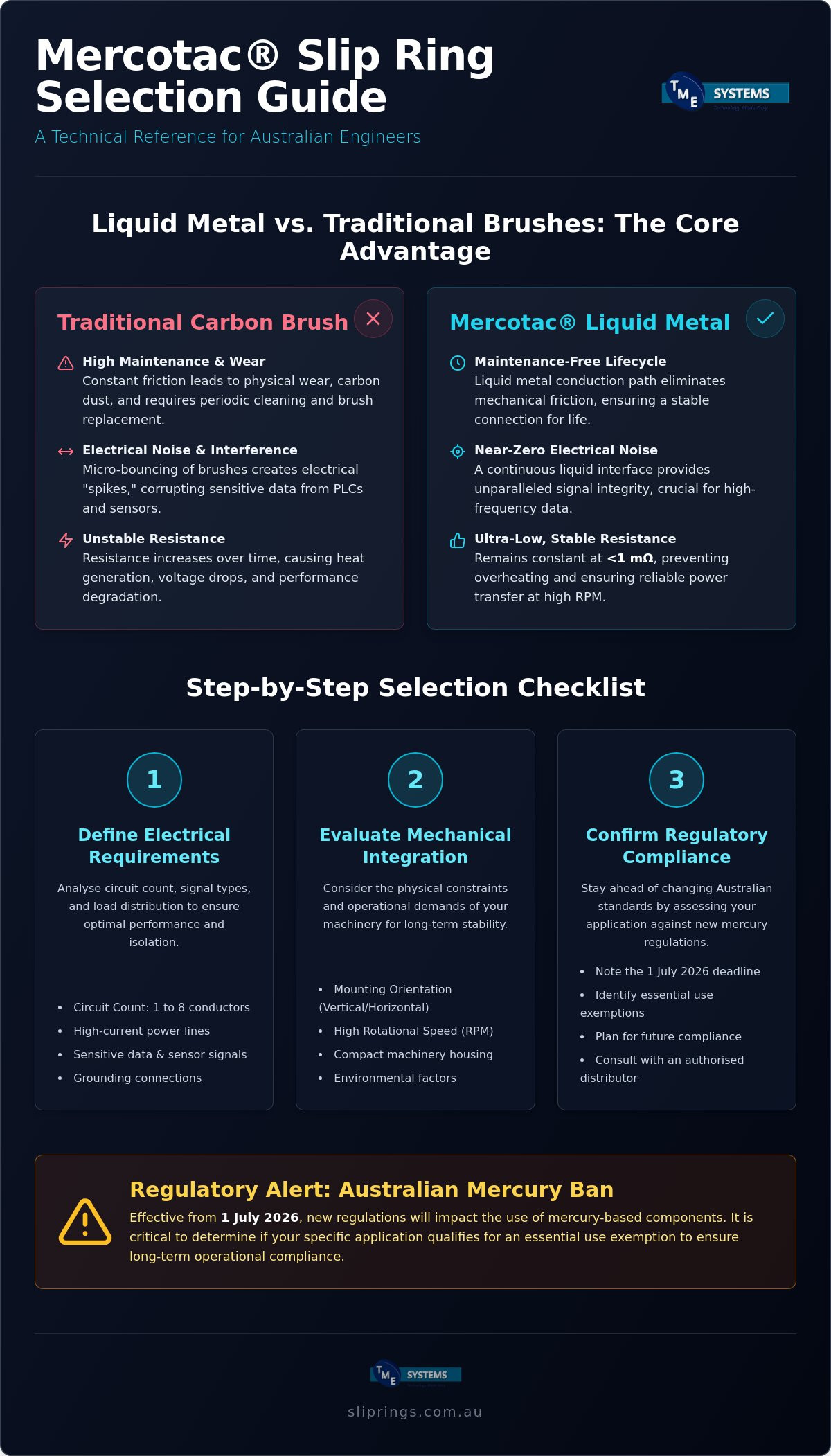
A structured approach to procurement prevents costly integration errors and ensures the rotary connector meets the specific demands of your machinery. This Mercotac slip ring selection guide provides a logical sequence for evaluating technical requirements before finalising a specification. By following these five steps, you can secure a reliable, low-noise connection that aligns with Australian engineering standards.
- Step 1: Identify the total number of power and signal circuits. Determine if you require a single-conductor unit for high-current grounding or a multi-conductor model for combined power and data transfer.
- Step 2: Determine maximum continuous current and voltage. Assess the electrical load for each circuit. Remember that exceeding continuous current ratings leads to heat accumulation and potential seal failure.
- Step 3: Confirm maximum operational RPM. Verify that the equipment's rotational speed falls within the rated limits of the chosen Mercotac model. High-speed applications may require specialised variants rated up to 7,500 RPM.
- Step 4: Assess environmental conditions. Evaluate exposure to moisture, dust, and temperature extremes. Harsh zones may necessitate additional protective measures to maintain the unit's integrity.
- Step 5: Select the appropriate mounting style. Choose between stud or flange mounting based on shaft configuration and available space, ensuring the design avoids rigid mounting to protect internal bearings.
Environmental Assessment: IP Ratings and Sealing
Australian industrial environments are notoriously demanding. Sites often contend with fine particulate dust, high humidity, or corrosive salt spray in coastal regions. While Mercotac units are robust, they aren't inherently waterproof. In areas where moisture ingress is a risk, you should utilise protective boots or specialised enclosures to safeguard the electrical interface. For a broader overview of hardware standards, see Industrial Slip Rings Australia: The Technical Procurement Reference. Ensuring the IP rating of your assembly matches the installation zone is critical for preventing short circuits and corrosion.
Signal Integrity and Shielding Requirements
Maintaining near-zero electrical noise requires more than just a brushless connector. You must also consider the external wiring. We recommend using shielded cables for all data circuits to prevent electromagnetic interference (EMI) from adjacent power lines. Best practices include keeping lead wires as short as possible and using high-quality terminal connections to maintain the low-resistance path provided by the liquid metal. If your project involves complex data protocols or custom wiring configurations, you can contact TME Systems Pty Ltd for technical application consulting to ensure your signal integrity is preserved from the controller to the rotating interface.
Procurement and Technical Support in Australia
Successful implementation of brushless technology relies as much on procurement strategy as it does on technical specifications. While this Mercotac slip ring selection guide provides the foundational data for your design, partnering with a local specialist ensures that environmental variables and Australian compliance standards are fully addressed. TME Systems Pty Ltd operates as the authorised Australian distributor, providing a technical bridge between complex manufacturing capabilities and the specific requirements of local industry. We move beyond simply providing a part number, offering technical application consulting to ensure the hardware you select is fit for purpose.
Logistics and regulatory compliance are increasingly complex for rotary connectors containing liquid metal. With the Australian mercury ban effective from 1 July 2026, procurement now requires careful navigation of IChEMS standards and "essential use" exemptions. TME Systems Pty Ltd assists engineers in confirming stock availability for 2026 projects and determining if their specific application qualifies for continued use or if a transition to mercury-free alternatives is necessary. Our team also provides cross-referencing support for legacy replacements, helping you identify modern equivalents for older rotary connector models that may no longer meet current performance or environmental benchmarks.
Custom Solutions and Application Engineering
Standard units don't always fit the unique mechanical constraints of bespoke machinery. TME Systems Pty Ltd assists in modifying mounting interfaces and lead wire configurations to suit specialised installations. For instance, we recently worked on optimising a rotary table for a high-speed packaging line where standard mounting was restricted. By applying the principles found in our Slip Ring Application Engineering reference, we helped the client achieve a stable, low-noise connection within a very compact footprint. This level of customisation prevents the need for expensive machine redesigns and ensures the connector integrates seamlessly with existing drive systems.
Long-term Reliability and Warranty Support
Procuring through an authorised Australian channel secures the full manufacturer's warranty and ensures you receive genuine components. Post-purchase support is a vital component of our service, offering technical troubleshooting and performance monitoring to maximise the lifespan of your investment. If you encounter unexpected signal noise or mechanical resistance, our consultants can help diagnose whether the issue stems from mounting misalignment or electrical overloading. To ensure your next project benefits from this level of technical oversight, contact TME Systems Pty Ltd for expert Mercotac selection advice and comprehensive application support.
Future-Proofing Your Rotary Connections with Precision Selection
Selecting the right rotary connector is a decision that fundamentally impacts the long-term reliability and maintenance cycles of your industrial systems. This Mercotac slip ring selection guide has provided a framework for evaluating your electrical loads, mechanical constraints, and the unique environmental challenges found across Australian sites. By transitioning from traditional carbon brushes to maintenance-free liquid metal technology, you're ensuring near-zero electrical noise and superior signal clarity for your most sensitive data circuits.
As the authorised Australian Mercotac distributor, TME Systems provides the expert technical application support necessary to navigate complex hardware configurations and the upcoming 2026 regulatory shifts. We're committed to acting as your technical partner, helping you bridge the gap between rigorous engineering requirements and long-term operational success. Whether you're replacing legacy components or designing a new high-speed system, our team is ready to assist.
Request a Technical Consultation for Your Mercotac Selection to ensure your machinery is equipped with the most reliable rotary connection available. We look forward to helping you achieve a more efficient and reliable industrial operation.
Frequently Asked Questions
Are Mercotac slip rings safe for use in Australian food and beverage packaging?
Mercotac units contain liquid mercury and are generally not recommended for applications where direct food contact is possible. While the units are factory-sealed, risk assessments for food safety usually preclude mercury-added products in open processing zones. If your packaging machinery is located in a non-contact area, they may be suitable, but we recommend consulting our technical team to discuss specific site requirements and local safety standards.
Can Mercotac rotary connectors handle high-speed data like Ethernet or USB?
Yes, these connectors are exceptionally well-suited for high-speed data transfer due to their near-zero electrical noise. Because the liquid metal conduction path eliminates the "chatter" found in traditional brushes, signal integrity is maintained for Ethernet, USB, and various PLC protocols. This Mercotac slip ring selection guide highlights that for reliable data transfer, users should always use shielded cabling and ensure correct grounding to prevent external interference.
What is the typical lifespan of a Mercotac unit compared to a brush slip ring?
A Mercotac unit typically outlasts a traditional brush slip ring by several years because it lacks mechanical wear parts. While carbon brushes require periodic replacement as they grind down, the liquid metal interface remains consistent. The service life of these units is generally determined by the bearing and seal integrity rather than the conduction path, making them a far more durable choice for high-cycle industrial applications.
How do I mount a Mercotac slip ring to avoid mechanical failure?
You must avoid rigid mounting on both the shaft and the body to prevent premature bearing failure. We recommend mounting the unit by its shaft and using flexible lead wires or a floating torque arm to secure the body. This allows the connector to self-centre and prevents mechanical stress caused by minor shaft misalignments, which is a common cause of seal degradation in industrial installations.
Is there a mercury-free alternative for applications where liquid metal is prohibited?
Yes, we provide several mercury-free alternatives for environments where liquid metal is restricted or prohibited. For applications requiring high performance without mercury, we often recommend Meridian Laboratory slip rings, which utilise a gallium-based liquid metal alloy. These units offer similar low-noise benefits while complying with specific environmental regulations that may ban mercury-added products in certain Australian sectors.
What happens if I exceed the RPM or current rating on my Mercotac connector?
Exceeding the rated RPM or current leads to excessive internal heat, which can cause the seals to fail or the liquid metal to expand beyond its design limits. This thermal stress can result in a dielectric breakdown or physical leakage of the conductive fluid. Always refer to the technical specifications for your specific model to ensure the operational parameters remain within the safe working limits defined by the manufacturer.
Do Mercotac slip rings require any periodic maintenance or lubrication?
No, Mercotac connectors are designed to be maintenance-free and do not require lubrication or cleaning. Unlike traditional slip rings that need regular dust removal and brush tensioning, these brushless units are factory-sealed. Once installed correctly, they operate without intervention until the end of their service life, significantly reducing the total cost of ownership for Australian facility managers.
Can I use a Mercotac connector in a vertical mounting position?
Yes, a vertical mounting position is actually the preferred orientation for most models. Specifically, installing the unit with the shaft pointing downwards ensures the liquid metal remains properly seated within the conduction channels. While some models are rated for horizontal use, you should always verify the orientation requirements for your specific part number to ensure optimal performance and prevent internal fluid migration.