The most expensive component in your rotary system isn't the hardware itself; it's the unplanned downtime caused by a single worn brush. For engineers managing high-speed data or sensitive sensor feeds, the constant battle against signal noise and carbon debris often feels like a losing game. When you specify Meridian Laboratory slip rings Australia, you're moving beyond the limitations of traditional contact-based designs. These brushless systems eliminate the friction and electrical interference that typically plague industrial operations, providing a level of reliability that carbon brushes simply can't match.
It's a common frustration when critical data packets are dropped or maintenance schedules are dictated by hardware failure rather than operational needs. This guide explains why Meridian Laboratory’s brushless ROTOCON technology has become the gold standard for high-speed, low-noise rotary electrical connectors in Australian industry. We'll examine the technical architecture that allows for zero-maintenance performance and clean signal transfer for Ethernet and sensors. You'll also learn how TME Systems acts as the local technical bridge to ensure your ROTOCON assembly meets the specific demands of your application while complying with the AS/NZS 3000:2018 Wiring Rules.
Key Takeaways
- Understand how liquid metal contact technology eliminates the mechanical wear and maintenance requirements typical of traditional carbon brush systems.
- Discover why specifying Meridian Laboratory slip rings Australia ensures clean signal transfer for sensitive data and sensors by removing electrical interference.
- Evaluate technical performance benchmarks for high-speed and high-current applications, including configurations capable of reaching 40,000 RPM.
- Learn to select the appropriate ROTOCON series for your mechanical footprint, including miniature models for robotics and through-bore designs for fluid integration.
- Access professional application consulting through TME Systems to align technical specifications with the specific environmental and electrical demands of your site.
What are Meridian Laboratory ROTOCON Slip Rings?
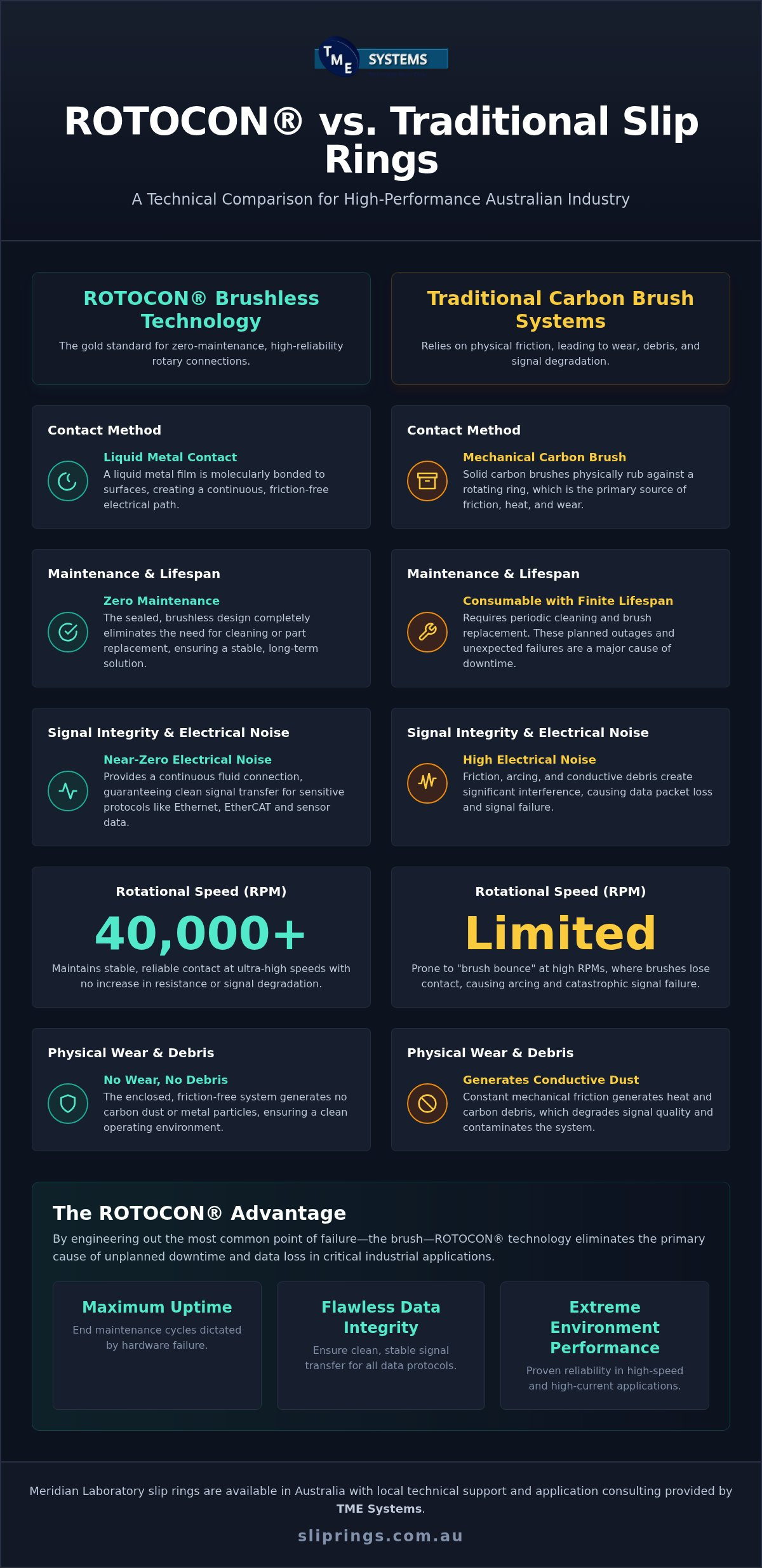
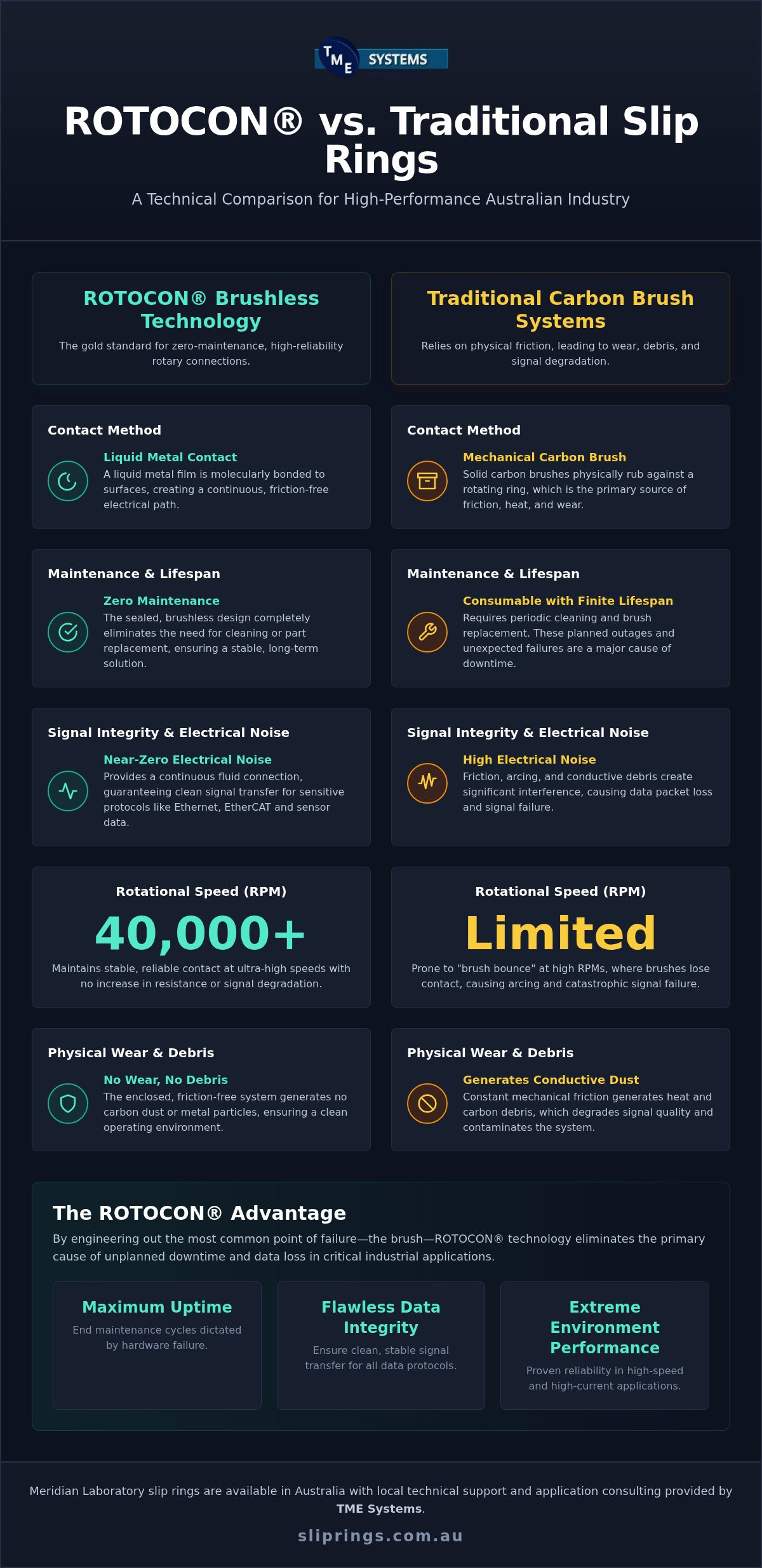
A ROTOCON is a brushless rotary electrical connector designed by Meridian Laboratory as a high-performance alternative to traditional carbon brush systems. While a standard electromechanical device relies on mechanical friction to transfer power or data, the ROTOCON utilises a liquid metal contact that is molecularly bonded to the rotating surfaces. This design choice directly addresses the most common failure point in rotary systems: the physical degradation of the brush itself. For technical managers sourcing Meridian Laboratory slip rings Australia, this technology marks a transition from a component requiring frequent intervention to a stable, long-term solution.
In many Australian industrial sectors, from mining to advanced manufacturing, the cost of downtime is often measured in thousands of dollars per hour. Traditional slip rings require periodic cleaning and brush replacements, which necessitates planned outages. ROTOCONs remove this requirement entirely. A key differentiator is their performance profile; unlike carbon brushes that may require a "run-in" period or show variable resistance at different speeds, these brushless units provide identical electrical characteristics from start-up through to high-speed operation.
The Science of Brushless Rotary Contacts
The use of liquid metal contacts eliminates the friction and wear that define carbon brush assemblies. In conventional systems, the physical contact between the brush and the ring generates heat and carbon dust, both of which degrade signal quality over time. ROTOCON technology maintains a stable, milliohm-level resistance across the entire 360-degree rotation. This extreme stability is essential for modern digital signal protocols like Ethernet or high-speed sensor feeds. By providing a continuous fluid connection, the system eliminates the "electrical noise" that typically disrupts sensitive data transfer. By integrating Meridian Laboratory slip rings Australia into their designs, local engineers can ensure their systems operate without the interference common in brush-based models.
Meridian Laboratory’s Heritage in Precision Engineering
Meridian Laboratory has a history spanning more than 50 years, focused on solving the most difficult motion control challenges. Their journey from basic connectors to specialised high-current and high-speed ROTOCON solutions shows a commitment to engineering excellence. They've earned a global reputation for enabling "impossible" applications in sectors such as aerospace, defence, and precision automation. For Australian operators, this means access to hardware that has been proven in the world's most demanding environments. Whether integrated into a robotic welding cell or a high-speed packaging line, these Meridian Laboratory slip rings are built for 24/7 reliability.
ROTOCON vs. Traditional Slip Rings: A Technical Comparison
Selecting the right rotary connector requires a clear understanding of the mechanical trade-offs between contact types. Traditional slip rings utilise carbon or precious metal brushes that physically rub against a rotating ring. This mechanical friction creates a consumable component with a finite lifespan. In contrast, Meridian Laboratory slip rings Australia employ a brushless ROTOCON design where a liquid metal film provides the electrical path. This fundamental shift in engineering removes the primary cause of electrical degradation; physical wear.
Rotational speed highlights a critical performance gap. As RPMs increase, traditional brushes often experience "brush bounce," a phenomenon where the brush momentarily loses contact with the ring. This leads to arcing, increased electrical noise, and eventual signal failure. Research into alternatives to traditional slip rings shows that liquid metal contacts maintain a constant molecular bond regardless of velocity. ROTOCON units can operate at ultra-high speeds, sometimes exceeding 10,000 RPM, without any loss in contact stability or increase in resistance.
Analysing Signal Noise and Data Integrity
Signal noise in the context of rotary connectors is the primary cause of data packet loss in automated systems. When using protocols like Ethernet or EtherCAT, even a microsecond of contact interruption can lead to dropped packets and system resets. Traditional rings struggle here because their contact resistance fluctuates as the brushes wear and carbon dust accumulates. For sensitive sensor data, such as thermocouple or strain gauge signals, these fluctuations manifest as inaccurate readings. The liquid metal interface in a ROTOCON maintains a stable, milliohm-level resistance that ensures data integrity is preserved across every rotation.
Total Cost of Ownership (TCO) in Australian Industry
For Australian mining and manufacturing operations, the initial purchase price of a slip ring is only a small fraction of its total cost. The real expense lies in maintenance labour and the lost production time during brush changes. In remote sites where specialist technicians are not always available, "fit and forget" technology is a significant operational advantage. By switching to a brushless system, plants can move from reactive maintenance to continuous-duty cycles that last for years. You can find more details on evaluating these factors in our Industrial Slip Rings Australia: The Technical Procurement Reference. If you are currently managing high-maintenance rotary joints, a technical application review can help identify the most cost-effective upgrade path for your specific machinery.
Technical Specifications for Australian Industrial Environments
Industrial sites across Australia, from the iron ore mines of the Pilbara to high-volume packaging centres in Melbourne, present environmental challenges that exceed standard operating parameters. High ambient temperatures, pervasive fine dust, and constant mechanical vibration can quickly compromise standard rotary connectors. Meridian Laboratory slip rings Australia are engineered to maintain electrical continuity under these specific stressors, providing a robust technical foundation for heavy machinery and precision instrumentation alike.
The technical architecture of a ROTOCON assembly prioritises environmental resilience. Unlike open-frame brush systems that are susceptible to ingress, these units often feature hermetically sealed housings. This sealing is vital for preventing the contamination of electrical contacts by airborne particulates or moisture. When specifying hardware for Australian conditions, engineers typically look for specific protection levels:
- IP65 Ratings: Suitable for environments where equipment is subject to low-pressure water jets and total dust ingress protection.
- IP67 Ratings: Essential for applications where temporary submersion or extreme wash-down procedures occur.
- Vibration Resistance: The liquid metal contact remains stable under high-shock loads, making them the preferred choice for defence equipment and heavy earthmoving machinery.
High-Speed Performance and RPM Limits
In the context of Meridian Laboratory technology, 'high speed' refers to a capability that far exceeds the limits of traditional contact rings. While standard brush-style connectors often struggle to maintain signal integrity above 2,000 RPM, ROTOCON designs are capable of ultra-high-speed operation ranging from 10,000 to 40,000 RPM. This makes them indispensable for centrifuge testing, high-speed spindles, and turbine monitoring. Thermal management is a key factor here. Because the liquid metal contact has significantly lower electrical resistance than a carbon brush, it generates less internal heat. This allows the unit to dissipate thermal energy more effectively, preventing the overheating that leads to premature bearing failure or signal drift.
Sealing and Protection in Harsh Conditions
The longevity of a rotary connector in a coastal or saline environment depends heavily on its material construction. ROTOCON units utilise stainless steel and specialised alloys to resist corrosion and maintain structural integrity over long-term deployments. This hermetic sealing does more than just block moisture; it ensures that the internal liquid metal remains uncontaminated, preserving the milliohm-level resistance required for sensitive sensors. For a deeper look at how these specifications align with local regulatory requirements, refer to our guide on Slip Ring Application Engineering: A Technical Reference for Australian Industry. Matching the correct IP rating and material build to your site's specific environmental profile is the most effective way to guarantee 24/7 operational reliability.
Selecting the Right Meridian Laboratory Series
Choosing the correct configuration for Meridian Laboratory slip rings Australia involves more than just matching circuit counts. It requires a precise alignment between the mechanical constraints of your machinery and the electrical demands of your control systems. While the underlying brushless technology remains consistent across the entire range, the physical housing and circuit density vary to suit different industrial environments. Identifying the right series early in the design phase prevents costly integration issues during commissioning.
The Miniature Series is engineered for compact automation and robotics where every millimetre of space is critical. These units provide high-precision signal transfer in a small footprint, making them ideal for end-of-arm tooling. Conversely, for applications involving heavy fabrication, High-Current Rotary Grounds offer a specialised solution for welding and plating. These units are designed to handle massive current transfer without the overheating or arcing that typically degrades traditional ground connections. If a standard configuration doesn't meet your specific needs, custom ROTOCON solutions can be engineered to accommodate unique mounting requirements or high circuit counts.
The Through-Bore Advantage for Integrated Systems
Specifying a through-bore ROTOCON is essential when your application requires a hollow shaft to accommodate hydraulic lines, pneumatic hoses, or structural supports. This design allows the electrical connector to be mounted around the existing mechanical shaft, which simplifies the drive train and saves valuable axial space. When selecting a bore diameter, you must account for shaft tolerances and thermal expansion to ensure long-term reliability. Many Australian machinery upgrades involve combining these electrical circuits with fluid or gas rotary unions into a single, integrated assembly.
Multi-Channel Capsule vs. Modular Configurations
Deciding between a capsule and a modular configuration depends largely on the complexity of your data and power requirements. Capsule designs are typically more compact and are often used for lower circuit counts where space is the primary constraint. Modular systems provide the flexibility to scale up, allowing for the integration of dozens of channels for power, EtherCAT, and sensitive sensor feeds in one unit. It's vital to ensure that your chosen configuration is compatible with Australian electrical standards and your existing cable terminations. If your project requires a non-standard configuration, you can request a technical application review for Meridian Laboratory solutions to ensure the final specification meets your operational goals.
Procurement and Technical Support in Australia
The procurement of specialised rotary connectors requires more than just a part number. For engineers sourcing Meridian Laboratory slip rings Australia, the process begins with a thorough technical review to ensure the chosen ROTOCON assembly matches the operational environment. TME Systems serves as the authorised Australian distributor, providing the technical bridge between manufacturing in the United States and the specific needs of local industrial sites. This partnership ensures that Australian clients receive not only the hardware but also the engineering expertise required to integrate it successfully.
Ordering high-spec components from overseas without local consultation often leads to specification errors that are expensive to rectify. By engaging in a technical application review before purchase, you can verify that variables such as RPM limits, peak current loads, and IP ratings are correctly aligned with your machinery. This consultative approach is designed to prevent the deployment of under-specified hardware in harsh Australian environments. It moves the procurement process from a simple transaction to a professional engineering consultation.
Working with TME Systems for Application Reviews
The path from identifying a rotary connection problem to receiving a specified Meridian Laboratory solution is a methodical process. TME Systems requires specific data points to provide an accurate recommendation. You should be prepared to provide the total circuit count, the operating voltage, and the maximum current per channel. Additionally, environmental variables such as ambient temperature ranges and potential exposure to moisture or dust must be documented. This data allows engineers to specify the correct sealing and housing materials for your site, ensuring the unit performs as expected from day one.
Why Local Distribution Matters for High-Spec Components
Relying on local distribution significantly reduces the risk of importing incorrect specifications from overseas vendors. This is particularly important when specifying Meridian Laboratory slip rings Australia, where the precision of the brushless contact must be matched to the exact rotational speed of the machine. Having technical documentation and engineering support available in the Australian time zone means that queries regarding installation or maintenance are addressed without the delays of international communication.
Local expertise also provides access to a broader range of solutions. If a ROTOCON is not the optimal fit for a specific budget or application, TME Systems can offer alternatives from Mercotac or BGB Innovation. This ensures that the final recommendation is based on the technical requirements of the project rather than the availability of a single product line. By working with a local partner, you gain a dependable intermediary that prioritises the long-term reliability of your rotary connections.
Future-Proofing Your Industrial Rotary Connections
Transitioning to brushless technology represents a significant shift in how Australian industries manage rotary electrical connections. By eliminating the mechanical friction of carbon brushes, ROTOCON systems provide a stable, zero-maintenance solution that protects signal integrity even at speeds reaching 40,000 RPM. This reliability is vital for maintaining 24/7 operations in the demanding environments of the mining and manufacturing sectors.
Selecting the right Meridian Laboratory slip rings Australia requires a detailed understanding of your specific circuit, speed, and environmental parameters. As the authorised Australian distributor, TME Systems acts as your specialist partner, offering the technical selection consulting needed to ensure your hardware is correctly specified from the start. This professional review prevents costly procurement errors and ensures long-term compatibility with local standards.
If you're ready to eliminate signal noise and reduce your total cost of ownership, you can request a technical application review for Meridian Laboratory slip rings today. Investing in precision engineering ensures your systems remain operational and efficient for years to come.
Frequently Asked Questions
Are Meridian Laboratory ROTOCON slip rings truly maintenance-free?
Yes, ROTOCON slip rings are virtually maintenance-free because they eliminate the friction-based components found in traditional designs. Since there are no carbon brushes to wear down or generate dust, there is no requirement for periodic cleaning or replacement of contact parts. This makes them ideal for 24/7 industrial operations where downtime is a significant cost factor.
Can ROTOCON slip rings handle high-speed data protocols like Ethernet?
Yes, these brushless connectors are specifically engineered to handle high-speed data protocols including Ethernet, EtherCAT, and Profinet. The liquid metal contact provides a stable, milliohm-level resistance that prevents the packet loss and signal degradation common in brush-style rings. This ensures reliable data integrity for sensitive automated systems and sensor networks.
What is the maximum RPM supported by Meridian Laboratory slip rings?
Meridian Laboratory offers configurations capable of supporting ultra-high speeds ranging from 10,000 to 40,000 RPM. While standard industrial applications typically operate at lower velocities, these high-speed ratings are essential for centrifuge testing and high-speed spindles. When sourcing Meridian Laboratory slip rings Australia, it's important to specify your exact RPM to ensure the internal bearings and thermal management are correctly matched.
How do I choose between a Mercotac and a Meridian Laboratory ROTOCON?
The choice depends on your specific circuit count, speed, and mounting requirements. Mercotac units are often selected for simpler applications with fewer channels, while the ROTOCON range is preferred for high-channel counts, ultra-high speeds, or through-bore integration. TME Systems provides technical application consulting to help you determine which brushless technology best fits your mechanical footprint and electrical specifications.
Do Meridian Laboratory slip rings contain mercury?
Yes, ROTOCON slip rings utilise a mercury-wetted contact to achieve their brushless, low-noise performance. This liquid metal is hermetically sealed within the housing to prevent leaks and environmental contamination. Because of this construction, they must be handled and disposed of according to specific safety protocols, which our technical team can outline during the procurement process.
Can I get a custom-designed through-bore slip ring in Australia?
Yes, custom through-bore configurations are available through TME Systems, the authorised distributor for Meridian Laboratory slip rings Australia. These designs allow for a hollow centre to accommodate existing shafts, pneumatic lines, or hydraulic hoses. We work directly with your engineering team to specify the required bore diameter, circuit count, and environmental sealing for your custom build.
What environmental ratings are available for Meridian Lab products?
Meridian Laboratory products are available with various environmental protections, including IP65 and IP67 ratings for dust and moisture resistance. Many models feature hermetic sealing to protect the internal contacts from harsh industrial contaminants or saline environments. These ratings ensure the hardware remains reliable in the extreme conditions found on Australian mining and infrastructure sites.
How does liquid metal technology improve signal-to-noise ratios?
Liquid metal technology improves the signal-to-noise ratio by providing a constant, molecularly bonded electrical path rather than a sliding mechanical contact. This eliminates the "brush bounce" and contact resistance fluctuations that create electrical noise in traditional rings. The result is a clean, stable signal transfer that is essential for high-resolution sensors and high-speed digital communications.