In the operational environment of modern defence, a robotic system is only as reliable as its weakest rotating joint. Selecting an unsuitable component often leads to signal degradation in high-vibration scenarios or total mechanical failure when exposed to the relentless heat and dust of the Australian landscape. You've likely experienced how even minor electrical noise can compromise critical HD sensor data during a mission, effectively turning a sophisticated platform into an operational liability. Finding specialised parts and local technical support shouldn't be the bottleneck in your engineering timeline.
This 2026 technical guide provides a pragmatic framework to specify and procure high-reliability slip rings for military robotics. We believe that achieving zero-maintenance operation in the field requires matching specific contact technologies to the signal-to-noise requirements of your mission. You'll learn how to navigate the selection process for rotary connectors that ensure crystal-clear data transmission for high-definition sensors. We will preview the latest engineering standards from global leaders such as Mercotac and Meridian Laboratory, while outlining how to access reliable local distribution and technical advice within Australia to keep your projects on track and mission-ready.
Key Takeaways
- Understand why traditional cabling is insufficient for modern 360-degree autonomous sensor suites and how to transition to robust rotary solutions.
- Learn to balance circuit counts with voltage and current ratings to ensure reliable power delivery for high-torque robotic actuators.
- Compare contact technologies, such as precious metal brushes and liquid metal, to specify the correct slip rings for military robotics for low-noise data transmission.
- Identify engineering strategies to mitigate the impact of fine particulate ingress and extreme thermal fluctuations in harsh Australian operational environments.
- Discover how local technical consulting and national supply chain support can streamline the procurement process for sovereign defence-grade projects.
The Evolution of Slip Rings in Modern Military Robotics
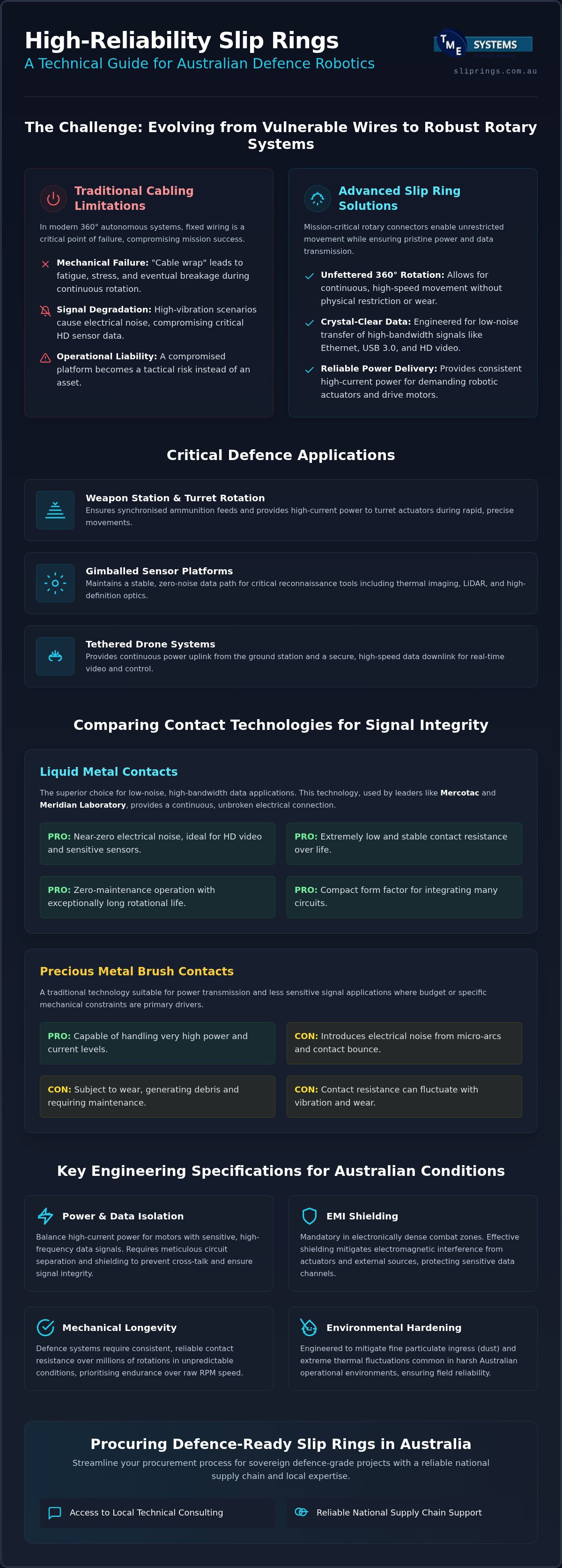
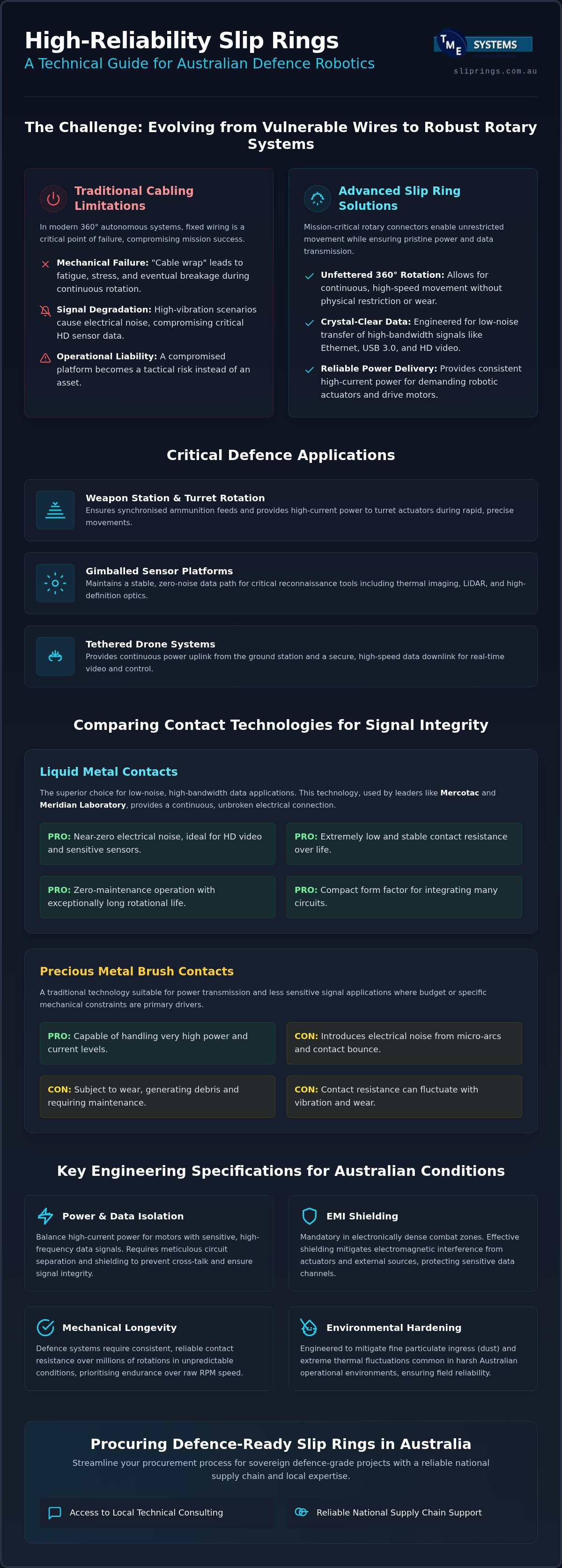
Military engineering has undergone a significant transformation, moving beyond basic mechanical pivots to integrated, autonomous platforms. Contemporary hardware relies on sophisticated sensor suites that require unfettered, 360-degree continuous rotation to maintain operational superiority. Traditional cabling is no longer a viable solution for these systems. When a turret or robotic arm rotates repeatedly in one direction, hard-wired connections inevitably suffer from "cable wrap," leading to mechanical fatigue and eventual failure. This physical limitation has redefined the importance of the electromechanical device, transforming it from a simple peripheral into a mission-critical component that must facilitate the simultaneous transfer of power and high-bandwidth data within a single, compact footprint.
Critical Applications: From UGVs to Turret Systems
Modern Unmanned Ground Vehicles (UGVs) and remote weapon stations depend on seamless rotation to maintain situational awareness in high-stakes environments. The integration of slip rings for military robotics allows these platforms to operate without the risk of snagged wires or restricted movement. Engineering requirements for these systems often include:
- Weapon Station Rotation: Maintaining ammunition feed synchronisation while providing high-current power to turret actuators during rapid slewing.
- Gimballed Sensor Platforms: Ensuring a stable, low-noise data path for thermal imaging, LiDAR, and optical reconnaissance tools.
- Tethered Drone Systems: Providing a continuous power uplink and a secure, high-speed data downlink to the ground control station.
Without a robust rotary interface, these systems risk signal dropouts during high-speed manoeuvres or when subjected to the intense vibrations typical of tracked or wheeled military platforms.
The Shift Toward High-Bandwidth Data Transmission
The rise of AI-driven sensor processing has fundamentally changed what we require from a rotary joint. We've moved from simple analogue signals to complex digital protocols like Ethernet, USB 3.0, and high-definition video feeds. Signal latency isn't just a technical inconvenience; in a remote-operated platform, it's a tactical risk that can compromise mission success. Advanced slip rings for military robotics, such as those developed by Meridian Laboratory and Mercotac, are specifically engineered to handle these high-speed requirements. These components use specialised contact technologies to minimise electrical noise, ensuring that HD sensor data reaches the processor without packet loss or interference. Future-proofing your robotic platform requires selecting connectors that can scale with these increasing data demands while maintaining reliability in the field.
Essential Technical Specifications for Defence-Grade Rotary Connectors
Specifying slip rings for military robotics requires a precise audit of both electrical and mechanical parameters. It isn't enough to select a part based on circuit count alone. You must balance the physical constraints of the robotic housing with the competing demands of high-current power and high-frequency data. In complex assemblies, such as a multi-axis tread mechanism or a sensor-heavy turret, a specialised slip ring arrangement is often necessary to ensure that power for drive motors doesn't compromise the integrity of sensitive HD video feeds. Longevity is equally critical; while industrial units might prioritise raw RPM, defence systems require consistent contact resistance over millions of rotations in unpredictable conditions.
Managing Signal Integrity and EMI in Combat Environments
Combat zones are electronically dense environments where electromagnetic interference (EMI) is a constant threat to operational reliability. High-power robotic actuators generate significant noise that can bleed into data lines if they aren't properly isolated. Effective shielding techniques are mandatory to prevent cross-talk between power and signal channels. We recommend using low-resistance contacts to maintain the signal-to-noise ratio required for sensitive radio equipment and high-bandwidth sensors. This level of precision ensures that remote operators receive clear, lag-free data even when the robot is performing high-torque manoeuvres.
Power Requirements and High-Current Transfer
Robotic actuators often demand high peak currents during rapid movements or sudden directional changes. If the wire gauge is insufficient, you'll face significant voltage drops that reduce motor torque and responsiveness. Thermal management also becomes a factor within the cramped, enclosed housings typical of military hardware. Heat build-up can degrade contact surfaces and lead to premature failure. Specifying components with superior heat dissipation, such as those from Meridian Laboratory, helps maintain performance during sustained operations. Choosing the right wire gauge and contact material is the first step in ensuring your system doesn't overheat in the field.
If you're currently drafting specifications for a new platform, consulting with a technical application specialist can help you identify the specific electrical thresholds your project requires.
Comparing Contact Technologies: Brushes vs. Liquid Metal
The choice of contact technology determines the long-term operational cost and signal clarity of the entire robotic system. Traditional carbon or precious metal brush systems are often selected for their robustness in high-power applications, yet they carry inherent limitations for modern sensor-heavy platforms. These mechanical contacts rely on physical friction, which generates wear debris and electrical noise over time. In high-vibration environments, the intermittent contact of a brush system can lead to data packet loss, making it a challenging choice for slip rings for military robotics that rely on high-definition video feeds or precision telemetry.
Maintenance cycles also differ significantly between these technologies. Traditional brush systems require periodic inspection and cleaning to remove conductive dust that can cause short circuits. This increases the total cost of ownership, especially for equipment deployed in remote or inaccessible locations. Conversely, liquid metal interfaces offer a virtually maintenance-free alternative by replacing sliding friction with a continuous liquid pool of conductive metal. When specifying slip rings for military robotics, engineers must weigh these maintenance requirements against the specific vibration and speed profiles of the mission.
Mercotac Liquid Metal Connectors for Low-Noise Signals
Liquid metal technology is widely considered the gold standard for applications requiring near-zero electrical noise. By using mercury-wetted contacts, these connectors maintain a constant, low-resistance path that does not fluctuate during rotation. This stability is critical for military sensors that process high-frequency signals or 4K video streams. Because there is no mechanical wear between the moving parts, the signal remains crystal clear throughout the component's lifespan. You can learn more about Mercotac slip rings to understand how this technology preserves data integrity in sensitive reconnaissance systems.
Meridian Laboratory Slip Rings for Precision Engineering
While liquid metal is superior for noise reduction, certain high-speed robotic applications or specific mounting orientations require precision-machined mechanical contacts. Meridian Laboratory specialises in high-performance alternatives that bridge the gap between traditional brushes and liquid metal. Their proprietary contact designs are vital for robotics that require high-speed rotation without the orientation restrictions sometimes found in liquid metal units. These precision-engineered solutions ensure that high-torque actuators and high-speed gimbals maintain reliable electrical paths under extreme centrifugal forces. You can explore Meridian Laboratory solutions to find the right balance of speed and longevity for your specific platform.
Specifying Slip Rings for Harsh Australian Operational Environments
Australia’s operational landscapes present unique engineering hurdles that standard industrial specifications often fail to address. Fine particulate ingress, colloquially known as bulldust, is a primary threat to rotating joints in the Australian Outback. These microscopic particles can bypass standard seals, acting as an abrasive that quickly degrades contact surfaces and increases electrical noise. When selecting slip rings for military robotics, you must ensure the housing and seal design are specifically rated to withstand this level of environmental contamination.
Thermal expansion and contraction are equally problematic. In central Australia, temperatures can swing from below zero at night to over 40 degrees Celsius during the day. This rapid cycling affects the mechanical tolerances of internal components. If the metals and plastics within the assembly aren't matched for these extremes, you risk mechanical binding or intermittent contact failure. For coastal or maritime robotic deployments, corrosion resistance becomes the priority. Salt spray can compromise standard aluminium or steel housings within weeks, necessitating the use of specialised coatings or stainless steel configurations.
Sealing and Environmental Protection (IP Ratings)
Choosing the correct Ingress Protection (IP) rating is the first step in ensuring all-weather reliability. While IP65 might suffice for light industrial rain, amphibious or all-weather UGVs require IP67 or IP68 ratings to prevent moisture ingress during wading or heavy downpours. A dust-tight seal is non-negotiable for any platform operating in arid regions. We often recommend BGB Innovation Slip Rings Australia: Heavy Duty Solutions for projects that demand this level of environmental resilience. Their designs incorporate robust sealing technologies that maintain electrical integrity even when the exterior is caked in mud or fine dust.
Vibration and Shock Resistance in Robotic Platforms
Military-grade rotary connectors must maintain electrical continuity during high-G combat manoeuvres and across rugged terrain. Mechanical shock can cause momentary contact separation, which is catastrophic for high-speed digital data streams. Testing protocols for slip rings for military robotics should mirror the intended use case, often requiring compliance with MIL-STD-810 standards for vibration and shock. Selecting a component with high-performance contact materials and a reinforced internal structure ensures that your HD sensors and weapon systems remain online when the platform is under duress.
If your project faces extreme environmental or mechanical challenges, contact our technical team for a detailed application audit to match your requirements with the right hardware.
Procuring Defence-Ready Slip Rings in Australia
Procuring specialised components for sovereign defence projects involves more than just selecting a part number from a catalogue. In the context of slip rings for military robotics, the procurement process must account for long-term sustainment, technical compatibility, and the ability to adapt to evolving mission requirements. Relying on direct overseas procurement often introduces risks related to time-zone delays, a lack of nuanced technical support, and logistical bottlenecks. Working with a local specialist ensures that your project benefits from a national supply chain that understands the specific regulatory and operational standards of the Australian defence sector.
Navigating lead times is another critical factor. Critical robotic components often have complex manufacturing schedules; however, a local partner can provide more accurate forecasting and buffer stock management. When off-the-shelf solutions don't meet the precise spatial or electrical constraints of a unique UGV or turret assembly, custom configurations become necessary. This is where technical application consulting adds the most value, bridging the gap between global manufacturing capabilities and local engineering needs.
Technical Consulting and Custom Configuration
Optimising rotary electrical paths requires a deep understanding of how different signals interact within a confined space. Our approach involves collaborating directly with your engineering team to ensure that every circuit is specified for its intended purpose, whether that's high-current power or sensitive data. We focus on ensuring full compatibility with existing Australian military hardware, reducing the risk of integration issues during the prototype phase. For a deeper look at these engineering principles, you can refer to our guide on Slip Ring Application Engineering for Australian Industry.
Reliable National Supply Chains for Sovereign Capability
Maintaining a sovereign capability requires a dependable, Australian-based distribution network. TME Systems Pty Ltd serves as a knowledgeable intermediary for Tier 1 global manufacturers, including Mercotac, Meridian Laboratory, BGB, and Prosper Rotation. This ensures that you receive components of consistent quality while having access to local technical advice and logistical support throughout the platform's lifecycle. By maintaining these relationships, we help streamline the acquisition of slip rings for military robotics and provide the stability needed for multi-year defence contracts. If you require support with your current specifications, you can contact TME Systems Pty Ltd for expert technical assistance to discuss your project's specific rotary requirements.
Securing Operational Superiority with Precision Rotary Solutions
Building a reliable autonomous platform requires a methodical approach to component selection. The transition to high-bandwidth sensor suites necessitates a shift toward advanced contact technologies that can maintain signal integrity in high-vibration environments. Whether you're mitigating the effects of fine Australian bulldust or managing the electromagnetic interference of high-torque actuators, the technical specifications of your rotary joints dictate the platform's mission success. Choosing the correct slip rings for military robotics ensures that your HD sensors and weapon systems remain operational under the most demanding field conditions.
TME Systems Pty Ltd provides the technical expertise and sovereign supply chain support needed to navigate these complex engineering challenges. As the official Australian distributor for Mercotac and Meridian Laboratory, we specialise in low-noise signal integrity and high-reliability configurations tailored for defence applications. Our team has provided expert technical application consulting since our inception, helping you bridge the gap between global manufacturing and local operational requirements. Consult with our technical team for military robotics solutions to ensure your next project is built for long-term reliability. We look forward to supporting your technical objectives.
Frequently Asked Questions
What makes a slip ring military-grade compared to industrial versions?
Military-grade components are defined by their ability to meet rigorous standards such as MIL-STD-810. Unlike industrial versions, these units feature reinforced housings and specialised internal geometries to withstand extreme mechanical shock and constant vibration. They often utilise high-performance contact materials that ensure electrical continuity during rapid slewing or sudden impacts. This level of ruggedisation is essential for platforms that must maintain operational capability in unpredictable combat environments where standard hardware would likely fail.
Can liquid metal slip rings handle the vibration levels of a combat vehicle?
Yes, provided they are integrated within a properly engineered housing. While liquid metal is a fluid, the internal design of units like those from Mercotac ensures the conductive path remains stable during movement. For combat vehicles, we recommend configurations that account for high-G loads and specific mounting orientations. These units are often superior to brush systems in vibration-heavy scenarios because they don't suffer from the "bounce" or intermittent contact issues common with mechanical brushes.
How do I reduce electrical noise for a 4K camera on a robotic arm?
Reducing noise for high-definition video requires a combination of low-resistance contact technology and robust shielding. Using liquid metal slip rings for military robotics is the most effective way to achieve near-zero electrical noise, as they provide a continuous conductive path without the friction of mechanical brushes. Additionally, ensure that power and data channels are physically isolated within the assembly and that all high-speed data lines use high-quality twisted-pair or coaxial cabling to prevent electromagnetic interference.
What is the typical lifespan of a high-performance slip ring in a robotic application?
Lifespan varies based on the duty cycle, RPM, and environmental exposure. High-performance units often achieve between 100 million and several hundred million rotations before requiring replacement. In robotic applications, the limiting factor is usually the mechanical wear of the bearings or the degradation of the contact surfaces. Specifying a unit with a higher rotation rating than your projected mission profile ensures a safety margin, reducing the risk of mid-operation failure in the field.
Are mercury-free rotary connectors available for sensitive military environments?
Yes, mercury-free options are widely available for projects with strict environmental or safety protocols. Manufacturers like Meridian Laboratory and BGB Innovation specialise in precious metal brush systems that provide high-performance rotary electrical paths without using liquid metal. These alternatives are often selected for systems where the platform's orientation changes frequently or where specific material restrictions are in place. These units still provide the precision required for complex robotic actuators and sensor arrays.
How do IP ratings affect the performance of slip rings in dusty Australian conditions?
IP ratings define the level of protection against particulate and moisture ingress. In dusty Australian conditions, the first digit of the rating is critical. An IP6X rating indicates the unit is dust-tight, which is essential to prevent fine bulldust from entering the assembly and acting as an abrasive on contact surfaces. While the second digit refers to water protection, a high rating like IP67 or IP68 ensures the internal electrical paths remain clean and dry during amphibious operations.
Can a single slip ring transmit both high-voltage power and delicate data signals?
Hybrid configurations allow for the simultaneous transfer of high-voltage power and sensitive data within a single footprint. This is achieved through internal physical isolation and electromagnetic shielding to prevent the power circuits from interfering with data integrity. Specifying slip rings for military robotics with dedicated channels for Ethernet or fibre optics alongside high-current power lines is a standard requirement for modern UGVs. This integration reduces the overall weight and complexity of the robotic joint.
What maintenance is required for slip rings used in autonomous military robots?
Maintenance requirements depend heavily on the contact technology chosen. Traditional brush systems require periodic inspections to remove conductive wear debris and ensure brush tension remains within specification. In contrast, liquid metal units are virtually maintenance-free because they lack sliding mechanical parts that generate debris. For autonomous robots, we recommend a pragmatic schedule of visual inspections for seal integrity and electrical testing of signal-to-noise ratios to identify potential issues before they cause a mission failure.