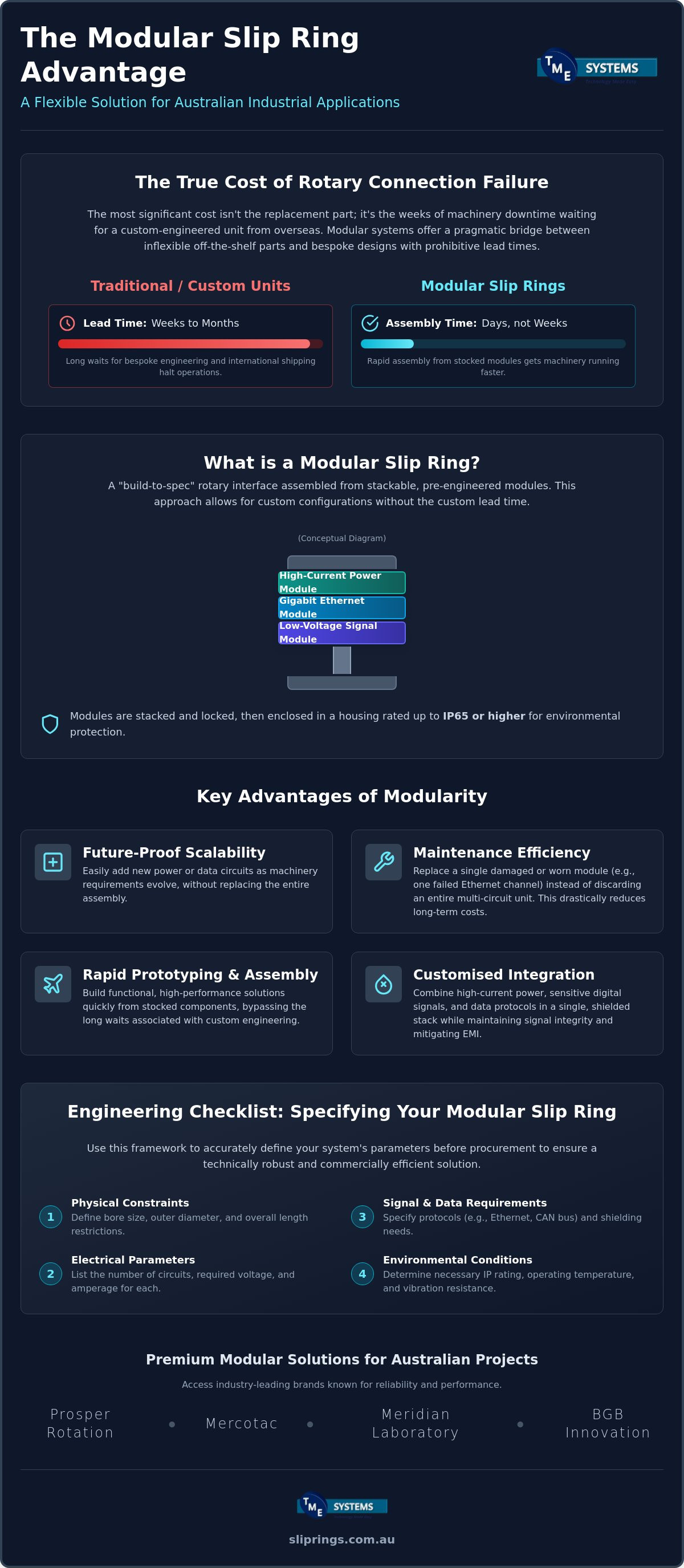
The most significant cost of a rotary connection failure isn't the replacement hardware; it's the weeks of idle machinery while you wait for a custom-engineered unit to clear international customs. Many Australian engineers find themselves trapped between inflexible off-the-shelf components and bespoke designs that carry prohibitive lead times. A modular slip ring provides a pragmatic bridge between these two extremes, allowing for the precise integration of high-current power and sensitive data signals within a single, scalable assembly.
You likely recognise the frustration of replacing an entire multi-circuit unit simply because one Ethernet channel has failed. This guide demonstrates how modularity allows you to specify, maintain, and upgrade individual layers without overhauling your entire system. We will outline the technical benefits of modular stacks, provide a step-by-step framework for specifying your requirements, and review reliable brands such as Mercotac, Meridian Laboratory, and BGB Innovation. By the end of this article, you'll understand how to configure a rotary solution that is both technically robust and commercially efficient for your specific industrial application.
Key Takeaways
- Learn how the "build-to-spec" approach of a modular slip ring allows for highly customisable configurations without the typical lead times of bespoke engineering.
- Understand the technical requirements for integrating high-current power and sensitive digital signals within a single stack while maintaining signal integrity.
- Discover why modularity reduces long-term maintenance costs by enabling the replacement of individual circuit layers rather than entire units.
- Use our engineering checklist to accurately define your system's physical constraints and electrical parameters before procurement.
- Identify premium solutions from brands like Prosper Rotation and Mercotac that are available to support Australian industrial projects.
What is a Modular Slip Ring? Defining the "Build-to-Spec" Approach
A modular slip ring is a configurable rotary interface designed to adapt to specific engineering requirements without the overhead of a fully bespoke build. Traditional capsule designs often feature a fixed number of circuits within a sealed unit, which limits their application to the original design parameters. In contrast, a modular system is built from stackable segments. This "build-to-spec" approach allows engineers to select the exact combination of power and signal circuits required for a specific project. To understand the fundamental mechanics of these devices, one might first ask, What is a Slip Ring? At its core, it's a device that transfers electrical signals from a stationary structure to a rotating one. Modular systems take this concept further by treating the housing, rings, and brushes as interchangeable segments that can be tailored to the application.
Australian industrial operators are increasingly moving toward modularity because it's a pragmatic choice. Holding stock for every possible circuit configuration is expensive and logistically difficult. By using a modular slip ring, procurement managers can reduce inventory overheads while maintaining the ability to assemble a variety of configurations on-demand. This flexibility is essential in sectors like mining and large-scale manufacturing, where downtime is measured in thousands of dollars per hour.
The Anatomy of a Modular Stack
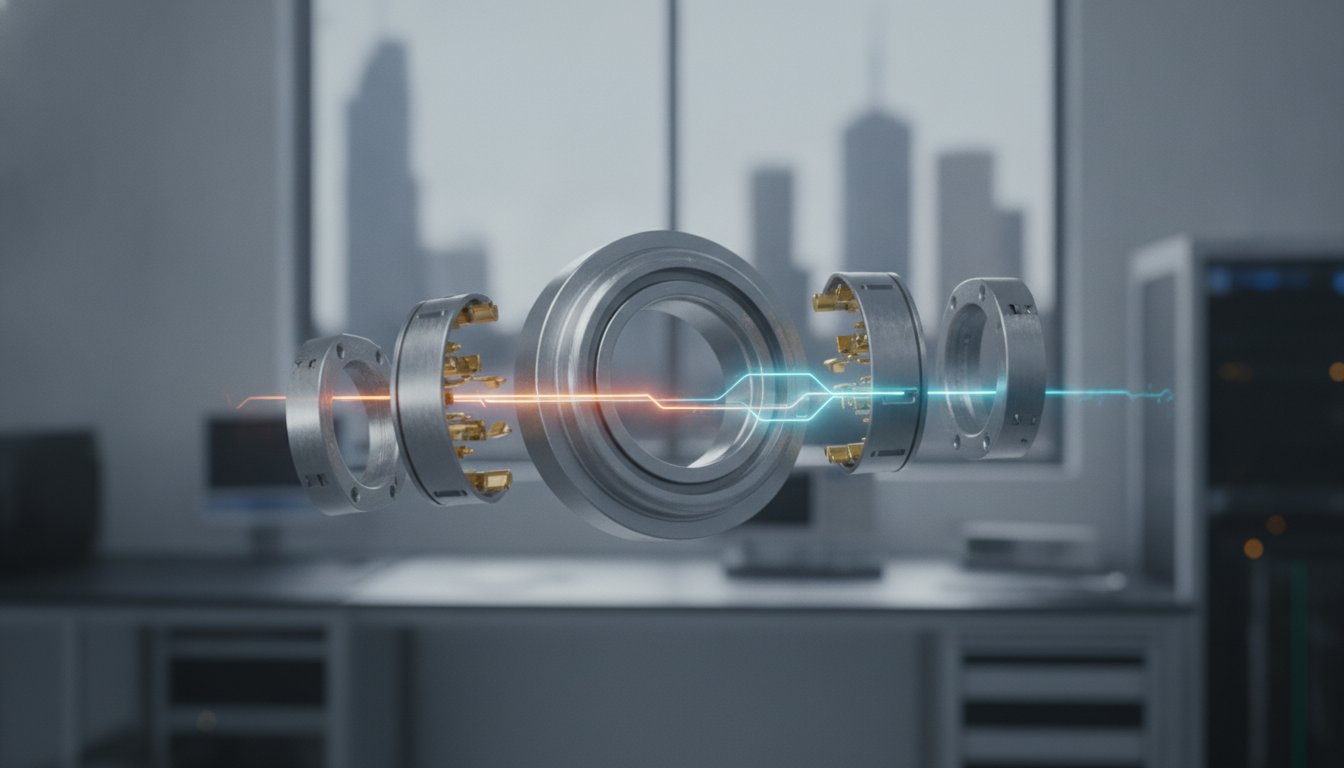
A modular stack consists of a central shaft that supports individual insulating plates or wafers. Each wafer contains the conductive rings and their corresponding brush blocks. These segments are keyed to ensure precise alignment during assembly and are then locked together using tie rods or specialised mechanical clips. This mechanical integrity is vital in high-vibration environments. The outer housing is selected to match the final height of the stack, providing environmental protection, often rated to IP65 or higher, without adding unnecessary bulk to the machinery.
Key Advantages: Flexibility and Future-Proofing
Scalability is the primary driver for modularity. As machinery requirements evolve, you can add additional circuits to the stack without replacing the entire assembly. This capability provides several distinct benefits:
- Rapid Prototyping: Engineers can create a functional, high-performance solution from stocked modular components rather than waiting weeks for a custom-engineered unit.
- Maintenance Efficiency: If a single module is damaged by an electrical surge or mechanical wear, it can be replaced individually. This avoids the high cost of discarding an entire multi-circuit assembly when only one path has failed.
- Customised Integration: You can mix different circuit types, such as high-current power lines and sensitive digital signals, within the same physical footprint.
By separating the rotary interface into discrete, manageable segments, the modular approach ensures that your hardware remains as flexible as your operational needs. It's a solution built for long-term reliability rather than a quick, fixed-purpose fix.
Technical Specifications: Power, Signal, and Data Integration
The primary technical advantage of a modular slip ring is its ability to serve as a consolidated hub for diverse electrical requirements. In complex Australian industrial environments, such as port facilities or automated processing plants, a single rotary assembly must often handle raw power alongside sensitive digital telemetry. Achieving this requires precise internal isolation. By using dedicated modules for different voltage levels, engineers can effectively mitigate the risk of cross-talk and electromagnetic interference (EMI).
Shielding is a critical consideration when mixing high-amperage lines with low-voltage signals. High-performance modular systems utilise internal metallic barriers and grounded spacer plates to ensure that the magnetic fields generated by power circuits don't corrupt data packets. According to the technical principles outlined in Modular Slip Ring Design, the physical separation provided by the wafer-style architecture is inherently better at managing these interference challenges than many compact, non-modular alternatives.
Power Modules: Handling High Amperage
For heavy-duty applications like Australian mining winches or ship-to-shore cranes, power modules are engineered with robust insulation and high-conductivity contact surfaces. These modules must withstand significant thermal stress during continuous operation. Typical current ranges for modular industrial units often exceed 100 Amps per circuit, necessitating silver-graphite brushes that offer low friction and high current density. If you require assistance in calculating your specific load requirements, our team provides technical application consulting to ensure your stack is correctly sized.
Signal and Data Modules: Precision Transfer
Integrating digital protocols such as Ethernet, Profinet, or CANbus requires a different approach to contact physics. Signal modules frequently employ gold-on-gold contact technology. Gold's resistance to oxidation ensures a stable, low-noise connection, which is vital when transmitting sensor data in high-vibration environments. Maintaining signal integrity depends on the precision of the modular interface; even minor mechanical misalignments can lead to packet loss. Modern modular stacks use keyed assembly points to maintain the concentricity required for high-speed data transfer up to 1Gbps.
RPM limitations are also influenced by the stack configuration. As you add more modules, the cumulative friction increases the internal temperature of the assembly. While a single-module unit might operate at higher speeds, a tall modular stack may require de-rating or the addition of cooling vents to maintain long-term reliability. Choosing the right contact material, whether it be precious metal for signals or carbon-based for power, remains the most effective way to optimise performance and service life.
Modular vs. Custom Slip Rings: A Performance Comparison
Choosing between a standard modular slip ring and a fully custom-engineered unit often comes down to the balance of project urgency and specific environmental stressors. In the Australian industrial landscape, where remote sites in regions like the Pilbara face extreme heat and airborne iron ore dust, the perceived fragility of modular systems is a common concern. Modern modular stacks are engineered to meet the same rigorous mechanical standards as bespoke units. The primary differentiator is the speed of deployment. While a custom unit may require a design-to-delivery window of twelve to sixteen weeks, a modular assembly can often be configured and shipped within a fraction of that time.
Cost-benefit analysis reveals that modularity offers superior long-term value for most applications. The initial investment might be comparable to a mid-range custom unit, but the maintenance savings are substantial. If a single data circuit fails due to mechanical wear or an electrical fault, a modular design allows for the replacement of that specific wafer. A custom, monolithic unit would likely require a complete replacement, resulting in higher hardware costs and extended operational downtime. For large-scale mining fleets, this standardisation simplifies procurement by allowing a single modular platform to be adapted for multiple machine types, significantly reducing the volume of unique spare parts held in inventory.
When to Choose a Modular System
Modular systems are the logical choice for projects with evolving designs or those requiring a mix of power and signal types within a standard lead-time constraint. They are frequently used in packaging machinery and large-scale rotating advertising displays where versatility is paramount. If your application is severely space-constrained and doesn't require the expandability of a stack, you might consider compact slip rings as a more suitable alternative. These provide a smaller footprint for fixed-circuit requirements while maintaining high signal integrity.
When Custom Engineering is Necessary
There are specific scenarios where modularity reaches its physical limits. Custom engineering becomes essential when operational speeds exceed several thousand RPM, as the mechanical balance of a multi-segment stack can become difficult to manage. Similarly, if your application requires hundreds of circuits that exceed the structural housing lengths of standard modular frames, a bespoke monolithic design is safer. Applications requiring hermetic sealing or specialised protection beyond standard IP67 or IP69K ratings, such as deep-sea submersibles or high-vacuum environments, also necessitate a fully custom approach to ensure environmental resilience.
Specifying Your Modular Slip Ring: An Engineering Checklist
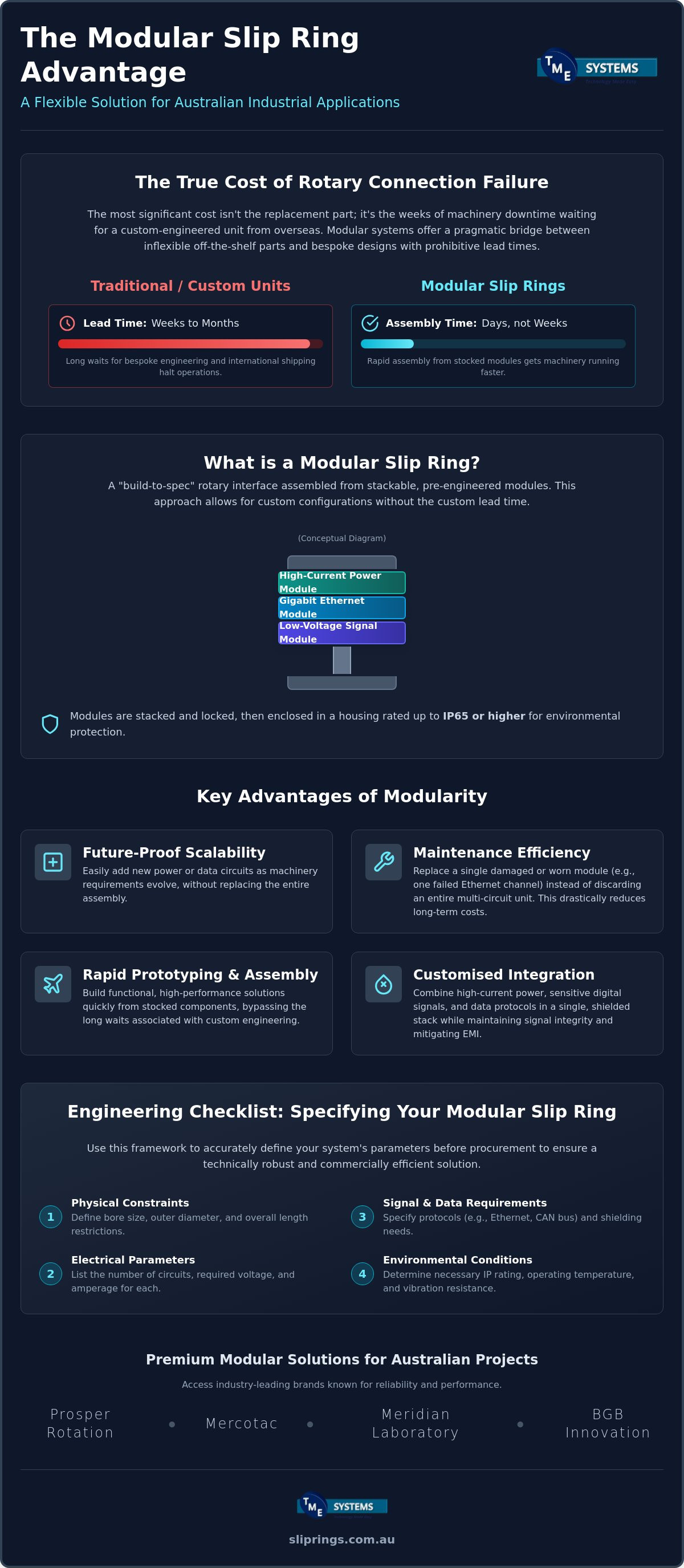
To ensure a successful integration, you must document several technical variables before procurement. This prevents the common issue of receiving hardware that meets electrical needs but fails mechanically within the application's footprint. A modular slip ring offers immense flexibility, but its performance depends entirely on an accurate initial specification. Use the following five-step framework to define your requirements.
- Step 1: Circuit Mapping. Itemise every required path. Group them by power (Amps/Volts) and signal type (Analog, Digital, or High-Speed Data). Mixing these requires internal shielding to prevent EMI.
- Step 2: Physical Footprint. Define the maximum allowable outer diameter and the required through-bore. If you're passing hydraulic lines or a central shaft through the unit, the bore size is your primary constraint.
- Step 3: Environmental Audit. Note the ambient temperature, humidity levels, and exposure to contaminants like iron ore dust or coastal salt spray.
- Step 4: Operational Dynamics. Calculate the continuous and peak RPM. High duty cycles require contact materials that prioritises low wear over long service intervals.
- Step 5: Mounting Interface. Decide if the application requires a flange mount, a shaft-end mount, or a torque arm to prevent housing rotation.
Environmental Protection and IP Ratings
Selecting the correct seal is vital for Australian industrial sites. An IP65-rated housing is generally sufficient for preventing dust ingress in inland mining operations. However, if the machinery undergoes high-pressure washdowns or operates in marine environments, an IP67 or IP69K rating is necessary. Material choice also plays a role; while anodised aluminium is the standard for most modular housings, 316 stainless steel is the pragmatic choice for offshore platforms to prevent accelerated corrosion. If you're unsure which rating fits your site, you can consult our technical team for an application-specific recommendation.
Circuit Configuration and Spare Capacity
Adhering to the "Spare Circuit Rule" is a smart engineering move. We recommend adding 10% to 20% extra modules to your initial stack. This allows for future sensor integration or provides an immediate fallback if a single circuit is damaged during installation. Properly organising wires with clear labelling and high-quality connectors will simplify the eventual commissioning. For more detailed procurement strategies, refer to our industrial slip ring supplier guide, which outlines how to vet vendors for technical support and local availability.
By following this methodical approach, you ensure that your modular assembly is not just a collection of parts, but a reliable component tailored to your machinery's specific operational reality.
Premium Modular Solutions: Brand Spotlights and TME Support
Selecting the right hardware is the final step in the engineering process. In Australia, TME Systems acts as a technical partner to ensure that the chosen modular slip ring aligns with both local operational demands and international manufacturing standards. By representing a curated portfolio of global brands, we provide access to specialised rotary solutions that address the specific pain points of the mining, energy, and automation sectors. Our role is to bridge the gap between complex manufacturing capabilities and your specific site requirements, ensuring that the final assembly performs reliably under Australian conditions.
Brand Specialisations
Different industrial challenges require different contact technologies and housing architectures. Integrating Prosper Rotation slip rings is a pragmatic choice for versatile industrial automation projects. Their designs allow for high circuit density and flexible through-bore diameters, making them ideal for machinery that must accommodate central shafts or fluid lines. For those operating in more demanding environments, utilising BGB Innovation hardware is recommended for high-reliability heavy machinery. BGB has a long history in the wind energy sector, and their modular units are engineered to withstand the vibration and thermal cycling common in Australian wind farms and port facilities. Additionally, Meridian Laboratory offers unique modular solutions for high-speed precision applications that require exceptionally low electrical noise and long-term maintenance intervals.
Technical Consulting and Local Support
Navigating the specification process for a modular slip ring requires more than just a product catalogue. TME Systems provides comprehensive technical application consulting to help Australian engineers move from a conceptual circuit list to a finalised, buildable stack. This consultative approach helps prevent common pitfalls, such as under-specifying insulation for high-voltage modules or overlooking the impact of RPM on contact wear. We provide direct access to technical data sheets and CAD models, which allows your design team to verify fitment and cable routing within your 3D models before any hardware is ordered.
Local support also means ensuring that every configuration remains compatible with Australian electrical and safety standards. We assist in selecting materials that resist the corrosive effects of coastal salt spray and the abrasive nature of outback dust. By providing a single point of contact for premium brands like Mercotac and Prosper Rotation, we simplify the procurement process and provide the technical assurance needed for high-stakes industrial projects. Whether you are upgrading an existing assembly or designing a new system from scratch, our focus remains on delivering a solution that is technically robust and commercially efficient.
Optimising Your Rotary Connection Strategy
Adopting a modular slip ring system is a pragmatic decision that balances immediate project requirements with long-term operational resilience. By utilising a build-to-spec approach, you gain the ability to integrate diverse power and signal types into a single, scalable assembly. This flexibility doesn't just reduce initial lead times; it simplifies future maintenance by allowing for the replacement of individual circuit layers rather than entire units. For Australian industries operating in harsh mining or marine environments, this level of serviceability is a critical factor in minimising unplanned downtime.
As an authorised Australian distributor for premium brands like Mercotac, BGB Innovation, and Prosper Rotation, TME Systems provides the technical expertise needed to navigate complex specifications. Our NSW-based team understands the environmental stressors unique to local sites and can help you engineer a solution that meets both performance and safety standards. If you are ready to define the parameters of your next project, Contact TME Systems for a Technical Consultation on Modular Slip Rings. We look forward to helping you achieve a reliable, high-performance connection for your rotating machinery.
Frequently Asked Questions
Can I mix power and data in the same modular slip ring?
Yes, you can mix power and data circuits within a single assembly. This is achieved by using dedicated wafers for different electrical requirements. High-current power modules are physically separated from sensitive data paths using grounded shielding or spacer plates. This architecture prevents electromagnetic interference from corrupting digital signals like Ethernet or CANbus while maintaining the capacity to drive heavy-duty motors or heaters.
How many circuits can I stack in a modular system?
Most industrial modular systems allow you to stack between 20 and 50 circuits, though some heavy-duty frames can accommodate more. The primary limiting factors are mechanical stability and the total height of the assembly. As the stack grows taller, tie rods or reinforced housings are used to maintain concentricity. It's always best to check the specific frame limits of brands like Prosper Rotation before finalising your design.
Are modular slip rings suitable for high-speed rotation?
Modular stacks are generally rated for speeds up to 500 or 1,000 RPM, depending on the contact materials and stack height. While they are reliable for most industrial automation, ultra-high-speed applications can cause excessive heat buildup and mechanical vibration in a multi-segment stack. If your machinery requires several thousand RPM, a liquid metal Mercotac unit or a monolithic custom design may be a more technically sound choice.
What is the typical lead time for a modular slip ring in Australia?
Lead times for a modular slip ring are significantly shorter than for bespoke, custom-engineered units. While a fully custom build might take several months to arrive from overseas, a modular assembly can often be configured from stocked components and shipped within a few weeks. This rapid turnaround is a major advantage for Australian projects facing tight commissioning deadlines or needing urgent replacements for failed machinery on remote sites.
Can I add more modules to my slip ring after it has been installed?
You can add modules after installation if the original shaft and housing were specified with spare capacity. This process requires disassembling the stack to insert the new wafers. It's much simpler to include these extra circuits during the initial build. If your current housing is already at its maximum length, you would likely need to upgrade to a taller frame to accommodate the additional circuits.
How do modular slip rings handle signal noise and EMI?
Signal integrity is managed through physical separation and specialised contact materials within the modular slip ring. Modular designs use grounded metallic plates between power and signal sections to block electromagnetic interference. For data transmission, gold-on-gold contacts provide a stable, low-noise connection that is resistant to oxidation. This combination ensures that sensitive telemetry remains clear even when adjacent to high-voltage power lines.
Are modular slip rings more expensive than standard capsule designs?
Initial hardware costs for modular units are typically higher than for fixed-circuit capsule designs. However, the commercial value lies in long-term maintenance and flexibility. Replacing a single damaged wafer is far more cost-effective than discarding an entire multi-circuit assembly. Additionally, the reduction in lead times prevents the expensive downtime associated with waiting for custom replacements, making modularity the more economical choice for critical industrial infrastructure.
What maintenance is required for modular rotary connectors?
Maintenance primarily involves periodic cleaning and monitoring brush wear. Conductive dust from carbon or silver-graphite brushes can accumulate over time; this should be cleared with dry, low-pressure compressed air to prevent short circuits. The frequency of these checks depends on your specific duty cycle and site conditions. For example, a unit in a dusty mining environment requires more frequent inspections than one in a clean, temperature-controlled processing plant.