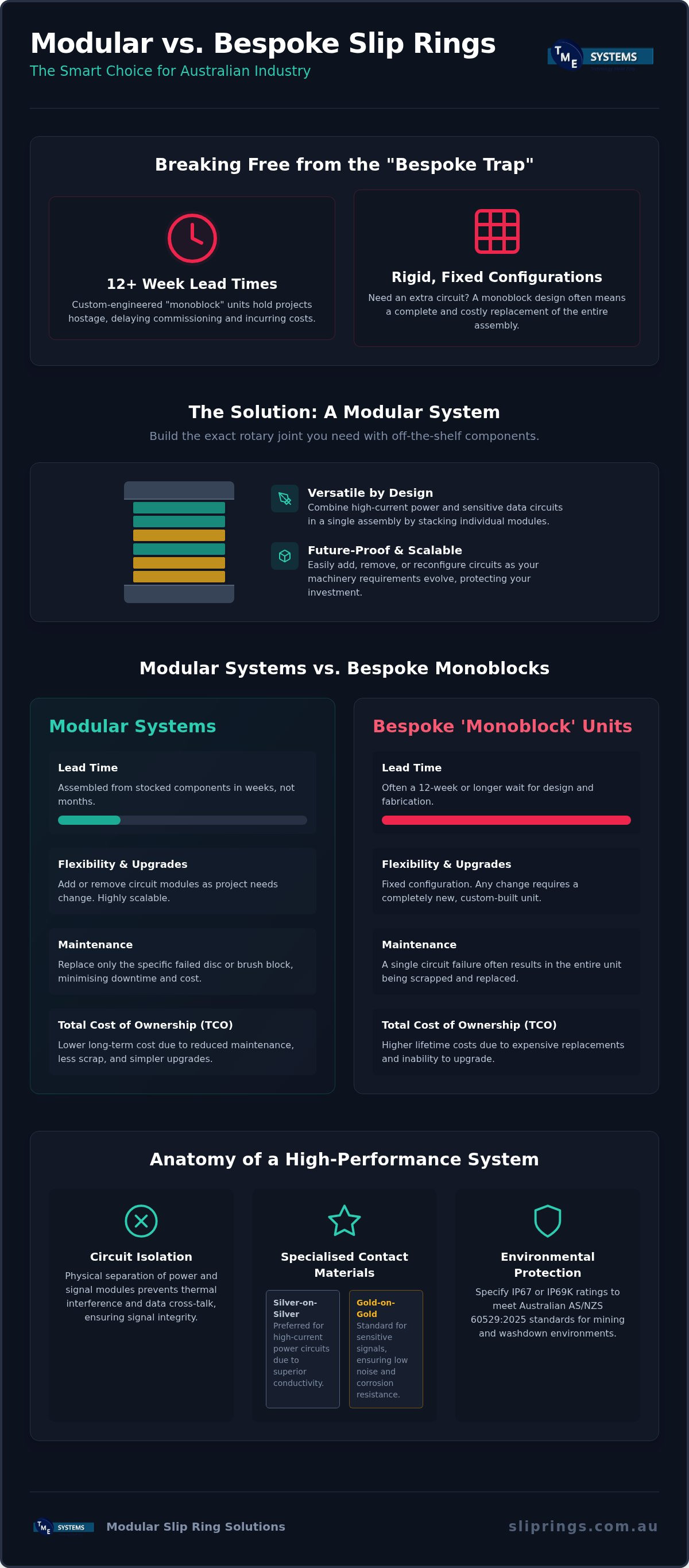
Why should your project timeline be held hostage by a twelve-week lead time for a custom rotary joint? In the fast-paced Australian industrial sector, waiting months for a bespoke component often isn't a viable option. You've likely felt the frustration of choosing between a standard unit that lacks the necessary capacity and a custom build that blows out your schedule. A modular slip ring system offers a pragmatic middle ground, providing the versatility of a custom solution with the availability of off-the-shelf hardware.
We understand the challenge of managing signal interference between high-current power and sensitive data circuits, especially when you need to scale circuit counts for future machine upgrades. This guide provides the technical roadmap you need to master modular systems, ensuring you can reduce maintenance downtime and optimise your procurement process. We'll explore the nuances of circuit isolation, compliance with the latest AS/NZS 60529:2025 standards for washdown protection, and the specific performance profiles of industry leaders like BGB Innovation and Prosper Rotation. By the end of this article, you'll have a clear strategy for selecting hardware that balances long-term reliability with immediate availability.
Key Takeaways
- Differentiate between stackable circuit discs and fixed-configuration designs to move away from the long lead times of bespoke "monoblock" connectors.
- Master the technical nuances of circuit isolation to ensure reliable data transfer and effective heat dissipation in high-current modular slip ring systems.
- Compare the Total Cost of Ownership (TCO) of modular units against custom-engineered alternatives to avoid the "bespoke trap" during future machine upgrades.
- Specify the correct environmental protection, such as IP67 or IP69K ratings, to meet Australian compliance standards for packaging and mining machinery.
- Learn how to utilise technical consulting to select the ideal hardware from ranges like Prosper Rotation or BGB Innovation for your specific project requirements.
Understanding the Shift to Modular Slip Ring Systems
Traditionally, Australian engineering firms relied on bespoke, "monoblock" rotary joints. These were single-piece units designed for a fixed set of parameters. If you needed an extra circuit or a different signal type later, you had to replace the entire assembly. The transition to the modular slip ring represents a fundamental change in how we approach rotary connectivity. By moving away from fixed configurations, facilities can now build assemblies from standardised, stackable components. This shift is particularly evident in Australian manufacturing and heavy machinery sectors, where the demand for adaptable hardware has never been higher.
The Mechanics of Modular Assembly
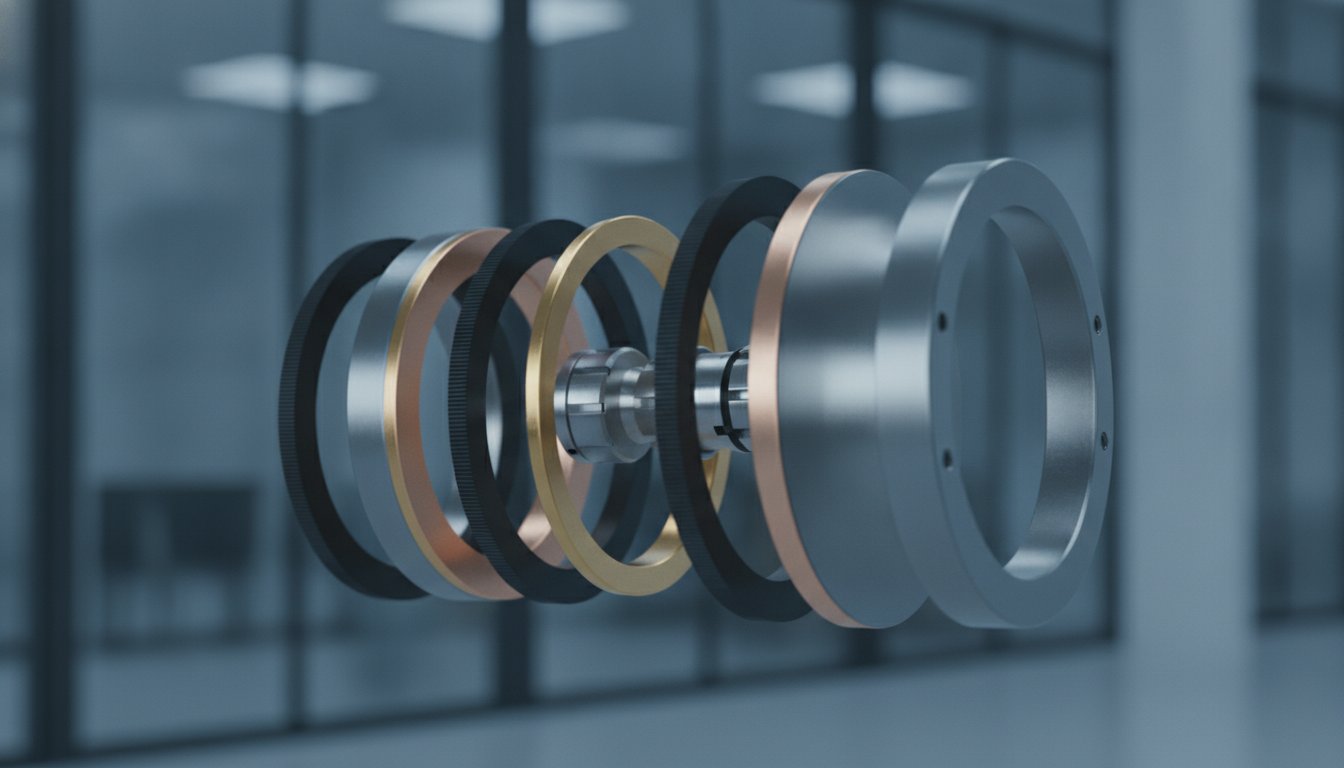
A modular system relies on individual circuit discs or modules that stack along a central shaft. Unlike a sealed capsule, where every wire is integrated during manufacturing, a modular unit allows for the physical separation of power and signal paths. You can combine high-current rings with low-noise signal rings in the same stack. This structural integrity is maintained by a robust housing and a central core that ensures concentricity even at high rotational speeds. Understanding Slip ring fundamentals helps in appreciating how these stackable brush blocks maintain consistent contact pressure across multiple modules. The result is a customisable assembly that doesn't require a ground-up engineering redesign for every new project.
When to Choose Modular over Capsule Designs
Capsule designs are compact but rigid. If your machine's requirements evolve, a capsule is often a dead end. Modular assemblies offer the flexibility to add or remove circuits as needed. Maintenance is another major factor. When a single circuit fails in a monoblock unit, the entire device is often scrapped. With a modular setup, you can replace specific discs or brush blocks, significantly reducing the total cost of ownership. While modular stacks might have a larger axial length compared to a pancake unit, the ability to scale circuit counts without redesigning the entire mount makes them the preferred choice for future-proofing industrial assets.
The most significant driver for this shift in Australia is the reduction in lead times. A fully bespoke rotary joint often involves a twelve-week wait for design and fabrication. In contrast, modular systems from brands like BGB Innovation or Prosper Rotation can be assembled from stocked components in a matter of weeks. This agility is critical for packaging and heavy machinery sectors where downtime or delayed commissioning has immediate financial consequences. By choosing a modular approach, you're investing in a system that balances specific performance needs with the speed of off-the-shelf availability.
The Anatomy of a Modular System: Circuits, Power, and Data
Engineering a modular slip ring requires a precise balance between electrical capacity and signal purity. In a modular stack, you aren't just piling rings; you're managing a complex thermal and electromagnetic environment. High-current power circuits generate heat, which can affect the resistivity of adjacent signal lines. By using modular segments, engineers can physically isolate these circuits. This separation is a key design feature in an advanced slip ring assembly patent, which highlights how structural modularity prevents cross-talk and thermal interference. This architecture allows for the simultaneous transfer of raw power and sensitive data without compromising the performance of either.
Choosing the right contact material is critical for long-term reliability. Silver-on-silver contacts are generally preferred for power modules due to their high conductivity and ability to handle the micro-arcs common in high-current transfers. Conversely, gold-on-gold contacts are the standard for sensitive signal rings. Gold's superior corrosion resistance ensures low electrical noise and stable contact resistance, which is vital for millivolt sensor data. For those managing complex fluid and electrical requirements, hybrid configurations can integrate pneumatic or hydraulic swivels into the same modular stack, creating a single point of rotation for all utility transfers.
Transferring High-Speed Data in Modular Units
Modern industrial automation relies on high-speed protocols like Ethernet, CANbus, and Profinet. In a modular unit, maintaining signal integrity for these protocols involves more than just wire selection. Techniques like using dedicated shielded modules and twisted-pair internal wiring are essential to mitigate electromagnetic interference (EMI). Modularity provides an inherent advantage here; you can place "blank" spacer modules between power and data sections to increase physical distance. This physical gap is a luxury often unavailable in compact capsule designs, making the modular slip ring the superior choice for high-interference environments.
Power Handling and Voltage Ratings
Standard voltage ratings for modular assemblies typically reach up to 680V AC/DC, though customisation allows for even higher thresholds. Current handling is equally flexible, ranging from milliamp-level signals for encoders to over 100 Amps for heavy-duty motors. Dielectric strength refers to the maximum electric field that an insulating material can withstand without undergoing electrical breakdown and becoming conductive. If you're unsure which contact material suits your specific RPM and current load, our team provides technical application consulting to help refine your assembly specifications.
Modular vs. Custom-Engineered Slip Rings: Cost and Lead Time
The decision between a modular slip ring and a custom-engineered unit often hinges on the balance between immediate performance requirements and long-term operational costs. While a ground-up design offers a tailored fit for a specific machine, it frequently leads to the "bespoke trap". This occurs when a unique component fails, and the replacement must be manufactured from scratch, leading to extended downtime. Modular systems avoid this by using standardised components that can be assembled to meet specific needs without the overhead of a full engineering design cycle. This approach ensures that your machinery remains serviceable throughout its entire lifecycle.
Lead times are the most immediate differentiator for Australian engineering teams. A bespoke rotary joint typically requires a lengthy design phase, prototyping, and custom fabrication, often stretching to twelve weeks or more. In contrast, modular assemblies are built from pre-engineered discs and brush blocks already in production. This reduces the timeline to a matter of weeks, allowing projects to stay on schedule even when specifications change late in the piece. By choosing modularity, you're prioritising availability without sacrificing the technical precision required for high-performance applications.
The Economic Case for Modularity
Evaluating the Total Cost of Ownership (TCO) requires looking beyond the initial capital expenditure (CAPEX). While a modular stack might have a comparable upfront cost to a custom unit, the operational expenditure (OPEX) savings are substantial over time. Maintaining a local inventory of spare modules is far simpler than stocking entire custom assemblies. Working with a professional Industrial Slip Ring Supplier Australia allows procurement teams to access these standardised parts from national hubs, ensuring that a single circuit failure doesn't halt production. This strategic approach to spare parts management reduces the financial risk associated with unexpected component failure.
Flexibility and Future-Proofing
Machine requirements rarely remain static over a ten-year lifecycle. A modular assembly allows you to add circuits or change signal types as your technology evolves. For instance, consider a packaging line upgrade where additional sensors are required for improved quality control. In a fixed-configuration system, this would require a total replacement of the rotary joint. With a modular assembly, you can simply add the necessary signal modules to the existing stack. This level of adaptability is seen in high-stakes environments, where innovations in power transfer for turbomachinery show that even complex systems benefit from a structured, adaptable approach to power and data transmission. This flexibility ensures that your hardware remains relevant even as data protocols and power demands change.
Specifying Your Modular Assembly: Key Technical Parameters
Selecting a modular slip ring involves more than just circuit counts; it requires a detailed audit of the operating environment and mechanical constraints. Because these units are assembled from individual modules, the cumulative effect of tolerances must be managed to maintain balance, especially at higher rotational speeds. While standard modular stacks perform reliably at moderate speeds, applications requiring higher RPMs need specific balancing to prevent vibration-induced wear. Thermal stability is equally paramount. Industrial components must operate consistently across a temperature range of -40°C to +80°C, ensuring that expansion and contraction of the modular housing don't compromise contact integrity.
Mounting configuration is the final piece of the specification puzzle. The choice between a flange mount or a torque arm depends on the mechanical stability of your drive system:
- Flange Mounts: Best for high-precision applications with minimal shaft run-out, providing a rigid connection to the machine frame.
- Torque Arms: Ideal for high-vibration environments where the slip ring must "float" to accommodate slight misalignments, protecting internal bearings from premature wear.
Contact Technology and Life Expectancy
The 10 million revolution benchmark is the industry standard for high-quality modular brush systems. However, achieving this longevity in Australia requires accounting for local environmental factors like abrasive dust and high humidity. These variables can increase contact resistance and lead to premature failure if the contact pressure isn't correctly calibrated for the specific RPM. For a deeper dive into these mechanical variables, consult our guide on Slip Ring Application Engineering. Proper calibration ensures that your modular slip ring reaches its full service life without unexpected signal degradation.
Environmental Sealing for Harsh Conditions
Protection levels are defined by the AS/NZS 60529:2025 standard, which is critical for Australian compliance in 2026. For standard washdown environments, a minimum of IP67 is required. In food processing or heavy industrial cleaning, IP69K is necessary to withstand high-pressure, high-temperature jets. Housing materials must also resist UV degradation and oil exposure, common in Australian outdoor and mining applications. We typically specify labyrinth seals for high-speed applications where friction must be minimised, while contact seals are preferred for low-speed units where absolute ingress protection is the priority. If you're currently drafting a specification for a new project, you can request a technical application audit to ensure your modular selection meets these rigorous standards.
Sourcing Modular Slip Rings in Australia via TME Systems
Selecting the correct modular slip ring in 2026 requires more than a simple catalogue search. As industrial requirements for data integrity and environmental resilience become more stringent, the role of a technical intermediary is vital. TME Systems acts as this bridge, connecting Australian engineering firms with world-leading hardware while providing the local expertise needed to ensure compliance with national standards. We don't just provide components; we offer a technical partnership that covers the entire lifecycle of your rotating equipment, from initial specification to long-term spare parts support.
Our portfolio includes specialised modular solutions from global leaders. The Prosper Rotation range is highly regarded for its versatility, allowing for rapid configuration of multi-circuit stacks that handle both power and sensitive signals. For applications in more demanding environments, such as mining or heavy manufacturing, we supply BGB Innovation modular units. These are engineered for heavy-duty performance and offer exceptional durability in high-vibration or high-dust scenarios. By maintaining strong relationships with these manufacturers, we ensure that Australian projects benefit from the latest innovations in modularity without the typical delays associated with international procurement.
The TME Systems Consultative Process
Our approach begins with a thorough review of your specific operational parameters. We analyse circuit counts, current loads, voltage ratings, and rotational speeds to determine the most stable configuration for your assembly. This process allows us to match brand-specific strengths to your application. We might recommend Prosper for a project requiring high circuit density in a compact footprint, or BGB for a heavy-duty industrial application where maintenance access is a priority. All technical support and national delivery are coordinated from our centre in Ingleburn, New South Wales, ensuring that your project remains on track with reliable local logistics.
Next Steps for Your Project
Before you commit to a specific hardware configuration, we recommend a technical audit of your rotating machinery. This ensures that factors like shaft run-out, mounting space, and environmental ingress are fully accounted for. To begin this process, prepare a data sheet that includes your peak current requirements, the specific data protocols you intend to transfer, and the expected duty cycle of the machine. Our engineers will use this data to refine your modular slip ring specification, ensuring optimal performance from day one. To get started, you can Contact TME Systems for a Modular Slip Ring Consultation and speak directly with an application specialist.
Future-Proofing Your Rotary Systems with Modular Scalability
Transitioning to a modular slip ring architecture is a strategic decision that balances immediate project delivery with long-term operational flexibility. By opting for stackable configurations, you eliminate the prohibitive lead times of custom builds while maintaining the ability to upgrade signal or power circuits as your machinery evolves. We've explored how proper circuit isolation and the selection of brand-specific modular strengths, such as those from BGB Innovation and Prosper Rotation, ensure reliable data transfer even in the most demanding Australian industrial environments.
TME Systems is your authorised Australian distributor for these world-leading brands. From our technical centre in New South Wales, we specialise in providing low-noise, high-reliability rotary connections tailored to your specific mechanical parameters. Our team is ready to help you navigate the complexities of environmental ratings and rotational speeds to ensure your next installation is both compliant and durable. Request a Technical Consultation for Your Modular Slip Ring Requirement today to secure the technical success of your project. We look forward to helping you optimise your rotating equipment for the challenges of 2026 and beyond.
Frequently Asked Questions
What is the main difference between a modular slip ring and a capsule slip ring?
The primary difference lies in configuration flexibility. A modular slip ring consists of stackable circuit discs that allow you to add or remove circuits as project requirements change. In contrast, a capsule slip ring is a sealed unit with a fixed number of circuits that cannot be altered after manufacture. This makes modular systems more adaptable for machinery that may require future upgrades.
Can I mix high-power and low-signal circuits in the same modular stack?
Yes, you can combine power and signal circuits within a single assembly. Modularity allows for the physical separation of these circuits by placing spacer modules or electromagnetic shielding between high-current power lines and sensitive data lines. This design technique is essential for preventing electrical noise from interfering with Ethernet, CANbus, or sensor signals.
How many circuits can I typically add to a modular slip ring system?
Circuit capacity is largely determined by the axial length of the central shaft and the mechanical stability of the final stack. While it's common to see assemblies with dozens of circuits, we typically review the total length to ensure the unit remains balanced and vibration-free. Each module adds a specific height to the assembly, so your mounting space must accommodate the full stack height.
Are modular slip rings suitable for high-speed applications above 500 RPM?
Modular systems can handle high-speed applications provided they are correctly balanced and specified with appropriate contact materials. While standard stacks perform well at moderate speeds, exceeding 500 RPM requires precise alignment to prevent centrifugal forces from affecting contact pressure. We often recommend gold-on-gold contacts for high-speed signal modules to maintain low electrical noise and consistent data integrity.
What is the typical lead time for a modular slip ring assembly in Australia?
Lead times for a modular slip ring in Australia generally range from two to four weeks. This is a significant improvement over the twelve-week lead time often required for bespoke monoblock designs. Because the individual modules are pre-engineered and stocked at our national distribution centre, we can assemble and test your specific configuration with a much faster turnaround.
Do modular slip rings require more maintenance than fixed designs?
Modular designs do not require more maintenance; in fact, they often reduce long-term maintenance costs. If a single circuit fails in a fixed design, the entire unit usually needs replacing. With a modular system, you can replace individual discs or brush blocks without scrapping the entire assembly. This simplifies your spare parts inventory and reduces total equipment downtime.
Can I integrate a pneumatic swivel with a modular electrical slip ring?
You can integrate pneumatic or hydraulic swivels into a modular electrical stack to create a hybrid rotary joint. This configuration allows for the simultaneous transfer of electrical power, high-speed data, and fluids through a single axis of rotation. These hybrid units are frequently used in automated packaging lines and robotic systems where mounting space is limited.
What IP ratings are available for modular slip ring housings?
Modular housings are available with ratings from IP65 for standard dust protection up to IP69K for high-pressure washdown environments. For Australian industrial applications, we ensure these housings comply with the AS/NZS 60529:2025 standard. The final rating depends on your choice of housing material and whether we utilise labyrinth seals or contact seals for your specific RPM requirements.