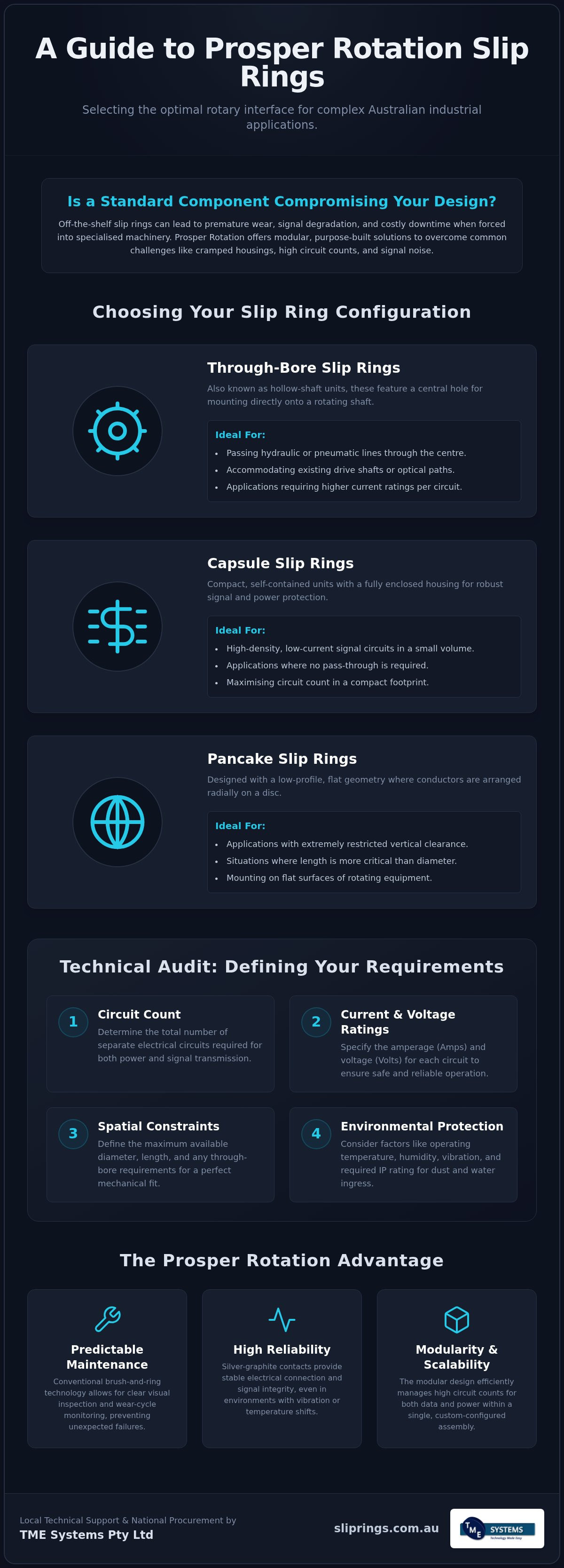
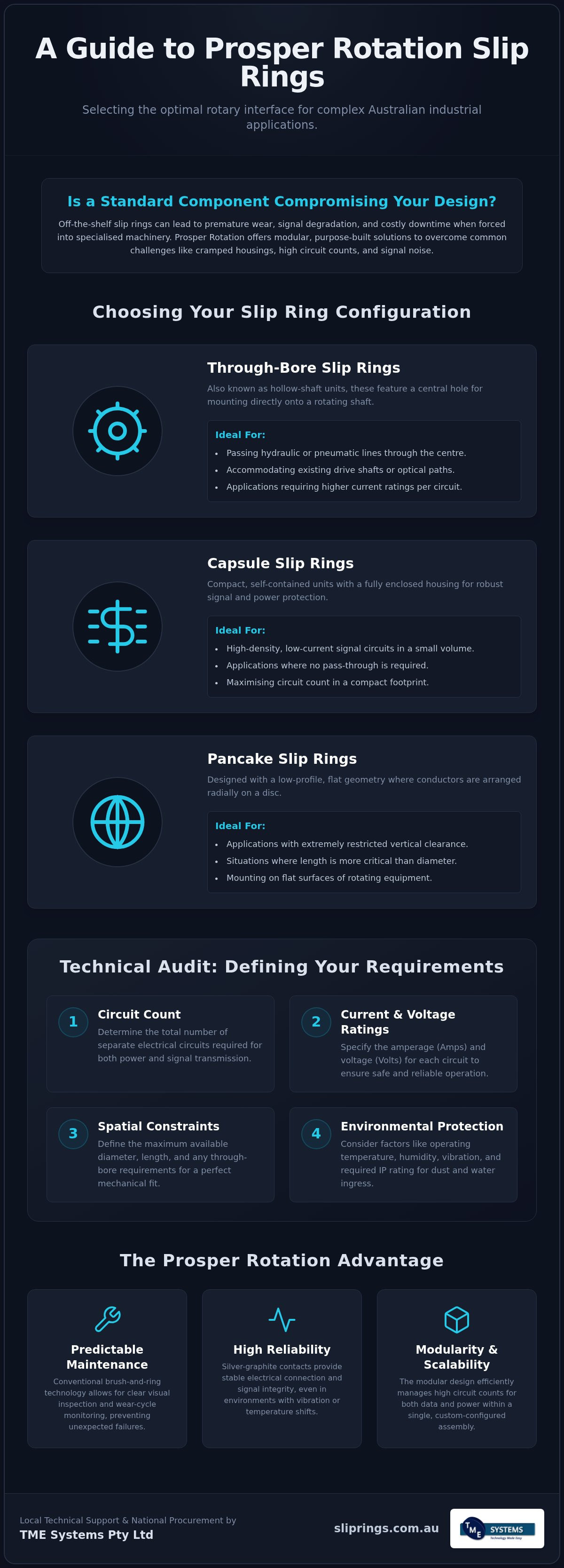
Is a standard, off-the-shelf component forcing you to compromise on your machine's design or signal integrity? For many Australian engineers, the challenge isn't just finding a rotating connection; it's finding one that fits into a cramped vertical housing or manages dozens of circuits without signal noise. If you're sourcing Prosper Rotation slip rings Australia, you likely understand that a mismatched slip ring leads to premature wear and data loss, yet securing specialised hardware with local technical backing often feels like an uphill battle.
We recognise that industrial downtime is costly and that every millimetre of space matters in modern automation. This professional guide demonstrates how Prosper Rotation slip rings Australia provide the modularity required for complex industrial applications. By focusing on technical accuracy, we'll help you identify the specific series that suits your spatial constraints, whether you require a low-profile pancake design or a through-bore configuration. We'll also explain how to specify circuit counts and current ratings for Prosper Rotation slip rings Australia while outlining the consultative support provided by TME Systems Pty Ltd.
Key Takeaways
- Identify why Prosper Rotation slip rings Australia are the preferred choice for modularity and mechanical versatility in complex Australian industrial environments.
- Differentiate between through-bore and capsule configurations to ensure your rotary interface effectively accommodates existing shafts or fluid lines.
- Resolve critical spatial constraints by learning how to specify low-profile pancake slip rings for applications with restricted vertical clearance.
- Master the technical audit process to accurately define circuit counts, current ratings, and environmental protections for custom-configured assemblies.
- Leverage local technical support from TME Systems to transition seamlessly from an initial application review to national procurement and delivery.
Why Prosper Rotation is the Versatile Choice for Australian Industry
Prosper Rotation is a global leader in conventional contact slip ring technology, known for its ability to solve complex electromechanical interface problems. In the Australian industrial sector, versatility isn't just a preference; it's a requirement. Local manufacturing and processing plants often operate legacy equipment alongside modern automation, creating a need for hardware that can adapt to varying mechanical footprints. Prosper Rotation slip rings Australia provide this adaptability through a modular construction that supports power and signal transfer across a wide range of circuit counts.
TME Systems integrates Prosper into a broader portfolio that includes Mercotac and BGB Innovation. While other brands might focus on liquid metal or high-current wind turbine applications, Prosper fills the gap for general industrial automation where custom physical configurations are paramount. This ensures that engineers don't have to force a one-size-fits-all solution onto a specialised machine.
Addressing Diverse Engineering Challenges
Standard rotary connectors often fail because they don't account for the unique spatial constraints of a specific machine. You might find that a standard unit is too long for a shallow housing or lacks the hollow centre required to pass a hydraulic line through the axis of rotation. Prosper Rotation solves these issues by offering various form factors, such as pancake and through-bore designs. TME Systems provides the technical bridge, helping you navigate these options to find a cost-effective solution that fits your exact envelope. This consultative approach ensures that the chosen hardware is matched to the specific industrial process, reducing the risk of premature failure due to mechanical stress.
The Benefit of Conventional Contact Technology
Before selecting a unit, it's useful to revisit the basics: What is a Slip Ring? It's an electromechanical device that allows the transmission of power and signals from a stationary to a rotating structure. Prosper utilises conventional brush-and-ring technology, employing high-grade materials like precious metal or silver-graphite contacts. This technology offers several advantages in Australian industrial settings:
- Predictable Maintenance: Conventional contacts allow for visual inspection and clear wear-cycle monitoring.
- Reliability: Silver-graphite brushes provide stable electrical contact even in environments with vibration or temperature fluctuations.
- Scalability: It's easier to manage high circuit counts for data and power in a single assembly compared to some alternative technologies.
Prosper Rotation slip rings Australia are engineered for longevity. By using superior contact materials compared to generic alternatives, these units maintain signal integrity over millions of revolutions, making them a dependable partner for long-term industrial projects.
Through-Bore vs. Capsule Slip Rings: Determining the Interface
Choosing the correct interface for a rotary connection requires a thorough analysis of the mechanical environment and the types of media being transferred. Prosper Rotation slip rings Australia are generally categorised into two primary physical formats: through-bore and capsule. The selection between these formats depends on whether your application requires a hollow centre for mounting or a fully enclosed housing for signal protection.
Technical considerations such as circuit count and current density also shift between these formats. Capsule units often allow for a higher concentration of low-current signal circuits within a small volume. In contrast, through-bore models provide the surface area necessary for higher current ratings per circuit, though they require more radial space. If you aren't sure which configuration fits your machinery, a technical application review can help clarify these requirements.
Through-Bore Designs for Hollow-Shaft Mounting
Through-bore slip rings, often called hollow-shaft units, feature a central hole that allows the assembly to be mounted directly onto a drive shaft. This design is essential when you need to pass other services through the centre of the rotation, such as hydraulic lines, pneumatic hoses, or even a smaller secondary shaft. Bore sizes in the Prosper range are highly adaptable, typically starting at 12.7mm and extending to accommodate large-scale industrial axles.
Integrating electrical circuits with central rotating components becomes straightforward with this architecture. It's a common choice for indexing tables and robotic arms where the electrical assembly must sit flush against existing mechanical hardware. As the through-bore diameter increases, the linear speed at the contact point rises, which typically necessitates lower maximum RPM limits and can influence the starting torque of the assembly. This relationship means that larger bores require careful management of brush pressure to maintain longevity and signal clarity.
Capsule Designs for Shielded Signal Transfer
When the priority is a compact, self-contained unit, capsule designs are the preferred solution. These slip rings are fully enclosed in a protective housing, shielding the internal contacts from dust and light debris. They're specifically engineered for sensitive data circuits where maintaining low electrical noise is critical. Because the rings and brushes are tightly packed, capsule units offer an excellent circuit-to-size ratio, making them ideal for small-scale automation.
Applications for capsule models are diverse, ranging from CCTV camera gimbals to medical equipment and precision sensors. The internal shielding helps prevent electromagnetic interference, which is vital when transmitting high-frequency signals alongside power. If your project involves restricted space and requires a high circuit count for data transfer, the capsule format provides a reliable, plug-and-play rotary interface. To ensure you select the right mechanical fit, you can consult with TME Systems to match these specifications to your existing equipment envelope.
Compact and Pancake Slip Rings: Solving Spatial Constraints
Performing a spatial audit is the first step in any successful rotary integration. You must measure the available envelope, paying close attention to both the axial length and the radial diameter. Prosper Rotation slip rings Australia offer specialised geometries that address these specific physical boundaries, ensuring that electrical performance isn't sacrificed for a smaller footprint. Balancing the required circuit count with these physical dimensions often involves choosing between a traditional cylindrical stack or a flattened disc configuration.
Miniature and Compact Series for Robotics
Specifying hardware for multi-axis robotic arms requires a focus on mass and volume. Every gram added to an articulated joint increases the inertia the motor must overcome. Miniature series slip rings provide a lightweight solution that minimises centrifugal forces during high-speed rotation. This is particularly important in automation cells where rapid, repetitive movements are standard. These compact units maintain signal integrity for sensors and encoders while fitting into the tight confines of a robotic wrist or elbow. For a deeper look at these requirements, see our guide on Selecting Slip Rings for Robotic Arms and Automation.
Weight considerations are paramount in these applications. A heavy slip ring can shift the centre of gravity of a robotic limb, leading to increased vibration and reduced accuracy. Prosper's miniature series uses high-density materials that provide the necessary electrical pathways without the bulk of standard industrial connectors. This allows engineers to maintain high circuit counts for complex instrumentation while keeping the overall assembly agile and efficient.
Pancake Designs for Vertical Height Limitations
Standard cylindrical slip rings stack circuits along the axis of rotation, which naturally increases the height of the unit. Pancake designs take the opposite approach by arranging the circuits concentrically on a flat plane. While this increases the overall diameter, it drastically reduces the vertical profile. This geometry is ideal for low-profile rotating platforms and packaging machinery where the clearance between the stationary base and the rotating table is minimal.
There is a specific trade-off to manage with this format. As you move from the centre of the pancake to the outer edge, the linear speed of the ring surface increases. This means the outer brushes experience more wear than the inner ones over the same number of revolutions. Despite this, the pancake configuration remains the only viable solution for applications where vertical space is the primary constraint. It provides a stable, low-profile electrical interface for turntables, medical scanners, and specialised display equipment across various Australian industrial sectors.
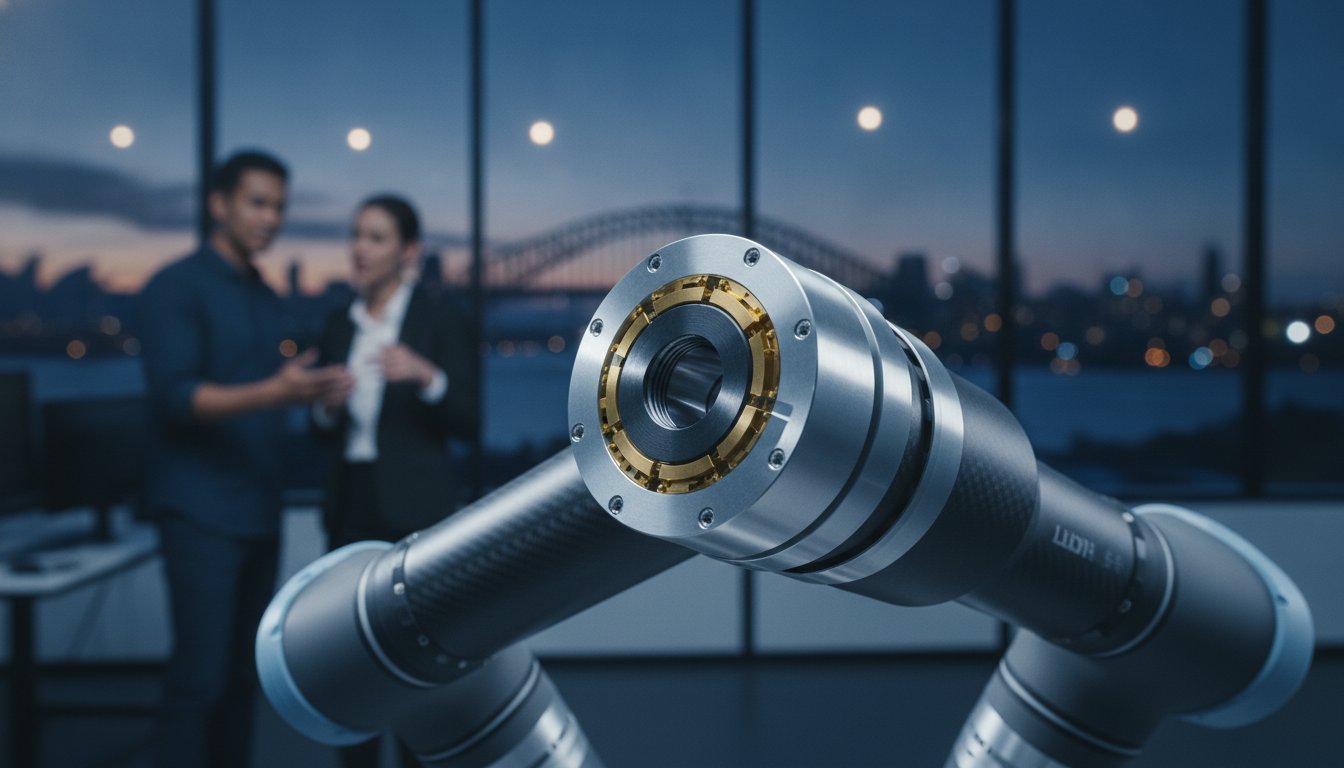
Modular Systems and Custom Configurations for Complex Needs
The modular nature of Prosper Rotation slip rings Australia allows engineers to move beyond the limitations of standard catalogues. Rather than adapting your machinery to fit a specific connector, you can build a slip ring assembly to your exact electrical and mechanical specifications. This building-block approach is essential for modern Australian processing plants that require a mix of high-amperage power and sensitive digital signals in a single rotary joint. Defining these requirements involves a methodical audit of your application's electrical load, rotational speed, and the physical space available for mounting.
TME Systems facilitates this customisation process by helping you navigate the various modular options. You must specify your required circuit count, voltage ratings, and peak current loads to ensure the internal components can handle the thermal stress of operation. To begin your configuration and ensure every parameter is addressed, you can request a technical application review from TME Systems.
Specifying Circuit Counts and Current Ratings
Combining power and signal circuits within a single modular assembly requires careful planning to prevent interference. In high-density configurations, managing voltage drop and electrical cross-talk is paramount, especially when sensitive Ethernet or PLC signals are present. Prosper modular units typically support current ranges from 2A for signal circuits up to 20A per circuit for standard power modules within a single compact assembly. By isolating power rings from signal rings through internal shielding and physical spacing, these units maintain high data integrity even when driving heavy motors. This versatility ensures that a single slip ring can manage everything from 240V power to low-voltage sensor feedback without compromising performance.
Environmental Protection and IP Ratings
Australian industrial environments present significant challenges, from the abrasive dust of mining sites to the moisture found in food processing wash-down areas. Selecting the right ingress protection (IP) rating is a critical step in the configuration process. While standard industrial units often carry an IP51 rating for indoor use, many Australian applications require enhanced IP65 or IP67 protection to prevent the entry of liquids and fine particulates. You can read more about these standards in our guide to IP65 and IP67 Ratings for Industrial Connectors.
Material choice for the housing further dictates the unit's resilience. Anodised aluminium housings offer a lightweight, cost-effective solution for most automation tasks. However, for applications in corrosive environments or coastal facilities, stainless steel housings provide the necessary durability to resist oxidation. Matching the housing material and sealing level to your specific site conditions ensures that your custom-configured slip ring survives the full duration of its intended service life.
Procuring Prosper Rotation Slip Rings via TME Systems
TME Systems operates as the authorised distributor for Prosper Rotation in Australia, providing a layer of technical expertise that goes beyond simple product supply. When you procure Prosper Rotation slip rings Australia, you aren't just buying a component; you're accessing a consultative process designed to eliminate mechanical mismatches. This approach ensures that every unit is compatible with relevant Australian standards, including AS/NZS 5368:2025, which governs equipment performance in challenging local conditions. Centralising your rotary requirements with a national specialist allows for consistent technical documentation and long-term support across your entire facility.
Technical Application Consulting and Support
A technical consultation is the most effective way to avoid costly rotary connection failures. TME Systems evaluates specific environmental variables that a standard data sheet might overlook. We analyse operational temperature ranges, maximum rotational speeds, and the presence of high-frequency vibration. These factors directly impact the wear rate of silver-graphite or precious metal contacts. By conducting an application review before purchase, you ensure the selected Prosper Rotation Slip Rings are fit for purpose. This proactive evaluation prevents signal interference and mechanical binding that often results from "best-guess" procurement. Our engineers work as an extension of your design team, providing the technical bridge between manufacturing capabilities and your end-user needs.
Streamlined Procurement for Australian Industrial Projects
Managing project schedules requires a clear understanding of lead times, especially for custom modular builds. TME Systems streamlines this process by coordinating directly with the manufacturer to align production with your site's installation windows. We act as a single point of contact for all technical queries, from the initial audit to final national delivery. This reduces the administrative burden on your procurement team and ensures that the technical specifications defined at the start of the project are exactly what arrives on site. We provide a steady, reliable rhythm to the procurement cycle, ensuring that technical accuracy remains the priority over marketing hype.
Whether you're retrofitting a legacy packaging line or designing a new robotic assembly, a methodical procurement path is essential. Our team provides the necessary CAD drawings and electrical schematics to integrate the hardware into your system design seamlessly. We understand that stability and precision are the foundations of industrial success. By choosing a partner that values long-term reliability over quick wins, you secure the technical success of your project. Contact TME Systems for a technical audit of your slip ring requirements.
Optimising Your Rotary Electrical Connections
Selecting the correct rotary interface requires more than just matching a part number; it demands a thorough analysis of mechanical envelopes, electrical loads, and environmental protection. Whether your application requires the hollow-shaft flexibility of a through-bore unit or the low-profile geometry of a pancake configuration, the modular design of Prosper Rotation slip rings Australia ensures a precise fit for your machinery. You don't have to compromise on signal integrity or spatial constraints when a custom-configured solution is available.
As the authorised distributor, TME Systems offers national Australian technical support and specialist application engineering to help you transition from a technical audit to a successful installation. Our team ensures that every assembly is matched to your specific industrial process, providing the long-term reliability your project requires. We invite you to Consult with TME Systems for Prosper Rotation Technical Specifications and secure the correct hardware for your next engineering challenge. We look forward to assisting with your application review.
Frequently Asked Questions
What is the maximum circuit count available for Prosper Rotation slip rings?
Prosper's modular range is highly scalable and can accommodate a high number of pathways. Standard models often support up to 96 circuits, but custom configurations can exceed this depending on the housing size and the electrical density required. TME Systems verifies the specific maximum count for your application during the technical audit to ensure that signal integrity is maintained across all channels without compromising the unit's mechanical stability or thermal performance.
Can Prosper Rotation slip rings be used for high-speed data transfer like Ethernet?
Yes, Prosper Rotation slip rings Australia are available in specialised configurations that support high-speed data protocols such as Ethernet (Cat5e or Cat6). These units incorporate internal shielding and specific contact materials to minimise cross-talk and data packet loss. This ensures reliable transmission of sensitive control signals alongside power circuits, which is essential for modern automated manufacturing cells and precision instrumentation used across various Australian industrial sectors.
How do I choose between a through-bore and a pancake slip ring?
The choice depends entirely on your machine's spatial constraints and mounting requirements. Select a through-bore model if you need to mount the assembly directly onto a drive shaft or pass pneumatic lines through the centre. If your primary limitation is vertical height rather than radial diameter, a pancake slip ring is the correct choice. TME Systems performs a spatial audit to help you determine which mechanical interface best fits your equipment's specific physical envelope.
Are Prosper Rotation slip rings compatible with Australian IP rating requirements?
Prosper slip rings are fully compatible with Australian IP rating requirements, offering ingress protection levels ranging from IP51 to IP67. For outdoor mining operations or food processing wash-down zones, we specify higher protection levels to ensure the internal contacts remain dry and free from abrasive dust. This compliance ensures your rotary connection meets the safety and reliability standards required by Australian industrial regulations and environmental conditions, providing long-term resilience in the field.
Can I combine high-current power and low-noise signals in one Prosper slip ring?
You can combine high-current power and low-noise signals within a single modular assembly by utilising internal isolation and shielding. This hybrid approach allows a single Prosper Rotation slip ring to drive a motor while simultaneously transmitting sensitive sensor data or PLC communications. TME Systems reviews your electrical load list to ensure that power circuits are physically separated from signal channels, preventing electromagnetic interference and maintaining high data integrity throughout the rotation cycle.
What maintenance is required for conventional contact slip rings in industrial environments?
Maintenance for conventional contact slip rings involves periodic visual inspections for brush wear and the removal of conductive debris from the housing. The required frequency depends on the rotational speed and the specific operating environment. Silver-graphite brushes are designed for high longevity, but a regular maintenance schedule ensures consistent electrical contact and prevents the build-up of dust that could lead to signal noise or premature component failure in demanding applications.
Does TME Systems provide technical drawings for Prosper slip rings before purchase?
TME Systems provides comprehensive technical drawings and CAD models for Prosper slip rings during the initial application engineering phase. Access to these documents before purchase allows your design team to verify mounting hole patterns and clearance zones within your system's final assembly. This detailed technical documentation is a standard part of our consultative process, ensuring a precise mechanical fit and reducing the risk of installation errors in Australian industrial projects.