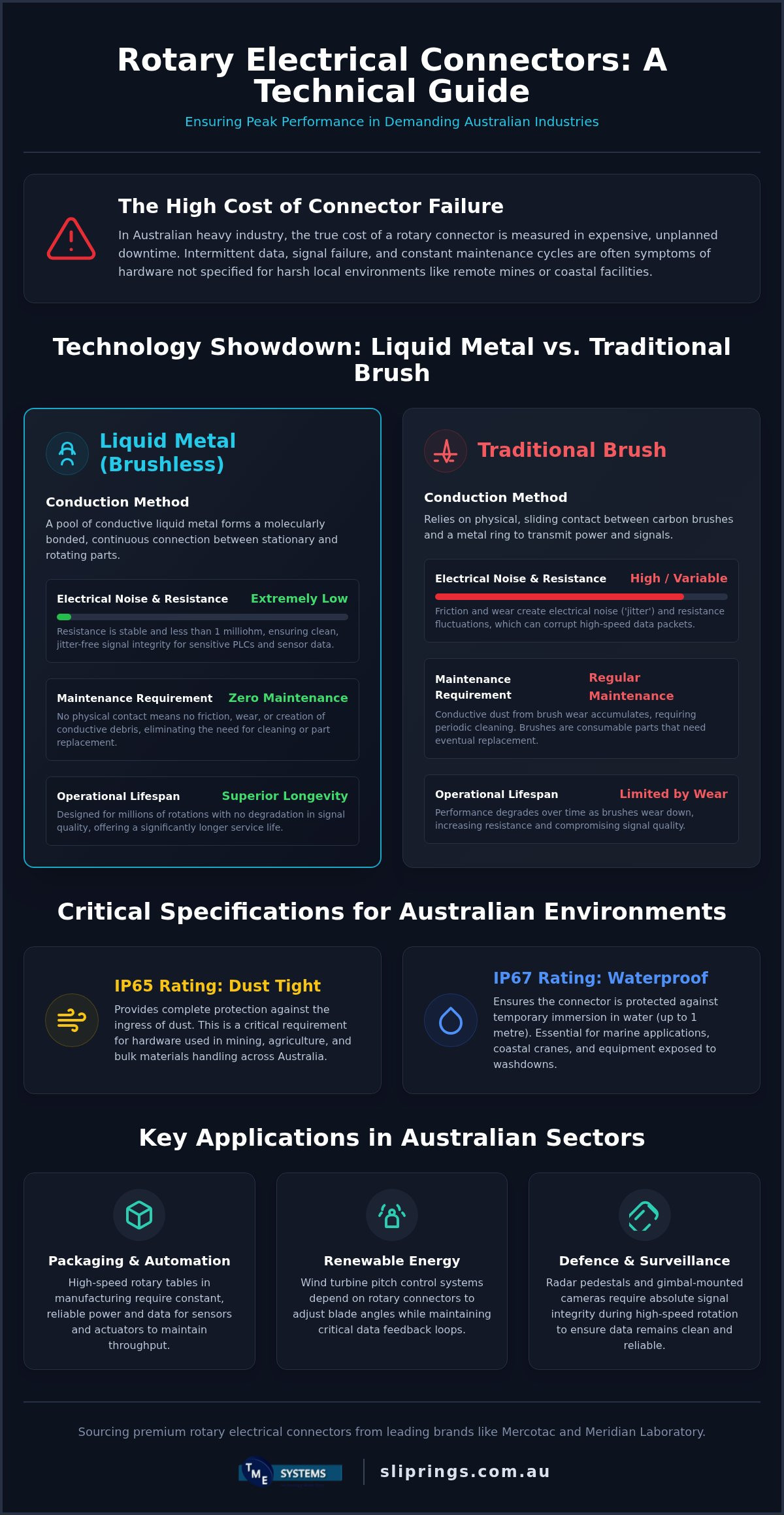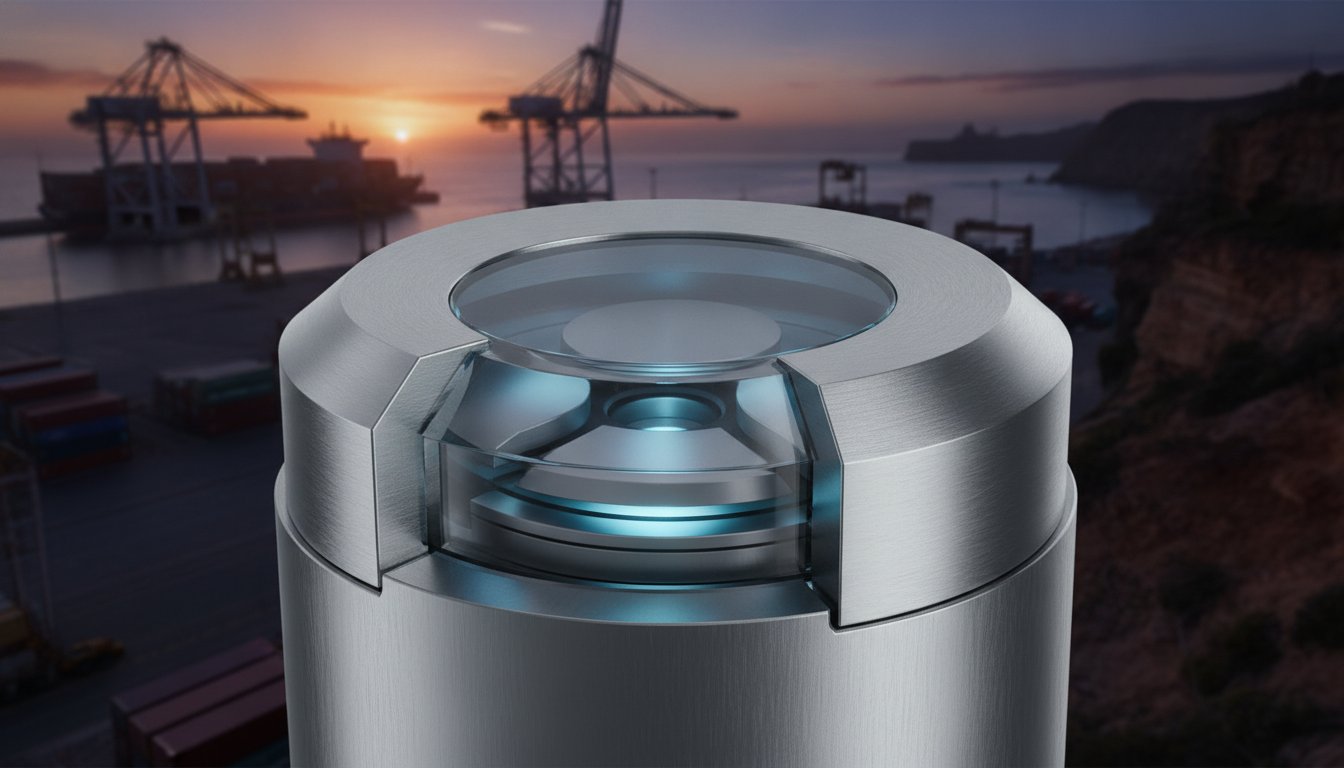
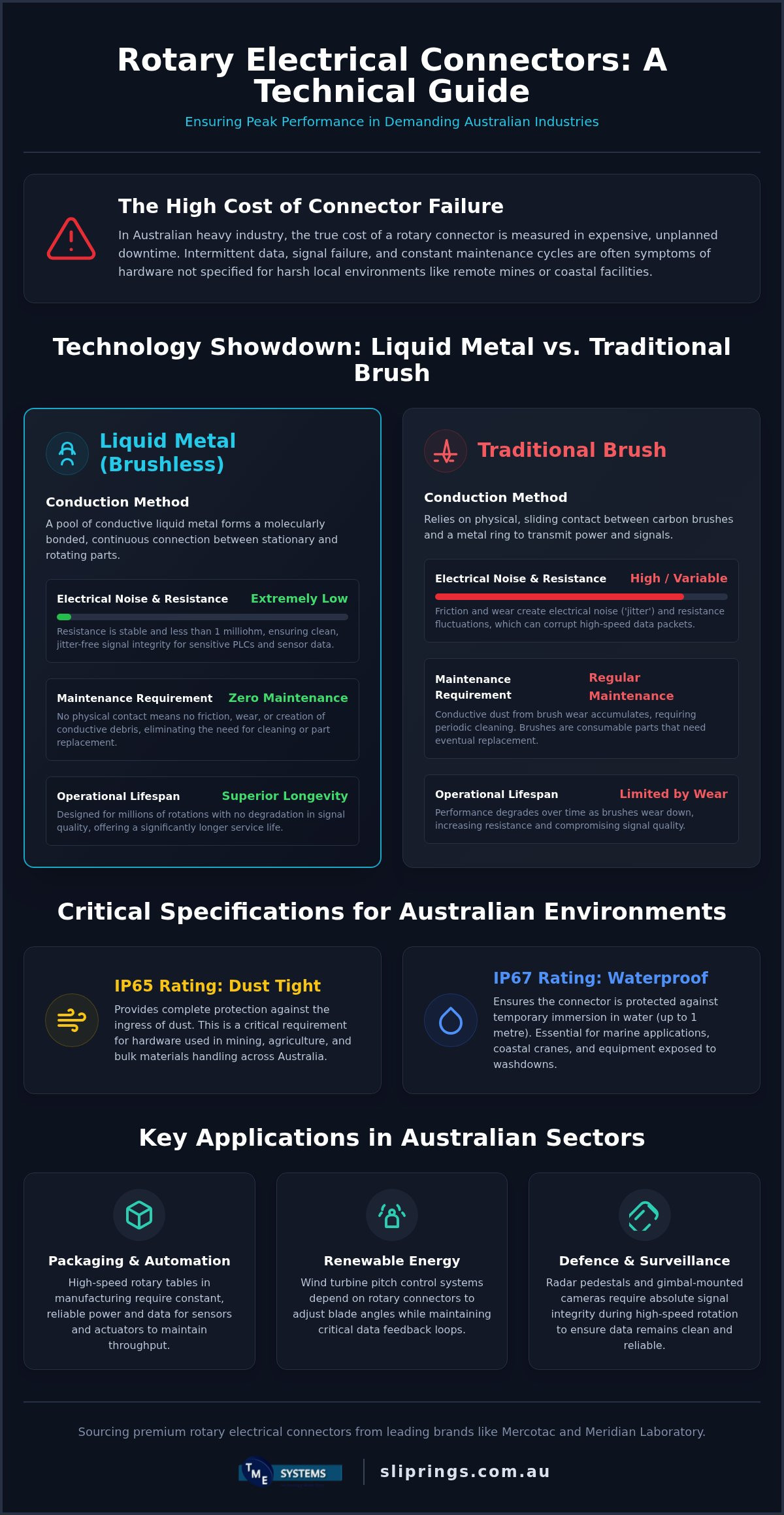
In the demanding environment of Australian heavy industry, the true cost of a rotary connector is never found on a purchase order; it's measured in the expensive hours of unplanned downtime caused by signal failure. You likely understand the frustration of troubleshooting intermittent data packets or managing the constant maintenance cycles required by traditional carbon brush slip rings. Whether it's dust ingress in a remote mining operation or salt spray on a coastal crane, environmental factors often compromise hardware that isn't fit for purpose.
By mastering the technical specifications for rotary electrical connectors Australia based engineers can eliminate electrical noise and achieve zero-maintenance operation for critical equipment. This reference provides the precise selection criteria needed to ensure peak performance in high-speed and high-precision applications. We will examine the shift toward brushless liquid metal technology, evaluate environmental protection standards, and outline how to establish a reliable local supply chain for specialised components like Mercotac and Meridian Laboratory systems.
Key Takeaways
- Differentiate between liquid metal and brush conduction paths to effectively eliminate electrical noise in sensitive PLC and sensor systems.
- Evaluate IP65 and IP67 ratings to ensure hardware resilience against the dust and heat characteristic of Australian industrial sites.
- Apply a methodical circuit audit and electrical load analysis to prevent cable fatigue and ensure long-term mechanical reliability.
- Source premium rotary electrical connectors Australia wide with the support of technical consultants specialised in Mercotac and Meridian Laboratory hardware.
- Transition to zero-maintenance operational models by selecting brushless components that offer superior signal integrity and longevity.
Understanding Rotary Electrical Connectors in Australian Industry
A rotary electrical connector, commonly referred to as a slip ring, is a precision-engineered device designed to transmit electrical power and data signals across a rotating interface. Unlike standard static plugs that require a fixed physical connection, these components maintain 360-degree continuity without restricting the movement of the host machinery. By integrating high-performance rotary electrical connectors Australia based engineers can ensure their systems operate without the risk of mechanical binding or signal dropouts.
The selection of rotary electrical connectors Australia wide often hinges on the ability of the hardware to withstand local environmental stressors. In the context of Australian industrial operations, the primary mechanical function of these connectors is the prevention of cable twisting and subsequent material fatigue. Without a reliable rotary interface, cables in rotating machinery would eventually reach their torsion limits, leading to insulation failure and internal conductor breakage. It's a common failure point that results in expensive, unplanned downtime.
Generic, off-the-shelf connectors frequently fail when exposed to the specific rigours of the local landscape. High ambient temperatures, pervasive dust in bulk material handling, and the high-duty cycles of automated production lines demand hardware with superior sealing. Standard nominal voltages for these systems often align with AS IEC 60038:2022 requirements, typically 230V for single-phase or 400V for three-phase industrial applications. Ensuring compliance with these standards is critical for safety and system longevity.
The Fundamental Purpose of Rotary Connections
The core objective is to ensure uninterrupted electrical continuity while one part of a system rotates relative to another. Modern engineering demands that these connectors manage the transition of sensitive digital data signals alongside high-current power circuits without cross-talk. Essentially, these connectors provide a seamless bridge for electricity where a permanent wire would otherwise tangle or snap. For applications requiring near-zero electrical noise, brushless solutions like Mercotac Slip Rings or Meridian Laboratory Slip Rings are often the preferred technical choice.
Key Applications Across the Continent
Australian industries rely on these components to maintain the operational integrity of several critical sectors. With the Australian factory automation market projected to reach USD 9.3 million by 2034, the demand for reliable rotary interfaces is increasing. Key applications include:
- Packaging machinery: High-speed rotary tables in manufacturing hubs require constant power for sensors and actuators to maintain throughput.
- Renewable energy: Wind turbine pitch control systems utilise rotary connectors to adjust blade angles while maintaining data feedback loops.
- Defence and surveillance: Radar pedestals and gimbal-mounted cameras require absolute signal integrity to ensure data remains clean during high-speed rotation.
Each of these sectors requires a specific balance of mechanical durability and electrical precision to function effectively in the field.
Liquid Metal vs. Brush Technology: A Technical Comparison
The choice between conduction technologies defines the long-term reliability of rotary electrical connectors Australia wide. Traditional slip rings rely on mechanical brushes sliding against a rotating ring. This mechanism creates friction, physical wear, and conductive debris that eventually increases electrical noise. In contrast, liquid metal connectors utilise a pool of conductive fluid to create a molecular bond between stationary and rotating parts. This eliminates the physical wear typically associated with rotary electrical contact devices, resulting in near-zero electrical resistance and a significantly longer service life.
Electrical noise, or EMF, is a critical variable for engineers managing modern PLC and sensor data. While brushes might suffice for high-voltage power transmission, they often introduce signal "jitter" that can lead to data loss in high-speed applications. Liquid metal alternatives maintain an exceptionally stable resistance, often less than 1 milliohm. This stability ensures clean data transmission over millions of revolutions without the signal degradation that plagues cheaper brush-based alternatives. For those managing critical data loops, the "fit and forget" nature of liquid metal systems offers a clear operational advantage over systems requiring periodic cleaning and brush replacement.
Mercotac and Meridian Laboratory: The Liquid Metal Advantage
Liquid metal systems, such as Mercotac slip rings, leverage mercury-wetted contacts to achieve signal integrity that mechanical brushes cannot match. These units are remarkably compact. Their small footprint makes them ideal for space-constrained designs in robotics, medical imaging, or precision laboratory equipment. Because there is no metal-on-metal friction, these connectors don't suffer from the mechanical fatigue that limits the RPM of traditional designs. They provide a high-performance pathway for both power and sensitive signals in a single, maintenance-free package.
Traditional Brush Systems: When to Choose Robustness
Traditional brush systems remain essential for specific industrial contexts, particularly where regulatory environments or food-grade applications strictly require mercury-free operation. When managing high-current loads that exceed the capacity of miniature liquid metal units, robust brush-based hardware is the industry standard. BGB Innovation slip rings are engineered for these heavy industrial rotations, providing a durable solution where sheer power throughput and environmental resilience are the priorities. If you're currently evaluating these technologies for a specific application, our team provides technical application consulting to assist with your selection.
Critical Specification Parameters for Australian Environments
Operating rotary electrical connectors Australia wide presents unique challenges that standard international specifications often overlook. Engineering teams must account for extreme ambient temperatures that frequently exceed 40 degrees Celsius in regional and desert areas. When internal resistance heat is added to these high ambient levels, the total operating temperature can quickly approach the thermal limits of standard seals and lubricants. Selecting a connector with a broad thermal operating range is essential to prevent the premature failure of internal gaskets and insulation materials.
In heavy industry sectors like mining and earthmoving, vibration and shock loading are constant variables. Connectors mounted on vibrating screens or rotating excavators must maintain electrical continuity despite significant G-forces. High-performance units often draw on research similar to the Liquid Metal Slip Ring Experiment conducted by NASA, which demonstrated that liquid metal interfaces can maintain stable contact under conditions that would cause mechanical brushes to bounce and arc. This level of stability is critical for preventing signal corruption in automated control systems.
Sealing and Ingress Protection
Environmental sealing is the first line of defence against the pervasive iron ore dust and coal fines found on Australian sites. While an IP65 rating provides protection against water jets, an IP67 rating is often required for equipment subjected to heavy wash-downs or temporary submersion. Precise sealing prevents conductive dust from entering the housing, where it could cause short circuits or abrasive wear on contact surfaces. In coastal or offshore marine applications, specifying 316-grade stainless steel housings is a pragmatic choice to combat salt-spray corrosion and ensure the connector's structural integrity over its service life.
Speed and Duty Cycle Considerations
The rotational speed, measured in RPM, directly impacts the heat generation and wear rate of any rotary interface. High-speed applications require connectors with low-torque designs to minimise frictional heat. It's also vital to match the connector's life expectancy to the machinery's planned maintenance intervals. If a machine is scheduled for a major overhaul every five years, the rotary connector should be specified to exceed that duration without intervention. For a deeper look at procurement strategies for these components, refer to our guide on Industrial Slip Rings Australia to ensure your selection aligns with local operational requirements.
A Step-by-Step Selection Framework for Engineering Teams
Selecting rotary electrical connectors Australia wide requires a disciplined engineering audit to move from a generic requirement to a specific part number. This framework ensures that all electrical and mechanical variables are accounted for before procurement. By following a logical progression, you can avoid the common pitfalls of underspecified hardware or over-engineered solutions that add unnecessary cost.
- Step 1: Circuit Audit. Quantify the exact number of power and signal paths. Mixing high-current power with low-voltage data requires careful internal separation to maintain signal integrity.
- Step 2: Electrical Load Analysis. Determine the peak voltage and current per circuit. In Australia, systems must typically align with 230V or 400V nominal standards to ensure compliance with AS IEC 60038:2022.
- Step 3: Mechanical Constraints. Assess the physical mounting space. Determine if the application requires a through-bore design for a rotating shaft, a pancake style for height-restricted areas, or a compact capsule for end-of-arm tooling.
- Step 4: Operational Environment. Factor in the maximum RPM, ambient temperature ranges, and the potential for wash-down or dust exposure. These variables dictate the necessary IP rating and bearing type.
- Step 5: Compliance and Safety. Confirm if the application permits mercury-wetted contacts or if mercury-free alternatives are mandatory. Additionally, check for hazardous zone certifications if the unit is operating in explosive environments.
Defining Circuit and Signal Needs
Effective signal management involves separating high-power circuits from sensitive communication protocols like Ethernet or Profibus. Shielding is vital to prevent electromagnetic interference or cross-talk within the connector housing. Engineers must recognise that the total circuit count is the primary driver of the connector's physical dimensions. As the number of required paths increases, so does the housing length and diameter, which may impact your equipment's overall footprint and balance.
Mechanical Integration and Mounting
Integration usually involves choosing between flange mounts for external bolting or shaft mounts for direct axial installation. Prosper Rotation slip rings provide versatile mounting options that are particularly effective for compact designs where space is at a premium. Beyond the mounting style, managing cable strain relief is a critical step that many engineering teams overlook. Without proper support, the weight or movement of the external cables can apply lateral force to the internal bearings, leading to premature mechanical failure. If you require assistance with model selection, you can consult with our technical team for a detailed application review.
TME Systems: Technical Consulting and Distribution in Australia
TME Systems Pty Ltd functions as a specialised technical intermediary, bridging the gap between global manufacturing capabilities and the specific operational requirements of Australian industry. Selecting the right rotary electrical connectors Australia wide isn't just about finding a part number; it's about ensuring the component can withstand the unique environmental rigours discussed in previous sections. By maintaining a national presence, we provide a stable point of contact for engineers and procurement officers who require more than just a vendor. Our team understands that industrial uptime depends on the reliability of every sub-component within a rotating system.
Our portfolio includes authorised distribution for world-leading brands, each selected for their specific engineering strengths. We supply Mercotac Slip Rings and Meridian Laboratory Slip Rings for high-precision, low-noise applications that demand brushless technology. For heavy-duty industrial rotation in mining or bulk material handling, we provide robust solutions from BGB Innovation and Prosper Rotation. This diverse range allows our consultants to offer an unbiased technical recommendation based on your specific circuit count, current load, and environmental exposure.
The Value of Application Engineering
Our role involves deep-dive application engineering to ensure the hardware is fit-for-purpose before it reaches the site. We assist technical teams in translating legacy specifications from older machinery into modern, high-performance equivalents. This process is essential for upgrading systems that currently suffer from excessive signal noise or high maintenance costs. For a comprehensive look at this process, see our guide on Slip Ring Application Engineering.
Streamlining Procurement and Support
Relying on a local Australian distributor significantly reduces the lead times and logistical complexities of international shipping. We provide direct access to technical data sheets and CAD models, allowing your design team to integrate the connector into your 3D models with precision. Local support also means that troubleshooting and replacement enquiries are handled within Australian business hours by specialists who understand local standards and compliance requirements. This proximity ensures that technical queries don't get lost in international time zones.
Contact TME Systems for a technical consultation on your rotary connector needs to ensure your rotating machinery achieves maximum uptime and signal integrity.
Optimising Rotating Systems for Long-Term Reliability
Achieving peak performance in Australian industrial applications requires a precise balance between electrical specifications and mechanical durability. By moving beyond generic hardware and adopting a structured selection framework, engineering teams can effectively eliminate the signal noise and maintenance downtime associated with inferior components. We've examined how conduction paths, environmental sealing, and mounting configurations dictate the lifecycle cost of your equipment. Correctly specified rotary electrical connectors Australia wide are the foundation of reliable automation and material handling.
TME Systems is an authorised distributor for Mercotac and Meridian Laboratory, providing technical application consulting for complex engineering projects. We maintain a national supply chain with local expertise to help you transition from legacy specifications to modern, high-performance solutions. Enquire with TME Systems for Expert Rotary Connector Selection Support to ensure your next project operates with maximum efficiency and minimal intervention. We're ready to help you solve your most challenging rotating interface requirements.
Frequently Asked Questions
What is the difference between a slip ring and a rotary electrical connector?
A slip ring and a rotary electrical connector are functionally identical, though "slip ring" typically describes traditional brush-style technology. Engineers sourcing rotary electrical connectors Australia wide often use the broader term to encompass high-precision brushless and liquid metal units. While both facilitate 360-degree power and signal transfer, the latter term often implies a higher level of signal integrity and mechanical precision required for advanced industrial automation and sensitive sensor applications.
Are mercury-wetted rotary connectors legal for use in Australia?
Mercury-wetted connectors are legal for use in Australia within most industrial environments, provided they're installed according to the manufacturer's specifications. They're valued for their near-zero electrical noise and long service life. However, certain sectors, such as food and beverage processing, may have specific site regulations that require mercury-free alternatives. We offer both mercury-wetted and mercury-free options from Mercotac and Meridian Laboratory to suit all regulatory requirements and environmental standards.
How do I reduce electrical noise in my rotating signal connection?
To reduce electrical noise in rotary electrical connectors Australia based engineers should transition from mechanical brush systems to brushless liquid metal technology. Traditional brushes create sliding friction and conductive debris, which generates electrical interference. Utilising liquid metal contacts ensures a stable molecular bond with minimal resistance. Additionally, using high-quality shielded cables and ensuring the connector is correctly grounded will further protect sensitive data signals from electromagnetic interference or signal jitter.
What maintenance is required for high-speed industrial slip rings?
The maintenance requirements depend entirely on the conduction technology. Traditional brush-based industrial slip rings require periodic inspections to remove conductive dust and replace worn carbon brushes. If left unserviced, these systems will eventually suffer from increased electrical noise and signal failure. In contrast, liquid metal connectors are sealed, brushless units designed for zero-maintenance operation. These "fit and forget" components eliminate the need for scheduled cleaning or internal part replacements throughout their service life.
Can I transmit Ethernet or high-speed data through a rotary connector?
Yes, you can transmit high-speed data protocols, including Ethernet, Profibus, and CAN bus, through specialised rotary connectors. Achieving clean data transmission requires hardware designed with specific impedance matching and internal shielding to prevent cross-talk between circuits. Brands like Meridian Laboratory and Prosper Rotation provide units specifically engineered for high-bandwidth communication. These connectors ensure that sensitive digital packets are transferred across the rotating interface without the packet loss or jitter often found in lower-grade components.
What happens if a rotary connector exceeds its RPM rating?
Exceeding the rated RPM of a rotary connector leads to rapid heat generation and premature mechanical failure. For brush-style units, excessive speed causes the brushes to "bounce" on the ring, creating electrical arcing and signal corruption. In liquid metal units, over-speeding can compromise the internal seals, leading to leaks or catastrophic failure of the conduction path. Always match the connector's speed rating to the maximum operating RPM of your machinery to ensure safety and longevity.
How do I choose between a through-bore and a capsule slip ring?
A through-bore slip ring features a hollow centre, allowing it to be mounted directly onto a rotating drive shaft or to accommodate hydraulic and pneumatic lines. These are common in large-scale industrial machinery. A capsule slip ring is a self-contained, compact unit typically mounted to the end of a shaft or within restricted enclosures. Your choice depends on the available mounting space and whether you need to pass other mechanical components through the centre of the connector.
Where can I find a Mercotac distributor in Australia for replacement units?
TME Systems is the authorised distributor for Mercotac and Meridian Laboratory in Australia. We maintain a national supply chain to provide replacement units and technical support for existing installations. Beyond simple procurement, our team offers technical application consulting to ensure that any replacement hardware is perfectly matched to your machinery's current electrical and mechanical requirements. This local expertise helps engineers avoid the risks and long lead times associated with unauthorised international sourcing.