Why do so many advanced rotating systems still suffer from intermittent signal dropouts and data corruption despite using high-specification sensors? The answer usually lies not in the software, but in the physical interface of the signal slip ring itself. It's a common frustration for engineers and technical managers across Australia's industrial landscape. Electrical noise and electromagnetic interference (EMI) can quickly turn a sophisticated automation project into a maintenance headache.
By understanding the nuances of contact materials and mechanical configurations, you can achieve a stable signal-to-noise ratio and eliminate frequent maintenance cycles. This guide provides the technical framework to select rotary connectors that deliver zero-maintenance operation and long-term reliability. We'll explore the critical role of liquid metal technology, compliance with AS/NZS 3000:2018 standards, and how to ensure your hardware survives the corrosive salt spray and extreme heat typical of local environments.
Key Takeaways
- Understand the critical role of precision electromechanical interfaces in preventing data loss within rotating robotics and telemetry systems.
- Learn how to identify and mitigate resistive noise and "electrical jitter" caused by fluctuating contact resistance in sliding connections.
- Evaluate the performance advantages of liquid metal technology over traditional precious metal brushes when specifying a signal slip ring for low-noise applications.
- Determine the essential selection criteria for Australian industrial environments, including bandwidth calculations for Cat6 Ethernet and environmental ingress protection.
- Discover why technical application consulting is necessary to move beyond off-the-shelf components and ensure long-term reliability in specialised projects.
What is a Signal Slip Ring and Why Does it Matter?
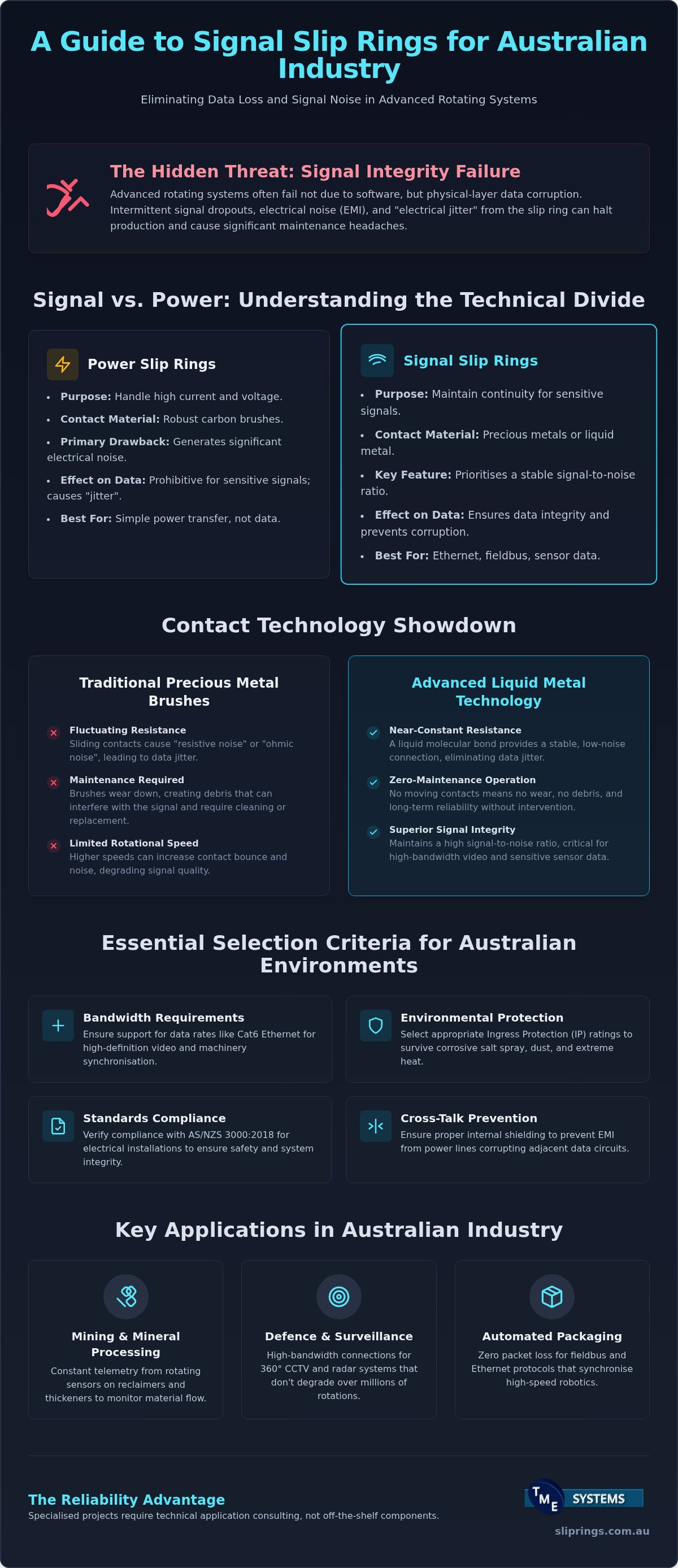
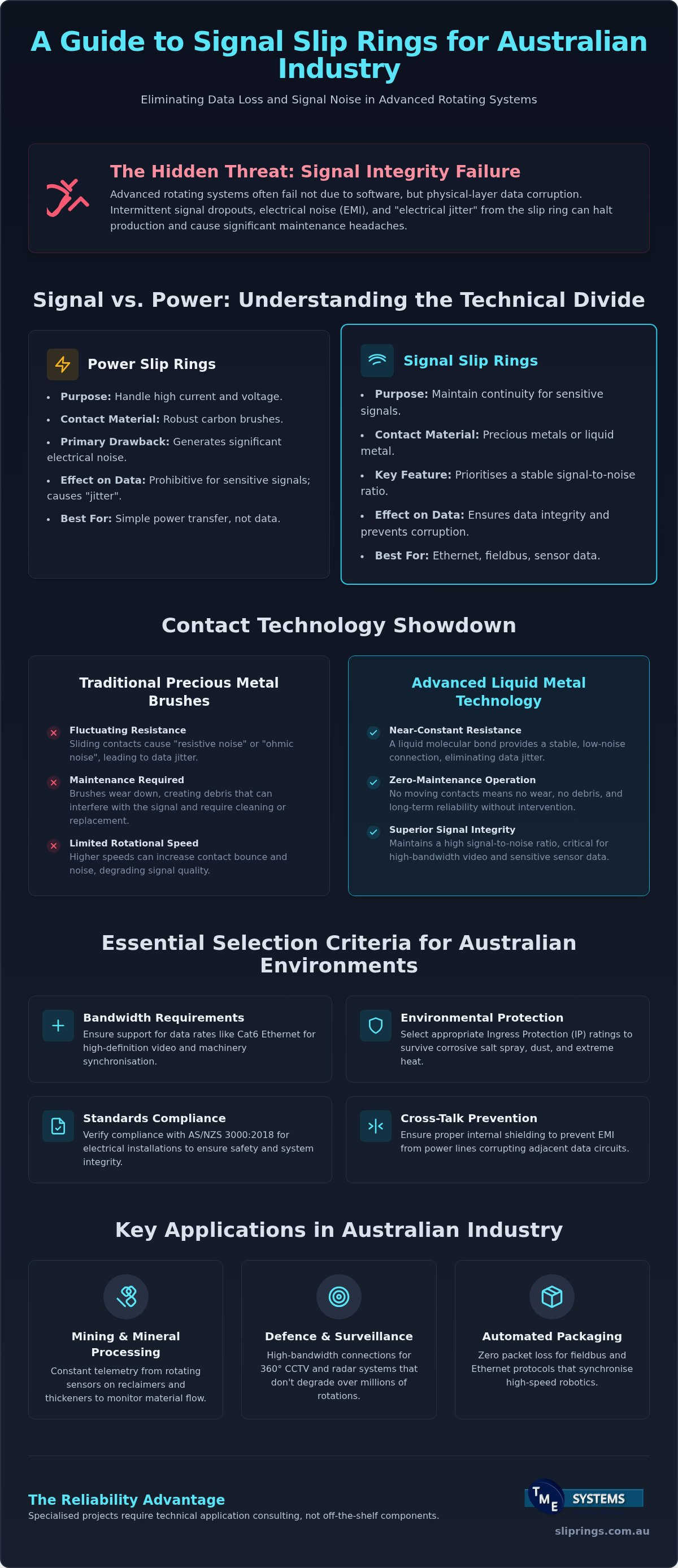
A signal slip ring serves as a high-precision interface within a rotating system. While many engineers view a slip ring as a simple electromechanical device, the requirements for data transmission are significantly more stringent than those for basic power transfer. In industrial automation, these components are responsible for maintaining the continuity of sensitive digital and analogue signals while parts of the machinery are in constant motion. Without a dedicated signal-grade solution, the data stream becomes susceptible to corruption, leading to system timeouts or incorrect sensor readings.
The importance of this component grows as Australian industries move toward higher levels of automation. Whether it's a robotic arm on a production line or a telemetry array in a processing plant, the reliability of the entire system hinges on the quality of the rotating connection. If the interface introduces electrical noise, the control logic may interpret this as a physical fault, causing unnecessary downtime or safety triggers. It's a risk that can be mitigated through proper hardware selection and an understanding of contact physics.
Signal vs Power: Understanding the Technical Divide
The primary difference between a power ring and a signal slip ring lies in the contact physics. Power-grade rings are designed to handle high current and voltage, often using robust carbon brushes that can withstand significant arcing. However, these brushes generate substantial electrical noise. For sensitive signals like Ethernet or thermocouple data, this noise is prohibitive. It creates "jitter" that disrupts the timing of digital packets.
Signal-grade rings prioritise a stable signal-to-noise ratio. This requires specialised contact materials, such as those found in Mercotac Slip Rings, which utilise liquid metal to ensure a near-constant resistance. Proper isolation and shielding are also critical in multi-channel units. You must prevent "cross-talk" between power and signal circuits within the same housing to maintain data integrity.
Common Applications in Australian Industry
In the local industrial sector, the demand for reliable rotary data transmission is diverse. Applications often involve harsh conditions where traditional connectors fail prematurely.
- Mining and Mineral Processing: Rotating sensor arrays on reclaimers and thickeners require constant telemetry to monitor structural integrity and material flow.
- Defence and Surveillance: High-definition video transmission for 360-degree CCTV systems requires high-bandwidth connections that don't degrade over millions of rotations.
- Automated Packaging: Modern plants use fieldbus and Ethernet protocols to synchronise high-speed machinery. Any packet loss in these environments can stop an entire production line.
Selecting the correct hardware involves more than checking a circuit count. It requires a thorough audit of the signal types, environmental variables, and the specific data rates required for the application. When performance is non-negotiable, the distinction between a generic connector and a precision signal interface becomes clear.
The Science of Signal Noise in Rotary Connections
In any rotating system, the physical interface is where data integrity is most vulnerable. A signal slip ring must maintain a consistent electrical path while the conductive surfaces are in constant motion. This movement introduces resistive noise, or ohmic noise, which is the fluctuation of electrical resistance across the contact point. While a static connector has a fixed resistance, a rotary joint's resistance changes with every degree of rotation. These fluctuations are the root cause of electrical jitter, a phenomenon that can corrupt digital data packets or introduce inaccuracies into sensitive analogue sensor readings.
For digital signals, the signal-to-noise ratio (SNR) is critical. If the noise generated by the sliding contact exceeds a certain threshold, the receiver cannot distinguish between a "0" and a "1". This leads to packet loss and system latency. Analogue signals, such as those from thermocouples or strain gauges, are even more sensitive. A tiny change in resistance can be misinterpreted as a change in the physical value being measured. This isn't a minor technical detail; a NASA report on signal integrity issues demonstrates that even sophisticated aerospace systems can fail if these rotary contact physics aren't managed correctly.
Resistive Noise and Contact Stability
Contact resistance is the primary variable in signal quality. In traditional systems, mechanical "brush bounce" occurs when the sliding contact momentarily loses pressure or separates from the ring due to vibration. This effect is magnified as the RPM increases. As the machinery spins faster, the centrifugal forces and mechanical resonances raise the noise floor, directly degrading the signal quality. It's why matching the slip ring's mechanical stability to your operational speed is non-negotiable.
Mitigating EMI and RFI in Slip Rings
Beyond internal resistive noise, external Electromagnetic Interference (EMI) can penetrate the rotating joint. In Australian industrial environments, proximity to high-power motors and variable speed drives creates a challenging RFI landscape. Effective Industrial Slip Rings Australia requires multi-layered shielding and dedicated grounding paths to isolate data circuits from power circuits. Ensuring a clean circuit path involves more than just physical separation; it requires specialised housing materials and internal barriers.
If you're dealing with persistent data errors in your rotating machinery, it might be time to audit your current contact specifications with a technical specialist to ensure your hardware is fit for purpose.
Contact Technologies: Liquid Metal vs Traditional Brushes
The performance of a signal slip ring depends almost entirely on the physical properties of its contact interface. Engineers usually choose between sliding mechanical brushes and liquid metal conductors. Each technology has distinct advantages depending on the data rate, environmental conditions, and maintenance budget of the project. While precious metal brushes are a versatile standard, they don't always meet the ultra-low noise requirements of modern high-speed telemetry.
Precious metal brushes, such as gold-on-gold or silver-on-silver, are frequently used for low-level signals. Gold is valued for its exceptional corrosion resistance and low contact pressure, which helps maintain a stable connection. However, even these high-end materials are subject to mechanical wear. Over millions of cycles, the friction creates microscopic debris. This debris increases electrical noise and eventually requires a maintenance intervention to clean the tracks or replace the brushes. In contrast, liquid metal technology offers a fundamentally different approach. Instead of a solid brush sliding over a ring, a pool of conductive liquid metal maintains a continuous, molecular-level connection. This eliminates the mechanical wear and "brush bounce" that often plagues traditional systems.
In Australia, thermal management is a significant factor. High ambient temperatures in regions like the Pilbara or Central Queensland can accelerate the degradation of lubricants in traditional brush-style rings. Liquid metal connectors are less sensitive to these thermal variables, provided they operate within their specified temperature range. This makes them a robust choice for outdoor industrial installations where reliability is paramount.
The Case for Liquid Metal Rotary Connectors
For applications requiring near-zero electrical noise, Mercotac Slip Rings are the superior solution. Because the connection is wetted, the resistance remains extremely stable even at high rotational speeds. This stability is essential for transmitting high-definition video or sensitive Ethernet packets where any fluctuation in resistance would cause data corruption. These units are virtually maintenance-free, offering a service life that often outlasts the mechanical components of the rotating system.
When to Choose Traditional Carbon or Metal Brushes
There are specific scenarios where traditional technologies remain the practical choice. Some industries, particularly food processing or specific medical environments, may have strict mercury-free constraints that preclude the use of liquid metal. In these cases, precision mechanical contacts from BGB Innovation Slip Rings provide a reliable alternative. These units are engineered for heavy-duty signal paths and can be configured with specialised silver or gold alloys to balance cost with performance. They are especially effective for hybrid systems where high-current power and sensitive signals must share the same rotating joint.
Selection Criteria for Signal Slip Rings in Australia
Choosing the correct signal slip ring involves more than just matching the number of wires. For technical managers and engineers, the selection process must begin with a detailed audit of the signal types involved. Whether you are transmitting sensitive analogue sensor data or high-speed digital packets via Ethernet, each circuit has specific requirements for shielding and contact stability. Mixing high-frequency data with low-level analogue signals within the same rotating joint requires a design that prevents internal cross-talk and EMI interference.
Bandwidth is a critical parameter. If your system relies on Cat6 Ethernet or high-definition video, the rotating connection must support the necessary data rates without introducing packet loss. When calculating required bandwidth, consider the overhead of your communication protocol. A standard Cat6 connection requires high-level shielding and precise contact geometry to maintain a 1 Gbps data rate through a rotating interface. Mechanical mounting also dictates the form factor. Through-bore designs are ideal for mounting directly onto a rotating shaft, while capsule designs offer a compact solution for space-constrained enclosures. Pancake designs are used for applications where vertical height is limited but diameter is less of a concern.
Technical Specifications Checklist
A thorough specification ensures long-term operational stability. You must verify that the voltage and current ratings are compatible with your sensitive electronics to prevent signal degradation. Maximum RPM is another vital metric; higher speeds can increase the noise floor and accelerate mechanical wear. Solutions such as Meridian Laboratory Slip Rings are engineered to maintain high signal integrity even at elevated rotational speeds, making them suitable for demanding industrial telemetry.
Environmental Resilience and Sealing
Australian industrial sites often present extreme challenges. From the fine iron ore dust of the Pilbara to the corrosive salt spray of coastal processing plants, environmental sealing is non-negotiable. Specifying an IP65 or IP67 rating ensures the internal contacts remain protected from moisture and dust ingress. For these harsh conditions, Prosper Rotation Slip Rings provide the necessary durability and environmental resilience. Selecting a housing material like 316 stainless steel can significantly extend the service life of the unit in maritime or chemical environments.
If you are unsure which configuration best suits your application, you can request a technical consultation to ensure your hardware selection meets all operational and environmental requirements.
Procuring Signal Slip Rings: Why Technical Support is Essential
Procuring a signal slip ring through generic industrial catalogues often leads to unforeseen system failures. While an off-the-shelf component might meet basic circuit counts, it rarely accounts for the specific electromagnetic environment or mechanical stresses of a specialised application. In industrial data transmission, "close enough" isn't an engineering standard. Using a component that isn't precisely matched to your data rate or shielding requirements can result in intermittent packet loss that's notoriously difficult to troubleshoot once the machinery is commissioned.
Technical support is the bridge between a theoretical specification and operational reality. At TME Systems, we provide application engineering that ensures every rotary connector is fit for purpose. This involves more than just verifying electrical continuity. We evaluate the entire rotating assembly, considering mounting tolerances, vibration profiles, and the proximity of high-power cables that could induce noise into sensitive signal paths. By tailoring the configuration to these specific constraints, you ensure long-term reliability and avoid the costly cycle of premature replacement often seen with lower-grade hardware.
The TME Systems Consultative Approach
We act as a knowledgeable intermediary for Australian industry, connecting global manufacturing excellence with local engineering challenges. Our team, based in Ingleburn, NSW, conducts a thorough technical audit of your requirements before recommending a solution. This process covers everything from signal-to-noise ratio targets to environmental ingress protection. For a deeper look at our methodology, refer to our guide on Slip Ring Application Engineering. This consultative path ensures that whether you need a liquid metal connector for high-speed video or a robust mechanical ring for mining telemetry, the hardware is selected based on data, not guesswork.
Next Steps for Your Project
To ensure you receive an accurate technical quote, it's essential to gather specific data points regarding your rotating system. We recommend identifying the following parameters before reaching out:
- Required circuit count and specific signal types (e.g., Ethernet, RS485, Thermocouple).
- Operational speed (RPM) and expected duty cycle.
- Environmental conditions, including temperature ranges and exposure to dust or moisture.
- Physical space constraints and preferred mounting style (through-bore or capsule).
Our Ingleburn-based team provides national support across Australia, helping you navigate the complexities of rotary data integrity. When you're ready to move beyond generic components, you can organise a technical consultation with TME Systems to secure a solution engineered for your specific industrial application.
Optimising Rotary Data Integrity for Long-Term Reliability
Maintaining data integrity in rotating systems requires a deliberate focus on contact physics and environmental resilience. The stability of your connection depends on selecting the appropriate technology, whether that involves liquid metal for ultra-low noise or precision brushes for heavy-duty signal paths. By auditing your specific bandwidth requirements and environmental variables, you ensure your automation remains stable under demanding conditions.
A high-quality signal slip ring is a critical interface that dictates the success of your engineering project. TME Systems serves as an authorised Australian distributor for Mercotac and Meridian Laboratory, providing specialised technical support for complex engineering projects. With national delivery and support across Australia, our team helps you move from generic hardware to a solution engineered for longevity. If you're ready to eliminate signal dropouts and reduce maintenance cycles, Contact TME Systems for Expert Signal Slip Ring Advice. Achieving zero-maintenance operation in your rotating systems is an achievable goal with the right technical partnership.
Frequently Asked Questions
What is the difference between a signal slip ring and a power slip ring?
The primary difference lies in the contact physics and intended electrical performance. Power slip rings are engineered to transmit high current and voltage, often using robust carbon brushes that can tolerate minor arcing. Conversely, a signal slip ring prioritises a stable, low-resistance connection to ensure data integrity. These units use specialised materials like gold or liquid metal to minimise electrical noise that would otherwise corrupt sensitive digital or analogue data streams.
Can a signal slip ring handle Ethernet or high-speed data protocols?
Yes, specific models are designed to maintain the tight tolerances required for Ethernet, Profinet, and other high-speed protocols. Transmitting Cat6 data at 1 Gbps through a rotating joint requires precision shielding and controlled impedance to prevent packet loss. For these applications, brushless or liquid metal technologies are often preferred because they eliminate the mechanical jitter and contact bounce that typically disrupt high-frequency digital communications.
How does electrical noise affect the performance of a signal slip ring?
Electrical noise, or resistive fluctuation, introduces "jitter" into digital signals and inaccuracies into analogue sensor readings. If the noise floor rises too high, digital receivers can't distinguish between high and low states, leading to packet corruption and system timeouts. In analogue systems, such as thermocouples, even milliohm fluctuations in contact resistance can be misinterpreted by control logic as a change in the physical measurement, causing process errors.
Are mercury-wetted (liquid metal) slip rings safe for industrial use?
Mercury-wetted connectors like those from Mercotac are safe and highly reliable when used within their specified industrial parameters. These are factory-sealed units designed to provide a maintenance-free, molecular-level connection. While they are superior for low-noise applications, they must be handled according to standard industrial safety protocols. Certain environments, such as food processing or specific medical facilities, may require mercury-free alternatives like gold-on-gold mechanical contacts instead.
What maintenance is required for a signal slip ring?
Maintenance requirements depend entirely on the contact technology. Traditional precious metal or carbon brush rings require periodic inspections to remove conductive dust and debris caused by mechanical wear. If left unserviced, this debris increases electrical noise and can cause short circuits. Brushless and liquid metal units are virtually maintenance-free because they don't rely on sliding mechanical friction, making them ideal for installations in remote or inaccessible locations.
How do I choose between a capsule and a through-bore signal slip ring?
Your choice depends on the mechanical configuration of your machinery. A capsule signal slip ring is a compact, self-contained unit typically mounted at the end of a rotating shaft. A through-bore design features a hollow centre, allowing it to be mounted directly over a drive shaft or to allow hydraulic and pneumatic lines to pass through the middle. Through-bore models are common in large-scale industrial equipment where centre-line access is required.
What IP rating do I need for a signal slip ring in an outdoor environment?
For outdoor industrial applications in Australia, you should specify a minimum of IP65 or IP67. These ratings ensure the internal contacts are protected against the ingress of fine dust, such as iron ore particulates, and moisture from heavy rain or wash-down procedures. In coastal regions, high-level sealing is also essential to prevent salt spray from corroding the internal conductive surfaces, which would quickly degrade signal quality and service life.
Can I transmit both power and signal through the same slip ring?
Hybrid slip rings allow for the transmission of both power and data within a single housing. However, this configuration requires internal shielding and physical separation between the circuits to prevent electromagnetic interference. High-power motor leads can induce noise into adjacent signal wires if the unit isn't properly engineered. It's vital to consult with an application engineer to ensure the internal isolation is sufficient for your specific data rates and power loads.