The success of a rotating table depends less on the slip ring itself and more on how the mounting configuration aligns with the mechanical drive system. It’s a common frustration for engineers to design a high-precision system, only to face unexpected downtime from cable fatigue or signal interference in sensitive data lines. You’ve likely dealt with the constraints of tight internal spaces and the risk of wires snapping after thousands of rotations, which compromises both performance and safety.
Choosing the right slip ring for rotating table applications is about more than just matching electrical specs; it’s about ensuring a reliable 360-degree connection that stands up to Australian industrial conditions. This guide will show you how to select and mount the ideal component to ensure seamless power and data transfer without the risk of tangled cables. We’ll examine the latest standards such as AS 60034.1:2023, evaluate mounting styles for space-constrained designs, and provide a methodical approach to achieving a clean, professional mechanical integration that reduces long-term maintenance costs.
Key Takeaways
- Eliminate cable fatigue and mechanical failure by transitioning from standard cabling to a continuous 360-degree rotary interface.
- Identify the optimal mounting configuration, such as through-bore or capsule designs, when selecting a slip ring for rotating table applications to suit your specific spatial constraints.
- Learn how to calculate RPM requirements and select contact materials that maintain signal integrity in sensor-heavy indexing environments.
- Follow precise mechanical alignment steps and implement anti-rotation features to protect the housing and ensure long-term reliability.
- Evaluate the benefits of local technical consulting and application engineering to streamline lead times for custom Australian industrial projects.
Why Your Rotating Table Needs a Slip Ring: Solving the Cable Management Puzzle
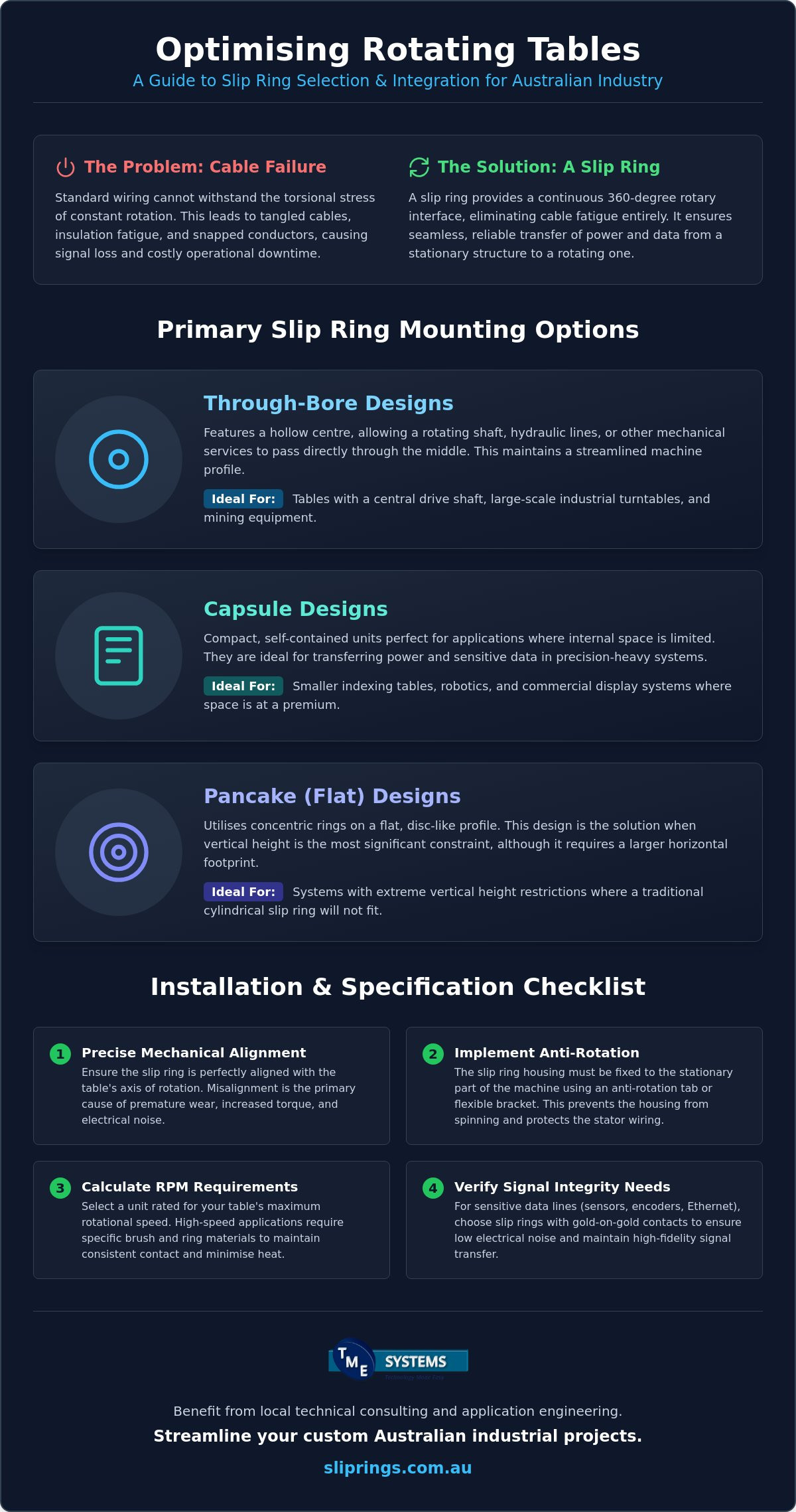
Rotating tables are essential components in everything from industrial indexing to large-scale display systems. However, providing power to a moving platform presents a significant engineering hurdle that standard wiring cannot solve. Integrating a slip ring for rotating table setups is the only way to achieve continuous movement without catastrophic cable failure.
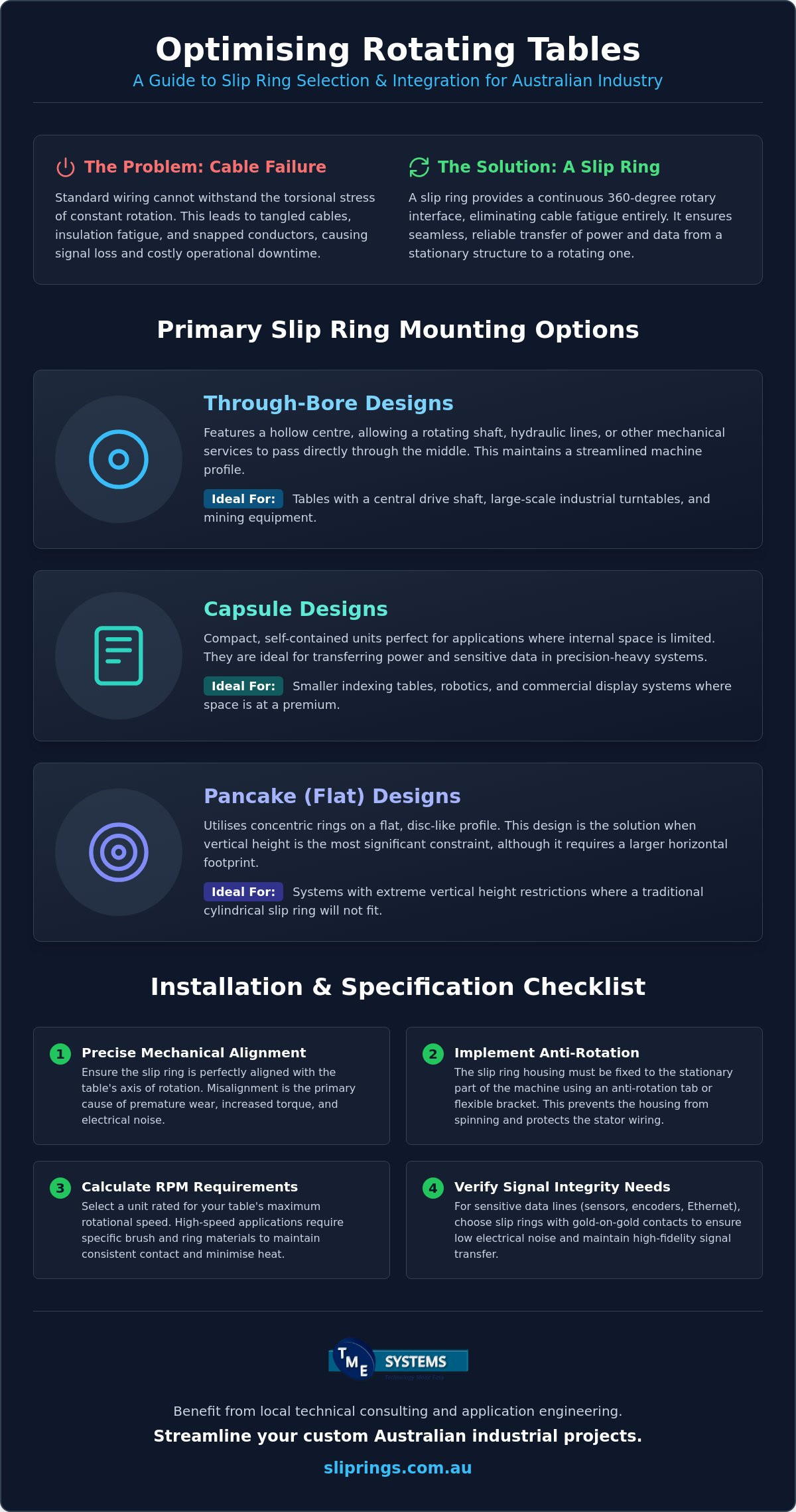
A fundamental question for many designers is: What is a Slip Ring? At its core, it is a rotary electrical interface that allows the transfer of power and data signals from a stationary structure to a rotating one. Without this interface, cables inevitably twist and tangle. Standard industrial cabling isn't designed to handle the torsional stress of constant rotation. Even with a generous service loop, you're limited to a few hundred degrees of movement before the insulation fatigues and the copper strands snap, leading to intermittent signal loss or total system failure.
The primary benefit of a dedicated slip ring is the immediate increase in mechanical performance. By removing the physical strain from the conductors, you drastically reduce maintenance overheads and prevent the downtime associated with wire repairs. In Australian industries, these components are vital for high-stakes applications. You'll find them in massive mining turntables handling tonnes of ore and in commercial revolving signage in urban centres where 24/7 operation is expected.
The Mechanics of Continuous Rotation
High-cycle table operations demand consistent contact. Unlike intermittent indexing, which might pause every 90 degrees, continuous high-speed rotation generates friction and potential heat. Slip rings use specialised brushes and ring materials to maintain a low-resistance path regardless of the turn count. While some engineers attempt to use long cable loops, these are usually an inferior solution. They eventually snag or require expensive unwinding cycles that kill productivity and complicate the control logic.
Identifying Your Table Drive System
Your drive choice dictates exactly where the slip ring is placed. A direct-drive system often leaves the centre of the table free, making a through-bore unit the most logical choice. Conversely, belt-driven tables might require an offset configuration or a compact capsule unit tucked into a side cavity. You must consider the space envelope early in the design phase. If the internal table cavity is tight, a compact unit from BGB Innovation or Prosper Rotation often provides the necessary clearance without compromising on circuit density.
Primary Slip Ring Mounting Options for Rotary Tables
The mechanical stability of your system depends entirely on how the rotary interface is physically secured. When selecting a slip ring for rotating table applications, the mounting configuration must align with the table's drive architecture, whether it is a centre-shaft or an edge-drive system. Most industrial tables fall into three primary categories: through-bore, capsule, and pancake designs. Each offers distinct advantages depending on your spatial constraints and the complexity of the media you need to transfer.
Through-bore models are the preferred choice for tables with a central rotating shaft. They allow the electrical circuits to wrap around the mechanical core of the machine, maintaining a streamlined profile. Capsule slip rings, by contrast, are self-contained units ideal for smaller, precision-heavy tables where internal space is restricted. If vertical height is your primary constraint, pancake slip rings provide a low-profile alternative, although they typically require a larger horizontal footprint to accommodate the concentric ring arrangement.
Choosing between flange mounting and shaft mounting is a decision based on stability and vibration requirements. A flange-mounted unit is bolted directly to the table base, providing excellent resistance to mechanical shock. Shaft mounting relies on the slip ring rotor being clamped directly to the rotating drive. Research into advanced slip ring technologies demonstrates that the precision of this alignment directly impacts the electrical noise and lifespan of the contacts. For compact applications where space is at a premium, Prosper Rotation slip rings offer versatile capsule designs that simplify this integration.
Through-Bore Integration (Hollow Shaft)
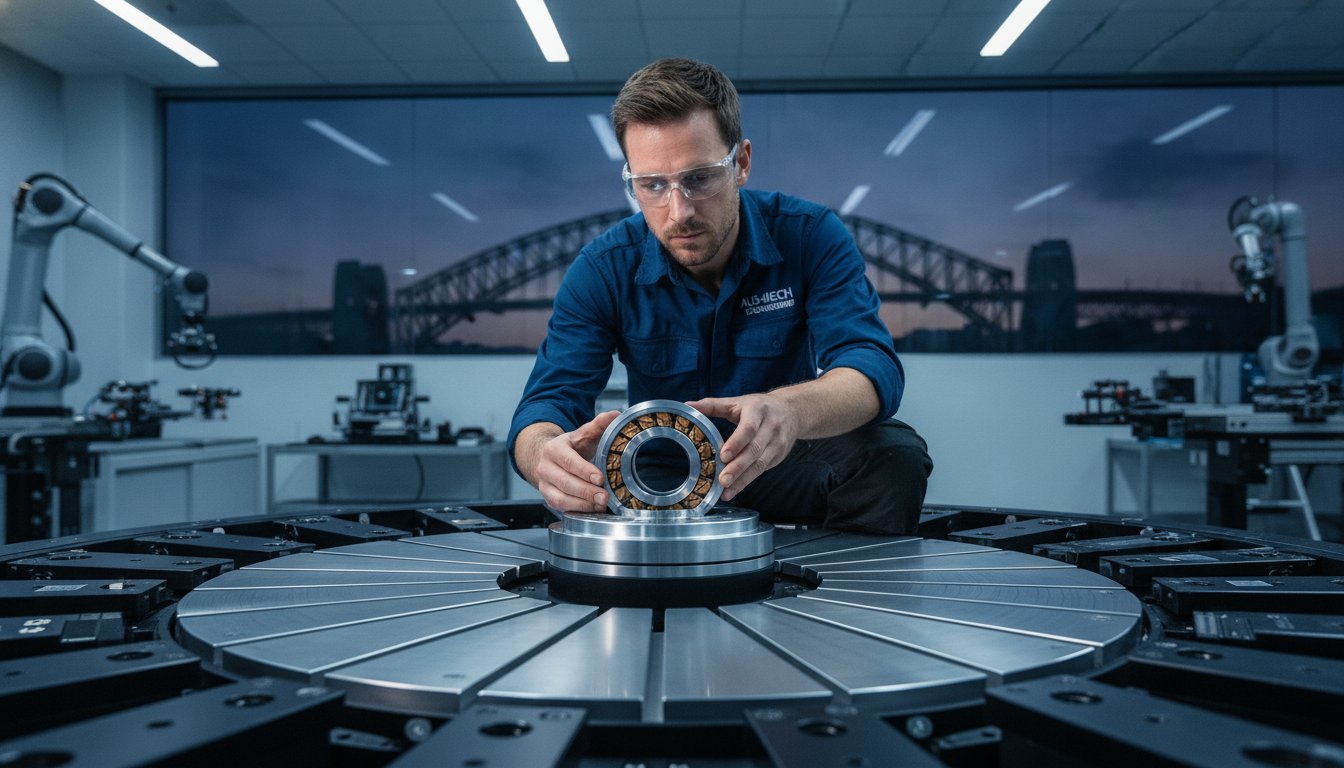
The central aperture of a through-bore slip ring is its most valuable feature. It allows you to pass hydraulic or pneumatic lines, or even a secondary drive shaft, directly through the centre of the electrical assembly. This creates a highly integrated, multi-media rotary joint. Standard bore sizes typically range from 12mm to over 100mm. To select the correct size, you must measure your shaft diameter precisely, accounting for any thermal expansion that might occur during operation. The rotor is typically secured to the shaft using set screws or mechanical clamps, ensuring the electrical rings turn in perfect synchronisation with the table.
Capsule and Flange Mounting
Capsule units are often the preferred choice for laboratory equipment or precision display tables. These units are usually flange-mounted to stabilise the housing against the table base. This configuration is particularly effective at preventing the housing from rotating, which would otherwise strain the stationary wire leads. When installing these, you must manage the fixed-end wires carefully. Using a torque tab or anti-rotation pin allows the housing to float slightly. This floats compensates for any minor axial misalignment between the table and the slip ring, preventing internal bearing wear and premature circuit failure.
Technical Specifications for Table Rotation
The operational success of a slip ring for rotating table installations depends on precise electrical and mechanical synchronisation. While mounting determines the physical layout, your technical specifications define the system's longevity. Calculating the maximum RPM is your first priority. High-speed rotation increases friction and wear on the internal brushes. If your table rotates at high speeds, you might require specialised precious metal alloys to maintain conductivity without overheating. Conversely, slow-moving indexing tables face different challenges, such as the potential for 'stiction' or uneven wear during frequent start-stop cycles.
Matching amperage and voltage to your table's motor and peripherals is a non-negotiable step. Overloading a circuit leads to arcing, which destroys contact surfaces and causes permanent data loss. You should always specify a circuit capacity that exceeds your peak load by at least 20% to account for start-up surges in heavy industrial motors. This buffer ensures that the internal components don't reach their thermal limits during peak operation, which is particularly critical when the table is under a heavy mechanical load.
Signal vs. Power Transfer
In sensor-heavy indexing tables, signal integrity is paramount. Electrical noise from high-current motor leads can easily corrupt sensitive data. You must ensure the slip ring is designed with sufficient shielding between power and signal circuits. For modern automation, Ethernet Slip Rings provide the necessary bandwidth for PLC communication while maintaining low-noise thresholds. Contact material choice is dictated by these signal requirements. Gold-on-gold contacts are preferred for low-voltage signals because they resist oxidation. Silver contacts are often more suitable for power circuits where higher current density is required.
Environmental Resilience in Australia
Australian industrial environments present unique challenges. Many tables operate in non-air-conditioned sheds where ambient temperatures can exceed 45 degrees Celsius. This heat affects the viscosity of internal lubricants and the expansion of contact materials. For outdoor or wash-down applications, an IP65 or IP67 rating is mandatory to prevent dust ingress and moisture damage. Research indicates that an IP67 rating is specifically recommended for coastal regions to protect against salt-mist, which can rapidly degrade the mechanical assembly and electrical contacts. Selecting a housing with high corrosion resistance will ensure your rotating installation remains functional in these harsh conditions.
Installation Guidelines for Long-Term Reliability
Successful integration of a slip ring for rotating table applications requires more than just a firm bolt-down. You must approach the installation with a focus on mechanical harmony between the stationary and rotating components. The first step is precise mechanical alignment. If the slip ring’s central axis does not perfectly match the table’s rotational axis, the resulting eccentricity will cause the internal bearings to bind. This creates parasitic drag and can lead to premature electrical failure as the brushes are forced to oscillate across the rings. Use a dial indicator to check for run-out before finalising the mounting bolts.
Once aligned, you must implement robust wire routing and strain relief. A common failure in industrial tables is the gradual pulling of wires out of their terminals due to vibration or thermal expansion. Every lead should be secured with enough slack to accommodate minor movements without placing tension on the slip ring’s internal connections. Before commissioning the system, perform a comprehensive electrical test. Check for continuity across all circuits and conduct an insulation resistance test to ensure no shorts occurred during the mounting process. This methodical approach prevents the "plug and play" errors that often lead to early system failure.
The Role of the Anti-Rotation Tab
A critical but often overlooked component is the anti-rotation feature. You should never hard-mount both the rotor and the stator of a slip ring to the table structure. Doing so turns the slip ring into a load-bearing member, which it is not designed to be. Instead, use a flexible anti-rotation bracket or pin. This allows the housing to float slightly, compensating for any mechanical run-out or shaft wobble. Using the electrical leads as an anti-rotation stop is a mistake that leads to sheared wires and costly downtime. If you require assistance with complex mounting configurations, consult our engineering team for application-specific advice.
Maintenance and Serviceability
Design your table assembly so the slip ring is easily accessible for routine inspections. In brush-based systems, you need to monitor for carbon dust accumulation and brush wear, which can eventually cause signal noise. However, if your application uses Mercotac slip rings, maintenance requirements are significantly reduced due to their liquid metal contact technology. Predictive maintenance should include regular signal checks to identify degradation before a total failure occurs. Monitoring the electrical resistance of the circuits during rotation can provide an early warning of contact wear or contamination in the assembly.
Selecting the Right Partner for Australian Industrial Projects
Procuring a slip ring for rotating table applications involves more than just selecting a part number from a catalogue. In the Australian industrial sector, where equipment often operates in remote locations or harsh environments, the value of local technical support cannot be overstated. A successful integration relies on a partnership where application engineering precedes the purchase. This ensures that the mechanical interface, electrical load, and data requirements are perfectly balanced before the unit arrives on-site. TME Systems provides this level of technical oversight, assisting with the complex selection process based on circuit count, rotational speed, and peak electrical loads.
Lead times are a critical factor in project management. While standard configurations might suit basic display tables, custom industrial projects often require specific modifications to the housing or circuit layout. Evaluating the trade-off between off-the-shelf availability and the performance gains of a bespoke unit is essential; you can learn more about custom metal fabrication options that support these specialised industrial requirements. By integrating world-class hardware from brands such as BGB and Meridian Laboratory, you ensure that your rotating table benefits from proven contact technologies that have been tested in demanding global industries. This approach minimises the risk of project delays and ensures the final assembly meets the intended service life.
Expert Consultation and Procurement
A thorough technical audit is a necessary prerequisite before you finalise your equipment choice. This audit should examine the total number of circuits required, including spares for future sensor integration, and the specific types of signals being transferred. For precision tasks that demand near-zero electrical noise and high-frequency data transfer, accessing high-performance Meridian Laboratory slip rings is often the most effective solution. Customising circuit counts allows you to match complex indexing requirements without the bulk of unnecessary hardware, keeping your table design compact and efficient.
Ensuring Compliance and Performance
Safety and regulatory compliance are paramount for any machinery operating within Australia. You must ensure that your rotary interface meets the relevant Australian electrical standards, such as AS 60034.1:2023, to guarantee safe operation under load. Referencing Slip Ring Current Ratings is a vital step in this process. It helps you understand how thermal limits and duty cycles affect the safe operating envelope of your machinery. If you are currently in the design or upgrade phase of a project, Contact TME Systems for a comprehensive technical review of your rotating table requirements to ensure a reliable, long-term solution.
Optimising Your Rotary Table Integration
Integrating a high-performance rotary interface is a technical necessity for any automated system requiring continuous motion. The longevity of your assembly depends on precise mechanical alignment and the implementation of flexible anti-rotation features to prevent internal strain. Matching your component's IP rating and contact materials to the specific environmental challenges of Australian industrial sites ensures that your power and data transfer remains uninterrupted. Selecting the correct slip ring for rotating table projects requires a methodical approach to both electrical and mechanical parameters.
TME Systems serves as an authorised Australian distributor for Mercotac and BGB Innovation, supplying high-reliability components to the mining and manufacturing sectors. Our team provides expert technical assistance to help you navigate application engineering challenges and ensure a clean, professional integration. We invite you to Consult with TME Systems for your slip ring requirements to secure a durable solution for your next project. Achieving a seamless 360-degree connection is straightforward when you have the right technical partner supporting your design.
Frequently Asked Questions
Can I use a slip ring for both power and data on my rotating table?
Yes, you can transfer both power and data signals through a single rotary joint. Hybrid slip rings are engineered with internal shielding and specific circuit separation to prevent high-voltage power lines from interfering with sensitive data, such as Ethernet or PLC signals. It's critical to specify your circuit requirements early to ensure the internal layout provides sufficient isolation for signal integrity.
What is the difference between a through-bore and a capsule slip ring for tables?
The primary difference lies in the mechanical configuration. A through-bore slip ring has a hollow centre designed to fit over a central rotating shaft or to allow the passage of pneumatic and hydraulic lines. A capsule slip ring is a self-contained, compact unit typically used when space is restricted or when the table is driven by an offset motor rather than a central shaft.
How do I prevent signal noise in my indexing table slip ring?
Minimising signal noise requires selecting a slip ring for rotating table applications that utilises precious metal contacts, such as gold-on-gold. These materials offer low electrical resistance and stable contact even during vibration. You should also ensure that signal cables are properly shielded and that the stationary leads are routed away from high-power motor cables to avoid electromagnetic interference.
Do slip rings require regular maintenance?
Maintenance needs depend entirely on the contact technology used. Traditional brush-based systems require periodic inspections to clean carbon dust and check for brush wear. Conversely, liquid metal units like those from Mercotac are virtually maintenance-free. You should align your service schedule with the manufacturer’s guidelines, taking into account the duty cycle and environmental conditions of your shed or factory. For those who want to ensure the same reliability for their residential mechanical systems in Melbourne, you can visit We Do Garage Doors for expert maintenance and repairs.
What happens if my rotating table exceeds the RPM rating of the slip ring?
Exceeding the rated RPM leads to excessive frictional heat and accelerated mechanical wear. This often results in electrical arcing, which damages the contact surfaces and causes intermittent signal loss. If your application requires higher rotational speeds, you must select a unit specifically designed for high-velocity operation to ensure the internal components don't reach their thermal limits.
Are there mercury-free options for food-grade rotating tables?
Yes, mercury-free options are the standard for food-grade and pharmaceutical environments. Brands like BGB Innovation and Prosper Rotation offer high-performance slip rings using gold or silver alloy brushes. These units provide reliable conductivity without the environmental risks associated with mercury, making them suitable for any sensitive production line or cleanroom installation.
How do I mount a slip ring if my table has no central shaft?
If your table lacks a central shaft, you can utilise an offset mounting configuration. In this setup, a capsule or pancake slip ring is mounted to the side and driven by a belt or gear system synchronised with the table's rotation. Alternatively, a flange-mounted slip ring can be secured directly to the underside of the rotating platform, provided the unit is perfectly aligned with the rotational centre.
What IP rating do I need for an outdoor revolving display?
For an outdoor slip ring for rotating table setup, an IP65 rating is the minimum required to protect against dust and rain. If the display is located in a coastal region or faces high-pressure wash-downs, an IP67 rating is highly recommended. This higher level of protection prevents moisture ingress and salt-mist corrosion, which are common causes of electrical failure in Australian outdoor environments.