A slip ring that fits the shaft can still be the wrong replacement. Electrical ratings, circuit count, rotational speed and operating conditions all affect whether it suits the application. Sourcing replacement slip rings Australia-wide starts with checking the full set of requirements, not just the part number or mounting dimensions.
Existing records are often incomplete or out of date, and engineering and procurement teams may need different details to assess the same replacement. TME Systems provides technical application consulting to help translate application information into a suitable specification across its Mercotac, Meridian Laboratory, BGB Innovation and Prosper Rotation slip ring ranges.
This guide explains what to gather when identifying a replacement, how to compare options against mechanical, electrical and environmental requirements, and what to include in a clear enquiry. It also covers the supply terms to agree so engineering review and procurement planning can proceed with the information each team needs.
Key Takeaways
- Start with the machine’s operating duty and installation, rather than relying on the old slip ring’s appearance or part number alone.
- Gather equipment records and operating details to build a specification covering circuit count, current, voltage, rotational speed rating and mounting style.
- Compare like-for-like replacements, alternative form factors and different connector technologies against the evidence available for your application.
- For sourcing replacement slip rings Australia-wide, prepare an RFQ with clear application details, required interfaces and outstanding questions.
- Separate technical acceptance criteria from supply terms, and use application engineering to support selection and final review.
Why sourcing a replacement slip ring in Australia starts with the application
Start with the machine’s requirements, not the label on the old unit. The original part number, drawing or installation record can help identify the component, but may not reflect changes made during the equipment’s service life. Sourcing a replacement means matching the installed arrangement and actual operating duty, then assessing whether a direct substitute or revised design is appropriate.
Physical fit confirms that a slip ring can be mounted, but full compatibility also depends on its electrical interfaces and operating limits. This distinction matters when a component has been in service for years, records are incomplete, or the machine now operates under different conditions. A like-for-like replacement aims to retain the existing interfaces and duty. A redesign may change the mounting, connections or requirements, so it needs a fresh engineering assessment rather than an assumption that the old specification still applies.
Include the reason for replacement in the initial assessment. This helps distinguish an obsolete part number from a changed application and gives engineering and procurement teams a clearer basis for the next steps.
When does an industrial slip ring need replacement?
Replacement may be considered after a documented component fault, recurring interruptions in transferred power or signals, visible damage, or maintenance findings that point to deterioration. A change in machine duty, operating environment or design can also make the existing unit unsuitable, even if it still functions.
Symptoms alone don’t establish the cause. Intermittent signals, for example, could relate to the slip ring, its connected wiring, another machine component or the wider installation. Compare maintenance records and observed behaviour with the equipment drawings before treating the slip ring as the confirmed fault. This helps avoid specifying a replacement for a symptom that may have another cause.
What does a suitable replacement need to match?
Assess four interfaces separately: electrical requirements, mechanical arrangement, operating duty and environment. Electrical details include the circuits and connections in use. Mechanical details include the mounting arrangement and how the unit connects to the rotating assembly. Operating duty describes how the equipment runs, while environmental conditions help define what the component must withstand.
Similar dimensions can make two units look interchangeable, but they don’t confirm that circuit arrangements, connections or operating limits match. Gather the application data and compare it with manufacturer documentation. TME Systems’ technical application consulting helps translate those details into a product specification. For the wider procurement process, the industrial slip ring procurement guide covers how to organise sourcing decisions. A basic explanation of the component’s construction and operation is also available in What is a Slip Ring?
Build a replacement slip ring specification from the equipment evidence
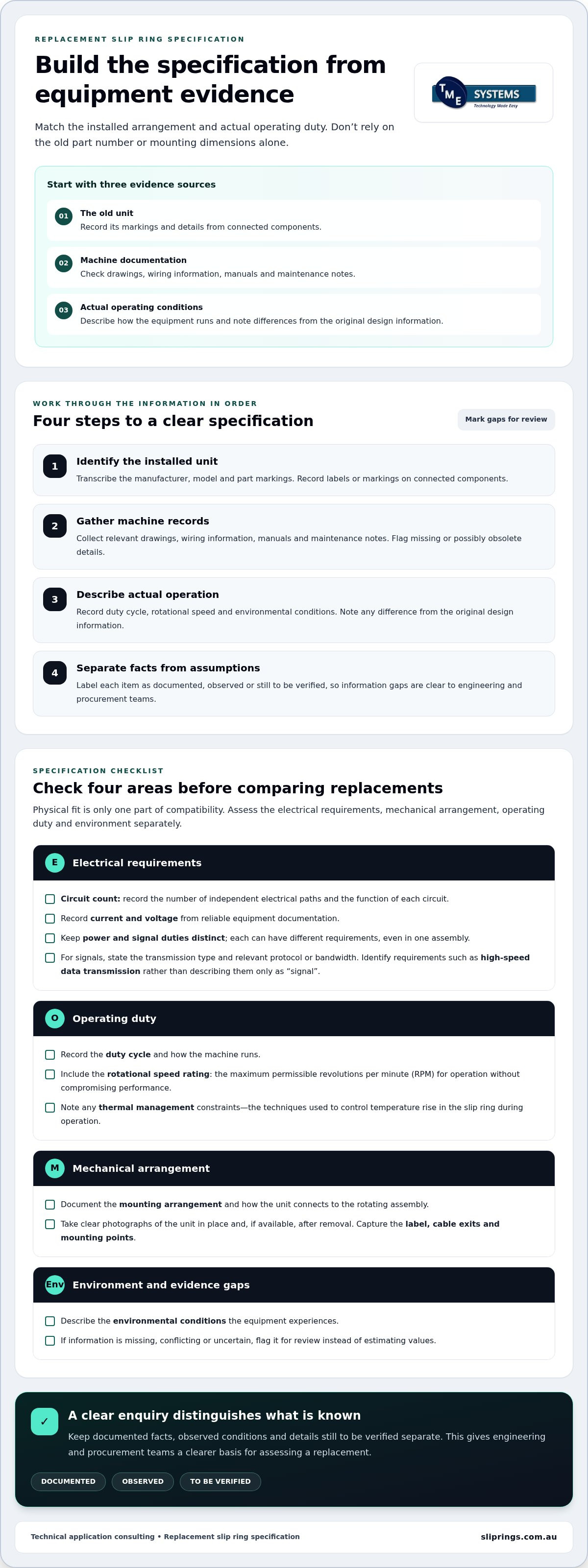
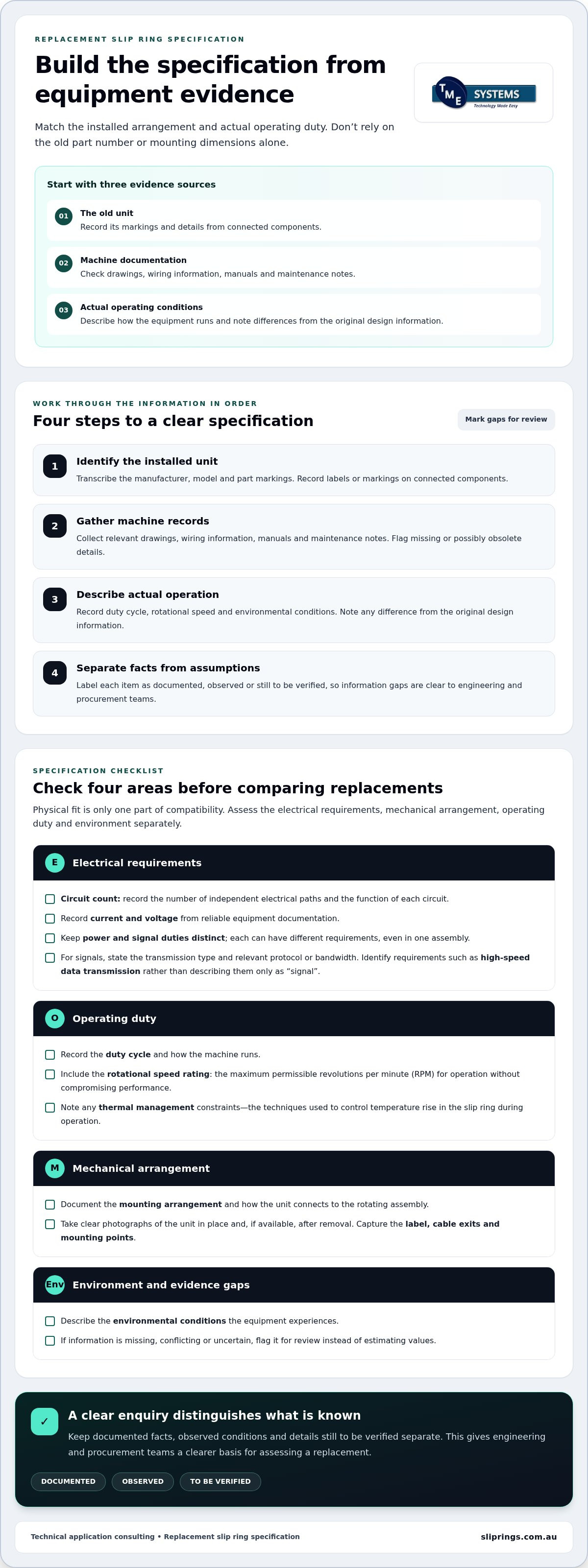
A useful specification brings together three evidence sources: the old unit, the machine documentation and the conditions the equipment actually experiences. Start with records rather than memory. If documents conflict with current operation, note the difference so it can be resolved during application review instead of carrying an outdated assumption into the enquiry.
Work through the information in order:
- Identify the installed unit. Transcribe its manufacturer, model and part markings, and record labels or markings on connected components.
- Gather machine records. Collect relevant drawings, wiring information, manuals and maintenance notes. Flag details that are missing or appear obsolete.
- Describe actual operation. Record how the machine runs, including duty cycle, rotational speed and environmental conditions. Note any difference from the original design information.
- Separate known facts from assumptions. Label each item as documented, observed or still to be verified. This makes information gaps clear to engineering and procurement teams.
Which electrical and operating details should the enquiry include?
Document the circuit count, the number of independent electrical paths for power and signal transmission, and the function of each circuit. Record current and voltage from reliable equipment documentation. Keep power and signal duties distinct, since each can have different requirements even when they share one assembly.
Include the rotational speed rating, the maximum permissible revolutions per minute (RPM) for operation without compromising performance, and the duty cycle. Note any thermal management constraints. Thermal management means techniques used to control temperature rise in the slip ring during operation.
For signals, state the transmission type and relevant protocol or bandwidth details. If the application requires high‑speed data transmission, the ability to transfer large-bandwidth signals such as Ethernet or HDMI through a rotating interface, identify that requirement rather than describing it simply as a signal. Flag missing values for review instead of estimating them.
How should the existing unit and mounting be documented?
Take clear photographs of the unit in place and, if available, after removal. Capture the label, cable exits, mounting points and the assembly’s relationship to the shaft or housing. Add drawings and dimensional information where available. Describe interfaces in words as well as images: a photograph may show a cable route but not its connection details or the space needed for installation.
Record the operating environment from application documentation, including relevant exposure to dust, water or other conditions. Include the required IP rating, a standard that defines protection against dust and water ingress, where specified for the application. Don’t infer a rating from appearance or from another machine component.
Before requesting a replacement, assemble the manufacturer and part markings, circuit count and function, current, voltage, rotational speed rating, signal requirements, duty cycle, mounting and connection details, dimensions, environmental conditions and any relevant IP rating. Mark unknowns clearly. TME Systems’ technical application consulting can help translate this evidence into a replacement specification and support a final engineering review.
Compare replacement routes without assuming every slip ring is interchangeable
Once the application evidence is assembled, compare possible replacements as distinct engineering routes. A direct substitute aims to preserve the existing arrangement. A different form factor may address space or mounting constraints, while a change in connector technology may alter how electrical continuity is maintained. None is automatically suitable just because it looks similar or appears newer.
Use the available evidence to frame the decision. The table below sets out the main compatibility questions and when engineering review is needed.
| Replacement route | Application requirement | Evidence available | Compatibility question | Engineering review needed |
|---|---|---|---|---|
| Like-for-like | Retain the current interfaces and duty | Identified part details, drawings and current operating records | Does the proposed unit match the installed connections and present operating conditions? | Where records conflict, details are missing or operating duty has changed |
| Different form factor | Address a mounting or space constraint | Installation dimensions, shaft or housing details and cable routes | Can the alternative mount and connect without interfering with the machine? | To assess mounting, interfaces and installation clearances |
| Changed connector technology | Meet a documented application requirement through another contact method | Electrical duties, signal needs and operating conditions | Does the alternative technology suit the circuit allocation and duty? | To review the changed technology against the complete application |
When is a like-for-like replacement the clearest route?
A like-for-like option is the clearest starting point when the existing unit is reliably identified and machine records support the same interfaces and operating duty. It still needs to match current conditions, not simply reproduce the original selection. If the part marking is unreadable, drawings disagree with the installed arrangement, or the machine’s duty has changed, record the uncertainty for technical application review rather than filling gaps by assumption.
When might another rotary connector approach be considered?
A different form factor or connector technology may be considered when the existing installation presents a defined constraint or the application requirements have changed. Any design change calls for a fresh check of mounting, circuit allocation, connections and operating conditions. Compare options against the documented need; no connector approach is universally superior.
Liquid metal rotary connectors are brushless rotary connectors that use a pool of conductive liquid metal to maintain electrical continuity, eliminating wear and reducing noise. The term mercury‑free liquid metal describes liquid metal technology that uses gallium-based alloys instead of mercury to avoid toxicity concerns. These terms describe the material and contact approach, not a blanket performance claim. Where an application review points to this type of option, the Prosper Rotation slip rings range is one route to assess against the stated requirements.
Keep the selection traceable: document why the route fits, what evidence supports it and which interfaces need engineering sign-off. Application consulting can help reconcile these points before the selection moves into procurement.
Prepare the RFQ and negotiate supply terms for a replacement slip ring
A clear request for quotation (RFQ) helps engineering assess technical suitability while procurement agrees workable supply arrangements. Keep these decisions related but separate: a supplier response on commercial terms doesn’t establish that a slip ring meets the machine’s requirements, and technical approval doesn’t settle invoicing or delivery details.
Use an ordered workflow to make the enquiry easier to assess:
- Attach the evidence. Include available part markings, drawings, photographs, machine details and relevant maintenance or equipment records. Identify any documents that conflict.
- State the operating duty. Summarise how the slip ring is used, including electrical requirements, rotational speed, duty cycle and environmental conditions. Label missing values as open questions rather than estimates.
- Identify required interfaces. Describe mounting, connections, cable exits and any interfaces that must be retained. State clearly whether the request is for a direct replacement or a change to the existing arrangement.
- Set the project context. Specify the required quantity, intended application and project milestones that affect delivery planning.
- List approvals and questions. Name who will assess technical suitability, who will approve procurement, and what documentation each review requires.
What information makes a replacement RFQ easier to assess?
Use consistent file names and refer to each attachment in the enquiry, so a drawing, photograph or specification can be matched to the right detail. State acceptance criteria in measurable, application-relevant terms, such as required circuit allocation, electrical ratings, mounting interfaces and operating conditions. Identify required manufacturer documentation and whether a final engineering review forms part of the technical approval process.
Technical application consulting can help reconcile evidence from the installed unit with the current duty and clarify which details still need engineering assessment. This gives reviewers a defined basis for evaluating the proposed selection, rather than relying on an old part number alone.
How can buyers discuss payment terms clearly?
Set out your organisation’s invoicing requirements early, including the information needed on an invoice, internal approval steps and payment-process requirements. Discuss payment timing and required supply documentation as negotiated terms. State delivery expectations and the project date they relate to, then record agreed dispatch or delivery arrangements in the written response.
Keep the commercial record distinct from technical acceptance. Before purchase approval, document the selected configuration, agreed supply terms, unresolved technical assumptions, the person responsible for resolving each item and any conditions that must be met before approval. A written record helps engineering and procurement work from the same agreed information.
Progress a replacement slip ring enquiry with application engineering
A well-prepared enquiry gives application engineering a basis to assess the proposed replacement against the machine’s current requirements. TME Systems supplies industrial slip rings across Australia, including products from Mercotac, Meridian Laboratory, BGB Innovation and Prosper Rotation. Technical application consulting connects information from the installed unit and machine records with the requirements the equipment must meet now.
The review considers the application as a whole. Circuit count, current, voltage, speed, mounting style and environment interact, so assess a proposed unit against the complete set of supplied data rather than one specification in isolation. For example, if an old drawing shows one mounting arrangement but an equipment record describes a later change, identify the discrepancy before finalising the selection.
What happens during a technical application review?
The review starts by comparing the stated application requirements with the evidence provided. It can identify missing information, conflicting records or assumptions that could affect the choice of replacement. A gap doesn’t always prevent progress, but it should be clear which details are established and which need resolution before the selection can be accepted.
A final engineering review checks the supplied application data and proposed selection together. It supports a reasoned assessment of fit for the stated duty, and depends on the accuracy and completeness of the information supplied. For more context on how slip ring requirements are assessed, see the slip ring application engineering reference.
How should the team prepare for the next procurement step?
Before progressing the enquiry, bring the technical and purchasing records into one review pack. Keep the latest specification distinct from superseded drawings, and label any assumptions that remain open. This gives engineering reviewers and procurement staff a shared reference while keeping technical approval separate from purchasing decisions.
- Specification: Record the selected configuration and the application requirements it is intended to meet.
- Evidence: Retain relevant machine records, drawings and correspondence used to assess the selection.
- Approvals: Identify the people responsible for technical acceptance and purchasing approval.
- Open items: Document unresolved assumptions, who will address them and how their resolution affects approval.
- Supply conditions: Keep agreed delivery, invoicing and other commercial terms in the procurement record, separate from engineering acceptance.
Where the documented application aligns with the relevant technology, Mercotac slip ring information can form part of the product assessment. Assess the selection against the supplied requirements and manufacturer documentation rather than assuming it is suitable by brand alone.
For teams sourcing replacement slip rings Australia-wide, application engineering offers a structured way to move from incomplete records to a documented selection and approval path. To progress a specific requirement, submit a replacement slip ring enquiry with the available application evidence. A clear starting point helps the technical and procurement review proceed using the same information.
Make the replacement decision part of your equipment record
Once a replacement is approved, preserve the technical basis for that decision with the machine records. Keep the accepted specification, supporting documents and any later changes together so future maintenance or redesign work starts from a traceable reference rather than an assumption. This makes sourcing replacement slip rings Australia-wide a repeatable engineering process, not a one-off search for a part.
Assign responsibility for keeping the record current. If the machine’s duty, interfaces or environment change, note the revision and review whether the installed slip ring still suits its operating requirements. A clear record also helps procurement distinguish a repeat order from a new application that needs fresh assessment. The aim isn’t to preserve old details indefinitely, but to make the reasoning behind each selection visible.
With your application information assembled, take the next step and submit a replacement slip ring enquiry. A well-documented starting point gives your team a clearer path to a considered selection and approval.
Frequently Asked Questions
Can I replace a slip ring with one that has the same dimensions?
Not on dimensions alone. A unit that fits the available space may still have a different circuit arrangement, connection layout or operating limit. Compare the proposed replacement’s documentation with the machine requirements, including how its terminals map to the existing wiring. If a drawing and installed-unit markings disagree, record the discrepancy rather than choosing whichever detail seems more likely. Resolve it through technical application review before approving the replacement.
What information do I need to source a replacement slip ring?
Gather the unit’s manufacturer and part markings, drawings, photographs, electrical details, mounting information and operating conditions. For sourcing replacement slip rings Australia-wide, note when records were created and whether they describe the machine as currently configured. Keep signal and power connections identifiable, and mark uncertain data clearly. This helps reviewers distinguish confirmed requirements from details that need clarification before assessing a selection.
Can a different slip ring technology replace the existing unit?
It may, but changing technology calls for an application assessment rather than a direct part substitution. Map the proposed unit’s electrical paths to the functions served by the existing assembly, and compare the connection and mounting interfaces. A change in contact method could affect how the existing design is evaluated, even if the replacement occupies similar space. Record the reason for considering the change and define the acceptance criteria before selection.
How do I prepare an RFQ for an industrial slip ring replacement?
Give the enquiry a clear project reference and identify which documents represent the current machine design. Attach relevant drawings and photographs, then state the duty and required interfaces in the RFQ so reviewers don’t need to infer them from attachments. Include the required quantity, technical approval contact and purchasing contact. List unanswered questions separately, and request the documentation your team needs to record its technical decision.
What happens if the original slip ring part number is unavailable?
Build the replacement specification from the machine evidence rather than relying on an unavailable part number. Check equipment schedules, wiring documents and maintenance records for clues, then compare them with markings and connections on the installed unit. If the records don’t identify the original model, describe what each connection does and note which details remain uncertain. A technical review can use this evidence to assess a like-for-like option or another configuration.
Can payment terms be negotiated with an industrial component supplier?
Yes. Buyers can raise payment timing and invoicing requirements during procurement discussions, since terms are agreed for the relevant transaction rather than assumed to be universal. Explain any internal purchase-order process, invoice details or approval steps that could affect processing. Keep the resulting commercial record separate from technical acceptance. Before approval, document the agreed conditions and any outstanding commercial questions for the people managing the purchase.
Is an engineering review useful when replacing a slip ring?
Yes, particularly if the original specification is incomplete, the machine has changed or the proposed replacement differs from the installed unit. A review considers how the supplied application details relate to the proposed selection and can identify assumptions that need resolution. TME Systems provides technical application consulting for industrial slip ring selection, and technical support can include a final engineering review of the application data and proposed choice.