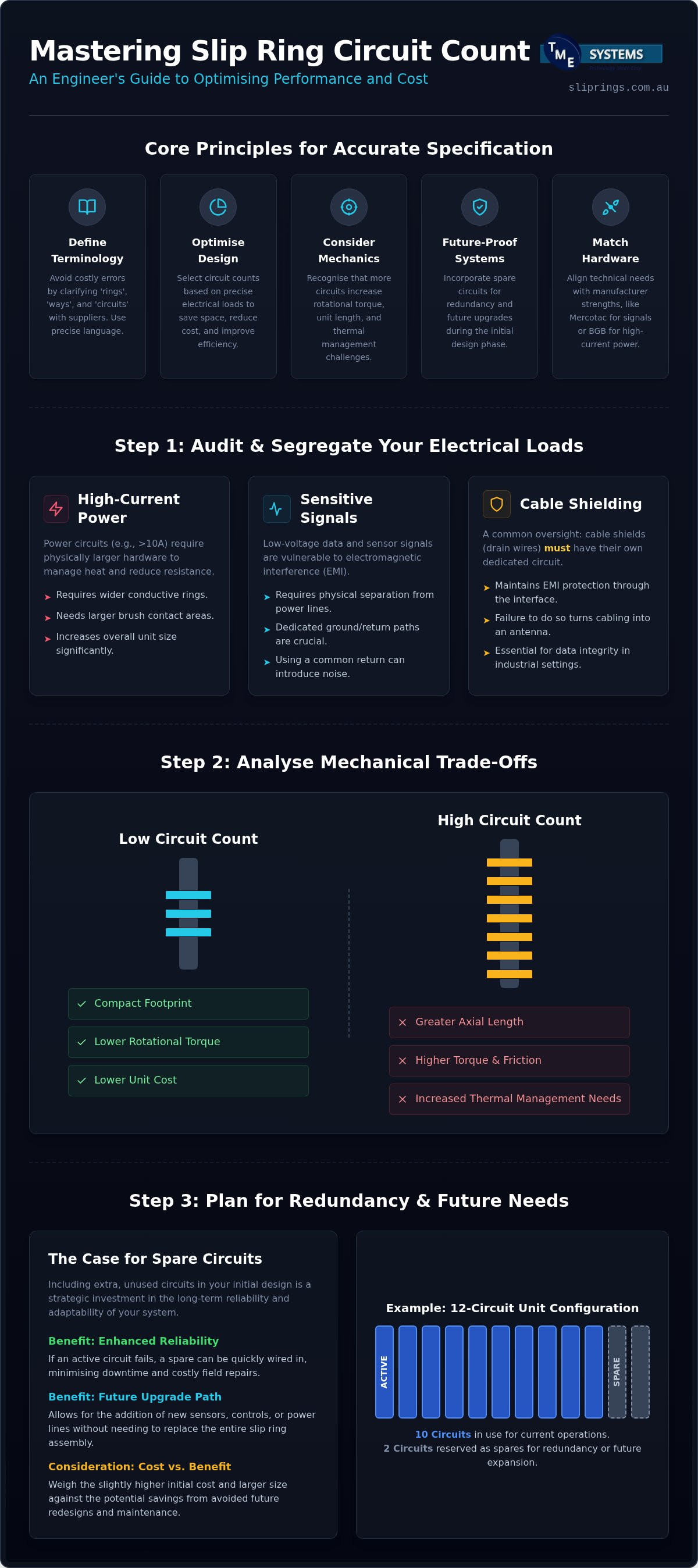
Specifying the wrong number of circuits in a slip ring is rarely a simple counting error; it's a fundamental engineering oversight that can compromise the thermal stability and mechanical integrity of your entire rotating system. Most engineers recognise the frustration of a footprint that has grown too large due to over-specification, or the signal interference that occurs when too many high-frequency channels are crowded together. Getting the balance right requires a precise understanding of how physical rings translate to functional signal paths in a real-world environment.
This technical reference helps you master the logic of slip ring circuit count selection to ensure your Australian industrial applications remain reliable and cost-effective. You'll gain a clear framework for auditing your electrical needs and optimising the mechanical footprint of your equipment. We will examine how to distinguish between physical rings and signal channels, while identifying the best pathways to achieve long-term durability in demanding environments using specialised solutions from Mercotac, Meridian Laboratory, BGB Innovation, or Prosper Rotation. This methodical approach ensures your hardware is neither over-engineered for your budget nor under-specified for your performance requirements.
Key Takeaways
- Standardise your procurement process by clearly defining the differences between ways, rings, and channels to avoid communication errors with manufacturers.
- Optimise your system's footprint and cost by applying a logical framework for slip ring circuit count selection based on precise electrical load and signal segregation.
- Identify the mechanical trade-offs of multi-circuit stacks, specifically how increased counts impact rotational torque and thermal management in high-speed applications.
- Future-proof your industrial operations by conducting a cost-benefit analysis on redundancy and the inclusion of spare circuits during the initial design phase.
- Align complex technical requirements with specific hardware strengths, such as low-noise Mercotac units for signal integrity or heavy-duty BGB Innovation stacks for high-current needs.
Slip Ring Circuit Count Fundamentals: Defining Your Requirements
A slip ring serves as the critical bridge between stationary and rotating components, facilitating the continuous flow of electricity or data. When you begin the process of slip ring circuit count selection, it's vital to look beyond a simple tally of wires. Every independent electrical path requires its own dedicated hardware within the assembly. Selecting the correct count is a balancing act between your system's functional needs and the physical space available in your enclosure. If you miscalculate this number early in the design phase, you may find yourself forced to choose between a cramped installation or a total system redesign.
The Anatomy of a Multi-Circuit Assembly
Inside a multi-circuit unit, conductive rings are stacked along a central rotor. Each ring is separated by an insulation barrier to prevent electrical leakage or shorting. These barriers are not negligible; they add significant axial length to the assembly. If you're using a high-current unit from BGB Innovation, the rings must be wider to handle the amperage, which further extends the unit. Standard configurations often come in fixed increments, but custom-engineered stacks allow you to mix high-power rings with sensitive signal paths in a single housing. You should always account for the cumulative height of these insulation layers when calculating your available mounting depth.
Terminology: Circuits, Poles, and Ways
Clear communication with your supplier prevents costly procurement errors. In many Australian engineering contexts, the terms "ways", "poles", and "circuits" are used interchangeably, yet they can carry different meanings depending on the manufacturer's origin. A slip ring circuit is a dedicated conductive path for current or data. We recommend avoiding the term "poles", as it's more suited to static switchgear and can lead to confusion regarding the mechanical layout of a rotary contact. Using the term "rings" is often the most accurate way to describe the physical hardware required for each independent path. Precision in these definitions ensures that your slip ring circuit count selection aligns perfectly with your wiring diagrams.
Total circuit count is also influenced by your grounding strategy. Using a common return for multiple signals can reduce the number of rings needed, effectively shortening the assembly and lowering the unit cost. You must weigh this against the risk of electrical noise. For high-precision applications, such as those using Mercotac slip rings, maintaining separate paths for every signal is often necessary to ensure data integrity. Reducing the ring count via common returns is a practical way to save space, provided it doesn't compromise the signal-to-noise ratio required for your specific sensors or controllers.
Auditing Electrical Loads: Power, Signal, and Data Segregation
A thorough audit of your electrical requirements is the first step toward successful slip ring circuit count selection. You can't simply count the wires entering the rotary union; you must categorise them by their electrical characteristics. Each power line, signal pair, and communication bus has a different physical footprint inside the housing. Failing to account for the segregation of these loads often leads to electromagnetic interference (EMI) or premature contact wear.
One common mistake in the slip ring selection process is neglecting the circuit requirements for shielding. If you're running shielded cables for sensitive sensors, the shield or drain wire must have its own dedicated ring to maintain continuity through the interface. If you bypass this to save on circuit count, you effectively turn your cabling into an antenna, inviting crosstalk that can corrupt your data. This is particularly critical in industrial environments where high-voltage motors operate in close proximity to low-voltage control signals.
High-Current Power Requirements
High amperage circuits demand wider rings and larger brush contact areas to manage heat and reduce electrical resistance. In applications exceeding 50 or 100 Amps, a single ring might not suffice. Engineers often specify multiple rings in parallel for a single high-current path to distribute the load and ensure reliability. You must also calculate the potential voltage drop across these contacts, as even a small resistance can lead to significant thermal issues in high-duty cycle Australian mining or manufacturing environments. Proper ring sizing is non-negotiable for system longevity.
Signal Integrity and Data Channels
Sensitive data channels, such as those for Ethernet or Profibus, require a different level of manufacturing precision. These circuits often utilise gold-on-gold contacts or specialised liquid metal interfaces like those found in Meridian Laboratory slip rings to maintain low contact resistance and high signal-to-noise ratios. Unlike power rings, signal circuits are highly susceptible to "noise" generated by mechanical vibration or nearby high-voltage lines. Proper segregation within the stack is essential to prevent data loss. If your application involves high-speed data transfer, consulting on your specific signal types will ensure the internal layout of the slip ring is optimised for performance.
Mechanical Constraints and Rotational Performance
Every additional circuit in a rotary union introduces a physical contact point that directly influences the mechanical performance of your machinery. When performing slip ring circuit count selection, you must account for the cumulative drag generated by multiple brush contacts. This isn't merely a matter of electrical capacity; it's a mechanical trade-off. A high circuit count unit inevitably faces greater rotational resistance, which can impact the sizing of your drive motors or the precision of sensitive positioning equipment.
Torque and Friction Considerations
The rotational torque of a slip ring is the sum of the friction produced by every brush-and-ring interface. In high-speed applications, even a small amount of drag per circuit can lead to significant parasitic power loss. If your machinery operates at several thousand RPM, a high-density assembly might generate enough friction to cause mechanical jitter or premature wear. To mitigate this, engineers often look toward brushless or liquid metal technologies, such as Meridian Laboratory slip rings, which offer near-zero friction regardless of the circuit count.
Heat Dissipation in Compact Assemblies
Thermal management becomes a primary concern when multiple power circuits are active simultaneously within a small footprint. Heat is generated by both electrical resistance and mechanical friction. In a high-density multi-circuit unit, this heat can become trapped, potentially degrading insulation or causing thermal expansion that alters contact pressure. Proper spacing between high-current rings is essential. For more detailed insights into managing these variables, see our guide on Slip Ring Application Engineering.
The physical layout of your circuits typically follows one of two paths: increasing the axial length of the assembly or increasing the diameter. If your application requires a hollow shaft for hydraulic lines or a central drive shaft, you'll likely opt for a through-bore design. However, a larger bore diameter increases the surface speed of the rings at the contact point, which can accelerate wear and increase noise. Referencing technical guides on How to Specify a Slip Ring helps clarify how these mechanical variables interact with your specific spatial constraints.
Environmental sealing, such as IP65 or higher, adds another layer of mechanical drag. High-count assemblies require larger seals, which increase the starting torque of the unit. In harsh Australian industrial environments, ensuring that the assembly can dissipate heat while remaining hermetically sealed is a complex engineering challenge. You must ensure the chosen housing can handle the thermal load generated by the internal circuit density without compromising the integrity of the seals.
Strategic Selection: Redundancy and Future-Proofing
The most expensive circuit in a rotary union is often the one you didn't include during the initial build. While it's tempting to specify a unit that matches your current wiring diagram exactly, this approach leaves no margin for error or future expansion. Strategic slip ring circuit count selection requires a forward-looking assessment of your machinery's lifecycle. By integrating extra capacity at the design stage, you protect your operation against the high costs of equipment obsolescence and emergency downtime.
When to Include Spare Circuits
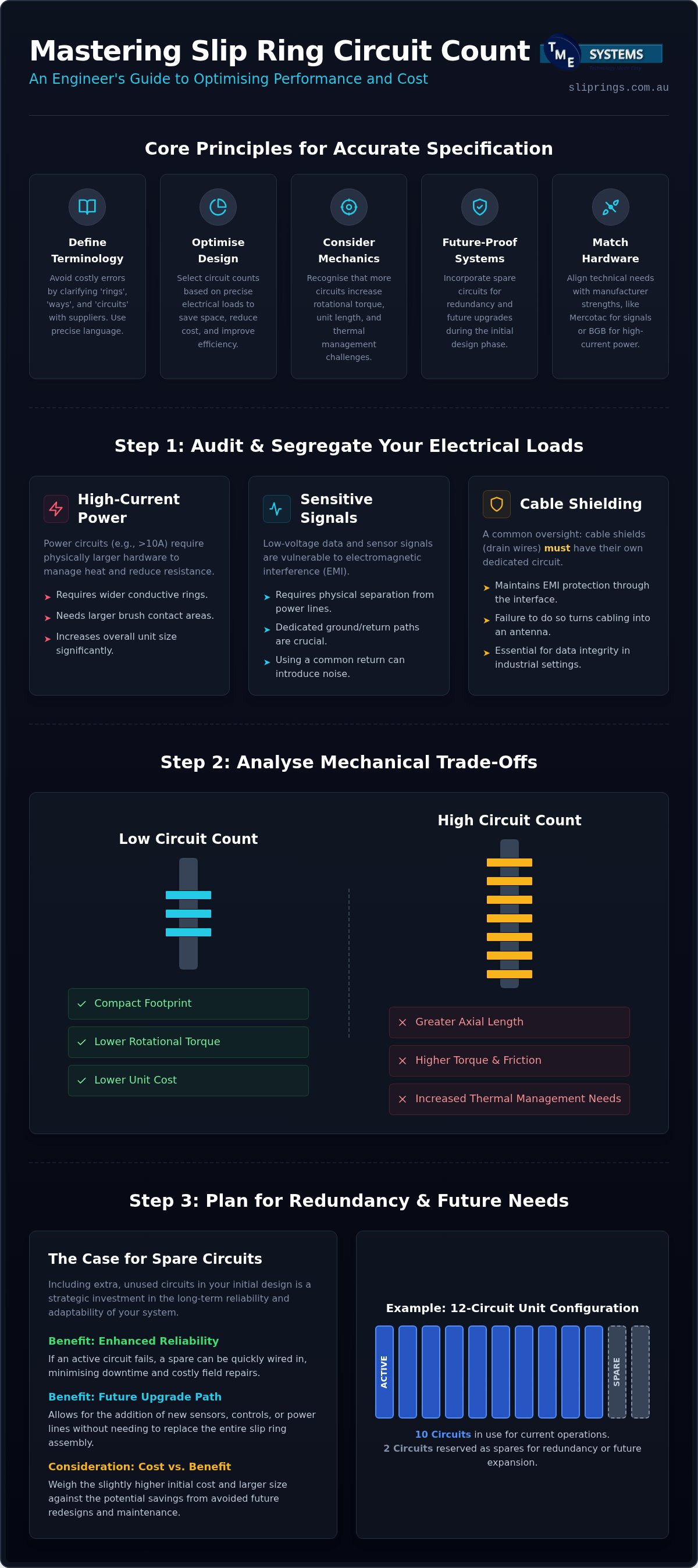
For most industrial automation projects, we recommend adding 10% to 20% extra circuit capacity. This buffer serves two primary purposes. First, it allows for the seamless addition of new sensors or control signals as your production requirements evolve. Second, it provides a vital safety net for field maintenance. If a single ring becomes damaged or contaminated in a remote Australian mining site, a technician can simply swap the lead to an unused spare circuit. This immediate fix bypasses the need for an urgent replacement unit, keeping your plant operational while a permanent solution is organised.
The cost-benefit analysis of adding extra rings during manufacture is usually straightforward. The incremental cost of adding three or four extra circuits to a Prosper Rotation stack is negligible compared to the thousands of dollars lost during a single shift of unplanned downtime. You should view these spare circuits as an insurance policy for your mechanical uptime.
Redundancy for Critical Signal Transfer
In safety-critical applications, such as emergency stop loops or high-precision feedback systems, redundancy is a technical necessity rather than an optional extra. You can improve reliability by paralleling two or more circuits for a single signal. This configuration reduces the overall contact resistance and ensures that if one brush momentarily loses contact due to vibration, the signal remains unbroken. This technique is a staple in the Industrial Slip Rings Australia procurement framework, where environmental stability is paramount.
Fixed circuit counts are standard for off-the-shelf units, but modular designs offer greater scalability for complex projects. If your system architecture is likely to change, a modular approach allows you to add or remove circuit blocks without replacing the entire housing. This flexibility is particularly useful in research and development environments or for machinery that undergoes frequent tooling changes. To ensure your hardware matches your long-term operational goals, you can request a technical consultation on circuit count optimisation to find the right balance between current needs and future-proofing.
Matching Manufacturers to Circuit Complexity
The final phase of slip ring circuit count selection involves aligning your technical audit with the specific manufacturing strengths of global leaders. Each brand offers a unique set of advantages that cater to specific circuit densities and electrical loads. Selecting the right hardware ensures that your system doesn't just function on day one but continues to perform under the rigours of Australian industrial environments. We work closely with several key manufacturers to match their technical specialities to your specific circuit requirements.
For applications requiring low-noise signal integrity in a compact footprint, Mercotac slip rings are the preferred choice. These units utilise a liquid metal conductive path, making them ideal for sensitive data and high-fidelity signals where traditional brush noise would be unacceptable. Conversely, if your project involves high-current power distribution in a heavy-duty industrial setting, the robust carbon brush stacks from BGB Innovation are the industry standard. These assemblies are designed for longevity in harsh conditions, such as wind turbines or wastewater treatment plants, where high circuit counts must be maintained alongside significant amperage.
Precision and speed often demand the specialised engineering of Meridian Laboratory. Their brushless technology is particularly effective for high-speed signal counts where mechanical wear must be eliminated. For engineers seeking a balance of versatility and cost-efficiency, Prosper Rotation provides modular circuit configurations. These units allow for a high degree of customisation, enabling you to mix and match power and signal rings within a single, scalable housing.
Brushless vs Conventional Technology
Choosing between brushless and conventional contact technology depends heavily on your maintenance schedule and signal requirements. Liquid metal connectors, such as those discussed in our Mercotac Distributors Australia guide, provide a zero-maintenance alternative for sensitive data paths. They offer near-constant resistance throughout the life of the unit. Conventional carbon brush stacks remain the superior choice for high-power distribution, as they handle the thermal loads of high-current circuits more effectively than liquid metal alternatives. You must decide if your priority is signal purity or raw power capacity.
Technical Consultation with TME Systems
Evaluating these variables requires more than a catalogue; it requires a technical partner who understands the complexities of slip ring circuit count selection. TME Systems provides a consultative approach to help you audit your electrical loads and specify the correct hardware. We assist in identifying potential pitfalls, such as crosstalk between unshielded signal paths or insufficient spacing for high-voltage rings. Our custom engineering services ensure that even non-standard circuit requirements are met with precision. With local Australian support, you can be confident that your technical selection is backed by expert advice and rapid response times for all your industrial rotary interface needs.
Optimising Your Rotary Interface for Long-Term Performance
Precise slip ring circuit count selection is a critical engineering decision that dictates the reliability of your entire rotating system. By conducting a meticulous audit of your electrical loads and accounting for mechanical constraints like torque and heat dissipation, you avoid the common pitfalls of over-specification or signal interference. Integrating spare capacity at the design phase isn't just a convenience; it's a strategic investment that minimises future downtime and simplifies maintenance in the field.
As technical distributors for Mercotac, Meridian Laboratory, BGB Innovation, and Prosper Rotation, TME Systems provides specialised engineering support tailored to the specific demands of Australian industry. Whether you're operating in mining, water treatment, or advanced automation, we ensure your hardware is perfectly matched to your application's complexity. Consult with TME Systems for expert slip ring circuit selection to ensure your next project is built for proven reliability. We look forward to helping you achieve a seamless and dependable rotary connection.
Frequently Asked Questions
What is the difference between a circuit and a channel in a slip ring?
A circuit refers to an independent physical conductive path through the rotary interface, whereas a channel describes a functional data or power stream. For example, a single Ethernet channel typically requires four or eight circuits depending on the protocol speed. Standardising your terminology during slip ring circuit count selection ensures that your electrical diagrams align with the hardware provided by the manufacturer.
How does increasing the circuit count affect the price of a slip ring?
Increasing the circuit count typically raises the unit cost because it requires additional conductive rings, brush contacts, and insulation spacers. Beyond the material costs, a higher count increases the axial length of the assembly and the complexity of the manufacturing process. While the price per circuit often decreases in larger stacks, the total investment reflects the increased mechanical and electrical complexity of the unit.
Can I mix high-voltage power and low-level signals in the same slip ring assembly?
You can mix high-voltage power and low-level signals in a single assembly, provided there's adequate internal segregation. Manufacturers use physical distance and grounded insulation barriers to prevent electromagnetic interference from power lines corrupting sensitive data. It's essential to specify these requirements early so that the internal layout can be engineered to protect signal integrity across the rotary gap.
What is the maximum number of circuits possible in a standard industrial slip ring?
Standard industrial slip rings often accommodate between 2 and 50 circuits, but custom modular stacks can exceed 100 paths in a single housing. The practical limit is usually dictated by your available mounting space and the allowable rotational torque. If your application requires an exceptionally high count, we often recommend a through-bore design to manage the axial length more effectively.
Do I need to count ground or earth wires as separate circuits?
You must count ground or earth wires as separate circuits because every conductor requires its own dedicated ring and brush set to maintain continuity. Bypassing the rotary interface for grounding isn't possible in a fully rotating system. Including these in your initial slip ring circuit count selection prevents unexpected wiring shortages during the installation of your control panels or motors.
How do I specify a slip ring if I have multiple data protocols like Ethernet and RS485?
When specifying for multiple data protocols, you should group circuits based on their bandwidth and shielding requirements. Ethernet requires high-frequency contacts with specific impedance matching, while RS485 is more resilient but still benefits from twisted-pair segregation. We recommend providing a full list of protocols to ensure the internal contact materials and wiring are compatible with your specific baud rates and signal types.
Does a higher circuit count reduce the lifespan of the slip ring?
A higher circuit count doesn't inherently reduce the lifespan, but it does increase the total friction and heat generation within the unit. If the assembly isn't designed to dissipate this extra thermal energy, the insulation and contact surfaces may degrade faster. Selecting the correct contact technology for your circuit density is the best way to ensure the unit achieves its full rated service life.
Should I always include spare circuits in my initial order?
Including 10% to 20% spare circuits in your initial order is a highly recommended practice for industrial automation. These spares allow you to add new sensors or bypass a damaged ring without replacing the entire unit or facing lengthy equipment downtime. While it increases the initial procurement cost slightly, the long-term savings in maintenance and flexibility for future upgrades are significant.