Could a single millimetre of contact wear be the silent catalyst for A$50,000 in unplanned machinery downtime? For many Australian plant managers, this is a frustrating reality when a rotary connector fails months before its rated lifespan. You likely understand that in high-stakes automation, there's no such thing as a minor component failure; even slight signal noise can ruin data integrity across an entire automated system. Identifying common slip ring selection errors early in the procurement phase is the only way to protect your operational budget from the high costs of incorrectly specified hardware.
This guide provides the technical clarity needed to specify for long-term reliability rather than just nominal load. You'll learn how to bypass frequent engineering oversights by using a robust specification checklist designed for harsh local conditions. We'll also examine the critical performance differences between traditional brush units and liquid metal connectors from brands like Mercotac or Meridian Laboratory. By the end of this article, you'll have a clear pathway to selecting hardware that meets AS/NZS 60529:2025 standards and maintains peak performance in the most demanding environments.
Key Takeaways
- Quantify the true cost of unplanned downtime and learn how inadequate duty cycle specifications lead to premature brush failure in industrial environments.
- Identify and bypass common slip ring selection errors related to electrical surges and signal-to-noise ratios that often degrade data integrity.
- Specify rotary connectors that withstand harsh Australian conditions by correctly assessing ingress protection and thermal operating ranges.
- Prevent mechanical wear by mastering correct mounting configurations that protect internal bearings from external shaft loads and misalignment.
- Streamline your procurement process with a technical checklist that ensures every power and data circuit is documented for maximum reliability.
The Real Cost of Incorrect Slip Ring Selection
In Australian mining and manufacturing sectors, unplanned downtime is a direct hit to the bottom line that often costs thousands of dollars per hour. Many of these incidents are entirely preventable. They frequently trace back to common slip ring selection errors where the hardware was specified for ideal laboratory conditions rather than the actual rigours of the industrial site. When a rotary connector fails prematurely, the initial savings on the component are quickly eclipsed by the expense of emergency repairs and lost output.
Downtime vs. Procurement Savings
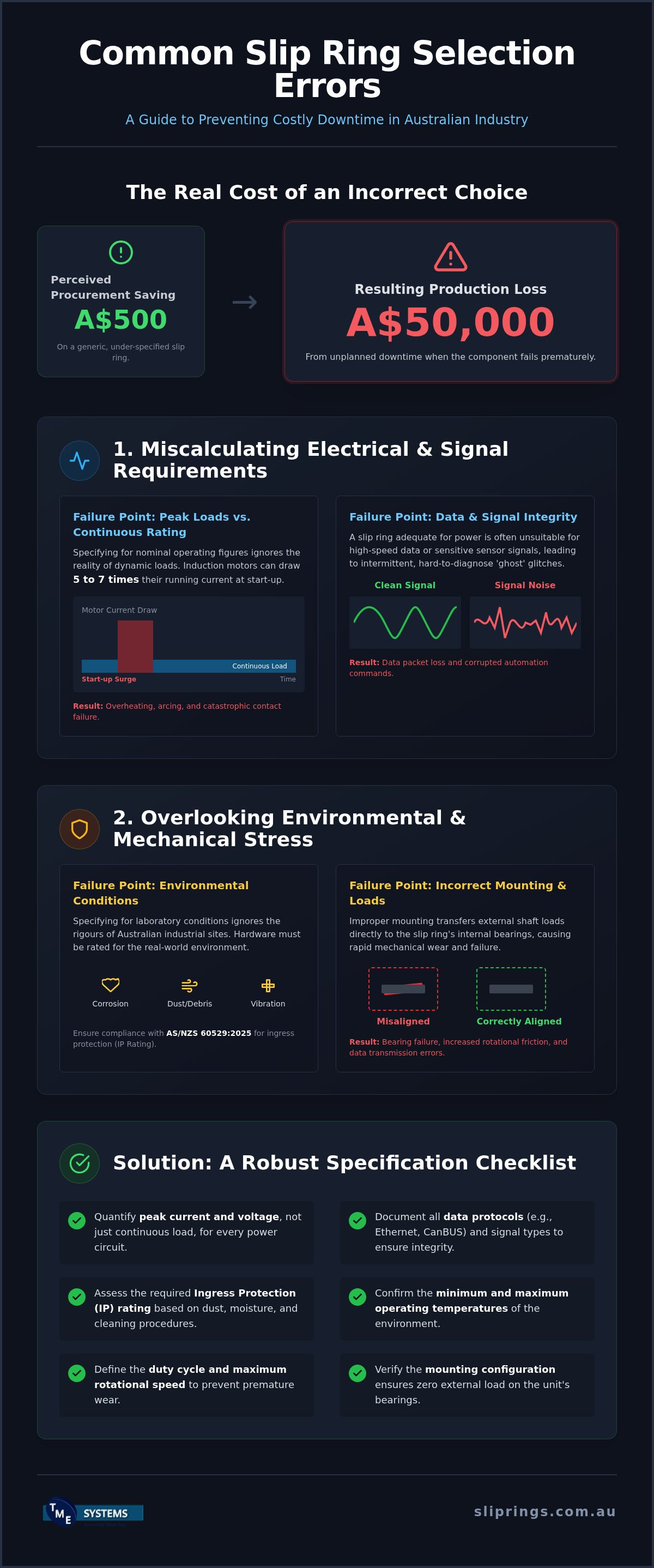
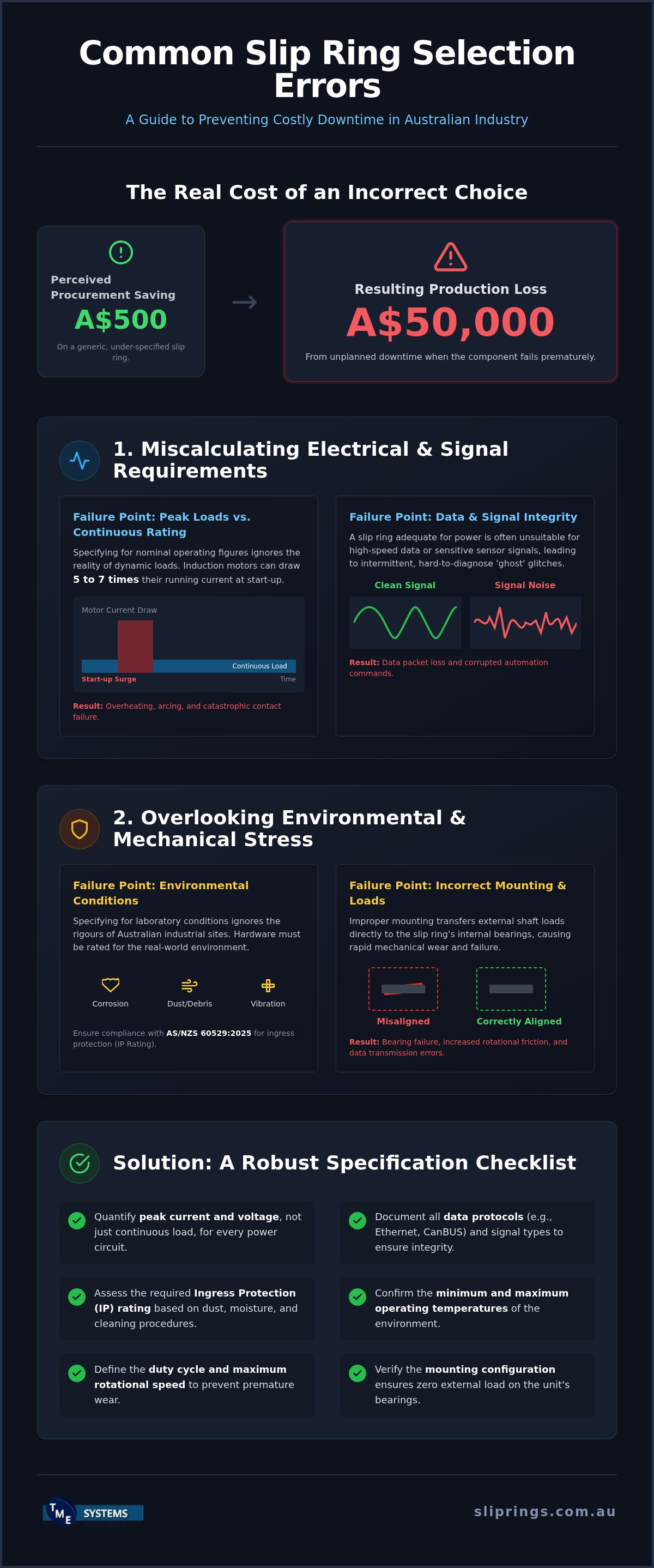
A$500 saving on a generic slip ring often turns into A$50,000 production loss when that unit fails during a critical shift. In the Australian market, this problem is compounded by geographic isolation. If a specialised replacement part is not held in local stock, lead times for international shipping can extend to several weeks, leaving machinery idle. False economy in industrial procurement occurs when a lower initial purchase price for a rotary component results in significantly higher long-term operational costs due to premature failure or maintenance requirements. Premature brush wear is a classic symptom of this. It usually happens because a unit with an inadequate duty cycle was chosen to meet a short-term budget, ignoring the continuous rotational demands of the application.
The Risk of Data Corruption in Automation
Precision is non-negotiable in modern automation. While a basic unit might suffice for simple power transmission, it will likely fail in high-precision data applications. To understand the baseline mechanics of these components, it helps to review what is a slip ring and how its contact materials influence signal quality. In automated systems using Ethernet-enabled slip rings, incorrect selection leads to signal packet loss and intermittent communication errors. These issues are notoriously difficult to diagnose because they often appear as "ghost" software glitches rather than mechanical failures.
A unit that is "good enough" for a motor drive is rarely suitable for sensitive sensor signals or high-speed data. For a deeper technical analysis of these requirements, consult our reference on Slip Ring Application Engineering. Specifying high-reliability options, such as Mercotac Slip Rings, can eliminate the signal noise that ruins data integrity in automated environments.
Total Cost of Ownership (TCO)
Evaluating the Total Cost of Ownership (TCO) requires looking beyond the initial invoice. A correctly specified slip ring from a brand like Meridian Laboratory might have a higher entry price, but its longevity reduces the frequency of replacement and the labour costs associated with routine maintenance. By addressing these common slip ring selection errors during the design phase, you ensure the machinery operates reliably throughout its entire service life, ultimately protecting your capital investment.
Miscalculating Electrical and Signal Requirements
Miscalculating the electrical parameters of a rotating system is one of the most frequent common slip ring selection errors encountered in industrial procurement. While it is tempting to specify a unit based on nominal operating figures, the reality of industrial hardware involves dynamic loads that can quickly overwhelm an undersized connector. Failure to account for these variables leads to intermittent signal loss or complete component failure.
Peak Loads vs. Continuous Ratings
Error 1 involves failing to account for peak current surges during motor start-up. Induction motors often draw five to seven times their running current upon initiation. If the slip ring is rated only for continuous load, the resulting heat can cause thermal runaway. This doesn't just shorten the lifespan of the unit; it can lead to catastrophic arcing that permanently degrades the contact surfaces. To avoid these common slip ring selection mistakes, engineers must specify hardware that accommodates the maximum possible surge. This ensures the thermal mass of the contacts can dissipate the energy without structural damage or voltage spikes that might damage downstream electronics.
Contact Technology: Brushes vs. Liquid Metal
Error 2 is ignoring the signal-to-noise ratio required for high-speed data. Traditional carbon or precious metal brushes are often sufficient for power transmission, but they struggle with sensitive thermocouple or Ethernet signals. These mechanical contacts inherently generate electrical interference as they move across the ring surface. Liquid metal interfaces eliminate the "bounce" found in traditional brush systems by maintaining a continuous, fluid molecular connection between rotating surfaces. This is why Mercotac Slip Rings are the preferred choice for low-noise requirements in Australian automation centres.
The common mistake of using traditional carbon brushes for high-speed data transmission often results in dropped packets and corrupted sensor data. In contrast, the brushless designs from Meridian Laboratory offer a maintenance-free alternative for high-speed data. Unlike traditional brushes that wear down and produce conductive dust, these units provide a stable impedance path over millions of revolutions. If you are unsure whether your specific signal requirements demand liquid metal or precision brushes, seeking technical application consulting can prevent a costly mismatch before the procurement phase concludes. This proactive approach ensures that the distinction between power circuits and sensitive signals is addressed during the specification stage, rather than after a failure occurs on the factory floor.
Overlooking Mechanical Limits and Environmental Stressors
Mechanical specifications are just as critical as electrical ones, yet they're frequently secondary considerations in the procurement process. This oversight contributes significantly to common slip ring selection errors that lead to mechanical fatigue or ingress-related failure. A unit might be electrically sound but physically incapable of surviving the rotational speeds or environmental stressors of a specific site. Ignoring these physical realities doesn't just shorten the component's life; it often leads to catastrophic failure of the entire rotating assembly.
RPM and Centrifugal Force
Error 3 involves operating a slip ring at its absolute maximum RPM rating continuously. Most manufacturers provide a maximum speed rating that represents a burst limit rather than a recommended operating constant. At high speeds, centrifugal force can cause brush lifting. This is where the physical contact between the brush and the ring becomes intermittent, resulting in increased electrical noise and accelerated wear. In through-bore designs, the relationship between the ring diameter and rotational speed is vital. A larger diameter increases the surface speed at the contact point, even if the RPM remains the same. High-speed applications require specialised, balanced internals like those found in Meridian Laboratory Slip Rings, which are engineered to maintain contact stability without the mechanical chatter common in standard units.
IP Ratings for the Australian Environment
Error 4 is underestimating the impact of fine dust and humidity in Australian workshops and mine sites. While an IP65 rating is often the industry default, it's frequently insufficient for outdoor mining or marine applications where wind-blown grit and high-pressure washdowns are standard. Fine iron ore dust or coastal salt spray can penetrate standard seals, creating a conductive slurry that causes internal short circuits. According to the AS/NZS 60529:2025 standard, selecting a unit with appropriate Ingress Protection is essential for both compliance and longevity. For environments requiring high-level sealing against moisture and particulates, BGB Innovation Slip Rings provide robust housing options designed for extreme conditions.
Vibration and shock loads are additional stressors that you must communicate to your supplier during procurement. If a slip ring is mounted on vibrating machinery without adequate dampening or internal reinforcement, the mechanical resonance can lead to premature bearing failure or fractured internal wiring. Ensuring your hardware is fit for purpose requires a deep understanding of local site variables. You can find more detail on matching hardware to regional demands in our guide on Industrial Slip Rings Australia. Addressing these mechanical limits during the specification phase prevents the most common slip ring selection errors from compromising your system's uptime.
Avoiding Mounting and Physical Configuration Mistakes
Physical integration is the stage where theoretical designs meet mechanical reality. Many common slip ring selection errors occur here because the unit is treated as a standalone electrical part rather than an integrated component of a rotating assembly. If the physical configuration is flawed, even the highest-quality electrical contacts will fail prematurely due to mechanical stress. Proper alignment and support are the foundations of long-term reliability.
Error 5 is using the internal slip ring bearings to support the weight of the rotating shaft. These bearings are designed only to support the internal rotor of the connector, not the external machinery. Error 6 involves misaligning the stationary and rotating components, which causes eccentric wear. A misalignment of just 0.5mm can reduce bearing life by 50% due to the resulting vibration and uneven contact pressure. The mounting centre must be perfectly aligned with the machine's axis of rotation to ensure the brushes track correctly on the rings without mechanical chatter.
Through-Bore vs. Capsule Applications
Selecting the correct form factor is essential for mechanical stability. A Prosper Rotation through-bore unit is the standard choice when you need to slide the slip ring over an existing shaft. This allows for a more integrated mounting solution that often results in better alignment. In contrast, capsule designs are compact and cost-effective but are often forced into high-vibration environments where they lack the structural mass to remain stable. For applications where vertical space is the primary constraint, pancake slip rings provide a flat profile, though they require careful consideration of their larger diameters and increased surface speeds.
The "Hard Mounting" Trap
A frequent mistake is the rigid bolting of both the rotor and stator ends of the housing. This "hard mounting" prevents the unit from floating. It creates immense internal stress as the machinery heats up and expands during operation. You should never bolt both ends rigidly; instead, use an anti-rotation tab or a flexible torque arm on one side. This allows for thermal expansion and slight axial movement without transferring those forces into the internal bearings. This simple mechanical allowance prevents the internal components from being crushed or warped over time.
If your project involves complex mechanical constraints, we recommend seeking technical application consulting before finalising your mounting design. Preventing these physical configuration errors at the procurement stage is far more efficient than attempting to correct a misaligned system after it has already caused a breakdown on your factory floor.
Optimising Your Procurement Process with Technical Consulting
Establishing a rigorous procurement strategy is the final step in eliminating common slip ring selection errors. While understanding the technical pitfalls is necessary, applying that knowledge within a structured decision-making framework ensures that the chosen hardware performs reliably in the field. A methodical approach to specification reduces the risk of project delays and prevents the need for costly retrofits after a system has been commissioned.
The first step is to define every circuit with precision. You must specify power, signal, and data protocols separately rather than grouping them under a general circuit count. Second, document the full range of environmental conditions. This includes minimum and maximum operating temperatures and the frequency of high-pressure washdowns. Third, consult with a specialised industrial slip ring supplier to verify that the selected unit matches these parameters. Finally, review your mounting plan. You must ensure that no mechanical loads are placed on the unit bearings, as established in previous sections.
The Value of Application Engineering
Technical consulting is not just about choosing a part number; it is about application engineering. At TME Systems Pty Ltd, we help Australian clients avoid the financial waste of over-specifying hardware while ensuring they don't under-specify and risk failure. For unique Australian requirements, such as those found in remote mining sites or coastal infrastructure, customisation options for BGB Innovation or Prosper Rotation units are often necessary. If your application involves high-speed data or sensitive signals, our role as Mercotac Distributors Australia allows us to guide you toward liquid metal solutions that eliminate electrical noise at the source.
Pre-Purchase Checklist
Before contacting a supplier, every engineer should have five critical data points ready for review. This preparation ensures the consultation is efficient and technically accurate. While "off-the-shelf" units might seem like the fastest path to a solution, they often lack the specific sealing or contact materials required for long-term industrial use. Ensure you have the following ready:
- Maximum continuous and peak RPM requirements.
- Peak current surges and operating voltage for all power circuits.
- Specific data protocols (e.g., Ethernet, Profinet, or Thermocouple types).
- Required IP rating based on AS/NZS 60529:2025 standards.
- Available physical envelope and mounting constraints.
By following this structured approach, you bypass common slip ring selection errors and secure a component that adds value to your machinery. If you are currently specifying a system and require expert oversight, contact TME Systems Pty Ltd for technical selection assistance to ensure your project meets its reliability targets.
Securing Long-Term Reliability in Rotating Systems
Specifying a rotary connector is a technical audit that requires balancing electrical precision with mechanical resilience. Successful procurement requires looking beyond nominal ratings to account for peak current surges and environmental stressors like fine dust or high humidity. By addressing common slip ring selection errors during the initial design phase, you ensure that your machinery remains operational without the constant threat of signal noise or bearing failure.
As the exclusive Australian distributor for Mercotac and Meridian Laboratory, TME Systems provides the technical oversight needed to match hardware to specific site conditions. We bring over 20 years of technical application experience in Australian industry to every consultation, helping you navigate the complexities of duty cycles and ingress protection. If you are ready to move from generic hardware to a solution engineered for longevity, consult with our technical team for expert slip ring selection. Our goal is to help you build a more reliable system that stands up to the rigours of your specific application.
Frequently Asked Questions
What is the most common reason for early slip ring failure in Australia?
Environmental contamination from fine particulates and moisture is the leading cause of premature failure. In Australian mining operations, iron ore dust often penetrates standard seals, creating a conductive path that leads to internal short circuits. This is one of the most common slip ring selection errors where the ingress protection is mismatched to the site reality. Specifying a unit with an IP67 rating or higher according to AS/NZS 60529:2025 is often necessary for these conditions.
Can I use a power slip ring to transmit high-speed Ethernet data?
You cannot reliably transmit high-speed Ethernet data through a standard power slip ring due to excessive electrical noise. Power circuits generate electromagnetic interference that corrupts data packets, leading to significant signal loss and intermittent communication. High-speed data requires specialised shielding or the near-zero resistance of liquid metal connectors. Using a general-purpose unit for data is a frequent mistake that results in system resets and corrupted sensor logs in automated production lines.
How do I know if I need a liquid metal or a traditional brush slip ring?
Liquid metal connectors are required if your application demands high data integrity or maintenance-free operation over millions of cycles. Traditional brush units are suitable for basic power transmission where some electrical noise is tolerable. However, if you are transmitting sensitive thermocouple signals or high-frequency data, the fluid interface of a liquid metal unit ensures a stable, low-resistance path. This choice is critical for preventing signal degradation in precision robotics and medical imaging equipment.
What happens if I operate a slip ring above its rated RPM?
Operating a slip ring above its rated RPM causes the physical brushes to lift off the ring surface due to centrifugal force. This creates intermittent contact and destructive arcing, which rapidly destroys the conductive surfaces and increases electrical resistance. The resulting heat can also lead to thermal expansion and bearing seizure. Continuous operation at high speeds requires balanced internal components and specific contact materials designed to maintain stability without mechanical chatter or signal dropouts.
Do IP ratings matter if the slip ring is mounted inside a machine cabinet?
Ingress protection ratings remain critical inside a cabinet because fine industrial dust and ambient humidity still penetrate most enclosures over time. Condensation can form during temperature shifts, leading to internal corrosion or short circuits on the slip ring contacts. Even in protected environments, a minimum rating of IP51 is usually recommended to guard against particulates. Neglecting this is a frequent oversight that leads to mysterious signal failures in seemingly clean control rooms and electrical centres.
Is it possible to combine power and signal circuits in a single unit?
It is possible to combine power and signal circuits in a single unit, provided there is adequate internal isolation between the circuits. Hybrid slip rings are designed with internal shielding to prevent power surges from interfering with sensitive data lines. This configuration saves space and simplifies the mechanical assembly. However, you must specify the voltage and frequency of each circuit clearly to ensure the internal layout prevents cross-talk and maintains the required signal-to-noise ratio.
How does shaft misalignment affect the lifespan of a rotary connector?
Shaft misalignment causes eccentric wear on the rings and places excessive radial loads on the internal bearings. Even a minor misalignment of 0.5mm can reduce the bearing life of a rotary connector by 50% due to constant vibration and stress. This mechanical error leads to increased friction and heat, which eventually degrades the electrical contact quality. Ensuring the axis of rotation is perfectly centred is vital for achieving the unit's rated service life and preventing premature failure.
Why should I avoid rigid mounting on both ends of the slip ring?
Rigid mounting on both ends prevents the slip ring from floating, which leads to internal structural damage as machinery expands during operation. As components heat up, they undergo thermal expansion; if the unit is bolted tightly at both the rotor and stator, this force is transferred directly into the internal bearings. Using a flexible torque arm or anti-rotation tab on one end allows for this movement while maintaining the stationary electrical connection, preventing the internal components from being crushed.