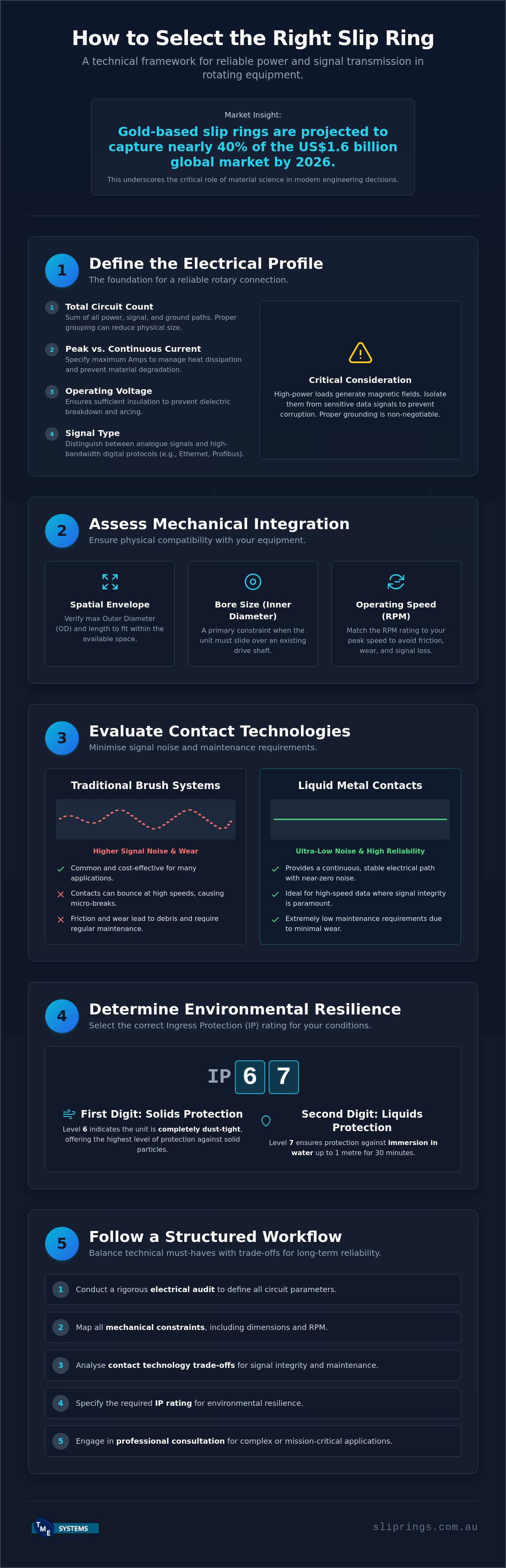
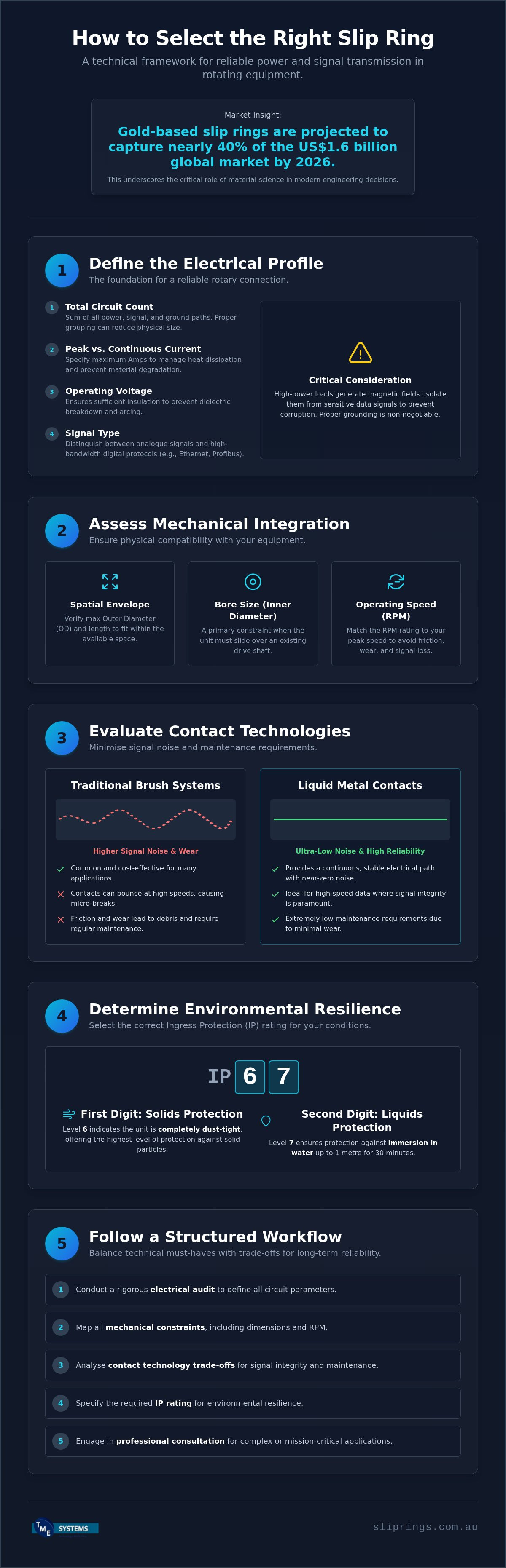
Did you know that gold-based slip rings are expected to account for nearly 40% of the US$1.6 billion global market in 2026? This statistic highlights a critical reality for engineers: material science is just as vital as mechanical design when managing rotary connections. Knowing how to select a slip ring involves more than just matching dimensions. If you're currently facing signal noise or frequent maintenance downtime, you've likely realised that a single overlooked specification can lead to costly failure in the field.
This guide will help you master the technical selection process to ensure reliable power and signal transmission in your rotating equipment. We'll examine the trade-offs between different contact technologies, clarify IP ratings for harsh conditions, and provide a clear checklist of specifications. By the end of this article, you'll have the technical framework needed to navigate complex procurement decisions with total confidence, whether you're evaluating liquid metal connectors or high-speed data circuits.
Key Takeaways
- Define your electrical profile and mechanical constraints, including circuit counts and bore sizes, to establish the baseline for your rotary connection.
- Understand how to select a slip ring by comparing traditional brush systems with liquid metal contacts to minimise signal noise and maintenance requirements.
- Identify the correct Ingress Protection (IP) rating to ensure your equipment remains resilient against moisture, dust, or corrosive industrial environments.
- Develop a structured selection workflow that balances technical "must-haves" with operational trade-offs for long-term component reliability.
Step 1: Defining the Electrical Profile and Technical Specifications
Before you look at mounting options or housing materials, you must conduct a rigorous electrical audit. This is the foundation of how to select a slip ring that won't fail under load or corrupt your data. You need to map out every single connection passing through the rotating interface. If you're wondering What is a Slip Ring? at its most basic level, it's an electromechanical device that allows the transmission of power and electrical signals from a stationary to a rotating structure. In industrial settings, this bridge must handle a diverse mix of high-amperage power and sensitive digital protocols simultaneously.
Your first task is to categorise every circuit. It's not enough to simply count the wires; you must understand the nature of the energy they carry. High-power electrical loads generate magnetic fields that can easily disrupt low-voltage data signals if they aren't properly isolated. When you're defining your requirements, consider the following parameters:
- Total Circuit Count: The sum of all power, signal, and ground paths.
- Peak vs. Continuous Current: Identify the maximum Amps each circuit will draw.
- Operating Voltage: Specify the Volts for each path to ensure insulation is sufficient.
- Signal Type: Distinguish between simple analogue signals and high-bandwidth digital protocols like Ethernet or Profibus.
Understanding Slip Ring Circuit Count Selection
Grouping circuits logically helps you organise the internal layout and can significantly reduce the physical size of the connector. A smaller footprint often means lower peripheral speed at the contact point, which extends the life of the unit. Don't forget to include dedicated circuits for shielding and grounding. Proper grounding is non-negotiable for industrial reliability, as it provides a path for electrical noise to dissipate safely without affecting your control logic or sensor accuracy.
Voltage and Current Rating Considerations
Managing heat dissipation is a primary concern for high-current industrial applications. When current flows through a contact, resistance generates heat. If this isn't managed, it can degrade the lubricant or the contact material itself. Rated current is the maximum continuous flow an assembly can handle without exceeding its specified thermal limits. In high-voltage systems, you also need to account for dielectric breakdown and arcing. Ensuring there is adequate spacing and insulation between circuits prevents catastrophic shorts that could halt an entire production line. Precision at this stage ensures the hardware stays operational for its intended service life without unexpected overheating or signal corruption.
Step 2: Mechanical Integration and Operating Speed Constraints
Once you've established the electrical profile, the next phase in how to select a slip ring focuses on physical integration. Mechanical compatibility is often the limiting factor in industrial design. You must account for the available spatial envelope, including the maximum outer diameter (OD) and total length. If the slip ring needs to slide over an existing drive shaft, the inner diameter, or bore size, becomes your primary constraint. Miscalculating these dimensions can lead to interference with other components or expensive redesigns of mounting brackets.
Operating speed is another non-negotiable parameter. Every slip ring has a maximum RPM rating, which is determined by the diameter of the contact rings and the type of contact technology used. High peripheral speeds increase friction and heat, which can degrade signal quality and shorten the service life of the unit. While selecting your hardware, you should also be mindful of Environmental Resilience and IP Ratings, as mechanical seals often impact the maximum allowable speed.
Matching RPM Ratings to Application Requirements
Centrifugal forces play a significant role at higher speeds. They can cause traditional brush contacts to bounce or lift, leading to intermittent signal loss or 'micro-breaks'. For precision applications where data integrity is paramount, standard ratings might not suffice. High-speed requirements often necessitate Meridian Laboratory slip rings, which utilise specialised contact technologies to maintain a constant electrical path even at several thousand RPM. Matching the RPM rating to your peak operating speed ensures that friction doesn't lead to premature wear or thermal expansion issues.
Through-Bore vs Capsule Configurations
Choosing between a through-bore, capsule, or pancake design depends on your machine's architecture. Through-bore models are ideal when you need to pass hydraulic lines, pneumatic hoses, or a central shaft through the assembly. Conversely, capsule slip rings offer a fully enclosed, compact solution for space-constrained environments like robotic joints. For applications where vertical height is limited but there is ample horizontal space, pancake designs provide a low-profile alternative. Regardless of the style, mechanical alignment is critical. Using flexible couplings can help compensate for slight misalignments between stationary and rotating parts, preventing bearing stress. If you're unsure which configuration fits your footprint, consulting with a technical specialist can clarify the best path forward.
Step 3: Evaluating Contact Technologies: Liquid Metal vs Brushes
The core of any rotary union is the interface where the stationary and rotating components meet. Understanding the physical properties of this interface is essential when determining how to select a slip ring that meets your performance benchmarks. Traditionally, this connection was achieved using carbon or precious metal brushes, but modern industrial requirements for high-speed data and low-noise transmission have led to the widespread adoption of liquid metal technologies. Each approach has distinct characteristics regarding conductivity, wear, and signal integrity.
Contact resistance is the primary enemy of signal reliability. It fluctuates as the ring rotates, creating electrical noise that can corrupt sensitive data packets or cause erratic sensor readings. While traditional brushes are robust, they inherently produce some level of wear debris and frictional heat. In contrast, liquid metal contacts provide a molecularly continuous path, resulting in extremely low and stable resistance. Choosing the right technology requires a careful analysis of your total cost of ownership, weighing the higher initial investment of specialised hardware against the long-term costs of maintenance downtime.
The Advantages of Mercotac Liquid Metal Connectors
For applications involving sensitive instrumentation or high-speed digital signals, Mercotac slip rings are often the superior choice. Because the electrical path is maintained through a pool of liquid metal rather than a sliding mechanical contact, signal noise is virtually eliminated. This technology is essentially maintenance-free in clean environments, as there are no brushes to wear down or replace. When evaluating your system, Understanding Slip Ring Contact Resistance is vital to predicting how much interference your control system can tolerate before errors occur.
When to Organise Traditional Brush Systems
While liquid metal offers high precision, there are many scenarios where you should organise a traditional brush-based system instead. Heavy industrial applications, such as wind turbines or large-scale manufacturing plant, often require the high-current capacity and environmental ruggedness of BGB Innovation brush systems. These units are designed to handle significant electrical loads and can be serviced easily if wear occurs over several years of operation.
Silver-graphite contacts are frequently used in these systems to strike a balance between high conductivity and mechanical durability. If your machinery operates in a high-vibration environment or one where liquid metal seals might be compromised by extreme temperature swings, a robust brush-and-ring assembly remains the industry standard. This ensures that how to select a slip ring remains a question of matching the contact technology to the specific rigours of your operating environment.
Step 4: Environmental Resilience and IP Ratings
Selecting a slip ring for an indoor laboratory is vastly different from choosing one for a remote mining site in the Pilbara. Environmental resilience is a critical pillar in the selection process. When you evaluate how to select a slip ring, you must look beyond the electrical datasheet and consider the physical stressors of the operating site. Dust, moisture, and corrosive chemicals can quickly compromise internal contacts if the housing isn't up to the task.
The international standard EN 60529, or IEC 60529, defines Ingress Protection (IP) ratings which are essential for hardware longevity. For many industrial washdown environments, IP65 is the baseline requirement. However, if your equipment is subject to temporary submersion or high-pressure jets, you'll need IP67 or higher. These ratings ensure that the internal electrical paths remain isolated from external contaminants that could cause short circuits or signal degradation.
Slip Rings for Harsh Australian Environments
Australia presents unique challenges, from the fine, iron-rich dust of mining regions to the high salt concentrations of coastal marine facilities. Mining and mineral processing applications require housings that can withstand abrasive particulates that act like sandpaper on seals. We often recommend Prosper Rotation designs for these scenarios because they are specifically engineered for ruggedised outdoor machinery. Using corrosion-resistant materials like stainless steel or specialised anodised aluminium is essential for survival in marine environments where salt spray is a constant threat.
Temperature and Vibration Management
Operating temperature extremes dictate your choice of internal lubricants and seals. Standard components might fail in industrial ovens or deep-refrigeration units as materials expand or contract at different rates, leading to seal failure. Vibration is another often-overlooked factor. High vibration levels in heavy machinery can lead to contact bounce, where the brush momentarily loses contact with the ring. This results in signal flickers or data corruption. Environmental sealing must be balanced against heat dissipation requirements. A tightly sealed unit may trap heat generated by high-current circuits, potentially leading to thermal failure if not properly ventilated or heat-sinked.
In hazardous zones where flammable gases or dust are present, you must specify explosion-proof housings that meet ATEX or IECEx certifications. These enclosures prevent any internal sparking from igniting the surrounding atmosphere. If you're dealing with complex environmental variables, consult with our technical team to ensure your hardware is fit for purpose.
Step 5: The Selection Workflow and Professional Consultation
The final stage of the procurement process involves consolidating the electrical and mechanical data gathered in the previous steps into a formal technical audit. This documentation ensures that the chosen hardware aligns perfectly with your machine's lifecycle requirements and maintenance schedules. When determining how to select a slip ring, you must distinguish between core functional requirements and optional enhancements. This clarity prevents over-specification while ensuring that critical parameters, such as signal-to-noise ratios and torque limits, are strictly met before the order is placed.
Deciding between a standard off-the-shelf model and a custom-engineered solution is a key part of this workflow. While standard units offer faster lead times, custom assemblies are often necessary when dealing with non-standard bore sizes or the integration of fibre optic rotary joints. This structured approach provides a framework for selecting hardware that delivers long-term ROI rather than just a temporary fix. It ensures the assembly is compatible with your existing drive systems and the specific environmental stressors identified in Step 4.
Preparing Your Technical Data Package
A robust data package is the primary link between your engineering team and the manufacturer. This package should include finalised circuit counts, peak current loads, and precise mounting dimensions. If your design involves complex integration, using existing CAD models to verify radial and axial clearances is essential to prevent interference during installation. You can find further details on documenting these requirements in our guide on Slip Ring Application Engineering.
Why Technical Consultation Reduces Project Risk
Engaging with a specialist distributor like TME Systems Pty Ltd provides an extra layer of validation for your design. Because we represent a diverse range of brands, including Mercotac, BGB, and Prosper, we can offer an objective assessment of which technology is best suited for your specific Australian industrial application. This consultation helps identify potential points of failure, such as thermal bottlenecks or impedance mismatches, before they reach the production floor. To ensure your rotary connection is optimised for performance and longevity, the final step is to Contact TME Systems Pty Ltd for a comprehensive technical review.
Ensuring Long-Term Reliability in Your Rotating Systems
Mastering how to select a slip ring is a process that integrates electrical specifications, mechanical constraints, and environmental resilience into a single, cohesive design. By prioritising these technical parameters, you ensure that your rotating equipment operates with minimal signal noise and maximum durability. Whether you're managing sensitive data in a laboratory or high-power loads on a remote mining site, the right component selection is the difference between seamless operation and frequent maintenance downtime.
As an authorised Australian distributor for industry leaders like Mercotac and Meridian Laboratory, TME Systems Pty Ltd provides the local expertise and technical support needed for these complex industrial applications. We maintain a national supply chain and offer specialist consulting to help you navigate every stage of the procurement process. To ensure your rotary connection is optimised for performance, consult with TME Systems Pty Ltd for expert slip ring selection advice. We look forward to helping you achieve a reliable, high-performance solution for your next engineering project.
Frequently Asked Questions
How do I know if I need a liquid metal or a brush slip ring?
Choose liquid metal for applications requiring near-zero electrical noise and high data integrity, such as sensitive sensors or high-speed digital signals. Brush slip rings are better suited for high-power, heavy-duty industrial environments where mechanical robustness and high current capacity are the priority. Liquid metal units like Mercotac are typically maintenance-free but require specific mounting orientations to keep the conductive fluid contained within the contact seals.
What is the most common cause of slip ring failure in industrial settings?
Mechanical wear and environmental contamination are the leading causes of failure. In brush-based systems, the friction between the brush and the ring eventually leads to debris buildup and contact degradation. Ingress of dust or moisture can also cause short circuits or signal corruption. Selecting the correct IP rating for your specific site conditions is the most effective way to prevent these premature failures and reduce downtime.
Can a slip ring transmit high-speed data like Ethernet or HDMI?
Yes, specialised slip rings are designed to handle high-bandwidth data protocols including Ethernet, Profibus, and HDMI. These units use shielded circuits and specific contact materials to maintain signal integrity and prevent data loss at high RPMs. When you're researching how to select a slip ring for data transmission, ensure the assembly is rated for the specific frequency and bandwidth of your communication protocol to avoid signal attenuation.
How do I calculate the required bore size for a through-bore slip ring?
The bore size should be slightly larger than the outer diameter of the shaft it will be mounted on to allow for easy installation and thermal expansion. You must also account for any hydraulic or pneumatic lines that need to pass through the centre of the assembly. Always check the manufacturer's CAD models to ensure the outer diameter and length of the housing will fit within your machine's spatial constraints.
Is it possible to combine power and signal circuits in a single slip ring?
Most industrial slip rings allow for a combination of high-power and low-voltage signal circuits within a single housing. To prevent electromagnetic interference, these circuits are typically separated by internal shielding or physical spacing. It's essential to define the electrical profile of each circuit early in the selection process to ensure the internal layout provides adequate isolation for sensitive data paths passing near high-amperage lines.
What maintenance is typically required for industrial slip rings?
Maintenance requirements vary significantly depending on the contact technology used. Traditional brush systems require periodic inspection for brush wear and the removal of conductive dust buildup to prevent arcing. Liquid metal slip rings, such as those from Mercotac, are generally maintenance-free because they don't have sliding mechanical parts that wear down over time. Always follow the manufacturer's service intervals to maximise the lifespan of your rotary union in the field.
How does operating speed (RPM) affect the lifespan of a slip ring?
Higher operating speeds increase the rate of mechanical wear and generate more frictional heat at the contact surface. This heat can degrade lubricants and accelerate the oxidation of contact materials, leading to increased electrical noise. If your application involves high-speed rotation, you should specify a unit with low-friction contacts, such as a Meridian Laboratory slip ring, to ensure a long service life even under continuous operation.
What are the standard IP ratings for slip rings used in outdoor applications?
Outdoor applications typically require an IP65 rating as a minimum to protect against dust ingress and low-pressure water jets. For more extreme environments, such as marine facilities or mining sites where heavy washdowns occur, an IP67 rating is often necessary to prevent moisture from entering the housing. Ruggedised designs from Prosper Rotation are specifically engineered to maintain these seals in harsh Australian conditions, protecting the internal electronics from corrosion.