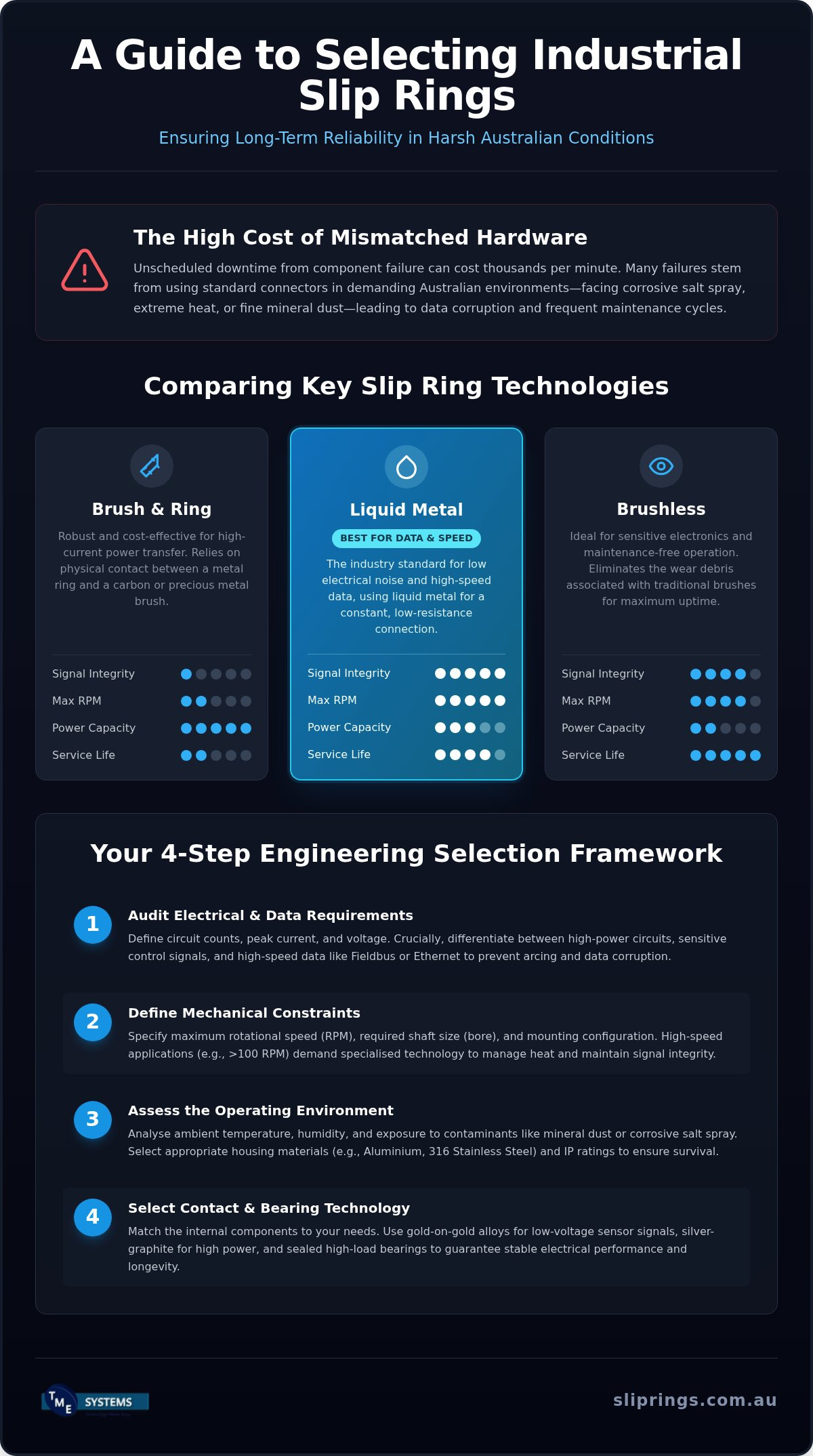
A single minute of unscheduled downtime can cost an Australian facility thousands in lost productivity; yet many of these failures stem from a fundamental mismatch between rotary hardware and its operating environment. When sourcing industrial slip rings Australia, engineers often face the frustrating trade-off between signal integrity and mechanical longevity. You likely understand that in harsh local conditions, from corrosive salt spray to extreme heat, a standard off-the-shelf connector rarely survives the long haul without causing data corruption or frequent maintenance cycles.
We've developed this guide to help you move beyond guesswork and secure long-term reliability for your rotary applications. You'll learn how to specify high-performance electrical connectors that eliminate signal noise and extend service intervals, even in the most demanding settings. We will examine the critical technical variables of liquid metal and brushless technologies, ensuring your procurement aligns with AS/NZS 3000:2018 standards while providing the clean power and data transfer your systems require. By matching specific rotary technology to your mechanical and electrical environment, you can significantly reduce the risk of component failure.
Key Takeaways
- Identify how precision rotary connectors allow for continuous 360-degree rotation while eliminating the mechanical stress of cable strain.
- Master a technical framework for specifying industrial slip rings Australia by accurately auditing circuit counts and peak current to avoid arcing.
- Compare the manufacturing philosophies of leading brands like Mercotac and BGB Innovation to determine the optimal mechanical configuration for your site.
- Utilise a step-by-step engineering selection process to define critical mechanical interfaces, including shaft size and mounting requirements.
- Understand the role of application engineering in reducing design risk and ensuring your hardware meets specific Australian industrial standards.
Understanding Industrial Slip Ring Technologies in Australia
An industrial slip ring is a precision-engineered rotary connector that facilitates the transfer of electrical power and signals from a stationary structure to a rotating one. By understanding basic slip ring technology principles, engineers can design systems that achieve continuous 360-degree rotation without the mechanical failure associated with twisted cables or strain-limited harnesses. In the context of industrial slip rings Australia, these components are critical for everything from packaging machinery and wind turbines to robotic arms and rotary tables.
Generic, off-the-shelf solutions often fall short in local applications. Australian sites frequently contend with high ambient temperatures, fine mineral dust, or corrosive coastal air. A standard connector might work in a climate-controlled laboratory, but industrial environments require a specific match between the electrical load and the contact technology used. You must distinguish between basic power transfer, sensitive control signals, and high-speed data like Ethernet, as each requires a different technical approach to prevent data loss or overheating.
The Three Main Contact Technologies
Conventional Brush and Ring systems rely on physical contact between a metal ring and a carbon or precious metal brush. They're robust and cost-effective for high-current power transfer. Brands like BGB Innovation Slip Rings excel here, offering modular designs that handle heavy-duty loads. For applications requiring extremely low electrical noise and high-speed data, liquid metal connectors are the industry standard. Mercotac Slip Rings use a pool of liquid metal to maintain a constant, low-resistance connection that doesn't degrade with speed. When maintenance-free operation is the priority, brushless technology from Meridian Laboratory Slip Rings provides a superior alternative. These units eliminate the wear debris associated with traditional brushes, making them ideal for sensitive electronics.
Key Components of a Rotary Connection
The choice of housing material determines the unit's resistance to environmental stressors. While plastic is suitable for light-duty tasks, aluminium or 316 stainless steel is necessary for wash-down areas or mining sites. Internally, the contact chemistry is equally vital. Gold-on-gold alloys provide the best performance for low-voltage sensor signals, while silver-on-graphite is better suited for high-power circuits. High-quality bearings are the backbone of any unit. If the bearings develop play, the electrical contact will become intermittent, leading to signal noise or arcing. Selecting a unit with sealed, high-load bearings ensures the electrical performance remains stable throughout its operational life in industrial slip rings Australia.
Technical Specifications for Australian Industrial Sites
Specifying the correct hardware for an Australian facility requires more than a simple audit of electrical loads. It involves a holistic assessment of how the mechanical, electrical, and environmental variables interact over thousands of operational hours. When procuring industrial slip rings Australia, your primary goal is to balance circuit density with thermal management. Overcrowding a small housing with high-current circuits without adequate spacing leads to heat build-up. This eventually causes insulation breakdown and arcing, leading to the unscheduled downtime that plagues poorly specified systems.
Rotational speed (RPM) is another critical factor often overlooked during procurement. High-speed applications generate more friction and heat, which can degrade contact surfaces and increase electrical noise. While a standard brush might suffice at 100 RPM, a high-speed application at 5,000 RPM demands specialized liquid metal or brushless technology to maintain signal integrity. You must define these mechanical constraints early in the design phase to avoid premature component wear.
Electrical and Data Requirements
Modern automation relies on high-speed data integrity. If your application involves Fieldbus or industrial Ethernet, you must manage signal-to-noise ratios aggressively. Traditional brush contacts can introduce electrical noise that corrupts data packets. You can find more detail in our technical guide to Ethernet data transfer. Beyond data, you need to calculate the relationship between peak current and heat dissipation to prevent failure. Our resource on slip ring current ratings provides a formulaic approach to this calculation. Ensuring your circuits are correctly rated prevents the overheating that leads to catastrophic connector failure.
Environmental Sealing and IP Ratings
Australia's industrial landscape presents unique challenges, from the fine red dust of the Pilbara to the high humidity of coastal Queensland. Protecting internal contacts is non-negotiable. While an IP65 rating provides protection against dust and low-pressure water jets, an IP67 rating is often necessary for equipment subject to temporary submersion or intense wash-down cycles. Note that new Workplace Exposure Limits (WELs) for airborne contaminants come into effect on 1 December 2026. Ensuring your machinery is sealed against dust emission is increasingly important for site compliance. Adhering to Australian workplace safety standards for industrial machinery is a legal necessity. This includes ensuring that your rotary connectors comply with AS/NZS 61439, which is mandatory as of 2026 for new industrial switchboard and control gear assemblies. For food processing or marine environments, 316 stainless steel housings are essential to prevent corrosion. If you are navigating these complex compliance requirements for industrial slip rings Australia, speaking with a technical consultant can ensure your selection meets all local regulatory obligations.
Comparing Leading Industrial Slip Ring Brands
Selecting the right brand for industrial slip rings Australia isn't about finding a single "best" manufacturer. It's about matching a brand’s specific engineering philosophy to your mechanical and electrical requirements. Some manufacturers specialise in high-speed data integrity, while others focus on the ruggedised transfer of high-current power. Your choice should be driven by the mechanical configuration of your machinery, such as whether you need a through-bore for a central shaft or a compact capsule for a robotic joint.
Local technical support is a critical part of this decision. While a cheaper component might reduce initial procurement costs, the total cost of ownership often tells a different story. If a unit fails and causes unscheduled downtime, the financial loss quickly exceeds any upfront savings. Manufacturer-backed warranties and Australian-based consulting provide a safety net that ensures your hardware is correctly specified for the environmental stressors we discussed earlier.
Mercotac and Meridian Laboratory: Precision and Speed
When your application demands the lowest possible electrical noise, Mercotac Slip Rings are the industry standard. Their mercury-wetted technology provides a near-constant resistance, which is essential for sensitive analog signals or high-speed digital data. If you're operating in a sector where mercury is restricted or you need a completely maintenance-free solution, Meridian Laboratory Slip Rings offer brushless ROTOCON technology. These units excel at high RPMs because they don't produce the wear debris or friction found in traditional brush systems. You should prioritise these brands when signal integrity and high-speed performance are your primary constraints.
BGB Innovation and Prosper Rotation: Power and Versatility
For heavy-duty industrial plant, BGB Innovation Slip Rings are the preferred choice. They're frequently used in wind turbines and water treatment facilities because they handle high-current loads and offer modular designs that are easy to maintain in the field. If your design requires a wide range of mounting options, Prosper Rotation Slip Rings provide versatile through-bore and capsule designs. These are particularly useful for automation and cable reel applications where the mechanical interface is complex. Choose these brands for high-current tasks like cranes or heavy machinery where physical robustness and mechanical versatility are non-negotiable for industrial slip rings Australia.
A Step-by-Step Selection Framework for Engineers
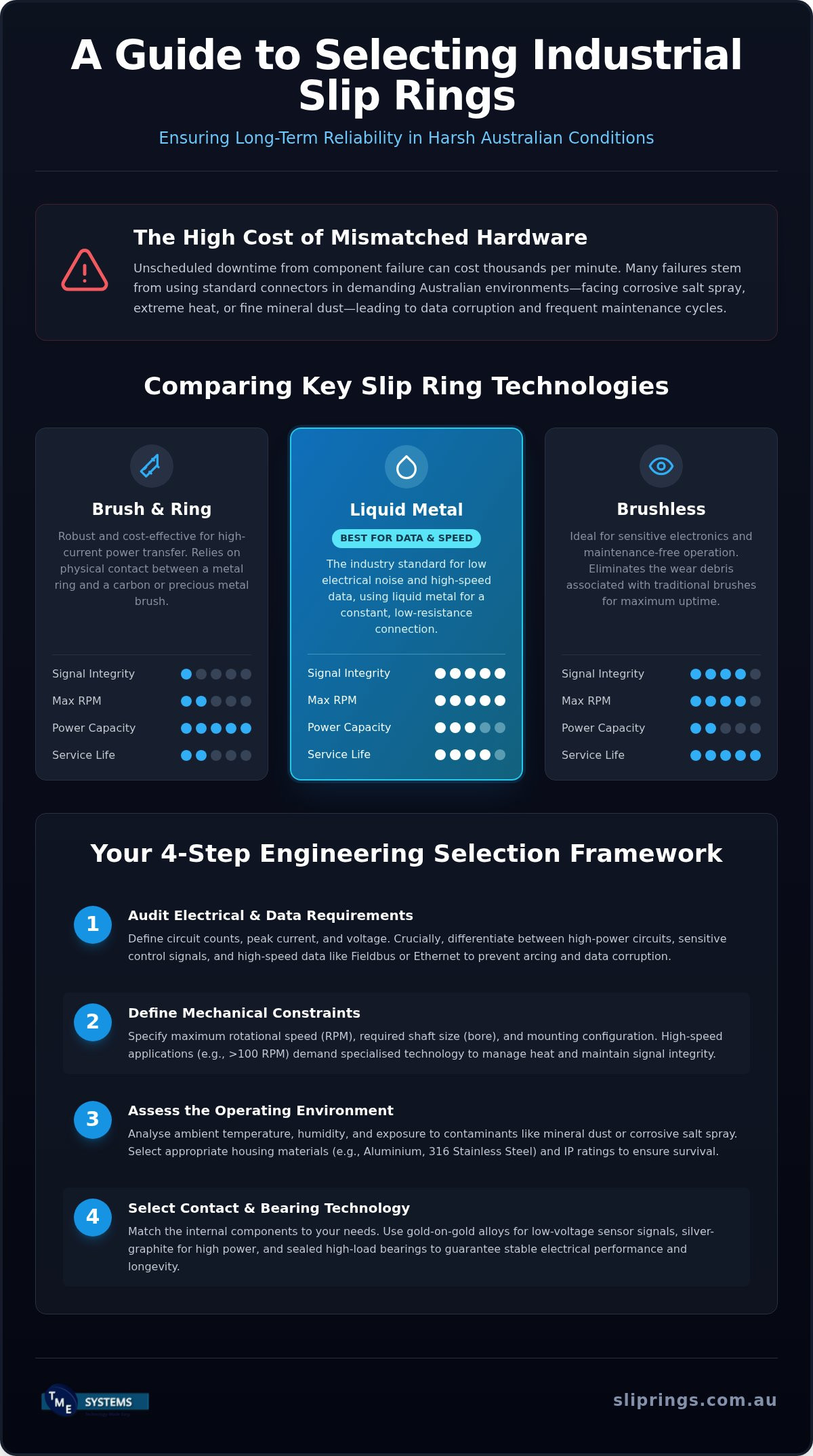
To ensure the successful procurement of industrial slip rings Australia, engineers must follow a methodical selection framework. This process moves beyond simply selecting a part number from a catalogue. It involves auditing the entire rotary system to identify potential failure points before they manifest on the factory floor. By following a structured approach, you can eliminate the guesswork that leads to signal noise or premature mechanical wear.
- Step 1: Define the mechanical interface. Determine if the application requires a through-bore for a central shaft or an end-of-shaft mounting configuration.
- Step 2: Audit the electrical load. Verify the exact number of circuits required and distinguish between peak and continuous current to prevent overheating.
- Step 3: Evaluate the data types. Identify if you are transferring sensitive analog sensor data, high-speed digital signals, or industrial Ethernet.
- Step 4: Assess the operational environment. Factor in the RPM, ambient temperature, and the specific ingress protection (IP) needs discussed earlier.
- Step 5: Review maintenance accessibility. Determine the expected service life and whether the location allows for periodic brush replacement or requires a maintenance-free brushless unit.
Mechanical Mounting and Integration
The choice between through-bore and end-of-shaft mounting significantly impacts your machine design. A through-bore design allows for the passage of hydraulic lines, pneumatic tubes, or a central drive shaft, which is often essential for complex automation. For more detailed advice on this configuration, refer to our technical guide to mounting and integration for rotating tables. You must also account for lead wire exits and anti-rotation features. If the lead wires are poorly managed or the anti-rotation tab is fixed too rigidly, the resulting mechanical stress will lead to premature bearing failure and intermittent electrical contact.
Avoiding Common Specification Pitfalls
One of the most frequent errors in procurement is overspecifying current. Engineers often apply a "bigger is better" logic, but selecting a 50A ring for a consistent 2A load can be counterproductive. Certain contact materials require a minimum current to effectively "clean" the contact surface; without this, resistance can actually increase over time. Vibration is another silent killer of reliability. If your machinery operates with high levels of harmonic vibration, standard brush contacts may bounce, causing data packets to drop. Finally, never underestimate the impact of contact resistance. In low-voltage signal circuits, even minor fluctuations in resistance can cause significant data corruption. If you need assistance refining your specifications for industrial slip rings Australia, contact our technical consulting team to review your application data.
Technical Consulting and Procurement in Australia
Procuring industrial slip rings Australia involves more than just selecting a component from a list. The value of application engineering lies in the reduction of design risk. By engaging with a specialist early, you ensure that the chosen hardware aligns with specific Australian industrial standards, such as the AS/NZS 3000:2018 wiring rules. TME Systems Pty Ltd assists in this process, preventing the mismatch of technologies that leads to signal corruption or mechanical failure in the field.
Supply chain management is equally vital for maintaining critical infrastructure. As of August 2026, standard components often show varying lead times; for example, specific 6-wire units may have local stock available for immediate dispatch, while others require a 10-day lead time from international suppliers. TME Systems Pty Ltd helps you navigate these timelines to ensure consistent supply. When a standard slip ring doesn't meet the brief, such as in high-vibration mining zones or corrosive marine environments, we facilitate custom solutions that integrate specialised housing materials and IP-rated seals.
Local Support for Global Technologies
Having an Australian-based technical point of contact is essential for complex projects. It allows you to access manufacturer data sheets and specialised CAD drawings quickly, which streamlines the integration process into your larger machine designs. Rather than dealing with overseas time zones, you get direct support from an Australian-owned proprietary company that understands local operational variables. This level of proximity is particularly beneficial during the procurement phase of large-scale infrastructure projects where technical verification is a mandatory step before purchase.
Next Steps for Your Rotation Project
To move forward with a technical assessment, you should prepare a data set that includes your required circuit count, peak current, rotational speed, and environmental conditions. Providing these specific parameters allows for a thorough audit of your needs. Whether you require a quote for specialised Mercotac liquid metal connectors or heavy-duty BGB Innovation components, a data-driven approach ensures the hardware will perform reliably over its intended service life. You can consult with TME Systems Pty Ltd on your industrial slip ring application to begin this process. We focus on providing the "correct answer" for your specific engineering challenge, ensuring your industrial slip rings Australia investment delivers long-term stability and reduced maintenance costs.
Optimising Your Industrial Rotary Strategy
Successful procurement depends on more than just basic electrical specifications. It requires a precise match between contact technology and the mechanical realities of your site. Whether you're managing high-speed data integrity with liquid metal or transferring heavy-duty power in mining environments, the decision framework we've discussed provides a clear pathway to reduced downtime. By prioritising environmental resilience and compliance with local standards, you ensure your systems remain operational under the harshest conditions.
When sourcing industrial slip rings Australia, the complexity of circuit density and RPM constraints often necessitates expert oversight. TME Systems Pty Ltd is an authorised distributor for Mercotac, Meridian Laboratory, and BGB Innovation, providing specialised technical consulting for the Australian industrial and defence sectors. We help you move from generic hardware to a verified solution that meets your specific design brief. Contact TME Systems Pty Ltd for expert technical assistance with industrial slip rings to secure the reliability your project demands. We're ready to help you solve your most complex rotation challenges.
Frequently Asked Questions
What are the main differences between mercury-wetted and brushless slip rings?
Mercury-wetted slip rings use a pool of liquid metal to maintain a constant, low-resistance connection, while brushless slip rings use proprietary contact technology to eliminate wear and maintenance. Mercury-wetted units like Mercotac offer the lowest electrical noise for sensitive signals. Brushless alternatives from Meridian Laboratory are often preferred in food processing or clean-room environments where liquid metal is restricted.
How do I choose between a through-bore and a capsule slip ring?
Choose a through-bore slip ring if your design requires a central opening for a drive shaft, hydraulic lines, or pneumatic tubing. If you're mounting to the end of a shaft or within a compact robotic joint, a capsule slip ring is the more appropriate choice. Mechanical integration is the primary driver for this decision when sourcing industrial slip rings Australia.
Can industrial slip rings handle high-speed Ethernet data transfer?
Yes, specialised slip rings can handle high-speed Ethernet and Fieldbus protocols, provided they are engineered with appropriate shielding and low-noise contacts. Standard power slip rings aren't suitable for data transfer because they generate too much electrical interference. For reliable data integrity, you must specify a unit designed for 1000Base-T or similar high-frequency standards.
What maintenance is typically required for conventional industrial slip rings?
Conventional brush slip rings require periodic cleaning to remove conductive wear debris and the eventual replacement of carbon or metal brushes. You should also inspect the ring surfaces for pitting or uneven wear. Brushless or liquid metal units significantly reduce these maintenance intervals, though they still require occasional checks of the mounting and bearing stability.
Are there mercury-free alternatives for applications in the food and beverage industry?
Mercury-free alternatives are readily available for the food and beverage industry, including brushless ROTOCON technology and high-performance gold-on-gold brush systems. These designs eliminate the risk of mercury contamination while providing the reliability needed for high-speed packaging lines. Our technical consultants often recommend stainless steel housings for these wash-down environments.
How does rotational speed (RPM) affect the lifespan of a slip ring?
Rotational speed directly impacts the mechanical wear rate of the brushes and the thermal load on the bearings. As RPM increases, friction generates more heat, which can degrade the contact surfaces and lead to higher electrical resistance. When specifying industrial slip rings Australia for high-speed tasks, you must ensure the unit's maximum RPM rating exceeds your operational peak.
What IP rating is recommended for outdoor industrial use in Australia?
For outdoor industrial use in Australia, an IP65 rating is the minimum requirement to protect against dust ingress and low-pressure water jets. If the equipment is located in coastal areas or subject to heavy wash-downs, an IP67 rating with a stainless steel housing is recommended. This prevents internal corrosion from salt spray and humidity.
Can slip rings be customised for high-voltage or high-current requirements?
Customisation is common for high-voltage or high-current requirements, allowing for increased insulation spacing and larger contact surfaces. Brands like BGB Innovation provide modular designs that can be scaled to handle hundreds of Amps or kilovolt-level potentials. These specialised configurations ensure safe operation in demanding sectors like mining, power generation, and heavy lifting.