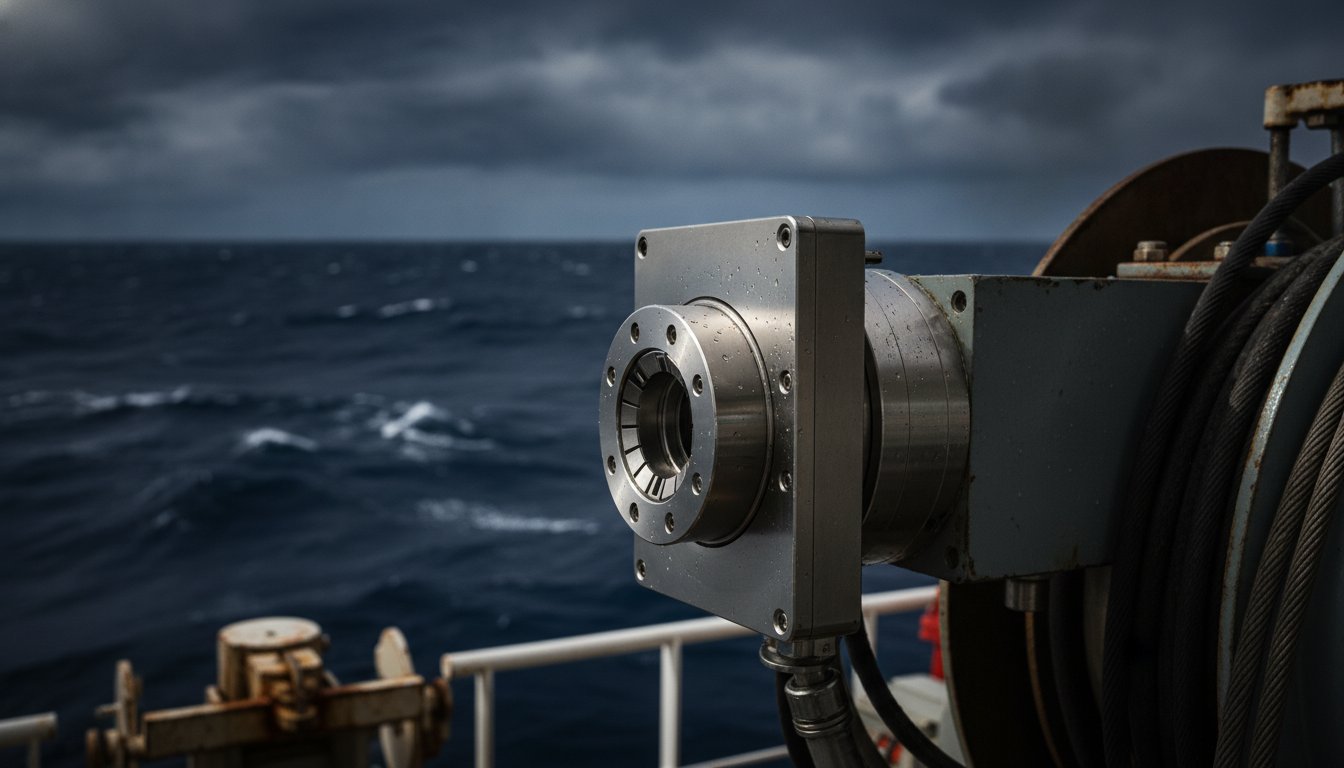
If you're relying solely on an IP68 rating to protect your offshore assets, you're likely overlooking the metallurgical factors that actually determine long-term survival in the Bass Strait or the North West Shelf. Most engineers recognise the frustration of pulling a winch or sonar turret apart only to find saltwater corrosion has turned a precision component into a seized mess. High maintenance costs and unexpected downtime are often accepted as part of the job, but these failures usually stem from specifying the wrong slip ring for marine application during the design or procurement phase.
We understand that signal noise disrupting sensitive sonar or data feeds can be just as damaging as mechanical failure. This guide will help you master the technical requirements for specifying marine-grade hardware that can achieve a 10+ year service life, even under the new 2026 SOLAS regulations for lifting appliances. You'll learn the critical trade-offs between IP67 and IP68 sealing, the necessity of 316 stainless steel, and how to identify a reliable Australian supplier for local technical support. We'll also explore why brushless technology is now the preferred choice for maintaining data integrity in high-vibration maritime environments.
Key Takeaways
- Learn how to specify a slip ring for marine application that balances high-speed data transmission with the rigorous sealing requirements of IP68 environments.
- Understand the critical role of 316 Stainless Steel and contact metallurgy in achieving a 10-year service life within corrosive offshore conditions.
- Identify the specific mechanical tolerances required to withstand the constant vibration and wave action experienced by deck machinery and propulsion systems.
- Discover how the 2026 SOLAS regulations impact the technical specifications for rotary connectors used in lifting appliances and anchor handling winches.
- Access a structured framework for evaluating electrical loads and environmental variables to ensure long-term reliability and lower asset maintenance costs.
The Unique Challenges of a Slip Ring for Marine Application
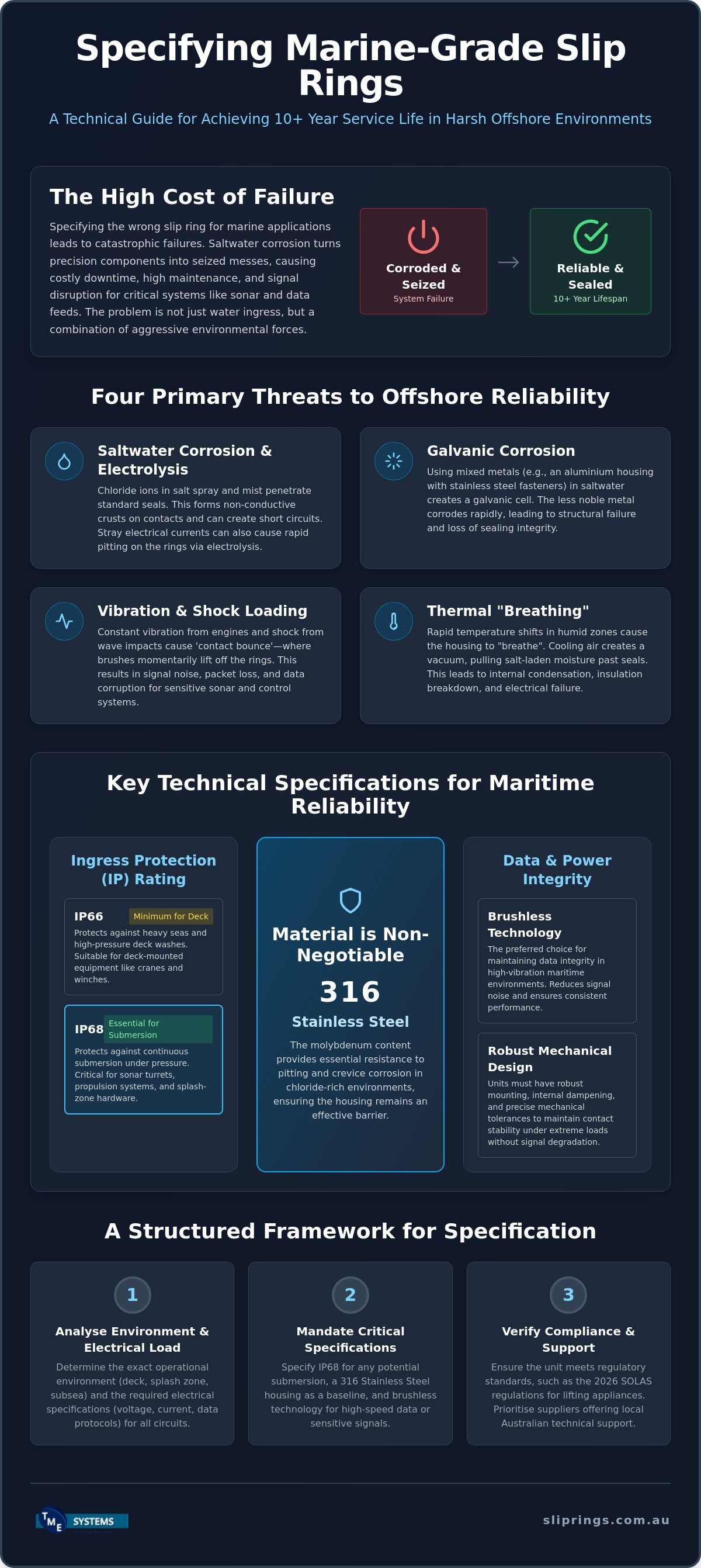
The maritime environment is arguably the most demanding setting for electromechanical hardware. A Slip ring used in these conditions must perform reliably while being attacked by aggressive chemical and mechanical forces. Unlike land-based industrial settings, the atmosphere on a vessel or offshore platform is saturated with chloride ions. These ions penetrate even the smallest gaps in a housing, initiating a cycle of corrosion that can seize bearings and degrade conductive paths within months if the unit isn't specifically designed for the task.
Galvanic corrosion is a primary concern that many general-purpose guides overlook. When a slip ring for marine application uses a mix of metals, such as an aluminium alloy housing with stainless steel fasteners, the presence of saltwater creates a galvanic cell. The less noble metal will sacrifice itself, leading to structural failure or a loss of sealing integrity. Engineers must specify housings where the potential difference between adjacent metals is minimised. This is why multi-metal rotary assemblies require careful material selection and, in some cases, sacrificial anodes to protect critical internal components.
Thermal expansion and contraction also play a significant role in offshore reliability. In high-humidity zones, rapid temperature shifts can cause the housing to "breathe." As the internal air cools, it creates a vacuum that can pull salt-laden moisture past standard seals. If this moisture condenses inside the unit, it leads to internal fogging, insulation breakdown, and eventual electrical failure. Managing these atmospheric transitions requires specialised sealing techniques that go beyond basic industrial standards.
Saltwater Corrosion and Electrolysis
Salt spray degrades standard contact materials by forming non-conductive crusts or creating unintended conductive paths that lead to short circuits. Electrolysis is another risk. Shipboard electrical systems often have minor stray currents that, in a rotating assembly, can cause rapid pitting on the rings. Using 316 Stainless Steel is the baseline for any serious marine housing. Its molybdenum content provides the necessary resistance to pitting and crevice corrosion in chloride-rich environments, ensuring the housing remains an effective barrier for the life of the asset.
Vibration and Shock Loading
Vibration from primary propulsion engines and auxiliary generators creates constant mechanical stress on every connection. In heavy sea states, shock loading from wave impact adds further strain. These forces can cause "contact bounce," where the brush momentarily lifts off the ring. For sensitive data feeds or sonar signals, this results in packet loss or signal noise. Robust mounting and internal dampening are essential to maintain signal integrity. BGB Innovation slip rings are frequently selected for these applications because they are engineered to maintain contact stability under extreme mechanical loads without degrading the signal.
Technical Specifications for Maritime Reliability
A marine slip ring is a rotary connector specifically sealed and housed to maintain electrical continuity in maritime environments. Unlike standard industrial units, these components must manage the transition of power and data across a rotating interface while completely excluding salt-laden air and pressurised water. The technical integrity of this interface is documented in various IEEE studies, which highlight that the efficiency of rotary transfer is directly linked to the stability of the contact surface and the exclusion of environmental contaminants.
Specifying the correct slip ring for marine application requires a move beyond basic "water-resistant" labels. Engineers must evaluate the unit based on its ability to maintain a constant contact resistance under thermal stress and mechanical vibration. This involves selecting a housing that can withstand external pressure without deforming, which would otherwise compromise the internal alignment of the rings and brushes.
Understanding IP Ratings for Marine Use
The distinction between "water-resistant" and "submersible" is defined by Ingress Protection (IP) ratings. For deck-mounted equipment like cranes or winches, IP66 is often sufficient to protect against heavy seas and high-pressure deck washes. However, equipment located in splash zones or areas prone to temporary flooding requires IP67, which ensures protection during immersion up to one metre for 30 minutes. When an application involves permanent submersion or deep-sea operation, IP68 is mandatory. It's vital to note that IP68 ratings are manufacturer-specific regarding depth and duration; a unit rated for 3 metres is not necessarily suitable for 30 metres. Achieving these ratings in a rotating assembly relies on high-grade dynamic seals, such as Viton O-rings or specialised lip seals, which maintain a barrier even as the shaft turns.
Contact Metallurgy and Signal Noise
The choice of contact material determines the unit's electrical performance and maintenance interval. Gold-on-gold contacts are the industry standard for sensitive data, such as sonar feeds or high-definition video, because they provide extremely low electrical noise and high corrosion resistance. For high-power applications, such as winch motors or propulsion systems, silver-graphite brushes are often preferred due to their ability to handle higher current densities and their self-lubricating properties. In zones where maintenance access is restricted, the brushless technology found in Meridian Laboratory slip rings offers a significant advantage. These units utilise a liquid metal film to provide a consistent, low-noise connection with virtually zero wear, effectively eliminating the need for periodic brush replacements. If you are unsure which contact technology suits your duty cycle, requesting a technical consultation can help clarify the trade-offs between brushed and brushless configurations.
Common Marine and Offshore Applications
Slip rings are the silent workhorses of the maritime industry, enabling 360-degree rotation across a vast array of hardware. Whether it's a crane on a Darwin wharf or a tidal turbine in the Bass Strait, the choice of a slip ring for marine application depends entirely on the specific operational environment and duty cycle. These components facilitate the seamless transfer of power, data, and sometimes hydraulic fluids while the host machine is in constant motion, ensuring that rotating systems don't become limited by cable tangling or signal loss.
Winches and Cable Reels
Deck machinery faces the most direct exposure to salt spray and UV radiation. Winches and cable reels often require complex umbilical cables that combine high-voltage power with fibre optic or Ethernet signals. Under the 2026 SOLAS Regulation II-1/3-13, new requirements for the design and testing of anchor handling winches make the selection of certified rotary components even more critical. For these heavy-duty power transfers, engineers often evaluate the use of collector rings versus integrated slip ring assemblies. While collector rings are robust for high-current power, modern marine winches usually demand the integrated shielding of a slip ring to prevent electromagnetic interference from disrupting sensitive data feeds.
Vessel propulsion systems also rely heavily on rotary connectors. Azimuth thrusters and pod propulsion units require massive rotary joints to transfer power to the propeller while allowing the entire unit to rotate for steering. These systems require extreme reliability, as a failure in the slip ring can lead to a loss of manoeuvring capability. Many established manufacturers, including Moog Marine Slip Rings, provide specialised solutions for these high-torque, high-current environments where downtime is measured in thousands of dollars per hour.
ROVs and Subsea Exploration
Subsea applications introduce the challenge of hydrostatic pressure. Remotely Operated Vehicles (ROVs) use slip rings in their tether management systems (TMS) to ensure the umbilical doesn't tangle during deployment. These units are often oil-filled and pressure-compensated to prevent the housing from collapsing at depth. As ROV technology advances, there's a growing need for miniature designs that can handle 4K video feeds and multibeam sonar data without signal degradation or packet loss. These compact units must maintain high-speed data transmission while being small enough to fit within the restricted footprints of underwater robotics.
The emerging sector of marine renewables, particularly tidal turbines and floating solar arrays, presents a unique "fit and forget" challenge. These installations are often in remote, high-energy locations where maintenance is difficult and expensive. A slip ring for marine application in a tidal turbine must withstand constant subsea motion for years without servicing. This makes the choice of contact metallurgy and sealing technology critical for the long-term financial viability of the project, as any failure requires specialised vessels and divers to rectify.
Selection Framework: Specifying the Right Marine Slip Ring
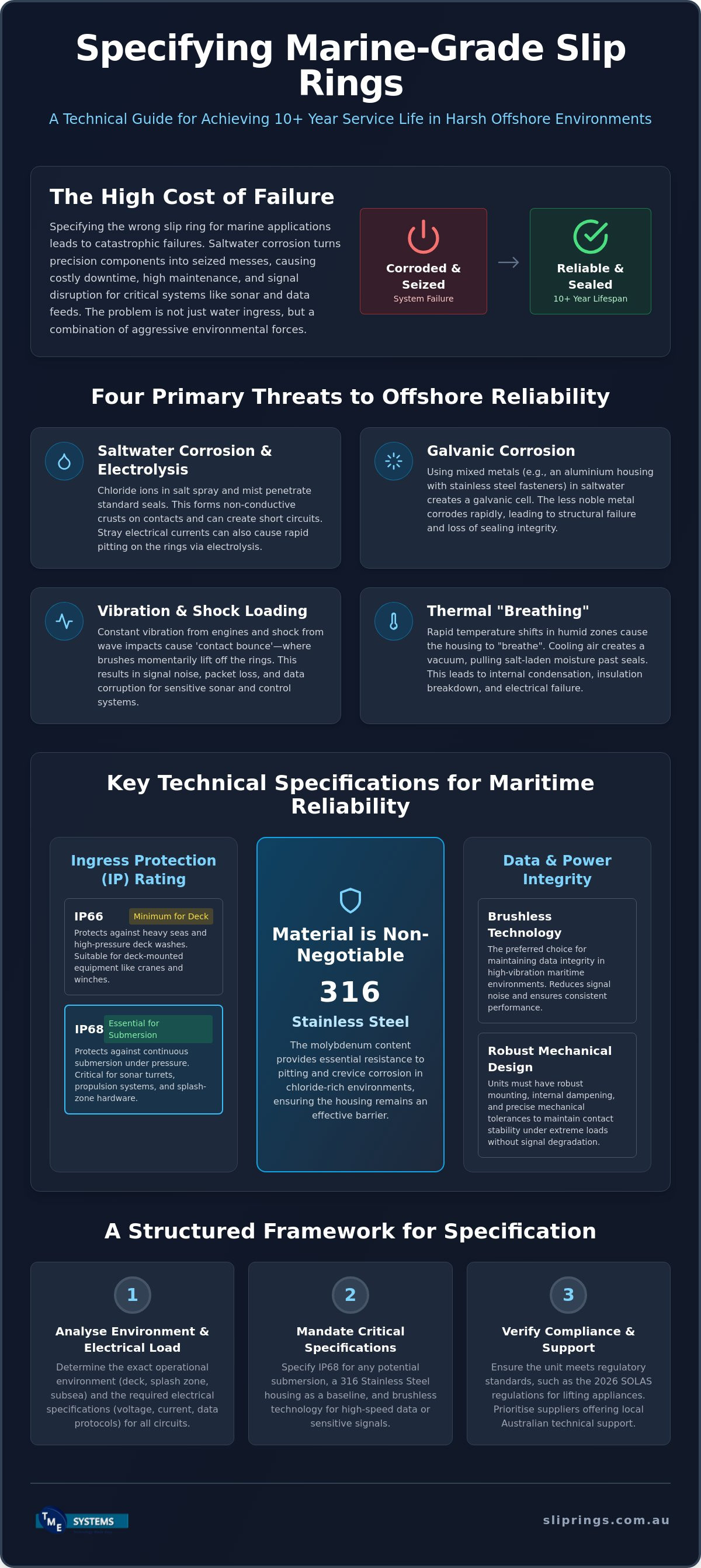
Selecting a slip ring for marine application requires a methodical audit of both the electrical requirements and the physical environment. A failure to account for one parameter often compromises the entire assembly. For instance, a unit with perfect electrical shielding will still fail if the housing material initiates galvanic corrosion when mounted to a different metal on a ship's deck. Engineers should follow a structured five-step framework to ensure long-term reliability.
- Step 1: Electrical Load Audit. Define the number of circuits, maximum voltage, and current per circuit. Distinguish between power lines and sensitive data signals.
- Step 2: Environmental Zoning. Identify if the unit will be deck-mounted (UV and spray), in a splash zone (periodic immersion), or fully submerged (constant pressure).
- Step 3: Mechanical Constraints. Determine the operating RPM, required through-bore size for hydraulic or pneumatic lines, and the available mounting footprint.
- Step 4: Lifecycle Planning. Evaluate the expected service life and whether the installation allows for periodic brush maintenance or requires a brushless, maintenance-free design.
- Step 5: Material Specification. Select housing and contact materials that resist the specific chemical and mechanical stressors of the target zone.
Electrical and Data Requirements
Modern vessels are dense electromagnetic environments. Mixing high-power circuits with low-voltage data in a single assembly requires internal shielding to prevent electromagnetic interference (EMI). When specifying units for ROVs or long umbilical runs, voltage drop becomes a critical factor. Engineers must ensure the contact resistance remains stable over millions of revolutions to prevent signal attenuation. For projects requiring high-speed data integrity across many circuits, Prosper Rotation slip rings provide specialised configurations that maintain low electrical noise in compact footprints.
Housing and Sealing Selection
While anodised aluminium is lightweight and cost-effective for internal cabins, 316 Stainless Steel is the mandatory standard for external marine housings. The molybdenum content in 316 SS provides essential resistance to pitting in chloride-rich environments. A common failure point in marine specifications is the oversight of galvanic corrosion. If a stainless steel slip ring is bolted directly to an aluminium deck without isolation, the deck will corrode rapidly. Sealing is equally vital; Viton seals are preferred for their superior chemical resistance and ability to maintain a tight barrier across a wide temperature range. For subsea units, pressure-compensated housings are used to equalise internal and external pressure, preventing seal collapse at depth. If you're designing for a permanent offshore installation, consulting with a technical specialist can help you navigate these material trade-offs effectively.
Procuring Marine-Grade Slip Rings in Australia
Procuring a slip ring for marine application within the Australian market requires more than just browsing a catalogue. Given the geographical isolation and the specific environmental rigours of the Southern Ocean and tropical northern waters, local technical consulting is essential. Engaging with TME Systems Pty Ltd ensures that your project benefits from real-time technical support and a deep understanding of local maritime safety standards. This consultative approach, often referred to as slip ring application engineering, ensures that every electrical and mechanical parameter is verified before procurement, reducing the risk of costly offshore integration errors.
For heavy-duty applications such as deck winches or large-scale propulsion systems, BGB Innovation slip rings are frequently the preferred choice. These units are engineered specifically for harsh environments where high current loads and constant rotation are the baseline. Conversely, for compact equipment like sonar turrets or small-scale sensors, Mercotac slip rings provide a low-noise, liquid-metal connection that maintains signal integrity without the footprint of a traditional brushed assembly. This variety allows engineers to match the technology to the specific duty cycle of the vessel.
BGB Innovation: The Maritime Standard
BGB Innovation has established itself as the maritime standard through decades of performance in the offshore wind and commercial shipping sectors. Their designs are highly customisable, allowing for the integration of fibre optic rotary joints (FORJs) alongside high-power circuits. This is particularly beneficial for offshore cranes where both motor power and high-definition sensor data must pass through a single rotating axis. These units are designed to be serviceable, which is a critical consideration for assets with a 20-year planned lifespan. You can find more detail on these specific configurations in our BGB Innovation Australia pillar article.
Prosper Rotation and Custom Solutions
When a project falls outside the standard specifications of off-the-shelf hardware, Prosper Rotation slip rings offer the versatility needed for diverse marine tasks. Whether you're designing a bespoke tether management system for an ROV or a rotary joint for an experimental tidal array, these units can be tailored to meet precise through-bore and circuit requirements. Local engineering support from TME Systems Pty Ltd facilitates this customisation process, ensuring that the final slip ring for marine application complies with Australian safety regulations and operational expectations. This level of specialised support is what differentiates a simple vendor from a technical partner in the maritime sector.
Future-Proofing Your Maritime Rotary Systems
Specifying a slip ring for marine application requires a holistic view that combines sealing integrity, contact metallurgy, and a clear understanding of the mechanical rigours of the Australian coast. We've established that relying on IP ratings alone is insufficient; true reliability comes from the interplay of 316 stainless steel housings and specialised contact technologies. Whether you're upgrading deck machinery to meet the 2026 SOLAS standards or designing new subsea assets, the goal remains the same: achieving a decade of service life with minimal maintenance intervention.
As an authorised Australian distributor for BGB Innovation and Meridian Laboratory, TME Systems Pty Ltd provides the technical engineering support necessary to navigate these complex specifications. We offer national delivery across Australia and a pragmatic approach to solving engineering challenges in harsh environments. Our role is to act as the technical intermediary, ensuring that your rotary systems perform exactly as intended from the first revolution to the last.
Consult with our Marine Slip Ring Experts to verify your technical requirements and secure a robust solution for your next maritime project. We're committed to the technical success of your offshore and shipboard installations.
Frequently Asked Questions
What is the minimum IP rating for a slip ring used on a ship deck?
IP66 is the standard minimum for deck machinery to protect against heavy seas and powerful water jets used during deck washes. For areas with frequent splash or partial flooding, upgrading to IP67 is recommended to ensure internal electronics remain dry during temporary immersion. This level of protection is vital for crane swivels and winches that face direct exposure to the elements on an open vessel deck.
Can I use a standard industrial slip ring in a marine environment?
No, standard industrial units will likely fail within months due to chloride-induced corrosion and galvanic reactions. Marine environments require 316 stainless steel housings and specialised dynamic seals to exclude salt-laden air. A slip ring for marine application is specifically engineered with metallurgy and sealing that standard factory-grade components lack, ensuring the internal conductive paths remain isolated from the aggressive maritime atmosphere.
How do I prevent signal noise in a marine slip ring?
Signal noise is best managed by using precious metal contacts, such as gold-on-gold, and ensuring the assembly is properly shielded against electromagnetic interference (EMI). Maintaining high contact pressure and using low-friction materials reduces the electrical resistance variations that cause noise. For high-definition data, using a brushless design or high-grade shielding is essential to maintain signal integrity in high-vibration zones found on most commercial vessels.
Are brushless slip rings better for marine applications?
Brushless slip rings are superior for data-heavy or maintenance-restricted zones because they eliminate the wear and debris associated with traditional carbon brushes. They provide a more stable electrical connection with near-zero signal noise, making them ideal for sonar and 4K video feeds. While they offer a longer service life, traditional brushed units may still be preferred for very high-current power transfer applications in heavy-duty deck machinery.
What housing material is best for preventing saltwater corrosion?
316 Stainless Steel is the premier choice for preventing saltwater corrosion due to its molybdenum content, which resists pitting and crevice corrosion. While anodised aluminium is lighter, it's susceptible to galvanic attack if not properly isolated from other metals. For submerged applications, 316 stainless steel provides the structural integrity and chemical resistance required for a 10-year service life in the harsh conditions of the Southern Ocean.
Can marine slip rings handle high-voltage power for propulsion?
Yes, marine-grade slip rings can be engineered to handle high-voltage and high-current loads required for azimuth thrusters and pod propulsion systems. These units often feature large-diameter rings and specialised silver-graphite brushes to manage heat and current density effectively. They are typically housed in robust, oil-filled or air-insulated enclosures to prevent arcing and ensure reliable operation during the constant rotation required for vessel manoeuvring.
How often do marine-grade slip rings require maintenance?
Maintenance intervals depend on the contact technology and the duty cycle; however, brushed units typically require inspection every 12 to 24 months. During these checks, technicians must remove carbon dust and verify brush wear limits to prevent arcing or signal degradation. Brushless or liquid-metal units are often marketed as maintenance-free, significantly reducing the long-term labour costs and downtime associated with the management of offshore assets.
What is the difference between IP67 and IP68 for underwater slip rings?
IP67 provides protection against temporary immersion up to one metre for 30 minutes, whereas IP68 is rated for continuous submersion at specified depths. For any slip ring for marine application that will be permanently underwater or attached to an ROV, IP68 is the mandatory specification. You must verify the manufacturer's depth rating, as IP68 requirements vary depending on the intended operational depth and pressure of the equipment.