Selecting a slip ring based solely on circuit count is a common mistake that often leads to catastrophic system failure in heavy industrial applications. You likely understand the frustration of unscheduled downtime caused by rapid brush wear or the signal noise that corrupts critical data when using an unsuitable slip ring for rotating equipment. In the harsh dust of a remote mine or the corrosive salt air of an Australian coastal facility, standard components often fall short of their rated service life. It's a costly reality that forces maintenance teams into a cycle of reactive repairs rather than planned optimisation.
This guide provides the technical framework to master the selection process, ensuring you achieve low electrical resistance and high RPM stability. We'll examine the critical variables of material science, environmental sealing, and specialised liquid metal technologies to help you specify a solution that maintains integrity over millions of revolutions. By the end of this article, you'll be able to identify the exact specifications required to ensure long-term reliability in specialised Australian industrial conditions.
Key Takeaways
- Understand how a specialised slip ring for rotating equipment facilitates continuous 360-degree power and signal transfer while eliminating the risk of cable fatigue.
- Learn to calculate necessary electrical headroom for voltage and current to ensure operational safety and hardware longevity in high-demand industrial environments.
- Discover how advanced contact materials, such as liquid metal and gold-on-gold interfaces, effectively mitigate electrical noise for clear data transmission.
- Identify the critical environmental sealing requirements needed to protect rotary connectors against the unique challenges of Australian mining and automation sites.
- Master a systematic two-step audit process to align your mechanical constraints, such as RPM and through-bore size, with your specific electrical load requirements.
The Role of Slip Rings in Rotating Equipment
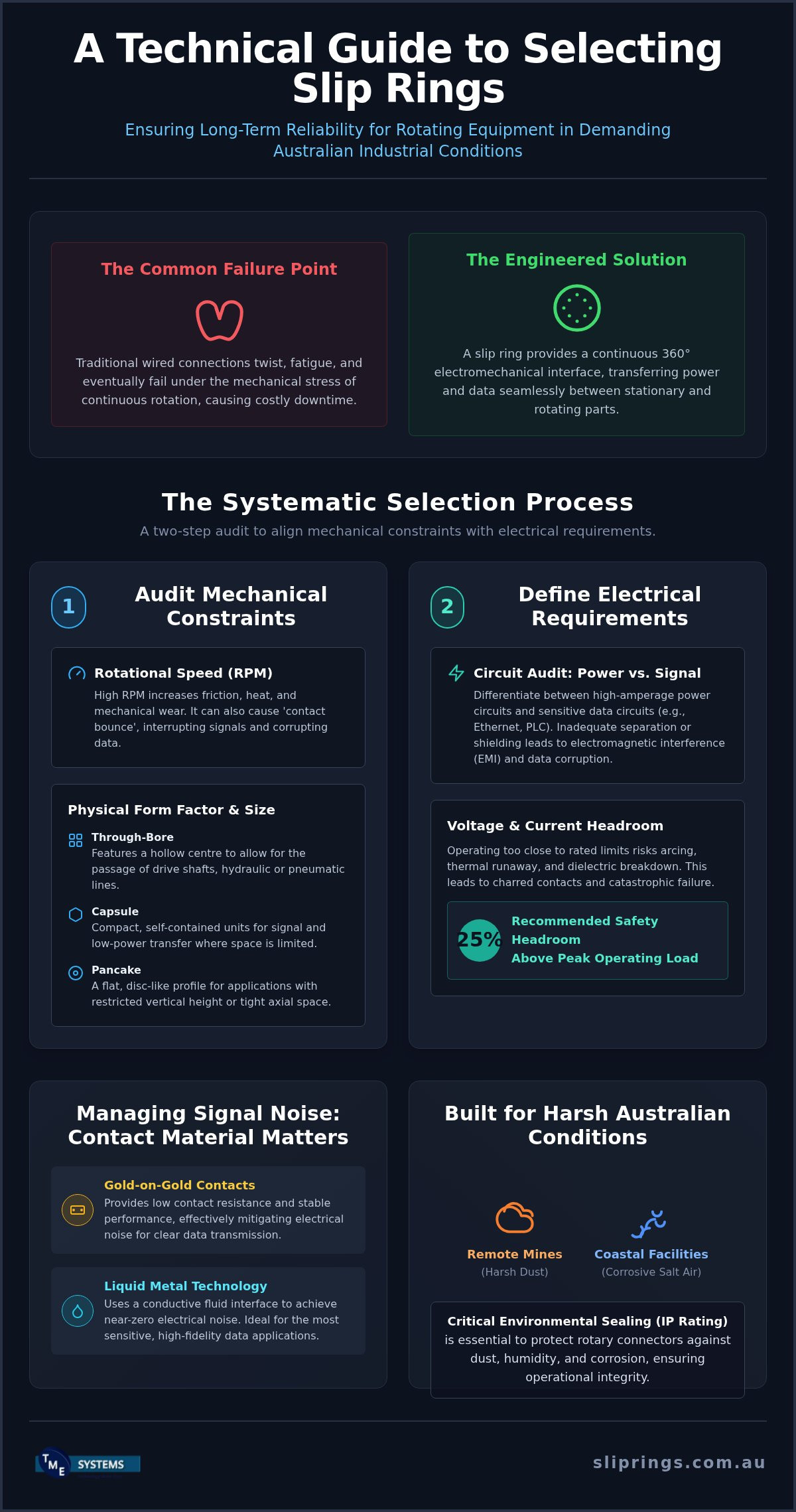
A Slip ring serves as a specialised electromechanical interface designed to maintain an electrical connection between a stationary source and a component that rotates indefinitely. Within industrial machinery, this is the standard method for transferring power and data across a rotating joint. Unlike a simple swivel that might only allow a few degrees of movement, a slip ring for rotating equipment enables 360-degree continuous rotation without the risk of mechanical binding or electrical interruption. It's the hidden component that makes modern automation and heavy machinery possible.
The hardware comprises two primary components: the stator, which remains fixed to the stationary structure, and the rotor, which turns with the equipment. Traditional wired connections are unsuitable for continuous motion because they succumb to cable fatigue. As the equipment turns, cables twist and eventually fail under mechanical stress. A slip ring for rotating equipment eliminates this failure point by using sliding contacts or conductive fluids to bridge the gap, ensuring seamless operation without the tangles that plague simpler setups.
Continuous Rotation Electrical Connectors
While some applications use limited-angle swivels for small ranges of motion, heavy industrial systems require continuous rotation electrical connectors. These components improve machine lifespan by removing the primary cause of electrical failure in moving parts. Mechanical stability is vital in high-RPM equipment. Any vibration or eccentricity leads to contact bounce and signal loss. Reliable connectors ensure that even at high speeds, the electrical path remains consistent and the equipment stays operational without frequent intervention.
Types of Rotary Electrical Interfaces
Selection is usually dictated by the physical configuration of the machinery and the available centre-space. Capsule slip rings are compact, self-contained units used for signal and low-power transfer where space is limited. Through-bore models feature a hollow centre, allowing for the passage of drive shafts or pneumatic lines. Pancake slip rings provide a flat, disc-like profile for applications with restricted vertical height. For systems requiring superior signal integrity, liquid metal rotary connectors offer a conductive fluid interface. These provide near-zero electrical noise, making them ideal for sensitive data transmission in modern automation.
Key Technical Specifications for Rotary Electrical Connectors
Technical specifications define the operational window of any slip ring for rotating equipment. A thorough audit begins with the circuit count. You must differentiate between power circuits, which carry high amperage, and signal circuits designed for sensitive data like Ethernet or PLC communications. Mixing these without adequate physical separation or shielding leads to electromagnetic interference. Contact resistance is the most critical metric for long-term performance. High resistance generates localised heat and degrades signal clarity, which eventually leads to system errors or hardware fatigue.
Voltage and Current Considerations
Voltage ratings determine the insulation requirements between the rings and the housing. Operating too close to the rated limit risks dielectric breakdown, especially in humid or dusty Australian conditions. High current circuits require substantial contact surfaces to prevent arcing and thermal runaway. We recommend specifying a headroom of at least 25% above your peak operating load to ensure industrial safety. Underspecifying these parameters often results in charred contacts and unscheduled downtime. Engaging in technical consulting early in the design phase helps avoid these common procurement errors.
RPM and Mechanical Life Cycles
Rotational speed dictates the rate of mechanical wear and heat generation. Traditional carbon or copper brushes have finite RPM limits before friction causes rapid degradation. Centrifugal forces at high speeds can also cause contact bounce, which interrupts the electrical path. This challenge is well-documented in research, including a NASA slip ring case study that examines how signal integrity and CRC errors are affected by contact stability and lubrication.
For applications requiring high-speed rotation without the maintenance burden, Meridian Laboratory slip rings offer a significant advantage. These units utilise brushless designs that maintain a constant, low-resistance connection regardless of speed. Certain liquid metal interfaces provide a maintenance-free alternative to sliding contacts. By replacing mechanical brushes with a conductive fluid, these systems eliminate the dust and friction that typically limit the lifespan of rotary electrical connectors. This transition to fluid-based conduction ensures that signal integrity remains high even in demanding high-RPM environments.
Managing Signal Noise and Environmental Resilience
Electrical noise, or interference, represents the most significant hurdle for maintaining data integrity in modern rotary systems. In a slip ring for rotating equipment, noise is typically generated by the mechanical friction of brushes against the rings or by electromagnetic interference (EMI) from adjacent power lines. This interference disrupts sensitive data signals like Ethernet and PLC communications, which leads to corrupted data packets or system logic errors. To mitigate this, you must prioritise contact materials. Gold-on-gold interfaces provide excellent conductivity and corrosion resistance for low-voltage signals. For even higher precision, liquid metal connectors use a conductive fluid to bridge the stationary and rotating components, offering a near-zero noise profile that traditional mechanical contacts can't match.
Effective shielding is equally vital to prevent cross-talk between high-amperage power circuits and low-voltage signal lines. By using internal physical barriers and shielded cables, you ensure that the electromagnetic fields generated by power transmission don't bleed into data channels. This separation is a fundamental requirement for any slip ring for rotating equipment that combines motor power with high-speed control signals.
Reducing Signal Noise in Rotary Connections
Achieving reliable data transfer requires a methodical approach to system design. Use this checklist for signal noise reduction to verify your current or planned setup:
- Select liquid metal or mercury-wetted contacts for high-speed data transmission.
- Ensure all signal cables are twisted pairs with individual shielding.
- Verify that the slip ring housing provides 360-degree electromagnetic protection.
- Maintain consistent contact pressure to avoid signal "chatter" during vibration.
Grounding is another critical factor that's often overlooked. Without a dedicated grounding path, the rotating structure can accumulate stray voltages that manifest as signal noise. A well-grounded system drains this interference, protecting the integrity of your control logic and sensitive electronics.
Environmental Protection and Sealing
Australian industrial operations present harsh conditions, from the fine dust of remote mining sites to the high humidity and salt spray of coastal facilities. Standard enclosures often fail when fine particulates penetrate the housing and contaminate the contact surfaces. For these environments, IP65 or IP67 ratings are mandatory. While standard units might suffice for indoor automation, heavy-duty applications require hermetically sealed units to prevent the ingress of moisture or dust. BGB Innovation slip rings are specifically engineered for these high-stakes environments. They provide the mechanical resilience needed for outdoor machinery, marine winches, and wind energy infrastructure where maintenance access is difficult and downtime is costly.
Industrial Applications Across the Australian Landscape
Australia's industrial diversity demands a versatile approach when specifying a slip ring for rotating equipment. From the high-amperage requirements of bulk material handling to the low-noise data needs of advanced robotics, the mechanical and electrical variables shift significantly based on the sector. While a standard connector might operate reliably in a controlled warehouse, it would likely fail within days in the abrasive dust or high-vibration environments typical of heavy Australian industry. Aligning the hardware with the specific operational context is essential for maintaining machine uptime.
Heavy Industry and Mining
In large-scale material handling, collector rings must facilitate massive current transfer while resisting the ingress of fine particulates. Equipment such as stacker-reclaimers and large excavators relies on these components for continuous 24/7 duty cycles. In hazardous processing zones, explosion-proof ratings are a mandatory safety requirement to ensure compliance with Australian industrial standards. BGB Innovation provides the heavy-duty rotation support necessary for these environments, offering the mechanical resilience to withstand the extreme duty cycles of the resources sector.
The renewable energy sector also represents a significant application for this technology. Wind turbines, which accounted for approximately 24.8% of the global market demand in 2025, rely on specialised connectors for pitch control and power transmission from the rotating blades. These units must be engineered for long-term reliability in high-altitude environments where maintenance access is difficult and costly, making the choice of contact material a critical factor in the turbine's overall efficiency.
Precision Engineering and Robotics
Automation and defence applications prioritise signal integrity and compact integration. Radar systems and high-speed surveillance equipment require the transmission of high-frequency signals without data loss or degradation. In the packaging and manufacturing sectors, robotic arms require compact, low-torque connectors that do not impede precise mechanical movements or introduce drag into the system.
For these versatile mounting needs, Prosper Rotation slip rings offer a modular solution that allows engineers to combine electrical circuits and fluid rotary unions in a single assembly. This modularity is particularly useful for complex robotic end-effectors that require both power and pneumatic control. If you are designing a system for a specific industrial application, we recommend seeking technical application consulting to ensure your hardware choice aligns with the intended mechanical constraints, duty cycle, and environmental variables.
Selecting the Right Slip Ring for Your Operation
Specifying a slip ring for rotating equipment requires a methodical audit of both electrical and mechanical parameters. Rushing the procurement process often leads to components that meet the circuit count but fail under environmental stress or high-speed operation. To ensure system reliability, we recommend following a structured selection framework that prioritises long-term performance over initial purchase price. A well-planned audit reduces the risk of premature failure and unscheduled maintenance cycles.
- Electrical Audit: Define the peak current (Amps) and operating voltage for every circuit. Identify sensitive signal types, such as Ethernet or thermocouple data, which require specific shielding or contact materials to maintain integrity.
- Mechanical Constraints: Determine the maximum operating RPM and the required mounting configuration. If the unit must fit over an existing drive shaft, specify the exact through-bore diameter needed to ensure a precise fit.
- Environmental Evaluation: Assess the presence of moisture, fine particulates, and vibration. Select an IP rating, such as IP65 or IP67, that matches the severity of the Australian industrial environment where the equipment will reside.
- Lifecycle Cost Analysis: Review the predicted maintenance interval. A lower-cost brush-based unit might incur significant labour and downtime costs compared to a maintenance-free liquid metal alternative.
The Value of Technical Consulting
Off-the-shelf solutions frequently fail in specialised applications because they aren't designed for the specific duty cycles of heavy industrial machinery. Technical data sheets provide the baseline, but they don't always account for the cumulative effect of high vibration and temperature fluctuations. Engaging with a specialised distributor allows you to verify compatibility before finalising procurement. TME Systems assists with slip ring application engineering, ensuring that every component is matched to the physical and functional realities of your project.
Mercotac and Liquid Metal Technology
For high-performance needs where signal noise and maintenance downtime are unacceptable, Mercotac slip rings provide a superior alternative to traditional brush-based systems. These units utilise liquid metal technology to create a brushless interface. This design offers a distinct advantage: there are no brushes to wear out, no carbon dust to clean, and near-zero electrical noise. It's a pragmatic choice for engineers who value stability and precision in their rotating systems. If you're ready to optimise your machinery's performance, contact TME Systems for a technical consultation to discuss your specific requirements.
Optimising Your Rotary Systems for Long-Term Reliability
Securing the right slip ring for rotating equipment requires more than matching circuit counts. It demands a thorough understanding of how contact materials, such as liquid metal, and environmental sealing standards like IP67 impact your total cost of ownership. By prioritising signal integrity and mechanical stability during the specification phase, you eliminate the risks of brush wear and data corruption that frequently plague industrial machinery in harsh Australian conditions.
TME Systems acts as your technical partner, bridging the gap between complex engineering requirements and high-performance hardware. As a specialised distributor of Mercotac, Meridian Laboratory, and BGB Innovation, we provide the expert support needed to navigate specialised industrial applications. Whether your project involves high-speed automation or heavy mining equipment, our focus remains on providing low-noise, reliable rotary solutions that stand up to rigorous duty cycles.
Take the next step in ensuring your machinery's operational success. Consult with TME Systems for expert slip ring selection and leverage our technical application consulting to find a solution tailored to your specific environment. We look forward to helping you achieve seamless power and signal transfer.
Frequently Asked Questions
What is the difference between a slip ring and a collector ring?
Technically, there is no fundamental difference; both terms describe a rotary electrical interface. However, "collector ring" is frequently used in heavy industrial sectors like mining or large-scale power generation for high-current applications. In contrast, "slip ring" is the broader industry term encompassing everything from compact signal units to large through-bore models. Regardless of the terminology, the primary function remains the continuous transfer of power and data across a rotating joint.
How do I reduce electrical noise in my slip ring connection?
To reduce electrical noise, you must prioritise contact material and shielding. Using a liquid metal slip ring for rotating equipment provides a brushless connection with near-zero noise levels. For traditional units, ensure signal circuits are physically separated from power lines and use shielded, twisted-pair cabling. Correct grounding of the rotating structure is also essential to drain stray voltages that interfere with sensitive PLC or Ethernet data packets.
Can slip rings transfer both power and high-speed data?
Yes, modern hybrid slip rings are specifically designed to handle both high-amperage power and high-speed data simultaneously. These units incorporate internal electromagnetic shielding to prevent cross-talk between circuits. For ultra-high data rates, manufacturers often integrate fibre optic rotary joints (FORJs) alongside electrical rings. This ensures that motor power transmission does not degrade the integrity of sensitive digital signals used in robotic control or surveillance systems.
How long does an industrial slip ring typically last?
The lifespan of an industrial slip ring depends largely on its contact technology and operating environment. Traditional brush-type units typically last between 10 million and 50 million revolutions before requiring maintenance. Conversely, brushless liquid metal designs, such as those from Mercotac, often exceed these figures without any performance degradation. Factors like rotational speed, ambient temperature, and exposure to abrasive dust will ultimately dictate the total service life of the hardware.
What maintenance is required for traditional brush-type slip rings?
Traditional brush-type slip rings require periodic inspections to manage mechanical wear. This involves cleaning accumulated carbon or metal dust, which can cause short circuits if left unchecked. Maintenance teams must also verify spring tension to ensure consistent contact pressure and replace brushes once they reach their wear limits. If your application cannot accommodate this downtime, upgrading to a brushless liquid metal or silver-on-silver system is a more pragmatic long-term solution.
Are there mercury-free alternatives for rotary electrical connectors?
There are several mercury-free alternatives available for high-performance applications. Meridian Laboratory offers liquid metal connectors that utilise non-toxic gallium alloys, providing the same low-resistance benefits as mercury-wetted units. Additionally, gold-on-gold brush technology is a reliable choice for signal integrity in medical and aerospace sectors. These alternatives ensure compliance with environmental regulations while maintaining the high conductivity and low noise required for modern industrial equipment.
What IP rating do I need for an outdoor industrial slip ring?
For outdoor industrial applications, a minimum rating of IP65 is required to protect against wind-blown dust and low-pressure water jets. In more severe environments, such as marine facilities or sites exposed to heavy rain, an IP67 rating is recommended to ensure the unit remains hermetically sealed against moisture ingress. Brands like BGB Innovation specialise in these high-protection enclosures, ensuring that internal contacts remain uncontaminated by the harsh Australian climate.
How does RPM affect the performance of a rotary connector?
Rotational speed directly impacts friction, heat generation, and contact stability. At high RPMs, traditional brushes can experience "contact bounce," where centrifugal forces cause the brush to momentarily lift, leading to signal loss. Increased speed also accelerates mechanical wear and thermal expansion. For high-speed applications, it is vital to select a slip ring for rotating equipment designed for the specific RPM, such as brushless or liquid metal models that maintain constant contact.