A single point of failure in your rotating equipment can halt an entire production line, and often, the culprit isn't the motor or the cable, but a compromised electrical connection. Selecting the right slip rings for cable reels is the critical difference between seamless operation and expensive, unplanned maintenance downtime. You likely recognise that Australia’s unique industrial conditions, from corrosive coastal salt spray to the extreme heat of the Pilbara, are unforgiving on standard hardware. When signal interference disrupts data transmission or electrical noise compromises system integrity, the impact on your operational efficiency is immediate.
This technical guide helps you master the requirements for selecting reliable components that ensure uninterrupted power and signal transfer. You will learn how to identify configurations that match specific RPM and circuit needs while reducing electrical noise in sensitive data-reeling applications. We will also examine the factors that ensure long-term reliability in outdoor Australian environments, including compliance with AS/NZS 3000:2018 and the necessity of the Regulatory Compliance Mark (RCM) for electrical safety and electromagnetic compatibility.
Key Takeaways
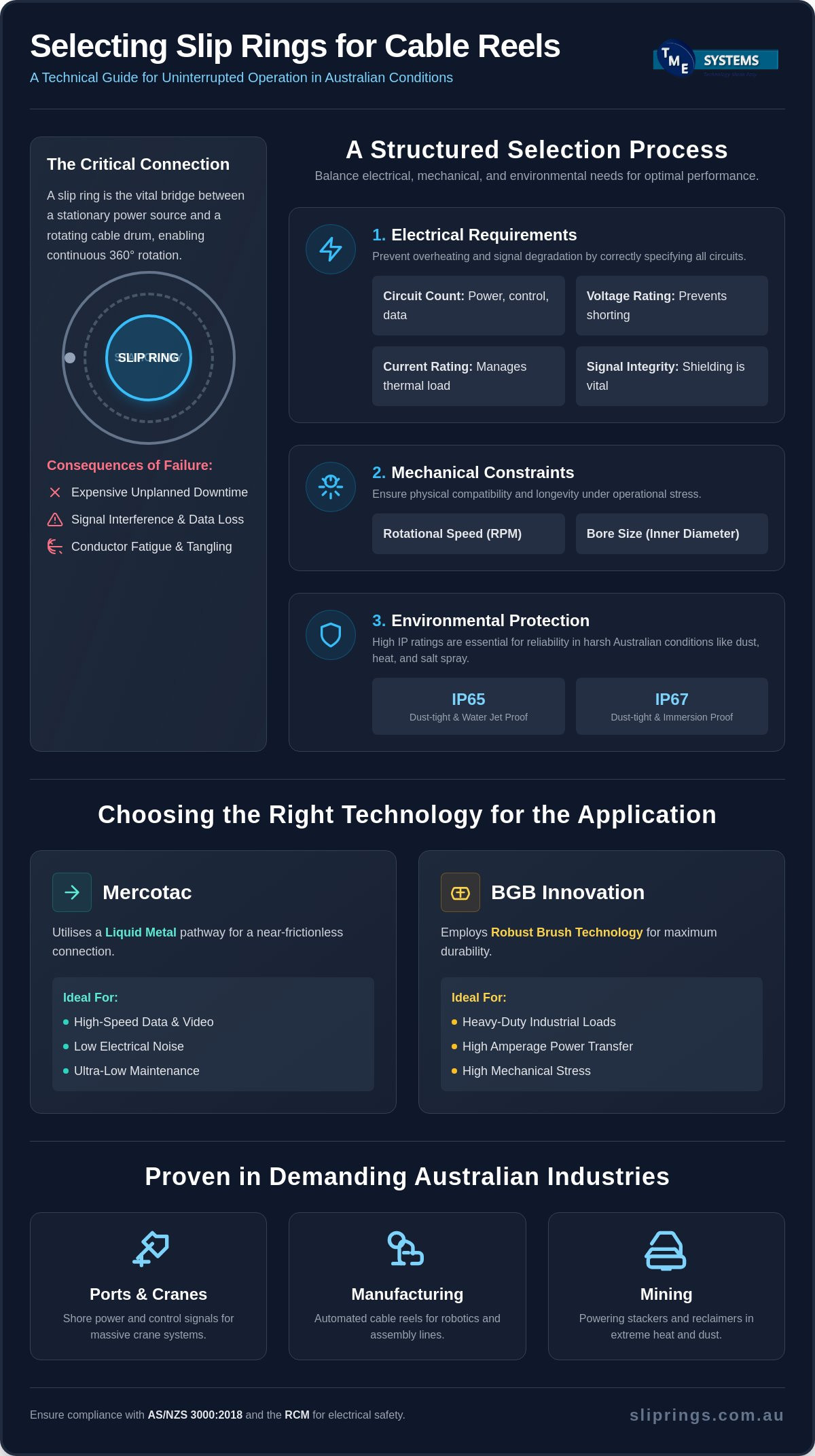
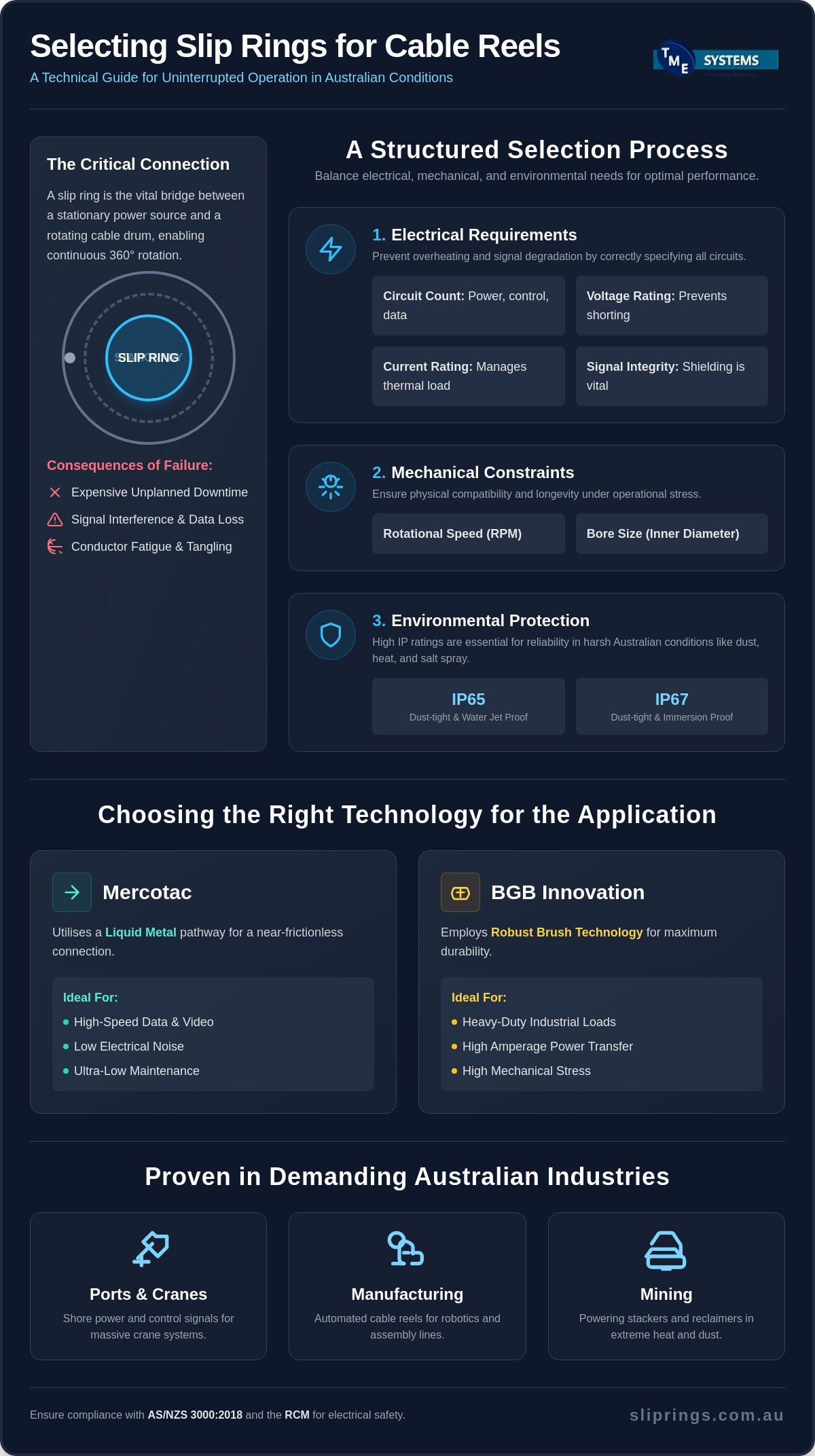
- Learn how to specify slip rings for cable reels to maintain continuous 360-degree rotation without conductor fatigue or tangling.
- Identify the correct circuit counts and voltage ratings required to prevent overheating in enclosed winding systems.
- Understand why high IP ratings, such as IP65 and IP67, are essential for protecting equipment against dust ingress and corrosion in harsh Australian environments.
- Follow a structured selection process to balance complex electrical loads with mechanical constraints like bore size and RPM.
- Discover how technical consulting helps you select high-performance components from brands like Mercotac and BGB Innovation to minimise maintenance downtime.
Understanding the Role of Slip Rings in Cable Reel Systems
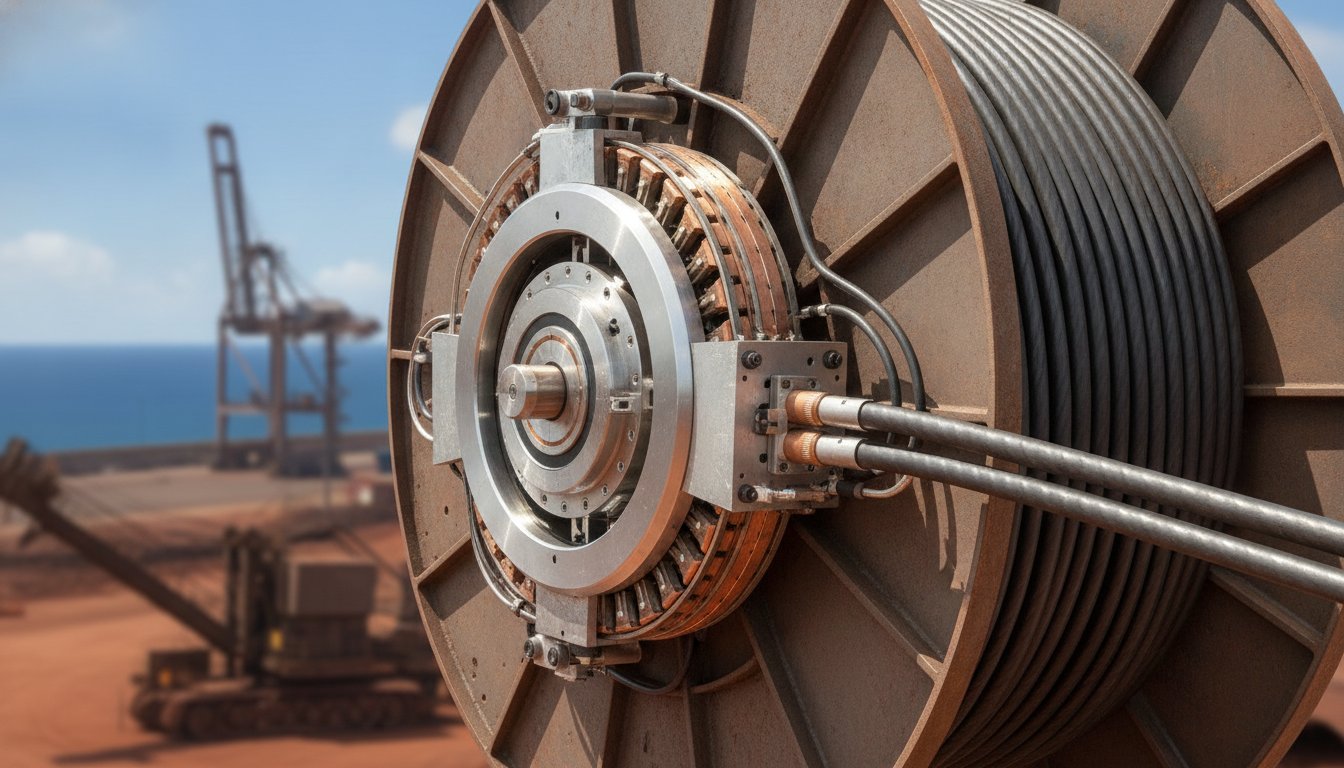
A slip ring acts as the critical bridge between a stationary power source and a rotating cable drum. In any industrial winding application, the cable must extend and retract while maintaining a constant electrical connection to the main grid or control system. Without this specialised interface, the internal conductors would twist around the central shaft, leading to immediate mechanical failure and electrical shorting. Choosing high-quality slip rings for cable reels is therefore the primary factor in ensuring 360-degree continuous rotation without conductor fatigue.
The technical challenge in reeling systems involves managing two distinct types of transmission: high-current power and sensitive low-level signals. While power transmission focuses on current-carrying capacity and heat dissipation, signal transfer requires extremely low electrical resistance and minimal "noise." Standard connectors often fail because they cannot maintain a clean signal during high-speed rotation. This leads to corrupted data in PLC communications or intermittent power loss, which triggers safety trips and halts production. Common failure points in lower-grade components include carbon dust accumulation, contact oxidation, and vibration-induced signal loss.
The Mechanics of Rotary Electrical Connectors
The basic assembly consists of a stationary stator and a rotating rotor. As the cable reel turns, the rotor maintains electrical continuity through sliding contacts. Rotational speed (RPM) plays a significant role in component longevity; higher speeds increase friction and accelerate the wear of contact surfaces. For applications requiring high-speed data or ultra-low maintenance, technologies like Mercotac Slip Rings use liquid metal to provide a near-frictionless connection. Conversely, for heavy-duty industrial loads where high amperage is the priority, robust brush technology from BGB Innovation Slip Rings provides the necessary durability to withstand mechanical stress.
Applications for Rotating Equipment in Australia
Australian industries rely on these components across diverse and demanding sectors. In the ports of Brisbane and Melbourne, massive crane systems use reeling stations to provide shore power and control signals. On local manufacturing floors, automated hose and cable reels facilitate the movement of robotic arms and assembly lines. The most extreme applications are found in the national mining sector. Large-scale stackers and reclaimers in the Pilbara or Hunter Valley use specialised slip rings to handle the immense power requirements of moving thousands of tonnes of material. These systems must operate reliably in environments where dust, heat, and vibration are constant threats to electrical integrity.
Mechanical and Electrical Requirements for Rotating Equipment
Specifying the mechanical and electrical parameters for slip rings for cable reels requires a methodical audit of the entire system's load. It isn't enough to simply count the number of wires; you must categorise each circuit by its specific function: power, control signal, or grounding. Balancing these needs within a single rotary joint involves managing physical space and electrical interference. High-frequency data signals are particularly vulnerable to the electromagnetic noise generated by high-current power lines. Proper circuit separation and shielding within the slip ring housing are mandatory to prevent signal degradation.
Managing the thermal load is equally vital. In many Australian applications, the slip ring is housed inside an enclosed cable drum where airflow is restricted. If the current ratings are underspecified, the resulting heat can cause the lubricant to dry out or the contact surfaces to warp. When calculating these loads, Understanding Slip Ring Current Ratings is essential for preventing thermal runaway and ensuring the longevity of the internal components. Correct specification ensures that the dielectric strength of the insulation remains intact even under peak voltage conditions.
Signal Integrity and Data Transfer
Modern reeling applications for high-definition video or complex sensor arrays demand superior signal integrity. Traditional carbon brushes often introduce micro-interruptions that corrupt digital data packets. For these requirements, gold-on-gold contacts or liquid metal interfaces are the preferred standard because they maintain a stable, low-resistance connection. This is especially critical for Ethernet-enabled equipment. You can find more detailed information on maintaining data throughput in our Ethernet Slip Rings Guide.
High Current Power Transfer for Heavy Industry
Heavy industrial reels often handle high amperage that generates significant heat within the assembly. To manage this thermal load, you should specify brush grades with high copper content. These materials offer better conductivity and lower friction than standard carbon alternatives. The collector ring configuration must also provide sufficient surface area to dissipate heat effectively. Ensuring the safety of the system requires rigorous attention to insulation materials and dielectric strength, particularly in high-voltage mining or port applications. If you're currently drafting a specification for a new project, consulting with a technical specialist can help you identify the precise circuit configuration needed for your specific load.
Environmental Protection and Durability in Australian Conditions
Australia's industrial landscape presents environmental challenges that standard specifications often overlook. While a component might be rated for "extreme environments" in Europe or North America, those ratings don't always translate to the high UV indices and abrasive red dust found in the Pilbara or the high salinity of coastal Queensland. Selecting slip rings for cable reels that can withstand these variables is essential for preventing premature failure. Ingress Protection (IP) ratings are the primary metric here; IP65 is the minimum requirement for outdoor reels to guard against water jets, while IP67 or IP69K is necessary for equipment subjected to temporary immersion or high-pressure washdowns.
Dust ingress is a leading cause of failure in mining and agricultural reeling systems. Fine particulates act as an abrasive on contact surfaces, significantly increasing electrical noise and physical wear. Beyond dust, the impact of high ambient temperatures on slip ring duty cycles is a critical consideration. When the outside temperature exceeds 40°C, the thermal "headroom" for the component's internal temperature rise is reduced. This necessitates either a derating of the current capacity or the selection of a unit with superior heat dissipation properties to ensure the slip rings for cable reels don't exceed their maximum operating temperature during peak loads.
Sealing and Housing Materials
The choice of housing material determines the unit's resistance to corrosion and solar degradation. For coastal marine applications or offshore reeling, 316-grade stainless steel is the industry standard due to its superior resistance to chloride pitting. In less corrosive environments, anodised aluminium offers a lightweight alternative, provided it features UV-stabilised seals and coatings. These specialised seals are vital; they prevent lubricant leakage under high heat and ensure that contaminants cannot reach the internal rotor assembly. Without UV protection, standard rubber seals can become brittle and crack within months of exposure to the Australian sun.
Vibration and Shock Resistance
Mobile equipment, such as stackers, reclaimers, and port cranes, subjects the cable reel to constant mechanical stress. Rapid acceleration and deceleration of the reel drum create shock loads that can cause standard electrical contacts to bounce or lose alignment. Ensuring contact stability during these movements requires a ruggedised internal design. Heavy-duty units from BGB Innovation Slip Rings are specifically engineered to handle these high-vibration environments. Their collector ring assemblies maintain consistent pressure and continuity even when the machinery is operating on uneven terrain or undergoing high-torque winding cycles.
Selection Criteria: Specifying Slip Rings for Cable Reels
Specifying slip rings for cable reels requires a structured approach to ensure the component survives the mechanical and electrical stresses of your specific application. It isn't just about matching a part number; it's about matching the component to the duty cycle of the machine. Start by defining the electrical load, which involves calculating peak voltage and amperage for power circuits while identifying the specific data protocols, such as Ethernet or CAN bus, for signal circuits. Each circuit type has different requirements for shielding and contact resistance.
Next, identify the mechanical constraints of your reel drum. You must determine the required bore size if the unit needs to fit over a central shaft, or choose an end-of-shaft mount for simpler configurations. Rotational speed (RPM) is also a primary factor, as it dictates the rate of contact wear and the necessity for specialised lubrication. Finally, evaluate the operating environment and the expected maintenance lifecycle. A reel that cycles fifty times a day in a dusty quarry requires a vastly different specification than a backup power reel that rotates once a month in a clean utility room.
Mounting Styles and Integration
The physical integration of the slip ring into your cable reel spindle is a primary design hurdle. Through-bore models allow you to pass hydraulic or pneumatic lines through the centre, making them ideal for complex reeling systems that handle multiple media types. Conversely, end-of-shaft mounting is typically more compact and easier to install for standard motorised reels. If you're managing a retrofit or a custom machinery project, our guide on Slip Ring for Rotating Table Mounting provides useful insights into managing different spindle orientations and mounting flanges.
Mercury-Free and Liquid Metal Options
When your application demands near-zero electrical noise for high-speed data, Mercotac Slip Rings are the industry benchmark. These units utilise liquid metal to maintain continuity, offering a more stable connection than traditional carbon brushes. However, certain Australian industries, particularly food and beverage processing or specific underground mining sites, may have strict mercury-free requirements. In these instances, you should specify high-performance brush-based alternatives or specialised mercury-free liquid metal alloys. These options provide a balance between signal integrity and compliance with site safety protocols. If you need help determining which technology meets your local safety standards, contact our technical team for a circuit-by-circuit review.
Optimising Rotary Performance with TME Systems Pty Ltd Technical Consulting
Selecting the correct slip rings for cable reels involves more than just matching basic electrical specifications. It requires a thorough understanding of how the component interacts with the entire mechanical system under specific Australian operational loads. TME Systems Pty Ltd operates as a technical consultant rather than a simple vendor, bridging the gap between complex manufacturing capabilities and the practical needs of local engineers. By providing a detailed application audit, we help you identify potential points of failure before procurement. This methodical approach reduces the risk of expensive integration errors or premature component burnout.
As a national distributor, we provide direct access to world-class brands including Mercotac Slip Rings, Meridian Laboratory, and BGB Innovation Slip Rings. This local presence ensures that technical support is available within your own time zone, facilitating faster resolution of complex rotary specifications. Whether you're designing a new robotic assembly or retrofitting an existing port crane, our engineering advice focuses on long-term reliability and environmental resilience. We prioritise technical accuracy over marketing hype, ensuring the hardware matches the physical realities of your site.
Custom Configurations for Australian Industry
Every project has unique constraints regarding space, circuit count, and housing durability. For versatile solutions that require high degrees of customisation, TME Systems Pty Ltd works closely with Prosper Rotation Slip Rings. This partnership allows Australian engineers to specify tailored circuit counts and housing styles that fit unique spindle diameters or mounting flanges. To start a technical consultation for your next project, you simply need to provide your basic load data and environmental parameters. Our team then reviews these variables to propose a configuration that balances performance with cost-efficiency.
Reliability and Long-Term Support
Industrial equipment in Australia often remains in service for decades, making technical continuity and spare part availability essential. By leveraging the heavy-duty expertise of BGB Innovation, TME Systems Pty Ltd ensures that your reeling systems are backed by components designed for high-amperage, high-vibration tasks. Our role extends beyond the initial sale to include ongoing technical assistance and national application audits. This steady, detail-oriented approach ensures that your slip rings for cable reels continue to perform reliably throughout their entire service life, even as your operational demands evolve. If you're currently managing a fleet of rotating equipment, contacting the TME Systems Pty Ltd team can help you establish a standardised procurement pathway that minimises maintenance complexity.
Securing Long-Term Reliability for Your Rotary Systems
Ensuring the reliability of your cable winding systems requires a rigorous approach to component selection. Successful integration depends on balancing the specific electrical load with the environmental stresses unique to the Australian landscape. Whether you're managing high-definition data signals or heavy-duty power transfer, the precision of your slip rings for cable reels determines the overall uptime of your machinery. By prioritising technical accuracy over generic specifications, you protect your equipment from signal noise and thermal failure.
TME Systems Pty Ltd provides the specialised expertise needed to navigate these engineering challenges. As an authorised Australian distributor for Mercotac and BGB Innovation, we offer proven solutions for both high-speed data and extreme industrial power needs. Our team delivers expert technical application consulting to national industry, helping you avoid expensive procurement mistakes through a circuit-by-circuit audit of your requirements. Consult with our technical team to specify the right slip ring for your equipment to ensure your operations remain uninterrupted.
We look forward to helping you optimise your rotary performance for long-term success.
Frequently Asked Questions
How do I know if I need a through-bore or a capsule slip ring for my reel?
The choice depends on your reel's spindle design and whether you need to pass other media through the centre. A through-bore slip ring is required if the unit must slide over an existing drive shaft or if you are passing hydraulic or pneumatic lines centrally. Capsule slip rings are typically used for end-of-shaft mounting where space is limited and no central clearance is needed.
Can slip rings handle both power and high-speed data (like Ethernet) simultaneously?
Yes, integrated units can manage both power and data circuits within a single housing. To ensure signal integrity, these slip rings for cable reels must feature internal shielding and physical separation between high-current lines and sensitive data pairs. This prevents electromagnetic interference from corrupting Ethernet packets or sensor signals during rotation.
What is the typical maintenance schedule for an industrial cable reel slip ring?
Maintenance intervals are determined by your equipment's duty cycle and the operating environment. For standard brush-based systems in moderate conditions, an annual inspection for brush wear and debris accumulation is usually sufficient. In high-cycle mining or port applications, you should schedule inspections based on the manufacturer’s revolution count ratings to prevent unplanned downtime.
Why is electrical noise such a problem in rotating equipment, and how can I reduce it?
Electrical noise is caused by fluctuations in contact resistance as the rotor turns against the brushes. This interference can disrupt sensitive PLC communications and video feeds. You can reduce this noise by selecting slip rings with precious metal contacts, such as gold-on-gold, or by using liquid metal technology which provides a much more stable electrical interface than traditional carbon brushes.
Are there mercury-free slip rings that offer the same performance as liquid metal?
Specialised mercury-free liquid metal alloys and high-performance gold-on-gold brush systems now provide comparable signal stability for many applications. While traditional liquid mercury offers the lowest possible resistance, these alternatives meet strict environmental safety standards for the food, beverage, and underground mining industries without sacrificing the data throughput required for modern automated systems.
What IP rating do I need for a slip ring used on an outdoor mining conveyor?
An IP66 or IP67 rating is the standard requirement for mining conveyors to protect against fine dust ingress and high-pressure water jets during washdowns. In environments where equipment is subjected to extreme cleaning protocols or heavy slurry, an IP69K rating may be necessary to ensure the internal electrical contacts remain dry and uncontaminated.
How does rotational speed (RPM) affect the lifespan of the slip ring brushes?
Higher rotational speeds accelerate the physical wear of the brushes and increase the heat generated at the contact interface. Most slip rings for cable reels are rated for a specific maximum RPM; exceeding this limit can lead to brush "bounce" and rapid degradation of the collector rings. Selecting a unit rated for higher speeds than your application requires will generally extend the service life.
Can TME Systems Pty Ltd help with retrofitting a new slip ring into an old cable reel?
TME Systems Pty Ltd provides technical consulting to assist with the mechanical and electrical integration of new components into existing machinery. We help identify the correct mounting flanges and circuit configurations to ensure a seamless retrofit. This process reduces the risk of compatibility issues and ensures the new slip ring meets current Australian safety and performance standards.