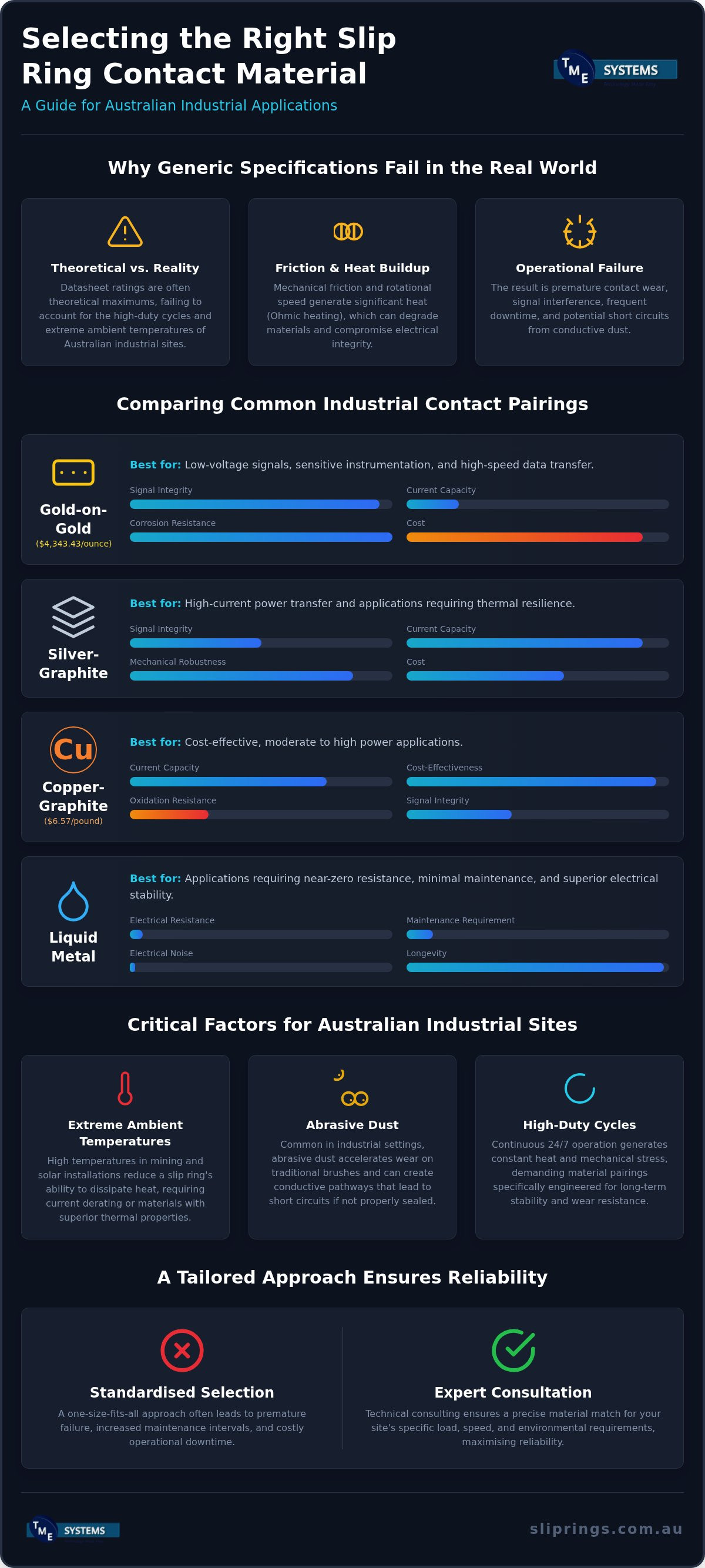
The listed slip ring current rating on a datasheet is often a theoretical maximum that fails the moment it encounters the reality of a high-duty cycle in a high-ambient-temperature Australian industrial site. If you've dealt with frequent downtime due to contact wear or signal interference in motorised assemblies, you know that a generic specification rarely accounts for the physical realities of friction and heat. Selecting the wrong contact material doesn't just lead to overheating connectors; it can compromise the electrical integrity of your entire operation.
We understand that engineers and procurement officers need hardware that survives beyond the first maintenance cycle. This article will help you discover how selecting the correct contact material determines your slip ring current rating, signal integrity, and long-term reliability in Australian industrial environments. We will provide a clear understanding of material trade-offs, considering that gold is priced at $4,343.43 per ounce as of August 2026. You will learn how to reduce maintenance intervals and confidently specify ratings for critical machinery while navigating the stricter oversight of the new National Environmental Protection Agency (NEPA).
Key Takeaways
- Understand how the specific electrical conductivity of contact pairings dictates the slip ring current rating and manages Ohmic heating during high-duty cycles.
- Compare the performance trade-offs between gold-on-gold pairings for low-voltage signal integrity and silver-on-graphite for high-current capacity.
- Identify strategies to mitigate the impact of abrasive dust and extreme ambient temperatures found in Australian mining and solar installations on contact longevity.
- Evaluate the benefits of liquid metal technology for applications requiring minimal maintenance and superior electrical stability in harsh environments.
- Recognise why a standardised approach to material selection often leads to premature failure and how technical consulting ensures a precise match for your site's specific requirements.
Understanding Slip Ring Contact Material: The Foundation of Rotary Transfer
At its most basic level, the contact material is the conductive interface where stationary brushes meet rotating rings. For those seeking a technical definition of What is a Slip Ring?, it's essentially a rotary electrical interface that allows the transfer of power and data between stationary and rotating structures. The performance of this interface depends entirely on the physical properties of the materials used. Without a stable contact, the assembly cannot maintain electrical continuity through a full 360-degree rotation.
The concept of "contact pairing" is vital. This refers to the specific metallurgical combination of the brush and the ring. This pairing must be compatible to prevent galling, excessive wear, or oxidation. It's the first variable engineers should evaluate when selecting a slip ring for industrial use. Because different metals have different resistive properties, the material choice directly dictates the slip ring current rating. Choosing an inappropriate pairing for the intended load often leads to thermal runaway and premature failure of the connector assembly.
Primary industrial materials include precious metals, carbon-graphite composites, and liquid metal alloys. Each serves a specific niche. Precious metals offer superior conductivity for low-voltage signals, while carbon-graphite provides the mechanical robustness needed for high-power applications. Liquid metal alloys, such as those found in Mercotac Slip Rings, offer a near-zero resistance path that traditional sliding brushes cannot match.
The Physics of Electrical Transfer in Motion
Mechanical friction and rotational speed are the primary drivers of electrical resistance at the contact interface. As a slip ring rotates, the sliding contact generates heat. If the rotational speed exceeds the material's thermal limits, the slip ring current rating must be derated to prevent damage. Traditional brush systems rely heavily on precise contact pressure. If the pressure is too low, the connection becomes unstable, causing electrical noise. If it's too high, the brushes wear down rapidly, filling the housing with conductive dust that can cause short circuits. Signal integrity depends on these material pairings remaining stable across the entire speed range of the application.
Categorising Materials by Application Type
Materials are generally grouped into three categories to suit specific operational needs. Signal-grade materials typically utilise gold-on-gold or silver-on-silver pairings to ensure low electrical noise for sensitive instrumentation and data transfer. Power-grade materials, such as silver-graphite, are engineered for high amperage and thermal resilience, maintaining a stable capacity under heavy loads. Hybrid configurations are increasingly common in complex machinery. These units combine multiple material types within a single housing, allowing for the simultaneous transfer of high-voltage power and high-speed data without interference between circuits.
How Material Science Dictates Slip Ring Current Rating
The slip ring current rating is not a static figure; it's a thermal limit dictated by the contact material's electrical resistivity. When current flows through the moving interface, it encounters resistance, resulting in Ohmic heating. This process follows the I2R law, where the heat generated increases with the square of the amperage. If the contact material cannot efficiently conduct electricity or dissipate the resulting thermal energy, the interface temperature will rise until it reaches the melting point of the metal or the breakdown temperature of the surrounding insulation.
Unlike stationary cable runs, a slip ring has a dynamic interface that creates a bottleneck where resistance is typically higher than in a solid conductor. High-performance materials like silver are often employed in high-performance slip ring design to minimise this resistive heating. While copper is a cost-effective alternative at $6.57 per pound as of August 2026, it lacks the oxidation resistance of silver or gold. In high-ambient-temperature Australian sites, oxidation can lead to a rapid increase in surface resistance, causing the assembly to overheat even when operating within its nominal rating.
Current Density and Surface Area
To handle higher amperage without excessive heat, designers must increase the contact surface area. Current density refers to the amount of current passing through a specific area of the contact interface. If the density is too high, localised "hot spots" occur, leading to contact welding. Multi-brush configurations, such as those found in BGB Innovation Slip Rings, distribute the load across multiple points. This reduces the current density on any single brush, effectively increasing the total slip ring current rating while keeping thermal output manageable. Material resistivity directly limits the maximum continuous amperage an assembly can safely carry before thermal runaway begins.
Peak vs. Continuous Load Resilience
Industrial machinery often experiences transient surges during motor start-up. Precious metal contacts handle these peaks well due to their high conductivity, but carbon-graphite brushes offer better mechanical resilience for continuous, high-current operation. Material hardness is a critical factor; softer materials like gold provide excellent signal integrity but can wear prematurely under high-current friction. Managing the duty cycle is essential for long-term reliability. If your application involves constant rotation at peak load, you may need a solution with superior heat dissipation, such as the liquid metal technology utilised by Meridian Laboratory Slip Rings. Selecting the right balance between conductivity and hardness prevents catastrophic failures. If you aren't sure which material suits your amperage requirements, technical application consulting can help align your hardware with your specific duty cycle.
Comparing Common Industrial Contact Pairings
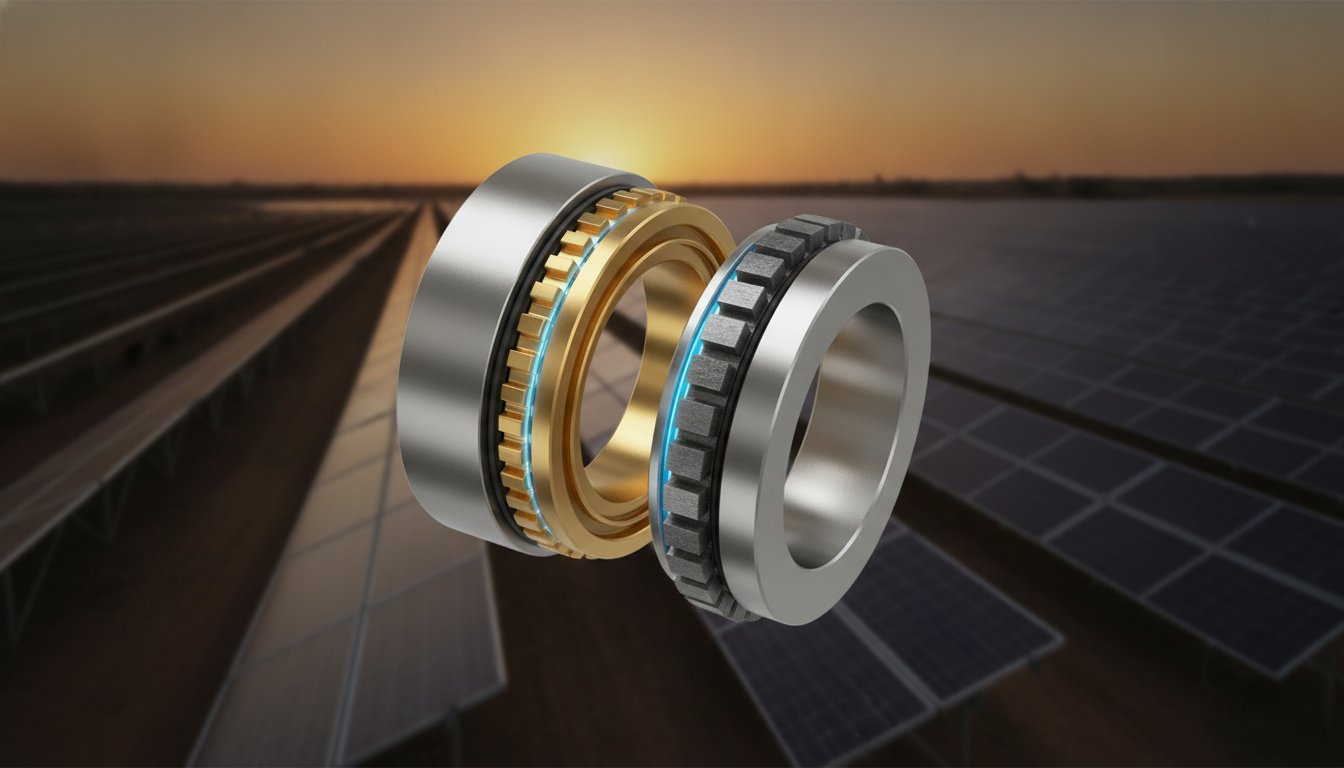
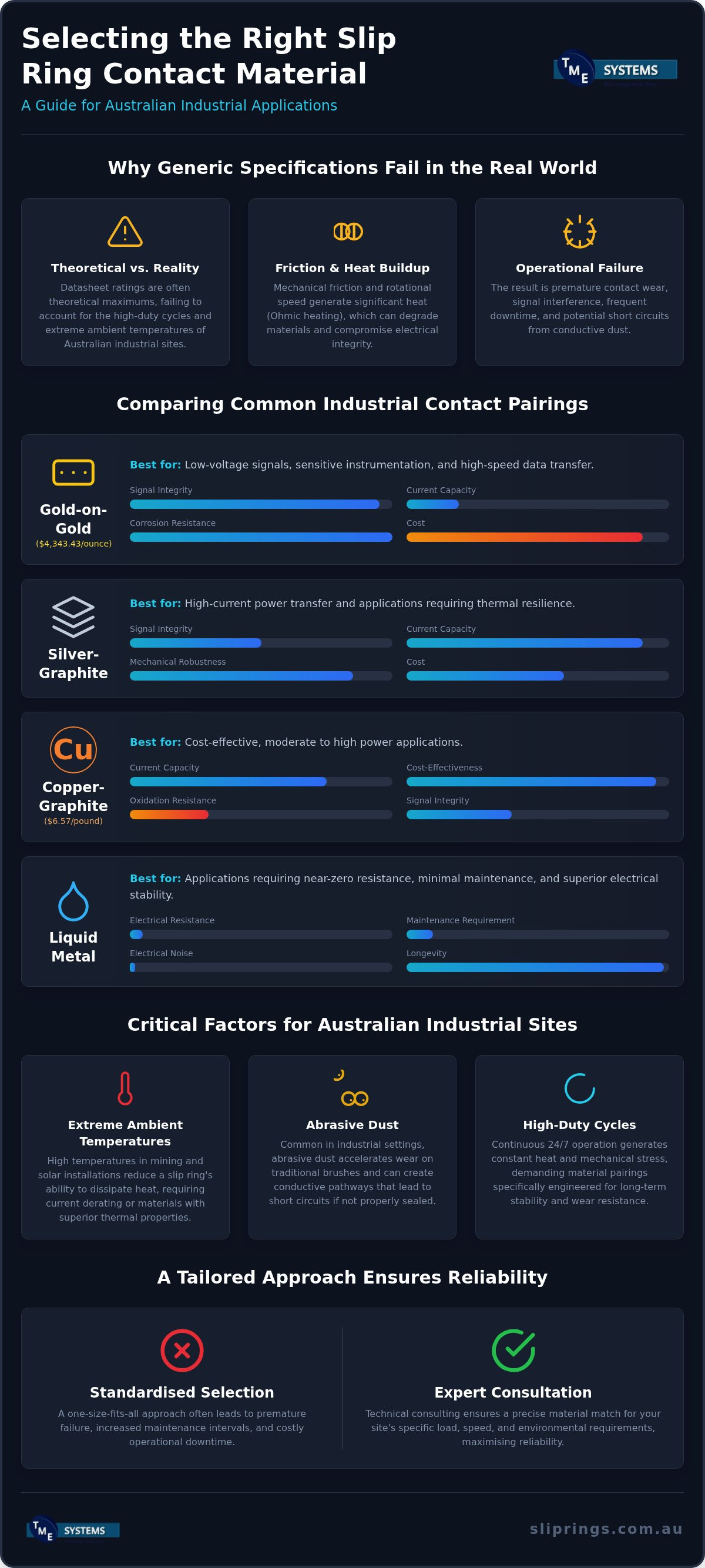
Selecting the right pairing is a balancing act between electrical conductivity, material cost, and mechanical durability. While the slip ring current rating provides a necessary baseline, the specific material determines how that rating holds up under constant friction and rotation. Gold-on-gold pairings remain the standard for signal slip rings, as they resist oxidation and maintain low contact resistance for low-voltage data. Conversely, silver-on-graphite is the industrial workhorse for power. The graphite provides self-lubricating properties that reduce mechanical wear, while the silver maintains the high conductivity required for heavy electrical loads. For simple, low-speed power transfer in heavy-duty machinery, copper or brass rings are often used due to their cost-effectiveness, although they require more frequent cleaning to remove oxidation.
Traditional Brushes vs. Liquid Metal Connectors
Traditional sliding brushes inevitably produce wear debris and electrical noise due to mechanical friction. In contrast, Mercotac slip rings utilise a pool of liquid metal to maintain the connection. This design offers a "fit and forget" solution that eliminates the maintenance requirements associated with brush replacement. Liquid metal connectors provide near-zero electrical noise, making them ideal for sensitive instrumentation where signal clarity is paramount. While traditional brushes have RPM limitations due to frictional heat, liquid metal designs can often sustain higher rotational speeds without degrading the slip ring current rating or increasing signal interference.
Material Selection Framework for Engineers
Effective specification depends on the primary function of the rotary joint. When data integrity is the priority, such as with high-definition CCTV or Ethernet, precious metal contacts are non-negotiable. For heavy-duty industrial applications like winches or cranes, heavy-duty carbon-graphite brushes are better suited to the high-vibration environment. Precision high-speed environments, such as those found in centrifuge or test equipment, often require the specialised engineering of Meridian Laboratory slip rings. By matching the contact pairing to the duty cycle and environmental conditions, you can significantly extend the service life of your equipment. It's about finding the point where material performance meets the operational reality of your machinery.
Environmental Factors in Australian Industrial Sites
Australian industrial sites, from Pilbara mines to coastal wind farms, present environmental challenges that standard hardware often fails to withstand. The slip ring current rating specified in a manufacturer's lab is rarely accurate for an outback solar installation where ambient temperatures frequently exceed 40 degrees Celsius. When environmental variables are ignored, the resulting thermal stress and abrasive wear lead to total system failure. Protecting the conductive interface from these external pressures is just as important as the initial material selection.
Thermal Management in the Australian Heat
Operating machinery in high-ambient-temperature zones requires a pragmatic approach to derating the slip ring current rating. As the external temperature rises, the delta between the contact interface and the environment narrows, reducing the material's ability to dissipate heat. This is particularly problematic for carbon brushes, where excessive heat can degrade self-lubricating properties and accelerate mechanical wear. Thermal equilibrium is significantly harder to achieve in non-vented enclosures because the internal air remains stagnant and cannot effectively transfer heat away from the rotating contacts. Engineers must account for these factors by specifying components with higher thermal resilience or larger surface areas than the nominal load suggests to avoid premature insulation breakdown.
Combating Contamination and Oxidation
Abrasive dust and high humidity are the primary enemies of electrical continuity. In coastal or marine environments, salt-laden air quickly corrodes base metals, creating a resistive oxide film that disrupts signal integrity. Gold is the preferred contact material in these high-humidity areas because it does not form a non-conductive oxide layer, ensuring that low-voltage signals remain clear over long service intervals. For dusty refineries or mines, IP65 slip rings provide a sealed capsule design that prevents particulate ingress from reaching the contact interface. Particulates that enter an unsealed unit act as an abrasive, grinding down the brushes and increasing electrical resistance. While open-collector rings are sometimes used for their ease of access, they require rigorous maintenance schedules to clear debris and prevent short circuits. With the establishment of the National Environmental Protection Agency (NEPA) in July 2026, ensuring hardware reliability is now also a matter of regulatory compliance and environmental safety. If you need hardware that meets these stringent site demands, our technical application consulting can help you match the right sealing and material to your environment.
Optimising Your System with Professional Material Selection
Relying on a "one size fits all" strategy for rotary connections is a primary cause of premature hardware failure in industrial settings. While a datasheet provides a nominal slip ring current rating, it doesn't account for the specific harmonics, vibration, or duty cycles of your machinery. A standardised component might work in a climate-controlled lab, but it often fails when subjected to the continuous rotation and thermal loads of an Australian processing plant. Professional material selection ensures that the conductive interface is matched to the actual electrical and mechanical stresses it will face.
Technical application consulting is the bridge between a theoretical specification and operational reality. By auditing your current rotating connections for thermal efficiency, you can identify bottlenecks before they lead to downtime. This process involves evaluating the amperage load, rotational speed, and environmental exposure to determine if your current hardware is under-specified. TME Systems Pty Ltd supports Australian industry by providing this specialised procurement expertise, ensuring that every component is fit for purpose and capable of sustained performance.
Custom Configurations for Unique Requirements
Modern industrial applications often require more than just a simple power transfer. Many systems need a modular assembly that combines high-amperage power circuits with sensitive signal channels in a single housing. This requires a sophisticated approach to material isolation and shielding to prevent cross-talk and electrical noise. We often facilitate these complex requirements through specialised hardware:
- Specifying BGB Innovation slip rings for heavy-duty wind and marine energy projects where corrosion resistance and high-current capacity are non-negotiable.
- Leveraging Prosper Rotation slip rings for compact, cost-effective automation where space is limited but reliability is still essential.
- Developing hybrid configurations that allow for the simultaneous transfer of hydraulic fluid, pneumatic pressure, and electrical signals.
Partnering with TME Systems for Technical Certainty
Partnering with a specialised distributor gives you access to local expertise for complex rotary connector specifications. This isn't just about purchasing hardware; it's about ensuring that your installation complies with Australian electrical safety standards and survives the specific rigours of your site. Whether you're managing a mining operation in the Pilbara or a manufacturing facility in Melbourne, the right material choice will directly impact your maintenance intervals and total cost of ownership. We help you move beyond generic ratings to achieve technical certainty in your rotary applications. If you're ready to improve the reliability of your machinery, consult with TME Systems for your slip ring requirements to ensure your slip ring current rating is accurately matched to your operational needs.
Securing Long-Term Reliability for Your Rotary Applications
Selecting the correct contact material is more than a metallurgical preference; it's a critical engineering decision that defines the operational lifespan of your machinery. We've explored how material science directly governs the slip ring current rating and why Australian environmental factors necessitate higher specifications for thermal resilience. By moving from generic hardware to application-specific pairings, you reduce the risk of contact welding and signal degradation.
TME Systems supports Australian industry as an authorised distributor for Mercotac and Meridian Laboratory. Our team provides specialised technical support for sectors including mining, defence, and automation, with national supply managed from our NSW distribution centre. If you're managing complex rotary connections, we can help you navigate these technical trade-offs with confidence.
Request a Technical Consultation for Your Slip Ring Application to ensure your hardware is optimised for your site's specific duty cycle. We look forward to helping you achieve greater technical certainty.
Frequently Asked Questions
What is the best contact material for high-speed data transmission?
Gold-on-gold is the preferred choice for high-speed data transmission due to its exceptional oxidation resistance and low contact resistance. It ensures stable signal integrity even at low voltages. For extreme high-speed data requirements, liquid metal connectors offer even lower electrical noise and higher bandwidth capabilities. These solutions are essential for maintaining clear communication in robotic and automated systems where signal precision is a non-negotiable requirement.
How does current rating change with rotational speed (RPM)?
The slip ring current rating typically decreases as rotational speed increases because higher RPMs generate more frictional heat at the contact interface. This additional thermal load reduces the assembly's ability to dissipate heat generated by the electrical current. Consequently, manufacturers often derate the current capacity for high-speed applications to prevent overheating. This ensures the temperature remains below the melting point of the contact materials.
Why do carbon brushes require more maintenance than precious metal contacts?
Carbon brushes require more frequent maintenance because they are designed to wear down to provide a self-lubricating film on the ring surface. This process creates conductive dust that must be regularly cleaned to prevent short circuits and insulation failure within the housing. Precious metal contacts, while still subject to wear, do not produce the same volume of problematic debris. This makes them more suitable for sensitive electronics that cannot tolerate contamination.
Can I use a liquid metal slip ring for high-power industrial motors?
Yes, liquid metal slip rings are highly effective for high-power industrial motors due to their superior conductivity and high current density. These units can handle significant amperage in a much smaller footprint than traditional brush-based assemblies. Their near-zero resistance path minimises heat generation during the high-current transfer required for motor operation. This makes them a reliable choice for heavy-duty rotary applications where space and thermal management are major constraints.
What happens to the current rating if the ambient temperature exceeds 40 degrees?
When ambient temperatures exceed 40 degrees Celsius, the slip ring current rating must be derated to account for the reduced thermal gradient. Since the surrounding air is hotter, the connector cannot shed heat as efficiently, leading to higher internal temperatures. Failure to adjust the load in these conditions often results in melted contacts or insulation breakdown. This is a common issue in outback Australian mining sites where equipment is exposed to extreme heat.
Is gold-on-gold always the best choice for low-noise applications?
Gold-on-gold is excellent for many low-noise applications, but it is not always the absolute best choice for every scenario. For applications requiring extremely low electrical noise with zero maintenance, liquid metal technology is often superior. Gold is primarily chosen for its ability to maintain a clean, oxide-free contact surface in low-voltage signal circuits. We recommend evaluating the specific noise floor of your equipment before finalising your material selection.
How do I know if my slip ring contacts are wearing out prematurely?
Premature wear is often indicated by increased electrical noise, intermittent signal loss, or visible accumulation of metallic dust around the brushes. You might also notice localised discolouration on the rings, which suggests excessive Ohmic heating at the contact point. Monitoring these physical and electrical signs during routine inspections helps prevent catastrophic failure on the production line. Regular audits ensure that your hardware remains within its safe operating parameters.
Are there mercury-free alternatives for food-grade packaging machinery?
Yes, there are several mercury-free alternatives, including specialised precious metal brush assemblies and gallium-based liquid metal alloys. For food-grade packaging, stainless steel housings and sealed designs are often combined with these dry-contact or non-toxic liquid technologies. These solutions ensure compliance with health and safety regulations while maintaining reliable rotary transfer. This is particularly important for machinery that must undergo regular washdowns or operate in sterile environments.