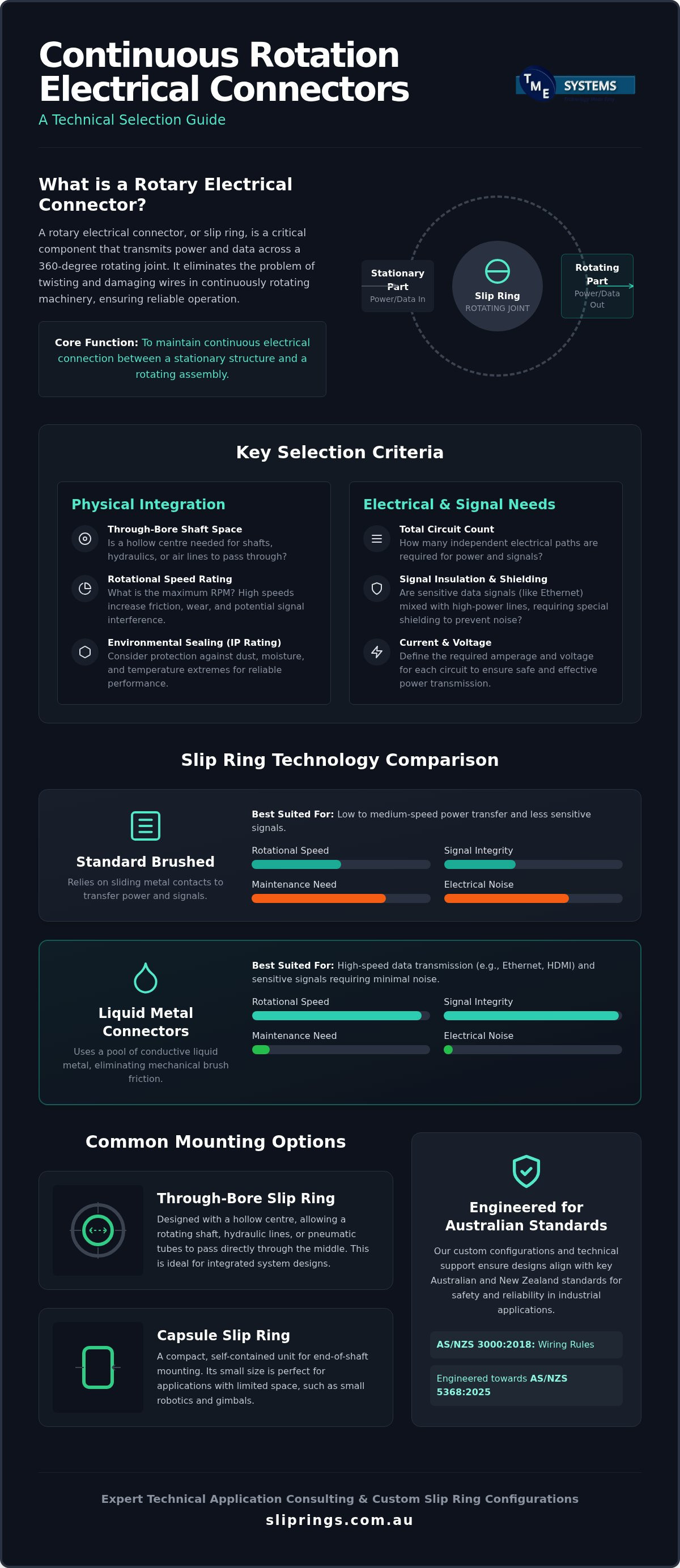
A continuous rotation electrical connector, commonly known as a slip ring, maintains continuous electrical conduction across a 360-degree rotating joint. Advanced industrial designs can support rotation speeds exceeding 10,000 RPM while delivering reliable signal and power transmission across harsh environments; standard brushed units remain better suited to lower-speed power transfer. Engineers rely on these components to prevent cable twisting in complex automated machinery. Your main decisions are which contact mechanism fits your speed and signal mix, whether you need a clear central bore, and how environment and maintenance shape total cost.
Key Takeaways: A continuous rotation electrical connector maintains 360-degree conduction across rotating joints using sliding brushes or liquid metal channels to prevent cable twisting.
- High-speed industrial designs support rotation exceeding 10,000 RPM while delivering reliable signal and power transmission.
- Standard brushed units are unsuitable for sensitive data unless you prioritize low-speed power transfer.
- Select liquid-metal ROTOCON technology for high-performance signals to eliminate mechanical brush friction and noise.
- The calculation for total cost must balance initial pricing against maintenance and lead times.
Match the rotating connector to your machine before you buy
You avoid premature field failures when you assess structural dimensions, operational speeds, and signal requirements together rather than buying on size and wire count alone. Typical situations we see with clients point to clear choices from the same facts: a shaft or hose running through the joint calls for a through-bore unit so hydraulics, a central shaft, or air conduits pass the open inner channel; high-speed sensing needs brush force calibrated to limit signal interference; standard industrial robotics need dynamic environmental seals, and mixed high power plus delicate data lines need customised channel insulation.
Selecting only on basic dimensions and circuit count (number of wires) is the off-the-shelf trap that ignores housing limits and electrical demands custom engineering is meant to catch. Balance physical space against how fast the joint must turn. Running near the unit’s rated rotational speed generates friction that accelerates wear on electrical contacts. As stated in the Wikipedia entry on Schleifring (2026), dynamic contacts use sliding metal rings to carry electrical current without winding the cables.
┌──────────────────────────────────────────────────────────┐
│             SELECTION REQUIREMENTS CHECKLIST             │
├────────────────────────────┬─────────────────────────────┤
│ Physical Integration       │ Electrical & Signal Needs   │
├────────────────────────────┼─────────────────────────────┤
│ • Through-bore shaft space │ • Total circuit count       │
│ • Rotational speed rating  │ • Signal insulation shielding│
└────────────────────────────────────────────────────────────┴─────────────────────────────┘
For matching mechanical constraints with electrical design, consult our technical selection guide. System stability depends on that accurate selection. For complex machinery, TME Systems Pty Ltd supplies engineered rotational designs and can assist with application review for Australian and New Zealand customers.
What a rotary electrical connector does in your assembly
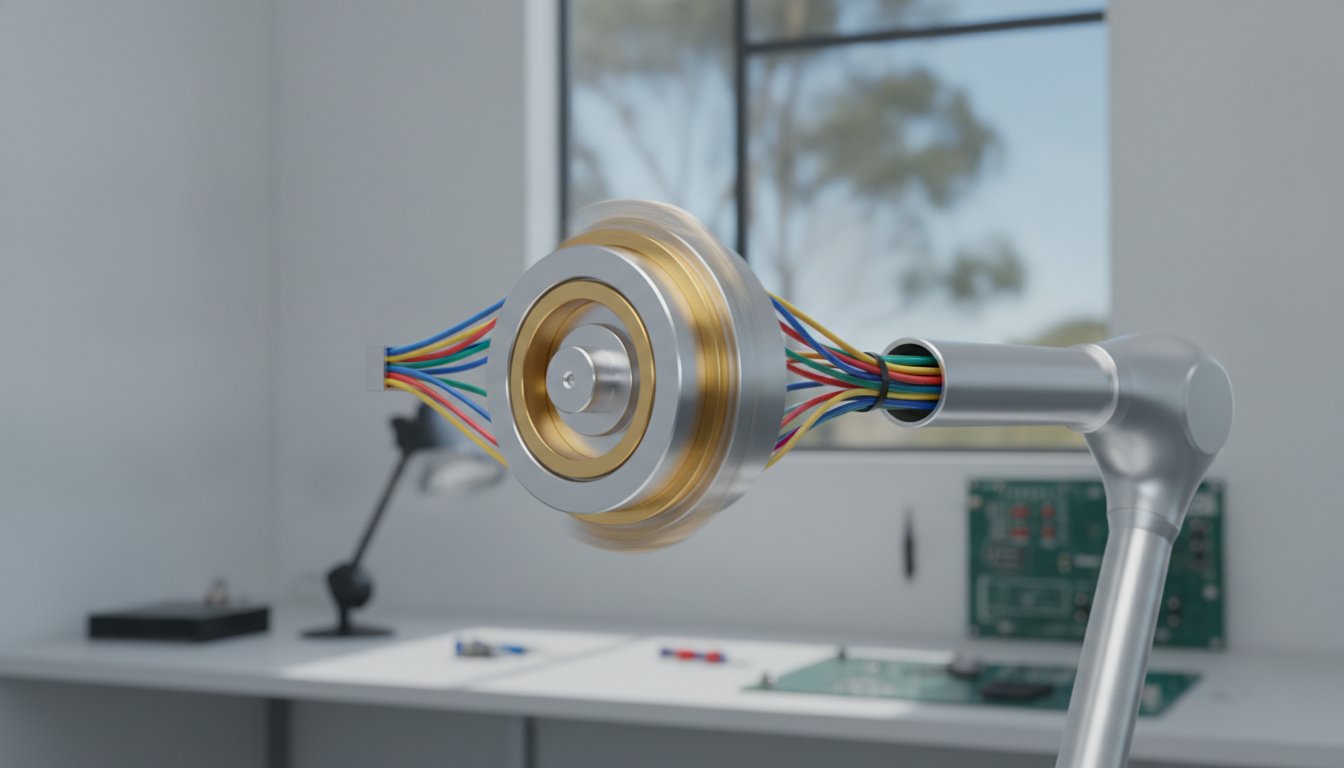
A rotary electrical connector passes power and signals across a rotating joint without twisting wires. Picture a lighthouse lantern that must keep turning so its beam sweeps the horizon while the structure below stays fixed: the connector’s job is to feed that rotating head without winding the supply cables. Stationary brushes press against rotating conductive rings to maintain electrical contact during movement.
When you configure a system, size and circuit count alone still omit environmental forces that drive early wear. You also need the speed the joint will actually see, so brush wear does not run away. A hollow-centre connector (through-bore slip ring) lets you pass fluid lines or shafts through the open middle. For sensitive data projects, read our Ethernet slip ring guide on continuous rotation data transfer.
Compact capsule designs suit small robotics, while modular continuous joints fit heavy industrial cranes. The right choice prevents costly downtime.
Which slip ring type fits your speed and signal needs
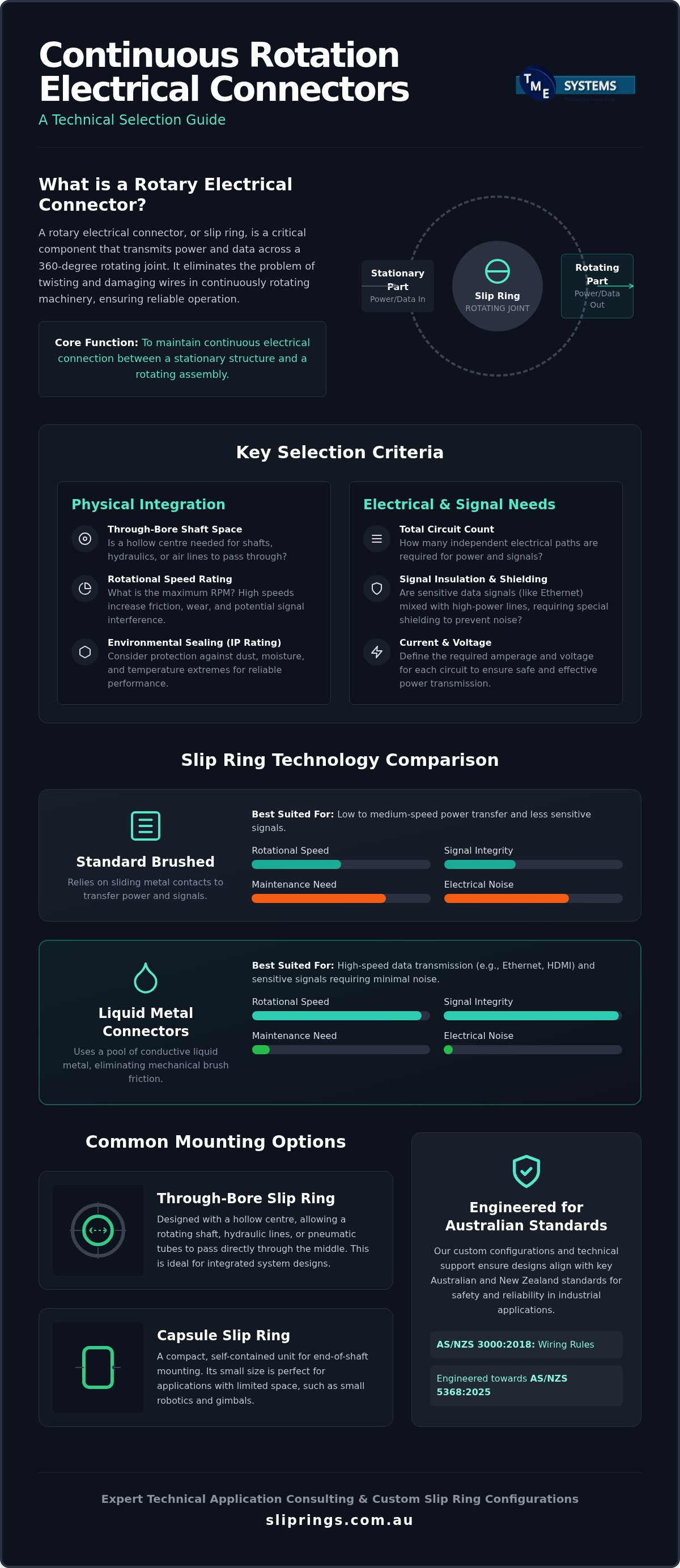
Standard mechanical brush units suit basic power transmission; liquid-metal ROTocON technology is built for high-performance signals where brush wear and noise become limiting.
Standard brushed designs rely on sliding contacts. Over time those parts wear and generate electrical noise. Liquid-metal designs use a fluid metal conduction channel so you avoid routine brush maintenance and hold more consistent signal integrity. They remove solid-to-solid brush friction; they still experience fluid friction (viscous drag) during rotation, so they are not a friction-free bridge. According to the Colector motor eléctrico Wikipedia 2026 entry, rotary collectors use sliding contacts to transfer power between stationary and rotating conductors. Sensitive automated equipment often needs those non-contact fluid interfaces where standard units only cover basic tasks.
| Connector Type | Contact Mechanism | Best Suited For |
|---|---|---|
| Standard Slip Ring | Sliding metal brushes | Low-speed power transfer |
| Liquid metal (ROTocON technology) | Liquid metal channel | High-speed data and sensitive signals |
| Hollow Centre Connector | Central passage bore | Routing hydraulic lines or shafts |
A hollow-centre connector fits systems that need a clear central shaft. Picking a model only by how fast it may spin can still leave you with signal loss under high bandwidth demand. For complex dynamic systems, fluid metal designs give stronger long-term reliability on sensitive channels. Learn more about selecting components in the industrial procurement reference.
How to select slip rings and control total cost
Selecting the right continuous rotation electrical connector means balancing application environment, operating speed, and total circuit count so you do not pay for capacity you will not use. In our engineering facility we regularly observe buyers overpaying for oversized units when standard designs would suffice. Matching exact functional demands prevents that extra spend.
Total cost of ownership depends on lead times, housing durability, and ongoing maintenance, not only the hardware line item. Custom engineering raises the initial budget; standardised off-the-shelf units lower upfront spend. High-speed continuous duty needs stronger contact materials, which lifts acquisition cost but cuts replacement frequency. Skipping environment, noise, and wear when you specify is what drives long-term cost up even when the unit looked cheap at purchase. For specifying industrial hardware, review the professional engineering reference.
A compact hollow-centre connector suits space-constrained shaft assemblies; larger encapsulated units fit heavy industrial machinery. To optimise your budget, state the speed you actually need rather than padding performance margins. Contact TME Systems Pty Ltd for a quote built around your operating environment and technical requirements.
Tip: Always spec IP65 as your baseline for Australian outdoor plant deployments to prevent premature failure from fine dust ingress.
5 Steps to wire a rotary joint without damaging contacts
Wiring a rotary joint assembly starts with mounting the stationary component before you make electrical connections, so internal wires cannot twist under rotation. Mechanical alignment keeps the system stable under dynamic loads. From client work we see that securing the housing first prevents accidental strain on internal contact points and prolongs internal brush life: the problem is strain on contacts during a rushed fit-up; the action is flange-mount and concentric alignment before any terminations; the outcome is smoother duty and fewer early brush failures on continuous cycles.
Follow these steps for safe installation:
- Mount the base: Attach the stationary housing to your frame using the designated mounting flange.
- Align the shaft: Position the rotating shaft inside your mechanical bearing assembly, ensuring perfect concentricity.
- Connect stationary leads: Wire the non-rotating input leads to your primary power source or control panel.
- Attach rotating leads: Connect the output wires to the rotating load or motor assembly.
- Verify rotation: Hand-spin the assembly to check for smooth mechanical clearance and clear wire routing.
Careful routing protects lead wires from rub hazards. Inspect every wire lead before applying power. Fixed lead lengths work best for standard enclosures; custom terminal blocks fit compact custom machinery. Confirm mechanical clearances before final torquing.
Frequently asked questions
What is a rotating electrical connector?
A rotating electrical connector is a device that passes electrical signals and power across a rotating interface. Engineers also call it a continuous rotation electrical connector. It keeps electrical continuity while machine components turn.
What types of rotating connectors exist?
Rotating connectors exist as traditional mechanical slip rings or liquid metal units. You can choose a hollow-centre connector when mounting directly onto a shaft. Circuit count and envelope still need technical review against speed, environment, and signal type before you lock a part number.
How do slip rings work?
Slip rings work by sliding metal brushes against rotating metal rings to conduct electricity. Physical friction between these moving parts causes mechanical wear over time. That continuous contact generates internal debris that requires routine maintenance.
What is a liquid metal rotating electrical connector?
A liquid metal rotating electrical connector is a brushless rotary union that uses a fluid metal path for electrical conduction (ROTocON technology is one form of this approach). Sealed units of this type are supplied to eliminate mechanical brush friction and to hold more stable contact resistance without the signal noise typical of worn brushes.
Can liquid metal units handle high current and high voltage?
Liquid metal units handle high power demands safely. According to the manufacturer's data sheet, specialised models process thousands of amperes and high voltage loads. They perform reliably at rotational speeds suited to heavy industrial use.
Find the right continuous rotation electrical connector for your system
Your decision set is unchanged from the opening: match contact type, bore, speed, environment, and circuit needs so power and signals stay continuous across the rotating interface without paying for the wrong failure mode.
In 2026, the engineering team at TME Systems Pty Ltd helps operators select components for long operational lifespans. The aim is to choose the correct rotating electrical connection for the job rather than simply replacing one slip ring with another similar-looking part.
To discuss channel requirements, shaft dimensions, or custom enclosures for your Australian operation, explore the Prosper Rotation range online and request a quote tailored to your system.