Why should your electrical routing be the bottleneck that dictates your entire mechanical drive shaft design? For many Australian engineers, the challenge isn't just about passing current; it's about doing so through a hollow shaft without introducing signal interference or compromising mechanical stability. You likely deal with tight mounting constraints on existing machinery and the frustration of seeking local technical support that understands industrial requirements. Sourcing high-specification Prosper Rotation slip rings Australia ensures that your rotary connections meet the latest IEC 60034-1:2026 standards while fitting your specific mechanical footprint.
We recognise that specifying a rotary connector requires a balance of electrical precision and mechanical durability. This guide explores the mechanical advantages and technical specifications of through-bore designs to help you optimise your rotary electrical connections. You'll gain a clear framework for comparing different connector styles, ensuring you have the confidence to specify the exact unit your machinery requires for long-term reliability in demanding environments.
Key Takeaways
- Learn why hollow shaft designs offer superior mechanical stability by mounting directly onto existing drive shafts in high-torque environments.
- Compare through-bore, capsule, and pancake form factors to identify the most efficient solution for your machinery's specific spatial envelope.
- Discover how to specify Prosper Rotation slip rings Australia by accurately calculating inner diameter requirements and balancing power leads with shielded signal pairs.
- Explore industrial applications across Australian packaging, bottling, and wind energy sectors where through-bore units optimise complex rotary electrical connections.
- Establish a technical selection framework that prioritises duty cycle and environmental resilience over generic off-the-shelf components.
What is a Through-Bore Slip Ring? The Fundamentals of Hollow Shaft Design
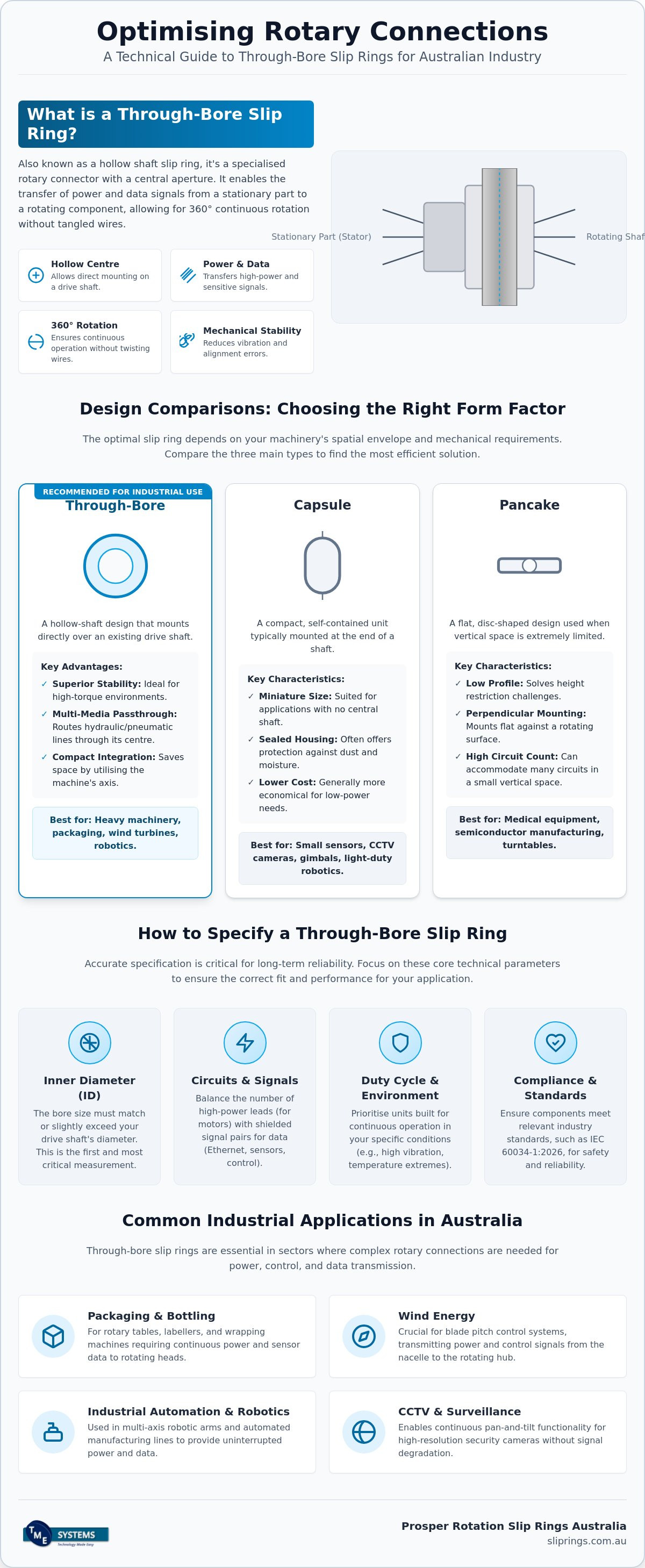
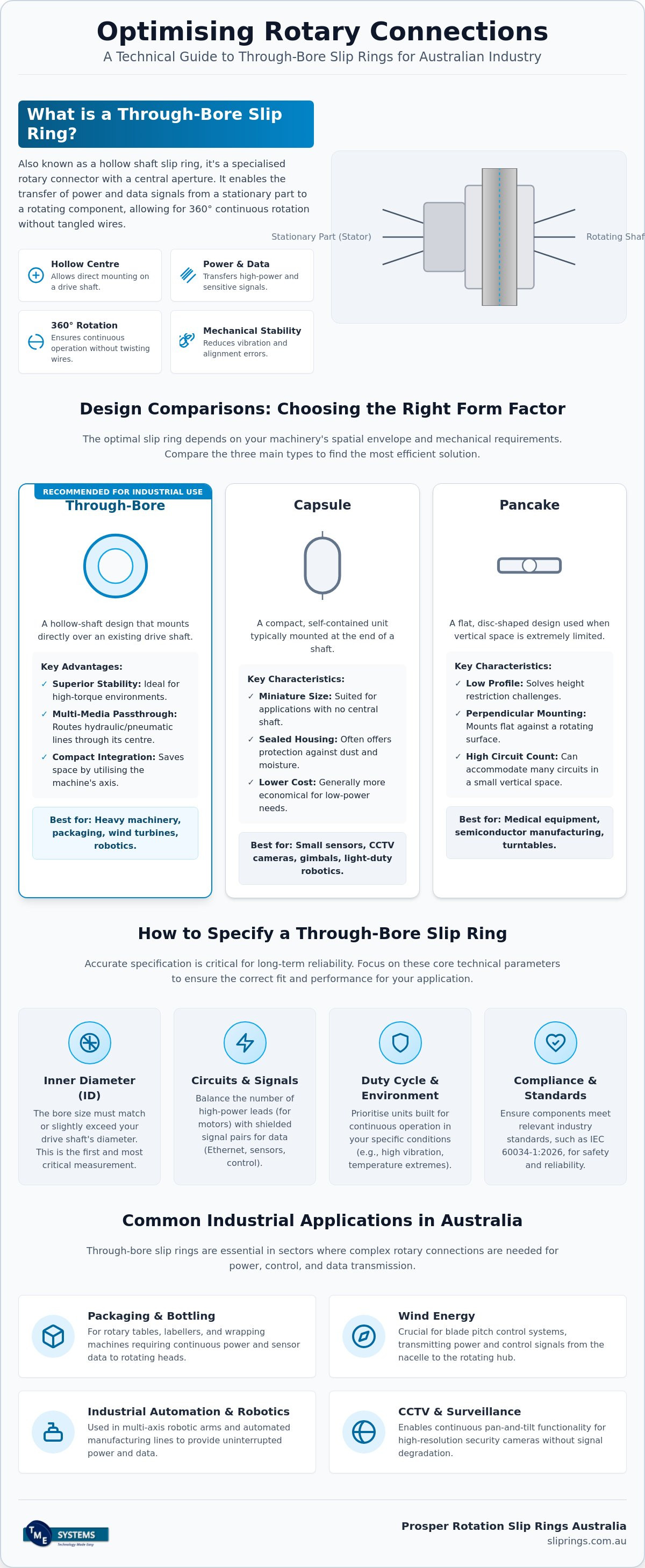
A through-bore slip ring, also known as a hollow shaft slip ring, is a specialised rotary connector designed with a central aperture. If you are new to the technology, it's helpful to understand What is a Slip Ring? at a foundational level. Essentially, these units allow for the transmission of electrical power and data signals between a stationary source and a rotating component. By integrating Prosper Rotation slip rings Australia into your machinery, you can achieve 360-degree continuous rotation without the risk of tangling or twisting internal wiring. This design is critical for industrial applications where mechanical constraints prevent the use of standard end-of-shaft connectors.
Modern hollow shaft units are engineered to handle a broad range of electrical loads. You can specify configurations that manage high-power transmission for drive motors alongside sensitive signal pairs for Ethernet or sensor data. The physical separation of these circuits within the housing is vital to prevent electromagnetic interference; this ensures your machinery's control systems remain stable even during heavy load cycles. Because the unit mounts directly onto the rotating shaft, it provides a more stable electrical connection than designs that rely on external mounting brackets.
The Mechanical Advantage of the Hollow Centre
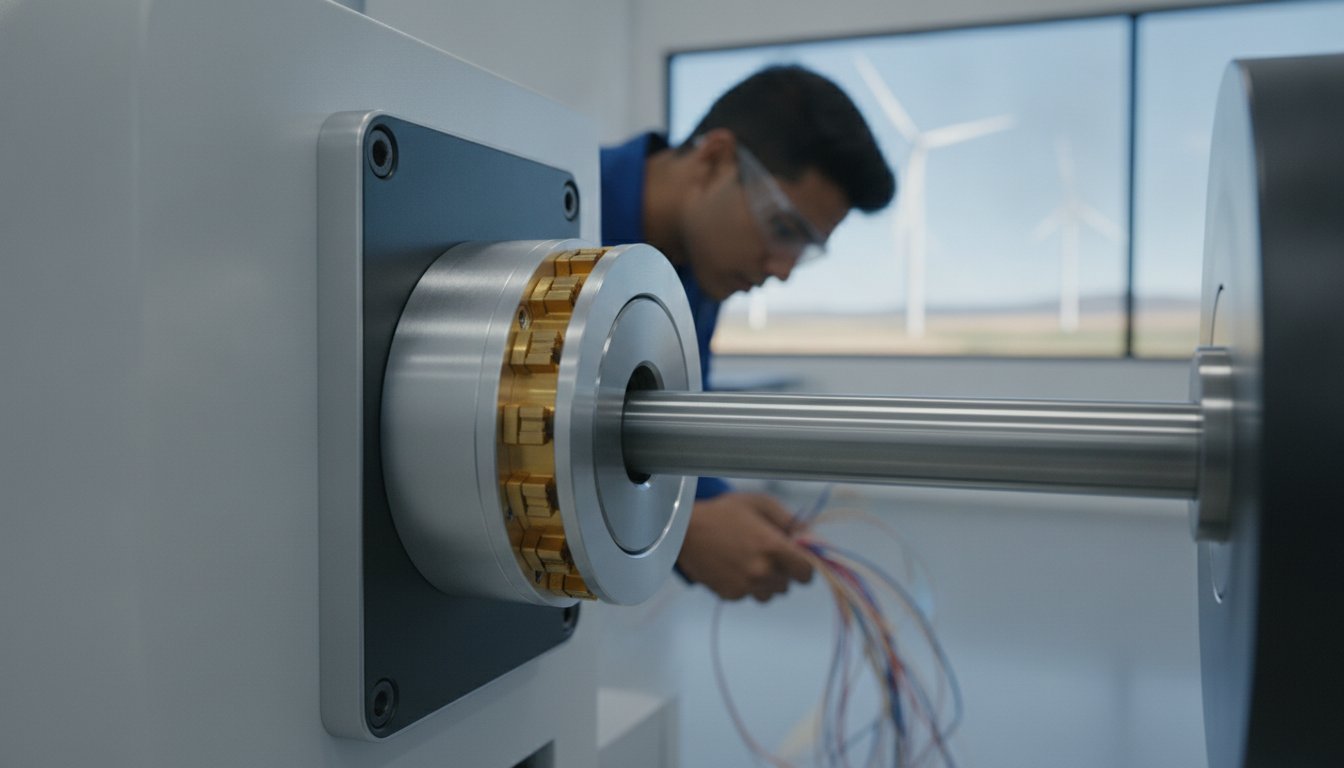
One of the most significant benefits of the through-bore design is its ability to facilitate multi-media integration. The central hole can route auxiliary lines, such as pneumatic or hydraulic hoses, directly through the machine's axis. This co-axial mounting approach allows for a more compact machine centre by nesting electrical and fluid components together. By aligning the slip ring precisely with the axis of rotation, you also reduce mechanical stress on the unit's internal bearings. This alignment is a practical way to extend the operational lifespan of the connector in heavy-duty environments.
Anatomy of a Hollow Shaft Slip Ring
Understanding the physical layout is key to correct installation. The unit consists of a rotor, which is the part that rotates with your drive shaft, and a stator, which remains stationary and connects to your power supply or control cabinet. When specifying Prosper Rotation slip rings Australia, you must consider the relationship between the inner diameter (ID) and the outer diameter (OD) to ensure the housing fits within your equipment's available space. The bore is the internal diameter of the hollow shaft that dictates compatibility with your machine's central drive shaft.
Design Comparisons: Through-Bore vs Capsule and Pancake Slip Rings
Selecting the correct rotary connector requires a deep understanding of your equipment's spatial envelope. It isn't just about electrical capacity; it's about how the physical housing interacts with the moving parts of your machine. When you evaluate Prosper Rotation slip rings Australia, you'll find that the through-bore design is often the primary choice for heavy industrial applications. This is because it allows for direct integration with existing drive shafts, providing a level of mechanical stability that other form factors struggle to match. For a broader look at sourcing these components, you might find our Industrial Slip Ring Supplier Australia: A Professional Procurement Guide useful.
Through-Bore vs Capsule Slip Rings
Capsule slip rings are generally the preferred solution for miniature applications where there is no central shaft to accommodate. They are compact and often fully sealed, making them ideal for small sensors or CCTV systems. However, through-bore units are far superior when you need to integrate with heavy machinery. High-torque industrial shafts generate significant mechanical forces that capsule designs aren't built to withstand. By using a hollow shaft design, the slip ring surrounds the shaft rather than sitting at the end of it, which reduces the risk of alignment errors. If your project involves tight spaces, you can read more in our Compact Slip Rings: A Technical Guide to Industrial Miniaturisation.
Through-Bore vs Pancake Slip Rings
Pancake slip rings are specifically designed for applications with severe vertical height constraints. They use a flat, disc-like arrangement for the rings and brushes. While they solve the problem of axial height, they often require a much larger radial diameter and can suffer from increased brush wear at high RPMs due to the varying circumference of the rings. Through-bore models are the standard for radial space efficiency. They offer more consistent signal integrity at speed because the contact points are more uniform. Maintenance is also simplified with through-bore housings; they often provide easier access to the brush blocks for inspection compared to the cramped internal layout of a pancake unit.
Choosing between these styles depends entirely on your specific duty cycle and mechanical footprint. If you're unsure which configuration fits your machinery, engaging in technical application consulting can help you avoid costly specification errors and ensure long-term operational reliability.
Key Technical Specifications: Sizing, Circuits, and Contact Technology
Specifying a through-bore unit requires a methodical approach to both mechanical and electrical variables. The first parameter to define is the inner diameter (ID). This dimension must accommodate your drive shaft with enough clearance for a secure fit without allowing for eccentric movement. An incorrect ID specification leads to vibration, which accelerates brush wear and introduces electrical noise. When you source Prosper Rotation slip rings Australia, the selection process focuses on matching this central bore to your specific shaft tolerances to ensure long-term mechanical stability.
Electrical requirements in the Australian industrial sector often demand a mix of power and data. Your unit must be rated for standard Australian voltages, typically 240V for single-phase or 415V for three-phase industrial equipment. Balancing circuit counts is a critical part of the design phase. You might require high-current rings for motor power alongside shielded twisted pairs for sensitive data. Packing too many circuits into a small envelope can increase the risk of cross-talk, so it's vital to provide clear data on your signal types during the consulting phase.
Rotational speed, measured in RPM, directly impacts the longevity of the internal contacts. High speeds increase the sliding velocity of the brushes, which generates heat and potential signal degradation. It's important to select a unit where the maximum rated RPM exceeds your machine's peak operating speed by a safe margin to prevent premature failure.
Contact Materials and Signal Integrity
The choice of contact material dictates how well the unit handles different signal types. Gold-on-gold contacts are the industry standard for low-voltage sensor signals and data transfer because they provide excellent conductivity and resist oxidation. Silver-on-silver is often preferred for higher power applications due to its durability under load. If your application involves high-speed data with extremely low noise requirements, you may need to consider Meridian Laboratory slip rings, which utilise specialised contact technologies to maintain signal integrity in demanding environments.
Environmental Protection and IP Ratings
Environmental variables determine the necessary Ingress Protection (IP) rating for your slip ring. A clean factory environment might only require an IP51 rating to protect against dust. However, Australian packaging or bottling facilities often require IP65 or IP67 ratings to withstand wash-down procedures and moisture. You must also choose the housing material carefully. While aluminium is sufficient for many applications, stainless steel is the better choice for corrosive environments or food-grade installations. Be aware that higher levels of sealing increase internal friction, which can lower the maximum allowable RPM of the through-bore unit.
Industrial Applications: When to Specify a Through-Bore Solution
Through-bore slip rings serve as critical mechanical integration tools across diverse Australian sectors. In high-speed packaging and bottling facilities, rotary tables and indexing machines rely on these units to maintain constant electrical connectivity while rotating at variable speeds. The hollow centre allows the machine's drive shaft to pass through the unit, ensuring the slip ring remains concentric and reduces vibration during rapid acceleration and deceleration cycles. This mounting style is essential for maintaining the high duty cycles required in local manufacturing plants.
Renewable energy is another primary sector for this technology. Wind turbines require large-bore connectors to manage power and pitch control signals through the main turbine shaft. Similarly, the Australian mining and bulk handling industry demands high-specification hardware that can withstand abrasive environments and heavy mechanical loads. For these heavy-duty requirements, BGB Innovation slip rings provide the necessary robustness to handle high current loads and mechanical shock without signal degradation.
In surveillance, CCTV pedestals often use through-bore units so that tilt motor cables can pass safely through the centre of the rotation axis. This prevents cable fatigue and ensures a full 360-degree field of vision without mechanical interference. When you specify Prosper Rotation slip rings Australia, you're selecting a component designed to solve these specific routing challenges. Choosing Prosper Rotation slip rings Australia ensures that your equipment meets the rigorous demands of both indoor automation and outdoor infrastructure.
Robotics and Automated Manufacturing
In modern manufacturing, the hollow bore is often utilised for routing vacuum lines or pneumatic hoses in robotic pick-and-place systems. This allows end-of-arm tooling to operate without external cable loops that could snag or wear. Continuous 360-degree rotation in robotic welding cells is also achievable, eliminating cable strain and reducing maintenance downtime. For a deeper look at these engineering challenges, consult our guide on Slip Ring Application Engineering: A Technical Reference for Australian Industry.
Water Treatment and Infrastructure
Large-scale infrastructure projects, such as water treatment plants, utilise through-bore units in clarifiers and rotating bridges. These applications require high environmental resilience and the ability to transmit safety-critical signals reliably over long periods. Modularity is key here; Australian infrastructure often requires custom configurations that can be maintained on-site. This same reliability is vital for rotating amusement park attractions, where electrical continuity is a non-negotiable safety requirement. If you need help determining the correct bore size or circuit configuration for your specific application, contact us for specialist technical consulting today.
Selecting Prosper Rotation Slip Rings for Australian Engineering Projects
Specifying the correct rotary connector is a task that requires more than just matching a part number. While off-the-shelf components might seem convenient, they often fail to account for the specific environmental and mechanical variables found in Australian industrial sites. Partnering with a local specialist like TME Systems Pty Ltd ensures your project benefits from national support and expertise, moving beyond the limitations of generic online configurators. When you select Prosper Rotation slip rings Australia, you're engaging with a technical partner that understands the complexities of bore sizing and circuit integration for high-torque applications.
To ensure a successful installation, you must provide several critical data points during the procurement phase. These include the precise inner and outer diameter (ID/OD) requirements to fit your existing shaft, the required current per circuit, and the expected duty cycle of the machinery. Understanding whether the unit will operate in a continuous or intermittent fashion allows for a more accurate assessment of brush wear and thermal management. Providing these details upfront helps our technical team recommend a unit that maintains electrical stability throughout its operational life.
We also recommend future-proofing your design by considering spare circuits. It's often more cost-effective to include a few additional rings during the initial build than to replace the entire unit later. These spare circuits can accommodate future sensor upgrades, Ethernet integration, or camera systems as your automated processes evolve. This proactive approach reduces long-term capital expenditure and minimises potential downtime during future equipment overhauls.
Customisation and Modular Options
There are many instances where a standard through-bore unit isn't sufficient for the task. You might require custom lead lengths to reach a distant control cabinet or specific industrial connectors to match existing wiring looms. Exploring the range of Prosper Rotation slip rings allows you to access versatile configurations tailored for the AU market. For projects requiring even higher levels of flexibility, our guide on Modular Slip Rings: A Technical Guide to Flexible Rotary Connections explains how these systems can be adapted to changing mechanical requirements.
Next Steps for Technical Procurement
If you're currently dealing with signal noise challenges or mechanical mounting constraints, requesting a technical audit of your rotary connections is a practical first step. Our team provides application engineering support to help you identify the root cause of electrical interference or premature component wear. When you request a quote, we include local Australian technical assistance to ensure the unit you receive is perfectly aligned with your machinery's performance specifications. We invite you to consult with TME Systems Pty Ltd to discuss your specific through-bore requirements and ensure your next project is built on a foundation of technical excellence.
Advancing Your Industrial Rotary Connections
Integrating through-bore technology into your machinery provides a robust solution for complex electrical and mechanical routing challenges. By choosing the hollow shaft design, you ensure your equipment maintains mechanical stability while facilitating 360-degree continuous rotation. Precise specification of bore size, circuit count, and environmental protection is vital for long-term operational longevity as your industrial requirements evolve.
TME Systems Pty Ltd serves as an authorised Australian distributor for BGB, Meridian Lab, and Prosper Rotation, providing national supply coverage and specialist application engineering support. We help you navigate the technical variables of Prosper Rotation slip rings Australia to ensure your project meets the highest performance standards. Our team is ready to assist with technical audits and custom configurations tailored to your specific industrial needs.
Contact TME Systems Pty Ltd for expert technical assistance with your through-bore slip ring selection. We look forward to helping you enhance your machinery's reliability with professional rotary solutions.
Frequently Asked Questions
What is the maximum bore size available for industrial through-bore slip rings?
Prosper Rotation provides through-bore slip rings with internal diameters ranging from 3mm up to 900mm. This extensive range allows for integration with everything from miniature precision instruments to the massive drive shafts found in heavy Australian infrastructure and mining equipment. When you specify Prosper Rotation slip rings Australia, you can select a bore size that precisely matches your existing mechanical requirements.
Can through-bore slip rings handle both power and high-speed data signals simultaneously?
Yes, these units are specifically engineered to manage high-current power leads alongside sensitive high-speed data signals within a single housing. To prevent electromagnetic interference, the internal circuits are physically separated and often use shielded twisted pairs. This configuration is essential for modern automated systems that require both 415V motor power and stable Ethernet or Fieldbus communication for real-time control.
How do I ensure the slip ring bore fits my machine shaft correctly?
To ensure a secure fit, you must match the slip ring's inner diameter to your machine's shaft diameter while accounting for thermal expansion and mounting tolerances. Most units are secured using set screws or clamping collars that lock the rotor directly to the shaft. Providing exact shaft dimensions during the technical consulting phase ensures the unit operates concentrically, which is vital for reducing vibration and brush wear.
Do through-bore slip rings require regular maintenance or lubrication in dusty environments?
Most modern through-bore units are designed to be maintenance-free and do not require manual lubrication of the internal contact surfaces. In dusty Australian industrial settings, the key to longevity is specifying an appropriate Ingress Protection rating, such as IP65. This prevents dust particles from entering the housing and contaminating the contacts, which ensures the Prosper Rotation slip rings Australia maintain electrical integrity without the need for frequent intervention.
What is the difference between a hollow shaft slip ring and a rotary union?
A hollow shaft slip ring is designed to transmit electrical power and data signals across a rotating interface. In contrast, a rotary union is a mechanical device used to transfer fluids or gases, such as hydraulic oil or compressed air. While they perform different functions, they are frequently integrated into the same assembly, with the slip ring's central bore providing the necessary clearance for the rotary union's fluid lines.
Are there through-bore slip rings rated for hazardous or explosive industrial environments?
Specialised through-bore slip rings can be supplied with explosion-proof ratings for use in hazardous zones common in the Australian mining and petrochemical sectors. These units feature reinforced housings and advanced sealing technologies to ensure they don't become an ignition source. It's critical to specify the exact hazardous zone classification during procurement to ensure the hardware meets the mandated safety standards for your specific site.
How does the RPM rating change as the bore size of the slip ring increases?
As the bore size increases, the maximum allowable RPM typically decreases. This occurs because a larger diameter increases the sliding velocity of the brushes against the rings, which generates higher levels of friction and heat at the contact point. For high-speed applications involving large shafts, you may need to consider specialised contact materials or cooling configurations to maintain reliable electrical performance over long duty cycles.
Can I route hydraulic or pneumatic lines through the centre of a through-bore slip ring?
Routing pneumatic or hydraulic lines through the central bore is one of the primary mechanical advantages of this design. This co-axial arrangement allows you to pass fluid or gas lines directly through the machine's axis of rotation, creating a highly compact and integrated system. This is particularly useful in robotic welding or pick-and-place applications where both electrical power and vacuum or air pressure are required at the end-of-arm tooling.