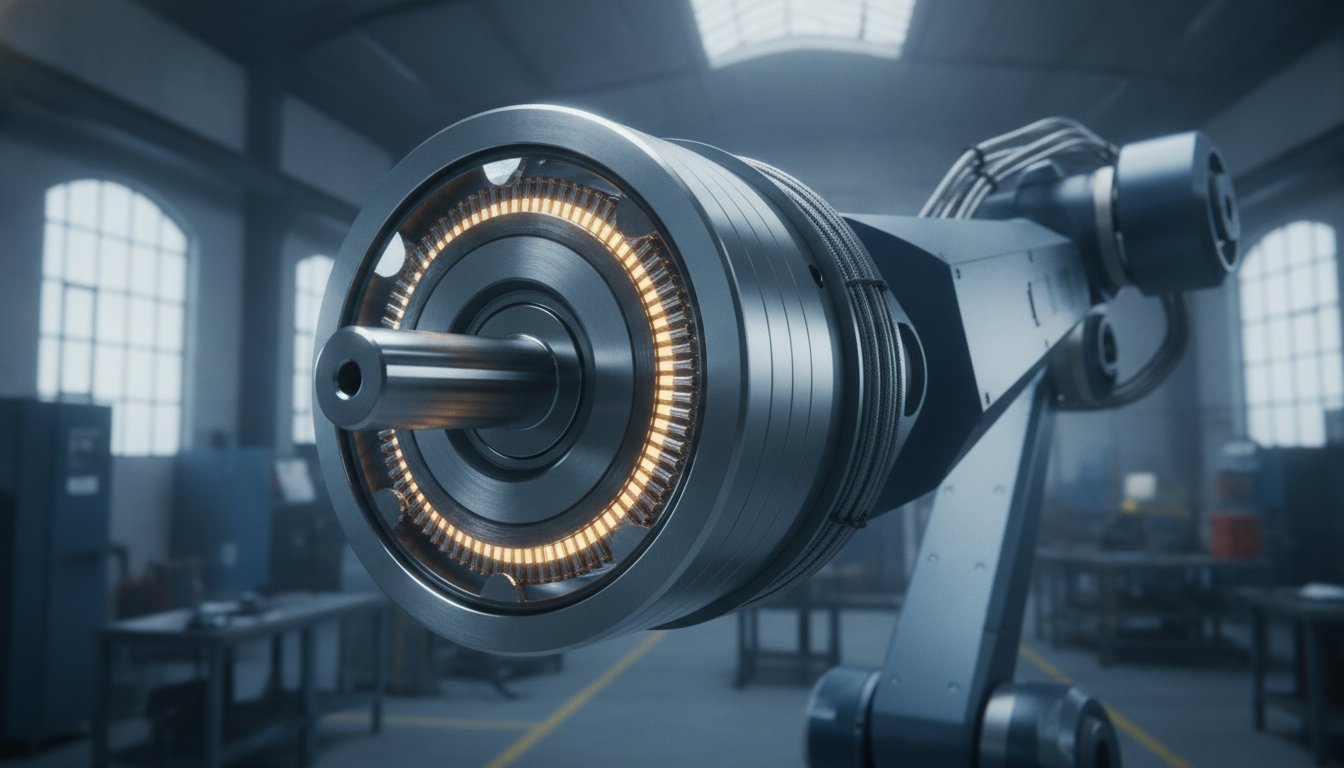
Integrating electrical power into a rotating shaft isn't just an engineering hurdle; it's often the primary bottleneck in machinery performance. You've likely dealt with the frustration of signal interference or the physical impossibility of mounting a standard capsule connector onto a pre-existing drive shaft. A through bore slip ring solves these mechanical constraints by providing a hollow centre that allows for the passage of shafts, cooling lines, or pneumatic pipes.
Selecting the correct rotary connector requires a balance between electrical performance and mechanical fit. You'll discover the mechanical advantages and technical specifications of world-leading brands like BGB Innovation and Prosper Rotation to help optimise your rotary electrical connections. We'll provide a clear framework for comparing different styles, ensuring you have the confidence to specify a unit that withstands the rigours of Australian industrial applications. This guide covers everything from circuit counts to environmental resilience, bridging the gap between complex manufacturing capabilities and your specific project needs.
Key Takeaways
- Understand why a through bore slip ring is the preferred choice for mounting directly onto rotating drive shafts in high-torque industrial environments.
- Learn how to evaluate equipment envelope constraints by comparing hollow shaft designs against capsule and pancake alternatives.
- Identify the critical technical parameters required for accurate specification, including inner diameter sizing, circuit counts, and duty cycles.
- Explore common industrial applications within the Australian market, such as rotary indexing tables and wind turbine pitch control systems.
- Gain a framework for professional technical selection to avoid the risks associated with off-the-shelf procurement for specialised machinery.
What is a Through-Bore Slip Ring? The Fundamentals of Hollow Shaft Design
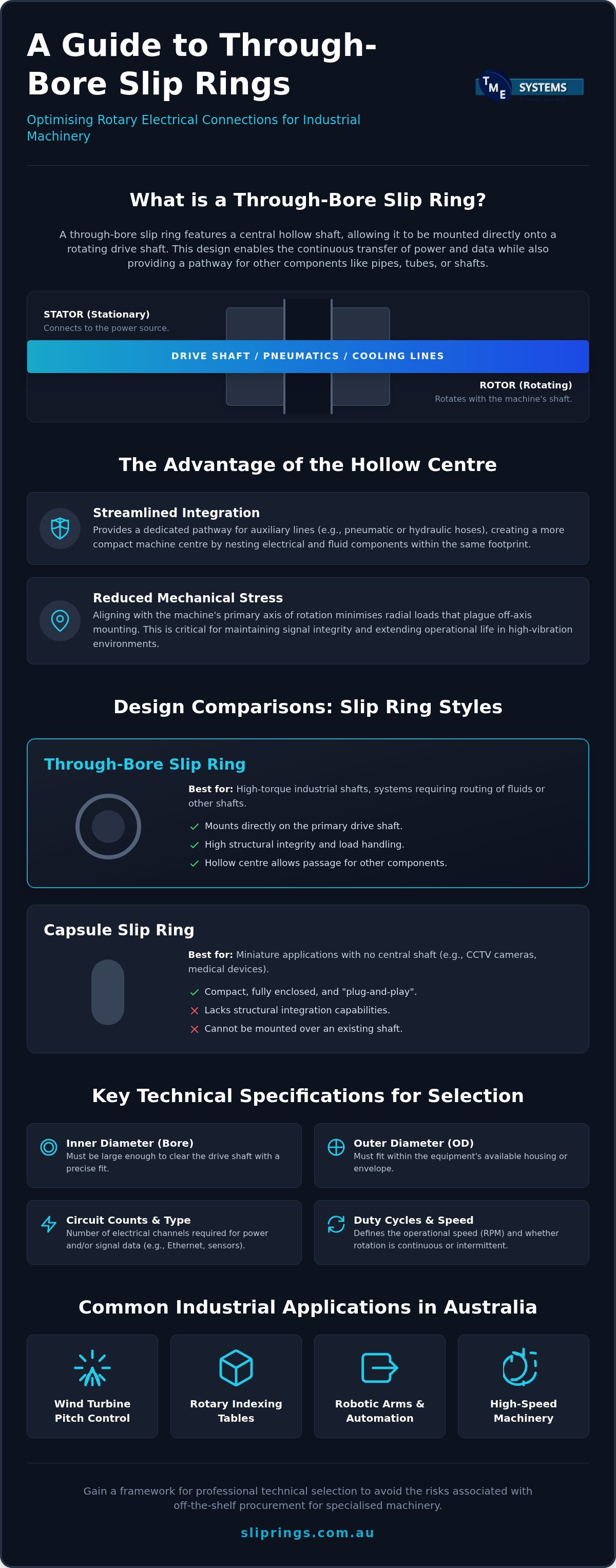
A Slip ring is a fundamental component for any system requiring power or data transfer across a rotating interface. In many industrial settings, engineers face the challenge of integrating these connectors into existing mechanical assemblies. A through bore slip ring addresses this by featuring a central aperture, which allows the unit to be mounted directly onto a rotating drive shaft. This design facilitates 360-degree continuous rotation without the risk of wire fatigue or cable tangling.
These units are versatile. They can transmit high-current power for motors while simultaneously handling sensitive signal data for sensors or Ethernet communication. By passing the rotating shaft through the centre of the connector, the assembly maintains a streamlined profile. It's an essential feature for modern high-speed machinery where space is at a premium.
The Mechanical Advantage of the Hollow Centre
The central hole offers more than just a mounting point. It provides a dedicated pathway for routing auxiliary lines. For example, you can run pneumatic or hydraulic hoses through the centre of the slip ring to supply actuators on the rotating side. This co-axial mounting technique creates a more compact machine centre by nesting electrical and fluid components within the same footprint. It solves the common problem of integrating multiple utility types into a single rotating joint.
Aligning the slip ring with the machine's primary axis of rotation also reduces mechanical stress. Because the unit is supported by the drive shaft itself, it minimises the radial loads that often plague off-axis mounting configurations. This alignment is critical for maintaining signal integrity and extending the operational life of the internal contacts in high-vibration environments.
Anatomy of a Hollow Shaft Slip Ring
Understanding the physical structure is the first step toward successful specification. The assembly consists of a rotor, which is the internal component that rotates with the shaft, and a stator, which remains stationary and connects to the power source. Contacts within the housing maintain the electrical connection as the rotor turns.
When selecting a unit for Australian machinery, you must balance the inner diameter (ID) with the outer diameter (OD). The ID must be large enough to clear the shaft with a precise fit, while the OD must fit within the equipment's housing. The 'bore' is the internal diameter that dictates shaft compatibility. Brands like BGB Innovation and Prosper Rotation offer various bore sizes to suit diverse engineering requirements, ensuring the through bore slip ring integrates seamlessly into heavy-duty industrial turntables or robotic arms.
Design Comparisons: Through-Bore vs Capsule and Pancake Slip Rings
Choosing the right rotary connector requires a careful evaluation of the physical "envelope" within your machinery. While electrical specifications are paramount, the mechanical form factor determines whether a unit can be successfully integrated or if it will become a point of failure. If you are currently evaluating your options, consulting an Industrial Slip Ring Supplier in Australia can help you navigate these mechanical constraints.
For high-torque industrial shafts, the through bore slip ring is often the default choice. Its design allows it to sit directly on the axis of rotation, which handles mechanical loads more effectively than offset designs. This robust approach to rotary connections is well-documented in historical engineering, such as the design principles seen in this NASA patent for a rotary joint. Furthermore, maintenance requirements vary across housing styles; through-bore units generally offer better access for brush inspection and debris removal compared to sealed, miniature designs.
Through-Bore vs Capsule Slip Rings
Capsule slip rings are ideal for miniature applications where there's no central shaft to accommodate. These units are typically fully enclosed and pre-wired, making them "plug-and-play" for small equipment like CCTV cameras or medical devices. However, they lack the structural integration capabilities of a through-bore unit. When you need to mount a connector onto a pre-existing drive shaft or pass other lines through the centre, the through-bore style is essential. For engineers focused on smaller footprints, our Technical Guide to Industrial Miniaturisation details how to specify compact rotary solutions.
Through-Bore vs Pancake Slip Rings
Pancake slip rings are designed for applications with severe vertical height constraints. By arranging the conductive tracks on a flat plane like a platter, they achieve a very slim profile. However, this comes at the cost of a much larger diameter and potential signal integrity issues.
In a through bore slip ring, the brushes and rings are stacked vertically, maintaining consistent contact speed across all circuits. In contrast, the outer rings of a pancake design travel at a higher linear speed than the inner rings. This leads to uneven brush wear and increased electrical noise at higher RPMs. Unless your machine's vertical space is extremely limited, the radial efficiency and superior signal quality of a through-bore unit make it the more reliable long-term investment. If you're unsure which housing style suits your duty cycle, our team can provide technical application consulting to ensure your selection matches your operational reality.
Key Technical Specifications: Sizing, Circuits, and Contact Technology
Specifying a through bore slip ring requires a methodical approach to both mechanical and electrical parameters. The most critical mechanical dimension is the inner diameter (ID). This must accommodate your drive shaft with enough clearance to prevent binding while ensuring a secure fit. In Australian industrial environments, we often see shafts ranging from 12mm to over 300mm. Selecting the correct ID is the foundation of the assembly, as it dictates the overall physical footprint and the maximum allowable rotational speed.
Electrical requirements are equally important. You must balance the number of power circuits with sensitive signal pairs. For Australian power standards, units must be rated for 240V single-phase or 415V three-phase applications. High-current power leads typically require larger rings and brushes, which can increase the outer diameter of the unit. Conversely, data signals for Ethernet or Fieldbus protocols require shielded circuits to prevent electromagnetic interference from the adjacent power lines. Rotational speed (RPM) also plays a decisive role. As RPM increases, the friction at the contact interface generates heat, which can accelerate brush wear and introduce electrical noise into the signal path.
Contact Materials and Signal Integrity
The choice of contact material directly impacts signal reliability. Gold-on-gold contacts are the gold standard for low-voltage, low-current signals due to their excellent conductivity and resistance to oxidation. Silver-on-silver contacts are often preferred for power transmission because they handle higher current densities more effectively. While electrical contacts are standard, some high-bandwidth applications might eventually look toward a broadband optical rotary joint for interference-free data transfer. For most industrial Ethernet needs, Meridian Laboratory slip rings provide high-speed, low-noise performance that maintains data integrity even in electrically noisy environments.
Environmental Protection and IP Ratings
Environmental variables dictate the level of ingress protection required. For clean, indoor factory settings, an IP51 rating is usually sufficient to prevent dust from interfering with the contacts. However, for outdoor mining or marine applications, you should specify IP65 or IP67 ratings to protect against moisture and heavy particulates. Housing materials also matter. Lightweight aluminium is common for standard use, but stainless steel is required for corrosive environments or food-grade washdown zones. Higher levels of sealing increase friction. This added drag can lower the maximum allowable RPM of the through bore slip ring, so it's vital to factor this trade-off into your design calculations.
Industrial Applications: When to Specify a Through-Bore Solution
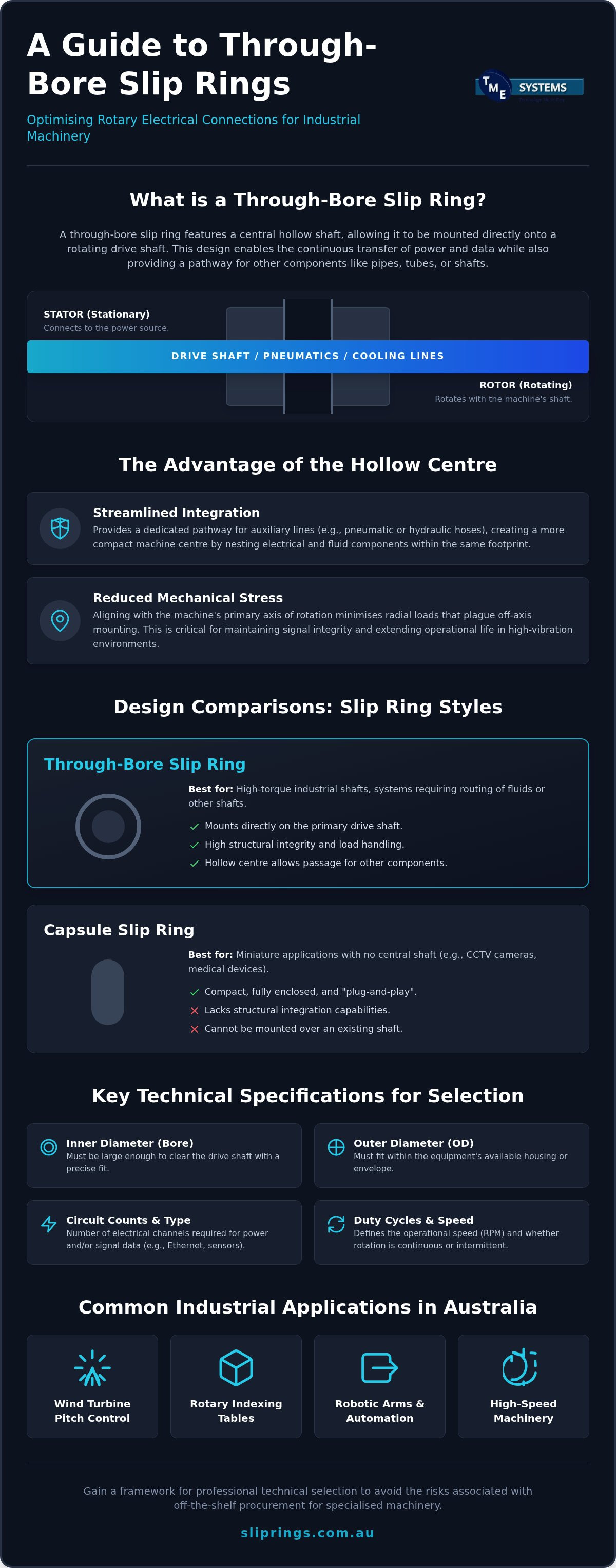
Industrial machinery in Australia often operates under demanding duty cycles where mechanical simplicity is key. A through bore slip ring is the standard solution for rotary indexing tables in packaging facilities across Sydney and Melbourne. These machines require high-speed, continuous rotation to manage filling and capping lines. By mounting the slip ring directly onto the main drive shaft, engineers eliminate the need for complex offset belt drives, reducing the overall parts count and potential failure points.
In the renewable energy sector, wind turbines rely on these hollow-shaft designs to manage power and pitch control signals. The central bore allows the hydraulic or electrical lines for the blade pitch actuators to pass through the main rotor shaft without interference. Similarly, heavy-duty mining equipment, such as stackers and reclaimers, requires the robust performance found in BGB Innovation slip rings. These units are built to withstand the abrasive dust and vibration common in the Pilbara and Hunter Valley, where downtime is exceptionally costly.
Surveillance technology also benefits from this configuration. In high-end CCTV pedestals, a through bore slip ring allows the camera's tilt and pan motors to rotate indefinitely. The hollow centre provides a clear path for the high-definition video cables, preventing the signal degradation that occurs when cables are twisted or stressed during repetitive movement. This mechanical routing is far superior to external cable management systems which eventually fatigue and fail.
Robotics and Automated Manufacturing
Modern robotic welding cells require 360-degree mobility to access complex joints. Integrating a through-bore unit into the robot's wrist or base ensures that power and gas lines remain untangled. This is particularly useful for end-of-arm tooling that uses vacuum lines for pick-and-place operations; the vacuum hose passes through the bore while electrical signals control the sensors. For a deeper dive into these configurations, see our guide on Slip Ring Application Engineering.
Water Treatment and Amusement Rides
Large-scale infrastructure projects, such as water clarifiers or rotating bridges at treatment plants, utilise massive through-bore units. These systems often require modularity to facilitate on-site maintenance without dismantling the entire drive assembly. This same principle applies to amusement park attractions. Safety-critical signals for passenger restraints must be transmitted reliably across a rotating interface. In these scenarios, the hollow shaft design provides the necessary structural integrity and redundant signal paths required by Australian safety standards.
To find the right fit for your next project, speak with our technical consulting team for a detailed application audit.
Selecting the Right Rotary Connector for Australian Engineering Projects
Procuring a through bore slip ring shouldn't be a generic e-commerce transaction. Because these units serve as both electrical connectors and mechanical interfaces, selecting a unit from a catalogue without technical validation often leads to integration failures. Professional technical selection ensures that the unit's mechanical tolerances align with your shaft's thermal expansion and rotational vibration. This consultative approach is what separates a reliable industrial installation from a costly maintenance headache. Partnering with a specialist like TME Systems Pty Ltd provides the expertise needed to navigate these complexities.
When you're ready to specify a unit, you'll need to provide several specific data points. The inner diameter (ID) must match your shaft with precision, while the outer diameter (OD) must fit your equipment's housing constraints. You also need to define the current per circuit in Amps and the expected duty cycle. A unit designed for intermittent rotation will fail prematurely if used in a 24/7 continuous production line. Providing these parameters early allows for a more accurate technical match and prevents operational downtime.
It's also wise to future-proof your assembly. We recommend specifying at least two to four spare circuits beyond your current requirements. This allows for the future integration of sensors or data lines without the cost of a complete hardware replacement. Having these redundant paths ready can save significant costs when upgrading machinery for Industry 4.0 standards. Working with TME Systems Pty Ltd gives you access to national support and expertise from our NSW base, ensuring your project remains on track through every stage of the design cycle.
Customisation and Modular Options
Standard units don't always meet every requirement. You might need custom lead lengths or specific industrial connectors to match your existing wiring looms. For these versatile configurations, we often recommend Prosper Rotation slip rings. Their modular design allows for a high degree of flexibility in circuit counts and housing materials. You can learn more about these adaptable systems in our Technical Guide to Flexible Rotary Connections.
Next Steps for Technical Procurement
If you're facing ongoing rotary connection challenges, the first step is a technical audit. This process identifies the root cause of signal noise or mechanical wear in your current setup. By requesting a quote that includes local Australian technical assistance, you ensure that you aren't just buying a part, but a validated solution. Our team provides the documentation and engineering support required for successful installation and long-term reliability. We invite you to consult with TME Systems Pty Ltd to discuss your specific through-bore requirements and ensure your machinery operates at peak efficiency.
Optimising Your Rotary Electrical Connections
Selecting a through bore slip ring is a critical step in ensuring the mechanical and electrical longevity of your industrial machinery. You've seen how precise bore sizing and high-quality contact materials can eliminate signal interference and mechanical bottlenecks. Whether you're managing power for wind turbines or routing pneumatic lines in a robotic cell, the right hollow shaft design provides a streamlined solution for complex engineering challenges.
As the authorised Australian distributor for world-leading brands like BGB Innovation, Meridian Laboratory, and Prosper Rotation, TME Systems Pty Ltd provides specialist application engineering support for complex rotary projects. We offer national supply coverage from our NSW base to ensure your machinery operates with maximum reliability. Contact TME Systems Pty Ltd for expert technical assistance with your through-bore slip ring selection. We look forward to helping you achieve technical excellence in your next industrial project.
Frequently Asked Questions
What is the maximum bore size available for industrial through-bore slip rings?
Industrial units are available in a wide range of sizes, with some heavy-duty models reaching inner diameters of 300mm or more. While standard industrial applications often utilise bores between 25mm and 100mm, custom engineering allows for much larger apertures. These massive units are typically found in large-scale Australian infrastructure, such as sewage treatment clarifiers or rotating bridges where substantial central clearance is required for the main pivot.
Can through-bore slip rings handle both power and high-speed data signals?
A through bore slip ring is capable of transmitting both high-current power and high-speed data signals simultaneously. To maintain signal integrity, these units incorporate internal shielding and specialised contact materials like gold-on-gold. This design prevents electrical noise from the power circuits from corrupting data packets in Ethernet or Fieldbus streams. It's a reliable solution for complex automated systems that require both motive power and real-time sensor feedback.
How do I ensure the slip ring bore fits my shaft correctly?
To ensure a correct fit, measure your drive shaft using precise callipers and account for any potential thermal expansion during high-duty cycles. The bore should be slightly larger than the shaft to allow for easy installation without mechanical binding. Most units are then secured using set screws or integrated clamping collars. This ensures the rotor turns in perfect synchronisation with the shaft while the stator remains fixed to the machine frame.
Do through-bore slip rings require regular maintenance or lubrication?
Maintenance needs vary significantly based on the contact technology and the operating environment. Standard carbon brush systems often require periodic inspection and the removal of conductive dust to prevent short circuits. In contrast, units featuring precious metal fibre brushes or sealed mercury-wetted contacts are designed for long-term, maintenance-free operation. Always check the manufacturer's specifications regarding the expected life span and any required cleaning intervals for your specific model.
What is the difference between a hollow shaft slip ring and a rotary union?
The primary difference lies in what they transmit. A slip ring transfers electrical energy and data signals, while a rotary union transfers fluids like oil, water, or compressed air. Engineers frequently combine these components by passing the fluid lines through the hollow shaft of the electrical connector. This integrated approach allows a single rotating joint to handle all utility requirements, from electrical power to pneumatic actuation, in a compact footprint.
Are there through-bore slip rings rated for hazardous or explosive environments?
Specialised through-bore units are manufactured with explosion-proof housings for use in hazardous areas. These models are designed to contain any internal sparks and prevent the ignition of external flammable gases or dust. You'll find these units in Australian mining, grain handling, and petrochemical facilities. It's vital to ensure the slip ring carries the appropriate certification for the specific hazardous zone classification of your industrial site to maintain safety compliance.
How does the RPM rating change as the bore size increases?
As the bore diameter increases, the maximum rated RPM typically decreases. A larger bore means the conductive rings have a larger circumference, which increases the linear travel speed of the brushes for every revolution. This higher surface speed generates more frictional heat and can lead to increased electrical noise or accelerated contact wear. When specifying a large-bore unit, always verify that the RPM rating meets your machine's peak operational requirements.
Can I route hydraulic lines through the centre of a through-bore slip ring?
One of the main benefits of a through bore slip ring is the ability to route hydraulic or pneumatic lines through the centre. This hollow path protects the hoses from external damage and prevents them from twisting during continuous rotation. It's an efficient way to supply fluid power to actuators or cooling systems on the rotating side of a machine without adding complexity to the external cable management system or drive assembly.