What happens to your rotary design when the vertical clearance is measured in millimetres rather than centimetres? For many Australian engineers, these tight spatial envelopes are a constant frustration, often forcing compromises in signal integrity or mechanical longevity. While a standard cylindrical unit might be the default choice, the pancake slip ring is often the only viable solution for applications where height is the primary constraint. You likely already know that managing electrical noise and mechanical wear in a flat-profile configuration requires a more nuanced approach than traditional through-bore models.
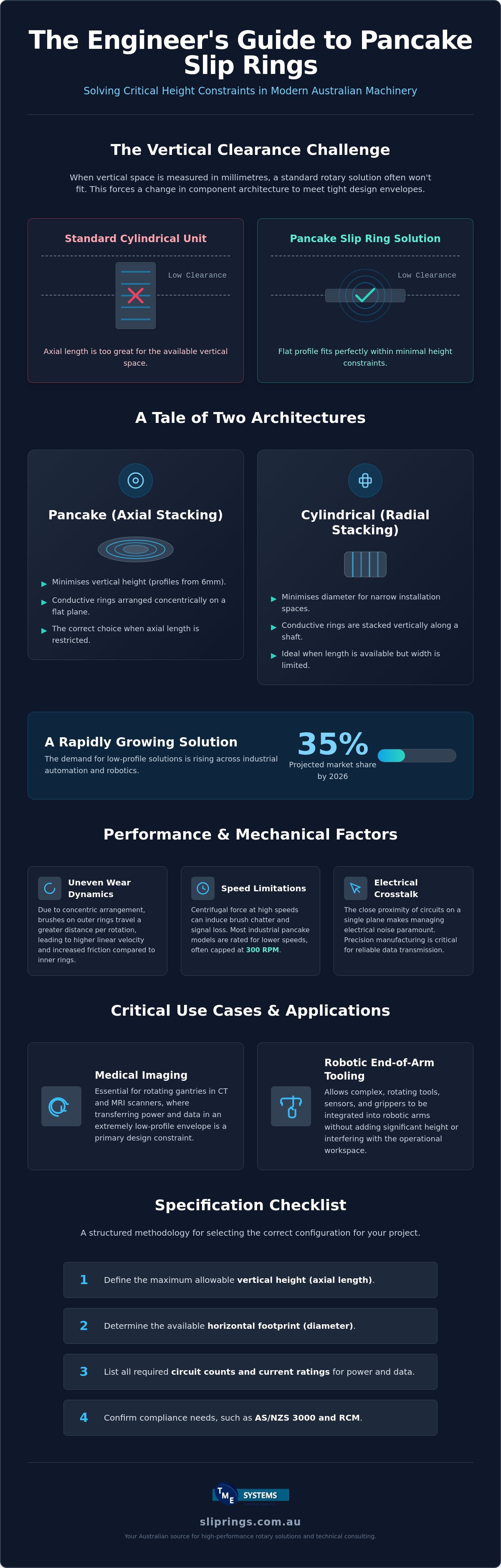
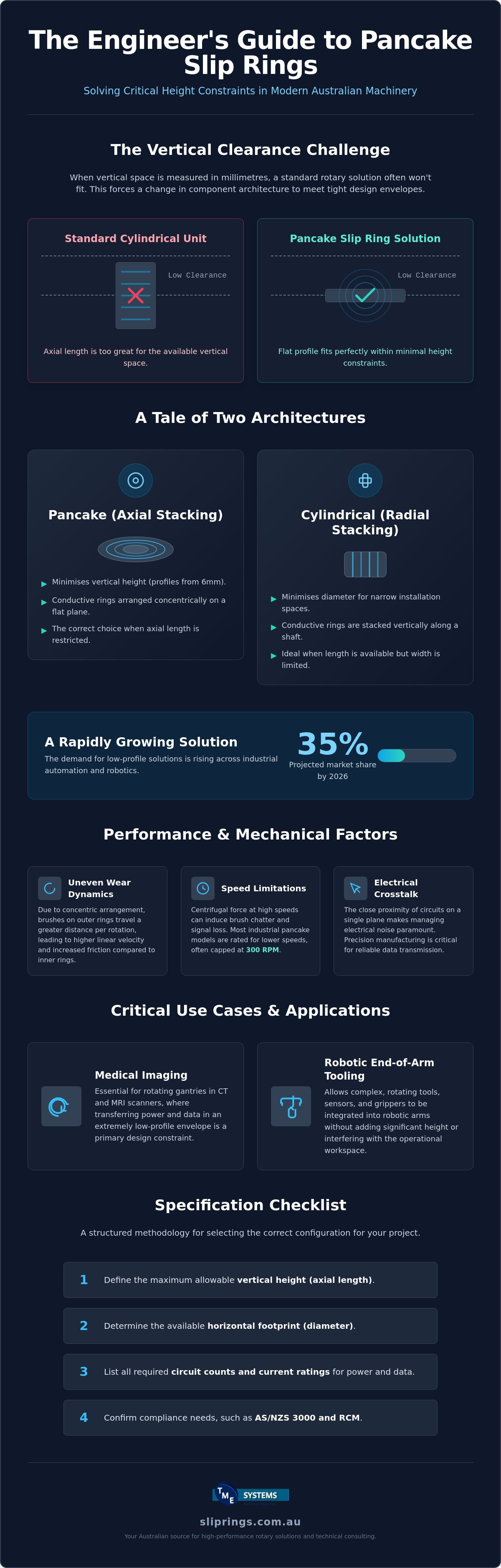
In this guide, you'll discover how pancake slip rings solve critical height constraints in industrial machinery and how to specify the correct configuration for your application. With pancake designs projected to account for 35% of the total slip ring market revenue by 2026, understanding their unique mechanics is becoming essential for modern industrial automation and robotics. We will examine the critical criteria for selecting circuit counts and current ratings while ensuring your equipment meets AS/NZS 3000:2018 standards and bears the necessary Regulatory Compliance Mark (RCM). This overview provides a clear pathway to sourcing high-performance components and technical consulting through established Australian expertise.
Key Takeaways
- Understand the fundamental architectural differences between cylindrical models and the pancake slip ring to determine suitability for low-clearance environments.
- Evaluate how mechanical factors such as brush pressure and centrifugal force impact electrical stability and wear in high-speed rotary applications.
- Identify critical use cases in medical imaging and robotic end-of-arm tooling where vertical space is the primary design constraint.
- Master a structured methodology for specifying hardware configurations based on restricted height, available diameter, and complex circuit requirements.
- Streamline procurement by accessing local technical consulting and premium global brands through an established Australian distributor.
What is a Pancake Slip Ring? Defining the Flat-Profile Architecture
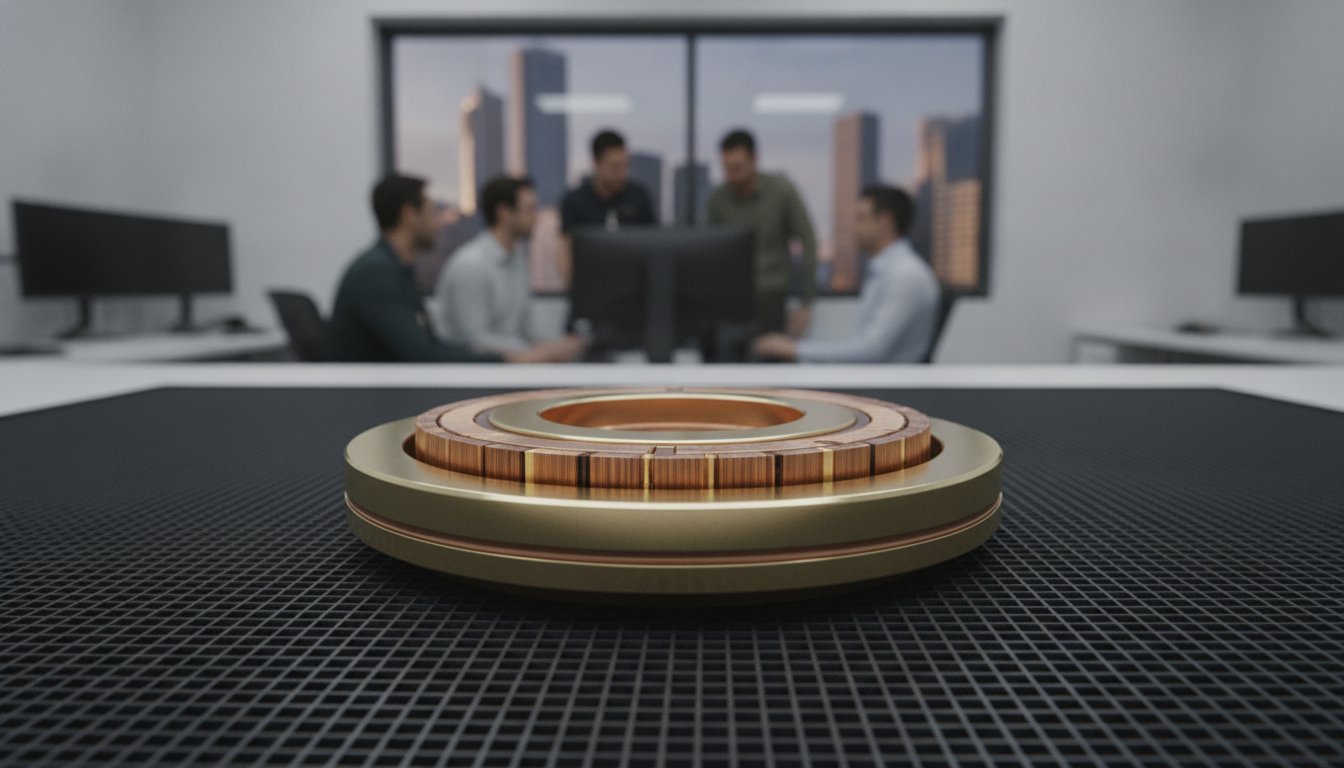
The "pancake" moniker is more than a descriptive label; it identifies a specific geometric solution to a common engineering problem. A Pancake slip ring is defined by its flat, disc-like architecture, where the conductive rings are arranged concentrically on a single horizontal plane. This contrasts sharply with standard cylindrical models where rings are stacked vertically along the shaft. The primary design objective is to minimise vertical height, often referred to as the axial length, at the expense of a larger horizontal footprint or diameter. In the Australian industrial sector, we frequently specify these units for equipment where height is severely restricted, with profiles starting from as little as 6mm.
Because the rings are arranged concentrically, the outer rings necessarily have a larger circumference than the inner rings. This variation in path length means the brushes on the outer circuits travel a greater distance per rotation than those near the centre. This is a critical technical consideration for predicting wear rates and signal consistency across different channels. When you select a pancake configuration, you're prioritising a low-profile envelope over the uniform brush wear typically found in cylindrical designs.
Pancake vs. Cylindrical Slip Rings
Choosing between these architectures depends entirely on your available spatial envelope. Cylindrical slip rings use radial stacking, which keeps the diameter small but increases the length of the assembly. In contrast, the pancake design uses axial stacking. If your design has ample horizontal space but cannot accommodate a long protruding shaft, the flat-profile model is the correct technical choice. For engineers dealing with extremely small-scale hardware where even a pancake's diameter is too large, compact slip rings may offer a more suitable alternative for miniaturisation. It's a matter of volume distribution; you're essentially flattening the cylinder into a disc to meet specific clearance requirements.
Integral vs. Separate Component Designs
Pancake assemblies are generally available in two distinct configurations to suit different integration needs. Housed units are self-contained assemblies that include the bearings and protective casing. These are straightforward to integrate into existing machinery and are often preferred for their environmental resilience. Alternatively, separate component designs consist of a rotor and stator kit, often manufactured using high-precision PCB technology. These ultra-thin kits allow for custom integration directly into the machine's existing bearing structure, further reducing the total footprint. In Australia, these components are typically constructed from robust materials like anodised aluminium or high-grade polymers to ensure they withstand local operational variables and maintain structural integrity during rotation.
Mechanical Architecture and Electrical Performance
The mechanical performance of a pancake slip ring is dictated by its planar geometry. Unlike cylindrical designs where brushes often sit in a V-groove, pancake contacts rely on axial pressure. Maintaining this pressure across multiple concentric rings requires sophisticated spring tensioning to ensure contact stability. This is particularly challenging as the linear velocity increases towards the outer edge of the disc. Because the outer rings travel a greater distance per revolution, the friction and wear dynamics differ significantly from the inner circuits.
Centrifugal force plays a significant role in high-speed applications. If the RPM is too high, the force can induce brush chatter or misalignment, leading to signal dropouts or intermittent power loss. Most industrial pancake models are therefore rated for lower speeds, often capped at 300 RPM. Signal integrity is further complicated by the proximity of the tracks. Because the circuits sit on a single plane, managing electrical noise and crosstalk is paramount. Engineers often look toward advanced manufacturing methods, such as 2.5D PCB technology for slip rings, to achieve the necessary insulation and precision required for reliable data transmission in these tight configurations.
Thermal management is a distinct advantage of this architecture. The large surface area of the disc acts as a natural heat sink, allowing for better dissipation of thermal energy compared to enclosed cylindrical units. This is beneficial in applications where ambient temperatures are high or where high-current circuits generate significant heat. The exposed nature of the disc, while requiring protection from contaminants, facilitates more efficient cooling during continuous operation.
The Trade-off: Height vs. Diameter
Specifying a pancake ring involves accepting a "horizontal tax." To achieve a vertical profile as low as 6mm, the assembly must expand radially. As you add more circuits, the diameter increases. This larger footprint also impacts the maximum allowable RPM; the outer rings travel a much greater distance per rotation than the inner rings, which can lead to non-uniform wear patterns across the assembly. Ensuring the structural integrity of the housing becomes more complex as the diameter grows, requiring robust materials to prevent warping under thermal or mechanical stress.
Contact Materials and Signal Integrity
The choice of contact material is the primary factor in determining electrical performance. Gold-on-gold contacts are the standard for low-voltage signals and sensitive data, providing low contact resistance and minimal noise. For power applications requiring up to 20A per ring, silver-on-silver configurations offer the necessary durability and conductivity. If you are unsure which material suits your noise tolerance, TME Systems provides expert guidance on selecting rotary electrical connectors Australia wide. For projects with unique environmental variables, we recommend a consultative review of Prosper Rotation hardware to ensure long-term reliability.
Industrial Applications: Where Height Constraints Rule
The decision to implement a pancake slip ring is usually driven by a non-negotiable physical limit in the equipment's Z-axis. While cylindrical models are efficient for many tasks, certain sectors require a rotary interface that can sit within a few millimetres of clearance. In Australia, we see this most often in high-precision robotics, medical imaging, and automated packaging lines where every millimetre of vertical space saved allows for a more compact and efficient machine footprint. You aren't just selecting a connector; you're enabling a design that would be physically impossible with a standard through-bore unit.
Robotics and End-of-Arm Tooling (EOAT)
In modern robotics, specifically within end-of-arm tooling (EOAT), space is at a premium. Multi-axis robotic joints often require a rotary connection that doesn't protrude significantly from the joint housing. A pancake slip ring allows for the transmission of power and Ethernet signals through these joints without adding unnecessary bulk. For precision-driven projects, integrating Prosper Rotation slip rings Australia wide ensures that the low-profile design doesn't compromise the high-speed data requirements of advanced robotic sensors. This allows for more fluid movement and reduced mechanical stress on the robot's primary structure.
Australian Packaging and Manufacturing
The Australian packaging and manufacturing sector presents its own set of challenges, particularly regarding environment and durability. Rotary filling machines and labelling carousels often operate in environments where moisture or chemical washdown is a factor. Technical challenges in these wet environments are well-documented, as seen in specialised pancake slip ring design research focusing on maintaining contact integrity under fluid exposure. When dealing with heavy-duty packaging lines that require high current ratings alongside signal tracks, we often recommend BGB Innovation slip rings Australia for their ability to balance flat-profile requirements with industrial-grade resilience and high IP ratings.
Medical technology relies heavily on this architecture for CT scanners and rotary medical tables. These machines require large-diameter openings for the patient while maintaining a thin profile to fit within the scanning gantry. Similarly, in defence and surveillance, pan-tilt-zoom (PTZ) camera systems often have strict height limits to maintain a low visual profile or to fit within aerodynamic housings on aircraft. In these scenarios, the pancake design is the only configuration that provides the necessary rotational freedom without exceeding the spatial envelope. It's a strategic choice for engineers who cannot afford to waste vertical space.
Technical Selection: Specifying the Correct Pancake Ring
Selecting the correct hardware requires a systematic evaluation of your machine's mechanical and electrical parameters. Because the pancake slip ring architecture trades vertical height for radial width, your first step is to establish the exact boundaries of your spatial envelope. A height restriction of 10mm might be achievable, but it will necessitate a larger diameter to accommodate the required number of circuits. You must approach this selection as a consultative process where physical constraints and electrical needs are balanced against mechanical longevity.
Step 1: Define the maximum allowable height and the maximum available diameter. These two figures represent your primary design constraints. Step 2: Identify your circuit requirements. You must distinguish between power circuits, which require higher current ratings, and signal or data tracks that demand low noise and high integrity. Step 3: Evaluate the rotational speed. As established in previous sections, these units typically operate best below 300 RPM. Higher speeds increase the risk of non-uniform wear on the outer rings due to higher linear velocity. Step 4: Select the IP rating based on the operating environment. Dust-controlled indoor settings may only require IP51, whereas exposed industrial sites require significantly higher protection. Step 5: Choose between a through-bore or solid shaft mounting style. A through-bore allows for the passage of hydraulic lines or a central shaft, while a solid shaft is often simpler for end-of-axis mounting.
Circuit Count and Current Ratings
Managing multiple circuits within a flat footprint requires precise ring spacing. Most standard configurations support between 2 and 48 rings. While signal tracks might only require a few milliamps, power transmission often necessitates ratings of 10A or 20A per ring. Hybrid configurations allow you to combine these requirements, placing high-current power rings on the outer, larger tracks to improve heat dissipation while keeping sensitive signal tracks closer to the centre where linear velocity is lower. This arrangement helps maintain signal integrity across the entire assembly.
Environmental Sealing (IP Ratings)
Standard pancake assemblies often carry an IP51 rating, which is sufficient for preventing dust ingress in controlled environments. However, for Australian mining or agricultural applications, upgrading to IP65 or IP67 is essential to protect against moisture and heavy particulates. Material selection is equally important; using stainless steel or treated aluminium housings helps prevent corrosion in humid or coastal environments. We recommend evaluating the specific chemical and thermal variables of your site before finalising the housing material.
If your application involves complex signal requirements or extreme height restrictions, expert guidance ensures you don't overlook critical compatibility factors. Consult with TME Systems to specify your pancake configuration and ensure your selection meets all operational and regulatory requirements.
Sourcing Pancake Slip Rings in Australia
Procuring specialised rotary components in the Australian market often presents challenges regarding lead times and technical compatibility. TME Systems acts as a dedicated technical bridge, providing local access to global manufacturing standards while maintaining Australian-based expertise. When you specify a pancake slip ring for a project, having a local partner ensures the configuration aligns with local regulatory requirements, including the mandatory Regulatory Compliance Mark (RCM) and AS/NZS 3000:2018 standards. This local presence eliminates the risks associated with direct international sourcing, where technical nuances can often be lost in translation.
Through our established partnerships, Australian engineers gain direct access to premium global brands. We facilitate the supply of BGB Innovation slip rings for heavy-duty industrial applications and Prosper Rotation slip rings for precision-driven robotics. Rather than acting as a simple vendor, we operate as a consultative partner. We manage the entire procurement lifecycle, from the initial technical audit through to final delivery, ensuring that the hardware integrated into your machinery is fit for purpose and environmentally resilient.
Technical Application Consulting
Our consulting process focuses on organising your technical specifications before any purchase is finalised. We help you navigate the common pitfalls of pancake slip ring selection, such as underestimating the impact of centrifugal force on brush wear or miscalculating the radial footprint required for high circuit counts. This methodical approach ensures long-term reliability by applying rigorous slip ring application engineering principles to every selection. By verifying your voltage, current, and RPM requirements upfront, we prevent costly integration errors and premature component failure.
Custom Configurations for Australian Industry
Standard off-the-shelf units don't always meet the unique demands of Australian industrial environments. We provide customisation options that allow you to tailor wire lengths, connector types, and housing materials to suit specific site conditions. This includes integrating through-bore holes into the pancake design to allow for the passage of hydraulic or pneumatic lines, effectively creating a hybrid rotary union. If your application requires a non-standard configuration, you can enquire about custom pancake slip ring solutions to receive a detailed technical assessment. Our goal is to ensure that the final assembly integrates seamlessly into your existing mechanical structure without requiring extensive modifications.
The procurement process is designed to be thorough and efficient. It begins with a detailed review of your spatial constraints and electrical needs. Once the optimal configuration is identified, we coordinate with our global manufacturing partners to oversee the build process. This structured pathway ensures that when the component arrives at your facility, it is ready for immediate installation and meets all specified performance benchmarks.
Optimising Rotary Performance in Restricted Envelopes
Integrating a pancake slip ring into your industrial machinery is a strategic response to severe vertical clearance restrictions. Successful implementation relies on balancing the necessary horizontal expansion against the requirement for stable signal and power transmission. By prioritising precise contact materials and appropriate IP ratings, you can overcome the unique mechanical challenges inherent in planar geometry while maintaining long-term reliability. This methodical approach ensures that your equipment remains compact without compromising on electrical integrity or operational life.
TME Systems serves as your technical partner in this process, bridging the gap between global manufacturers and local engineering requirements. As an authorised distributor for Prosper Rotation and BGB Innovation, we specialise in high-reliability rotary electrical connectors and expert technical consulting for Australian industrial projects. Our audit process ensures that every configuration is verified for performance and environmental resilience before it reaches your facility. You don't have to navigate these complex specifications alone.
Consult with TME Systems for Pancake Slip Ring Technical Specifications to ensure your next project achieves the perfect balance of compact design and operational excellence. We look forward to helping you solve your most difficult spatial challenges.
Frequently Asked Questions
What is the minimum height achievable with a pancake slip ring?
The minimum height for a pancake slip ring typically starts at 6mm. This ultra-low profile is achieved by arranging the conductive rings on a single horizontal plane rather than stacking them vertically. While 6mm is a standard industry minimum, the final height depends on the specific housing requirements and the number of circuits needed for your application.
Do pancake slip rings have higher electrical noise than cylindrical ones?
Flat-profile connectors can exhibit higher electrical noise if they aren't correctly specified for the application. This is due to the concentric ring arrangement, which results in different linear velocities for the brushes on the inner versus outer tracks. We mitigate this by using gold-on-gold contact materials and precise spring tensioning to ensure stable signal transmission across all circuits.
Can I get a pancake slip ring with a through-bore for central cabling?
Yes, many designs include a through-bore to accommodate central shafts, hydraulic lines, or pneumatic hoses. This configuration allows for a hybrid rotary solution where electrical signals and mechanical components pass through the same central axis. The bore size will directly influence the overall diameter of the disc, so it's a critical parameter to define early in the selection process.
What is the maximum rotational speed (RPM) for a typical pancake design?
Typical rotational speeds for these units are generally limited to a maximum of 300 RPM. Higher speeds are avoided because the outer rings travel at a much higher linear velocity than the inner rings. This speed differential can cause uneven brush wear and increased mechanical vibration, which may compromise the electrical connection's long-term integrity if the rated speed is exceeded.
Are pancake slip rings suitable for high-current power transmission?
These rings are primarily suited for signal and low-to-medium power transmission, with current ratings often reaching up to 20A per circuit. While they can handle power, they aren't typically used for ultra-high current industrial applications. The large surface area of the disc helps with thermal dissipation, making them reliable for continuous duty within their specified electrical limits.
How do I mount a pancake slip ring in my existing machinery?
Mounting depends on whether you choose a self-contained housed assembly or a separate rotor and stator kit. Housed units are usually secured via a flange or through-bore mounting, while separate kits are integrated directly into your machine's existing bearing structure. It's essential to ensure the mounting surface is perfectly flat to avoid warping the disc during the installation process.
What contact materials are best for signal integrity in flat-profile rings?
Gold-on-gold contacts are the superior choice for maintaining signal integrity and ensuring low electrical noise. For applications requiring higher current transmission, silver-on-silver options provide the necessary conductivity and mechanical durability. The choice depends on your specific noise tolerance and whether you're transmitting sensitive data or standard electrical power through the assembly.
Can pancake slip rings be used in outdoor or washdown environments?
Yes, these units can be specified with IP65 or IP67 ratings for use in outdoor or washdown environments. These configurations feature specialised seals and corrosion-resistant housings, such as anodised aluminium or stainless steel. You should always confirm the environmental variables of your site to ensure the sealing is adequate for moisture, chemical, and particulate exposure.